In-House vs Outsourcing: Pros, Cons & Key Differences
In-house vs outsourcing explained with key differences, pros, cons, costs, and practical tips to help you choose the best approach for your organization.
Growing a business often comes with a difficult decision, should you build an in-house team or outsource the work? Hiring full-time employees gives you greater control, while outsourcing offers flexibility and access to specialized expertise. Choosing the wrong approach can increase costs, slow projects, and make it harder to achieve your business goals.
Understanding in-house vs outsourcing helps you evaluate the differences, weigh the pros and cons, compare costs, and identify the right model for your organization. You'll also discover practical factors to consider before deciding and how to manage both in-house and outsourced teams effectively as your business grows.
What Does In-House Mean?
In-house refers to work that an organization plans, manages, and completes using its own employees, resources, and internal processes. Businesses rely on in-house teams to maintain direct oversight, improve collaboration, protect sensitive information, and build specialized knowledge that supports long-term growth and consistent operational performance.
What Does Outsourcing Mean?
Outsourcing is the practice of hiring external companies, agencies, or independent professionals to perform specific business tasks, services, or projects. Organizations use outsourcing to access specialized expertise, manage costs, increase operational flexibility, and quickly scale resources based on changing business needs and project requirements.
In-house vs Outsourcing: What Are the Key Differences?
Although both approaches help businesses complete work efficiently, they differ in how teams are managed, how resources are allocated, and how operations are controlled. The table below highlights the key differences between in-house and outsourcing across the factors that matter most when choosing the right workforce model.
| Aspect | In-House | Outsourcing |
|---|---|---|
| Cost | Requires higher upfront investment for salaries, benefits, training, and infrastructure. | Usually offers lower upfront costs with flexible pricing based on projects or services. |
| Control | Provides direct oversight of employees, workflows, and business processes. | Control depends on contracts, communication, and service agreements with external providers. |
| Expertise | Expertise develops through hiring, training, and employee experience. | Gives immediate access to professionals with specialized skills and industry experience. |
| Scalability | Expanding the team often takes more time because of recruitment and onboarding. | Resources can be increased or reduced quickly to match changing business needs. |
| Hiring Speed | Hiring and onboarding may take weeks or months, depending on the role. | Skilled professionals or teams are often available within a shorter timeframe. |
| Flexibility | Best suited for long-term business operations and ongoing responsibilities. | Works well for short-term projects, seasonal demand, or specialized business functions. |
| Communication | Team members communicate directly and collaborate closely across departments. | Communication follows defined channels, schedules, and project updates with external teams. |
| Data Security | Internal security policies provide greater visibility into how sensitive business data is handled. | Data protection depends on the provider's security standards, compliance, and contractual agreements. |
| Company Culture | Employees contribute directly to organizational values, collaboration, and workplace culture. | External professionals support business objectives but may have limited involvement in company culture. |
| Management Effort | Managers oversee hiring, performance, development, and day-to-day operations. | Management focuses on project expectations, deliverables, timelines, and vendor relationships. |
Pros and Cons of In-house vs Outsourcing
Both in-house teams and outsourcing offer unique advantages and challenges. Understanding their pros and cons can help you choose the approach that best fits your business goals, budget, growth plans, and operational needs.
In-house
Pros
- Greater Control Over Operations: You can closely oversee workflows, priorities, and quality standards, leading to better alignment with business objectives.
- Security: Sensitive data and key business decisions remain within the organization, reducing the risk of external exposure and improving confidentiality.
- Better Understanding of Company Culture: Employees are more familiar with your organization's values, processes, and long-term vision, which supports consistency and accountability.
Cons
- Higher Operating Costs: Recruiting, salaries, employee benefits, training, office space, and equipment increase overall business expenses.
- Longer Hiring and Onboarding Process: Finding qualified talent and preparing new employees for their roles can take significant time.
- Limited Flexibility for Rapid Scaling: Expanding an internal team often requires additional hiring, training, and resource planning, which can slow your business growth.
Outsourcing
Pros
- Access to Specialized Expertise: You can work with experienced professionals who have the skills needed for specific projects or functions.
- Lower Operational Expenses: Outsourcing can reduce costs related to recruitment, infrastructure, employee benefits, and ongoing training.
- Faster Scalability: Service providers can quickly adjust team size and resources as business demands change.
Cons
- Reduced Direct Oversight: Managing quality, timelines, and daily activities may require clear communication and regular performance reviews.
- Communication and Time Zone Challenges: Working with external teams across different locations can sometimes affect coordination and response times.
- Data Security and Confidentiality Risks: Sharing sensitive business information with third-party providers requires strong security measures and well-defined contractual agreements.
How to Choose Between In-House and Outsourcing
Choosing between an in-house team and outsourcing depends on your business priorities, available resources, and long-term goals. Consider the following factors to determine which approach is the best fit for your organization.
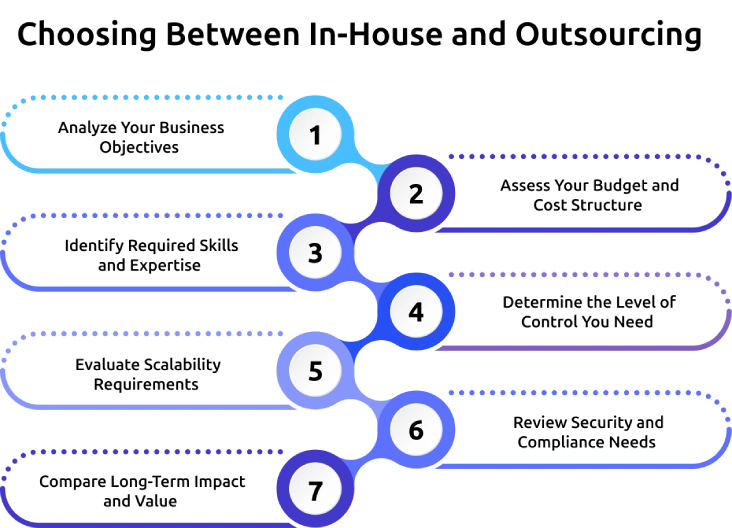
1. Analyze Your Business Objectives
Begin by clearly defining your short-term and long-term goals. Review how similar businesses structure their teams and identify whether your needs are ongoing or project-based. Choose an in-house team for continuous operations and consider outsourcing for specialized or temporary requirements.
2. Assess Your Budget and Cost Structure
Carefully evaluate all associated costs, including hiring, training, salaries, infrastructure, and employee benefits. Compare these with outsourcing expenses such as service fees and contract terms. Select the option that fits your financial capacity while maintaining efficiency.
3. Identify Required Skills and Expertise
Examine the skills needed to complete your tasks effectively. If your internal team lacks specific expertise, consider outsourcing to professionals with proven experience. For roles that require deep knowledge of your business, building an in-house team can be more beneficial.
4. Determine the Level of Control You Need
Decide how much oversight is necessary for your operations. If your work requires constant monitoring, collaboration, and alignment with internal processes, an in-house team is more suitable. For clearly defined tasks with measurable outcomes, outsourcing can be a practical choice.
5. Evaluate Scalability Requirements
Analyze how frequently your workload changes. If your business experiences fluctuating demands, outsourcing offers flexibility to scale resources up or down. For stable and predictable workloads, maintaining an in-house team can provide consistency.
6. Review Security and Compliance Needs
Assess the sensitivity of your data and any regulatory requirements you must follow. Ensure that whichever option you choose can meet the security standards and compliance obligations. This step is critical when handling confidential information.
7. Compare Long-Term Impact and Value
Look beyond immediate costs and consider long-term benefits such as productivity, quality, innovation, and growth. Study industry practices and outcomes to guide your decision. Choose the approach that supports sustainable success and aligns with your future plans.
How Time Champ Helps You Manage In-House and Outsourced Teams
Managing in-house employees and outsourced teams can become challenging when work happens across different locations, tools, and schedules. Time Champ is a smart employee monitoring software with hybrid workforce management capabilities that gives you complete visibility into work activities, productivity, and project progress, helping you manage every team with confidence from a single platform.
Here are the key features of Time Champ that help you manage in-house employees and outsourced teams more efficiently:
- Track Every Team from One Dashboard: Monitor work hours, activity levels, productivity, and task progress for both in-house employees and outsourced professionals without switching between multiple tools.
- Compare Workforce Costs with Accurate Time Data: Measure the actual time spent on projects and tasks to evaluate workforce costs, improve resource planning, and make informed hiring or outsourcing decisions.
- Identify Productivity Issues Early: Detect idle time, workload imbalances, and project bottlenecks before they affect deadlines, budgets, or overall team performance.
- Improve Transparency Without Micromanagement: Give employees and external contributors access to their own productivity dashboard, helping everyone stay accountable while maintaining a healthy and trusted work environment.
- Manage Hybrid Teams with Complete Visibility: View attendance, work patterns, and performance across office, remote, and outsourced teams in one place, making your hybrid workforce management simple and efficient.
- Protect Business Data with Enterprise-Grade Security: Keep workforce information secure with role-based access controls and compliance with leading security standards, including GDPR, ISO 27001, HIPAA, and SOC 2.
Conclusion
Choosing the right workforce model depends on your business goals, budget, operational priorities, and the level of control you need. Understanding in-house vs outsourcing helps you evaluate costs, expertise, scalability, and long-term value before making a decision. While some organizations benefit from building an internal team, others achieve better results through external specialists, and many succeed with a combination of both. No matter which approaches you choose, managing productivity, collaboration, and performance effectively is essential. With the right strategy and tools, you can build a workforce that supports sustainable growth and long-term business success.

Anjali

Table of Content
 What Does In-House Mean?
- What Does Outsourcing Mean?
- In-house vs Outsourcing: What Are the Key Differences?
- Pros and Cons of In-house vs Outsourcing
- How to Choose Between In-House and Outsourcing
- How Time Champ Helps You Manage In-House and Outsourced Teams
- Conclusion
Related Blogs

Struggling with managing hybrid teams? Explore practical tips to boost collaboration, prevent communication gaps, and improve team performance.
Guna Lakshmi | Jun 19, 2026
Turn hybrid teams into high performers with hybrid team productivity strategies that improve results, visibility, collaboration, trust, and accountability.
Anjali | Jun 19, 2026
Workforce management software is a set of tools and processes designed to improve employee productivity in a business.
Mounika Sai | Jan 08, 2024
Find the best communication tools for hybrid teams in 2026. Learn how to build a communication stack, choose sync or async tools, and boost collaboration.
Jahnavi Pulluri | Jun 16, 2026
Prevent hybrid work burnout in 2026 with practical manager strategies. Learn warning signs, support employee wellbeing, and reduce stress effectively.
Anjali | Jun 11, 2026
See what the data says about hybrid work productivity gains, including productivity, retention, engagement, cost savings, and long-term business impact.
Thasleem Shaik | Jun 08, 2026


 4.7/5 avg.
Ready to Manage Your Workforce Smarter?
Join our family of 1500+ companies using smart insights to redefine workforces!

Free Trial
No Credit Card Required