How to Measure Remote Employee Productivity: Key Metrics
Measure remote employee productivity with key metrics and a 6-step method to track performance, improve efficiency, and build productive remote teams.
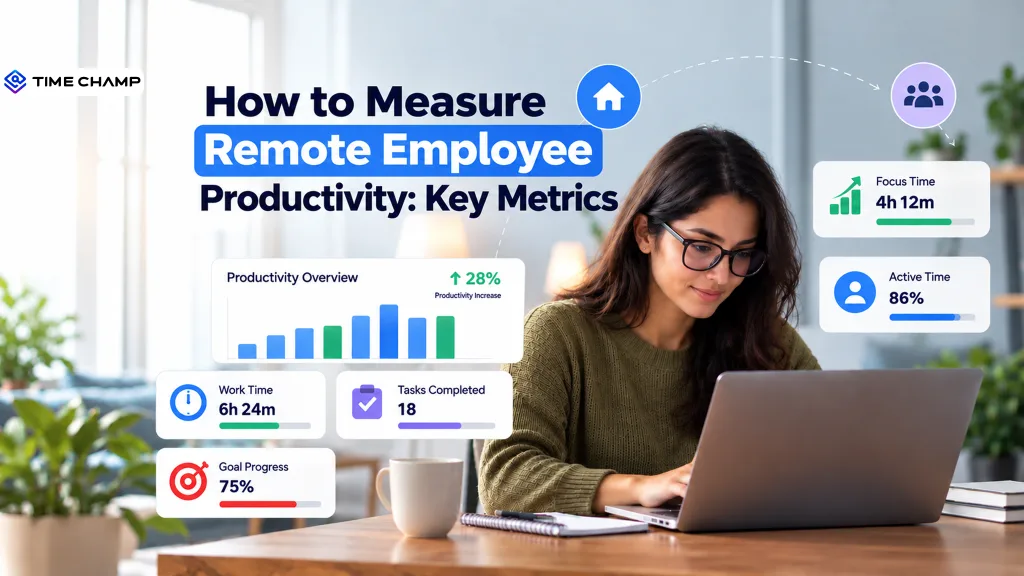
Remote work has transformed how teams operate, but it has also made it harder for you to clearly see how work is progressing day-to-day. Without direct visibility, it becomes challenging to understand where time is going or whether projects are on track. A structured way to measure remote employee productivity shifts the focus from activity to outcomes, helping you evaluate efficiency and performance through clear, meaningful signals without constant check-ins or assumptions.
Here you’ll understand the key metrics used to assess remote employee productivity and learn a practical 6-step method for measuring productivity effectively.
Why Measuring Remote Employee Productivity Matters
Remote employee productivity is the practice of evaluating how effectively employees use their time and resources to achieve results while working remotely. It focuses on outcomes such as task completion, goal progress, and work quality, with less emphasis on hours spent online. This approach helps ensure performance is assessed fairly in remote environments.
Measuring productivity is important because remote work can make daily activities less visible. It allows you to detect bottlenecks, workload imbalances, and performance gaps early. It also improves planning by revealing where time is lost, helping your teams increase efficiency and maintain steady progress without constant supervision or micromanagement.

Did You Know?
Microsoft’s Work Trend Index found that 80% of workers lack enough time or energy to get their work done. Tracking focused work time can help identify interruptions and work patterns that affect productivity.
What Are Key Remote Employee Productivity Metrics
Remote employee productivity metrics are measurable indicators that show how effectively employees turn their time and effort into meaningful work outcomes. The strongest approach combines output, quality, efficiency, and work patterns without relying on hours worked or online activity alone.

1. Task Completion Rate
Task completion rate shows how consistently your employees finish assigned tasks within a defined period. A high completion rate can indicate steady execution, while repeated delays may point to unclear priorities, workload issues, or unrealistic deadlines. Always consider task complexity and quality when evaluating this metric.
2. Quality of Work
Quality measures whether completed work meets the required standards for accuracy, completeness, and effectiveness. Depending on the role, this can include error rates, revision requests, customer feedback, or review scores. Pairing quality with output helps prevent teams from prioritizing speed at the expense of good work.
3. Goal and Milestone Achievement
This metric tracks progress toward individual, team, or project goals. It shows whether daily tasks contribute to larger business objectives and whether employees consistently meet important milestones. It is especially useful for roles where productivity cannot be judged by the number of tasks completed alone.
4. Output per Hour
Output per hour compares completed work with the time required to produce it. For example, a team could track tickets resolved, reports completed, or deliverables produced per hour. This metric helps you evaluate efficiency, but benchmarks should account for role complexity and should not encourage employees to sacrifice quality for speed.
5. Focused Work Time
Focused work time shows how much tracked work time employees spend on core tasks and productive applications or websites. It can reveal interruptions, excessive administrative work, or workflow patterns that reduce concentration. Use this metric as a supporting signal, but do not treat more tracked hours as automatically better productivity.
6. On-Time Delivery Rate
On-time delivery rate measures how consistently employees complete tasks, projects, or milestones by their agreed deadlines. It provides a clear view of execution reliability and can help you identify recurring bottlenecks or capacity problems. Like task completion, it should be reviewed alongside workload, task complexity, and work quality.
Not sure which metrics best reflect your remote team’s productivity?
Track key productivity signals with Time Champ for clearer performance insights.
How to Measure Remote Employee Productivity: A 6-Step Method
Measuring remote employee productivity requires a structured approach that focuses on outcomes over activity or online presence. A clear system helps you evaluate performance fairly while supporting employees in improving their work efficiency. The following steps explain how to measure productivity practically and consistently.

1. Set Clear Productivity Goals
Start by clearly defining what success looks like for each role. Set simple, measurable goals with clear deadlines, so employees know what is expected. These goals should align with your team and business objectives. For example, support teams may focus on response time, while developers focus on delivery quality. Clear goals make productivity easier to track and understand.
2. Choose the Right Productivity Metrics
Select a few key metrics that truly reflect job performance. Focus on things like task completion, quality of work, and timely delivery. Avoid using too many metrics or relying on just one. A mix of outcome and quality indicators gives a better picture, helping you ensure fair and balanced evaluation.
3. Track Work Time and Activity Patterns
Monitor how employees spend their work time to understand their working habits. This includes active hours, task time, and idle periods. These patterns can help you identify workflow issues or distractions. However, use this only as supporting information. Productivity should always be judged more by results than time online.
4. Measure Tasks, Projects, and Outcomes
Check whether employees complete tasks and meet deadlines. Track deliverables and project milestones to measure output. This ensures work is not just being done but done properly. For complex tasks, consider both quality and quantity. This helps you avoid rewarding speed over accuracy.
5. Review Productivity Trends Regularly
Look at productivity over a period, not single-day results. Weekly or monthly trends help you identify real performance patterns. This shows whether changes are consistent or temporary. Also consider workload and project difficulty when reviewing results, which gives a more reliable view than isolated data.
6. Use Insights to Improve Performance
Use productivity data to improve processes, not just monitor employees. If issues appear, first check workload and workflow before judging performance. Share insights with employees and discuss improvement steps together. This helps you remove bottlenecks and improve efficiency.
Did You Know?
Stanford’s survey found that only 44% of employees would comply with a fully onsite work requirement. Measuring actual work outcomes can give managers a clearer performance view as flexible work continues.
How Time Champ Helps Measure Remote Employee Productivity
When teams work remotely, visibility into how work time is actually spent, where productivity slows down, and how projects stay on track can quickly start to fade without constant follow-ups. Time Champ is smart employee monitoring software with remote work management features that help you measure productivity through time, activity, task, and workforce insights.
With Time Champ, you can streamline remote workforce productivity and gain real-time visibility into employee performance:
- Tracks Time and Productivity Accurately: Monitors work time and identifies peak and low productive hours to help you understand how teams use their time.
- Monitors Apps and Website Usage: Provides app and website activity, helping you identify work patterns and spot activities that may affect productivity.
- Understands Idle Time and Work Patterns: Provides clear visibility into long breaks and idle periods, helping you uncover workflow gaps, remove bottlenecks, and improve overall team efficiency.
- Tracks Tasks and Project Progress: Sets priorities, deadlines, and dependencies while using task views and Kanban boards that help you monitor progress and identify blockers.
- Analyzes Productivity Trends: Uses workforce analytics to compare productivity and efficiency, view focused hours, and identify areas that need attention, helping you and teams make data-driven decisions and improve overall performance.
- Provides Actionable Productivity Reports: Gives access to detailed reports and real-time insights from one dashboard to help you evaluate performance and make better workforce decisions.
Struggling to measure remote productivity without constant follow-ups?
Use Time Champ to track work time, productivity, tasks, and performance from one place.
Conclusion
Measuring remote employee productivity becomes easier when you focus on meaningful outcomes, quality, efficiency, and work patterns. The right metrics help you understand performance without relying only on hours worked or online activity. A structured six-step approach also helps you set clear goals, choose relevant metrics, track progress, and improve workflows. Combining clear expectations with the right productivity signals can help you measure remote employee productivity fairly, using consistent data on output, quality, and progress, while supporting teams to work more efficiently and achieve better results.

Anjali

Table of Content
 Why Measuring Remote Employee Productivity Matters
- What Are Key Remote Employee Productivity Metrics
- How to Measure Remote Employee Productivity: A 6-Step Method
- How Time Champ Helps Measure Remote Employee Productivity
- Conclusion
Related Blogs

Track the right remote worker productivity metrics to understand performance, improve output, and avoid micromanagement with clear insights.
Thasleem Shaik | Apr 24, 2026
Explore the most important productivity metrics and KPIs to measure employee performance, improve efficiency, and boost workplace productivity.
Anjali | May 12, 2026
Understand the role of productivity tracking in remote work and how it improves team clarity, workload balance, and performance with real insights.
Thasleem Shaik | May 01, 2026
Struggling with remote work productivity challenges? Learn what’s slowing your team down and how to improve focus, communication, and performance.
Guna Lakshmi | Apr 15, 2026
Learn how time tracking improves remote team productivity through better visibility, accountability, performance tracking, and smarter team management.
Anjali | May 16, 2026
Boost remote team productivity with practical management tips, proven best practices, key metrics, and tools that help your remote teams perform better.
Anjali | Jul 16, 2026


 4.7/5 avg.
Ready to Manage Your Workforce Smarter?
Join our family of 1500+ companies using smart insights to redefine workforces!

Free Trial
No Credit Card Required