History of the Business Process Outsourcing Industry
Explore the history of the business process outsourcing industry, from its early beginnings to global expansion and the growth of modern BPO services.

Businesses have a lot to manage, from customer calls and financial tasks to IT issues and data-related work. Business process outsourcing (BPO) emerged to make that workload more manageable. What began with simple, routine tasks has grown into a global industry that supports businesses across customer service, finance, IT, data analytics, and more.
But how did BPO become the industry it is today? Let’s explore the history of the BPO industry, its journey and key milestones, and how technology has shaped its evolution and continues to redefine the future of outsourcing.
2000s: BPO Becomes a Global Industry
During the 2000s, BPO expanded rapidly and became a major global business model. In India, for example, the BPO industry expanded from relatively basic data-entry and customer-contact work into more sophisticated finance, accounting, analytics, and legal services.
The growth was also visible in the industry's employment and revenue figures. U.S. International Trade Commission data shows that India's BPO employment increased from about 42,000 workers in 1999–2000 to approximately 243,500 in 2003-04 and 470,000 in 2005-06.
This period also changed why companies outsourced. Cost reduction remained important, but businesses increasingly looked for process efficiency, specialized skills, scalability, and better service quality.
Are you struggling to maintain workforce visibility across BPO teams?
Time Champ helps you gain clear visibility into employee activity, productivity, and attendance.
2010s: BPO Moves Toward Higher-Value Services
By the 2010s, BPO was moving beyond repetitive, transaction-based work. Providers began taking on more complex processes that required industry knowledge, analytical skills, and specialized expertise.
This shift contributed to the growth of Knowledge Process Outsourcing (KPO). Instead of simply processing transactions, outsourcing providers began handling activities such as research, analytics, financial analysis, market research, engineering, healthcare, and legal services.
2020s: Remote Work, Automation, and AI Transform BPO
The 2020s introduced another major shift. The COVID-19 pandemic disrupted traditional BPO delivery models, particularly in countries where large numbers of employees worked from centralized facilities. Lockdowns and restrictions forced BPO companies to rapidly explore work-from-home and distributed delivery models.
At the same time, Robotic Process Automation (RPA), artificial intelligence, machine learning, and generative AI began changing the nature of outsourced work.
The Evolution of BPO at a Glance
| Period | Major Development |
|---|---|
| 1950s-1970s | Data processing, mainframes, payroll, and early external computing services |
| 1980s | IT outsourcing becomes a strategic business decision |
| 1990s | Offshore outsourcing expands; India and the Philippines emerge as major destinations |
| 2000s | BPO expands into customer service, finance, HR, healthcare, and other business functions |
| 2010s | Growth of KPO, analytics, specialized services, cloud technology, and automation |
| 2020s | Remote delivery, RPA, AI, and generative AI reshape BPO operations |
Overall, the history of BPO shows a clear shift: from outsourcing simple tasks to outsourcing entire processes, then to using technology and specialized expertise to transform how those processes are delivered.
How the BPO Industry Grew in India
India's BPO industry grew rapidly as global companies looked for skilled talent, cost-effective services, and round-the-clock support. The country's large English-speaking workforce, growing technology sector, and improving telecommunications made it an attractive outsourcing destination.
The industry developed in several stages:
- Early 1990s: Companies began outsourcing basic back-office and data-processing work to India.
- Late 1990s: Call centers and customer support became more common as global companies expanded their offshore operations.
- 2000s: India's BPO sector expanded into finance and accounting, HR, payroll, healthcare, and technical support.
- 2010s: Providers moved toward higher-value services such as analytics, research, consulting, and knowledge-based processes.
- 2020s: Automation, cloud technology, AI, and remote work began reshaping how BPO services are delivered.
India's BPM industry reached nearly $49 billion in FY2024, with exports making up the majority of the market, according to NASSCOM. India's overall IT-BPM industry reached 5.8 million employees in FY2024-25, up from 3.7 million in FY2015-16. This growth also helped establish India as one of the world's leading destinations for offshore outsourcing.
What Factors Drove the Growth of the BPO Industry?
The BPO industry grew as businesses looked for ways to reduce costs, access specialized talent, and operate more efficiently. At the same time, advances in technology and globalization made it easier for companies to outsource business processes across borders.
1. Cost Reduction
Reducing operating costs has been one of the biggest reasons businesses turn to BPO. Outsourcing allows companies to access services at a lower cost without maintaining large in-house teams for every business function.
2. Access to Skilled Talent
BPO providers give businesses access to skilled professionals in areas such as customer service, finance, IT, HR, and data management. This helps companies find the expertise they need without having to build every capability internally.
3. Globalization
As businesses expanded into international markets, they needed support across different regions and time zones. BPO providers helped companies manage these operations without having to establish their own teams in every country.
4. Internet and Telecommunications
Better internet connectivity and telecommunications made it possible for employees and service providers to work together from different locations. This helped businesses outsource processes to providers in other cities and countries.
5. Time-Zone Advantages
Different time zones allow BPO teams to continue working after a company's in-house team has finished the day. This makes 24/7 customer support, IT monitoring, and other round-the-clock services easier to provide.
6. Government Incentives
Governments in major outsourcing destinations introduced policies, tax benefits, infrastructure investments, and special economic zones to attract BPO companies. These initiatives helped create favorable environments for the industry's growth.
7. Demand for Specialized Expertise
As business processes became more complex, companies needed expertise they did not always have internally. This increased demand for providers offering specialized services such as accounting, analytics, healthcare support, legal services, and technical assistance.
8. Cloud Computing
Cloud technology has made it easier for BPO providers to access applications, data, and business systems remotely. It has also reduced the need for companies to maintain extensive on-site infrastructure, making outsourced operations more flexible and scalable.
9. Automation and AI
Automation and AI have further transformed BPO by handling repetitive tasks, improving response times, and supporting data-driven operations. Instead of relying only on manual work, modern BPO providers increasingly combine human expertise with technologies such as robotic process automation, AI, and generative AI.
Do you need better control over your expanding BPO operations?
Time Champ helps you monitor workforce performance and manage teams more efficiently.
How Technology Changed the BPO Industry
Technology has played a major role in shaping the BPO industry. From internet-based communication to cloud platforms, automation, and AI, each advancement has changed how BPO providers deliver services and support business operations.
Internet and Telecommunications
The growth of the internet and telecommunications made it possible for BPO providers to serve businesses from different locations. Faster internet connections, VoIP, and digital communication tools allowed customer support and back-office teams to work remotely while staying connected with clients and customers.
This helped accelerate offshore outsourcing and enabled BPO companies to operate across countries and time zones.
Cloud Computing
Cloud computing made BPO operations more flexible and scalable. Instead of relying heavily on physical infrastructure, providers can access business applications, data, and communication systems through the cloud. This allows teams to work from different locations, scale services based on demand, and collaborate with clients more easily.
Robotic Process Automation
Robotic process automation (RPA) has changed how BPO providers handle repetitive, rule-based tasks. Software bots can perform activities such as data entry, invoice processing, report generation, and data validation with minimal human intervention. With automated routine work, BPO teams can reduce manual effort, improve consistency, and focus employees on tasks that require human judgment.
Artificial Intelligence and Generative AI
Artificial intelligence has changed how BPO providers handle both routine and complex tasks. AI can assist with customer queries, analyze data, identify patterns, and help employees make faster decisions. Generative AI takes this further by creating responses, summarizing information, and assisting with knowledge-based tasks.
This shift allows BPO teams to spend less time on repetitive work and more time on tasks that require human judgment, expertise, and problem-solving.
What Is the Future of the BPO Industry?
The BPO industry is moving beyond traditional cost-saving services toward AI-powered, specialized, and outcome-focused operations. Technology will continue to reshape how BPO providers deliver services, while human expertise will remain important for complex tasks and decision-making.
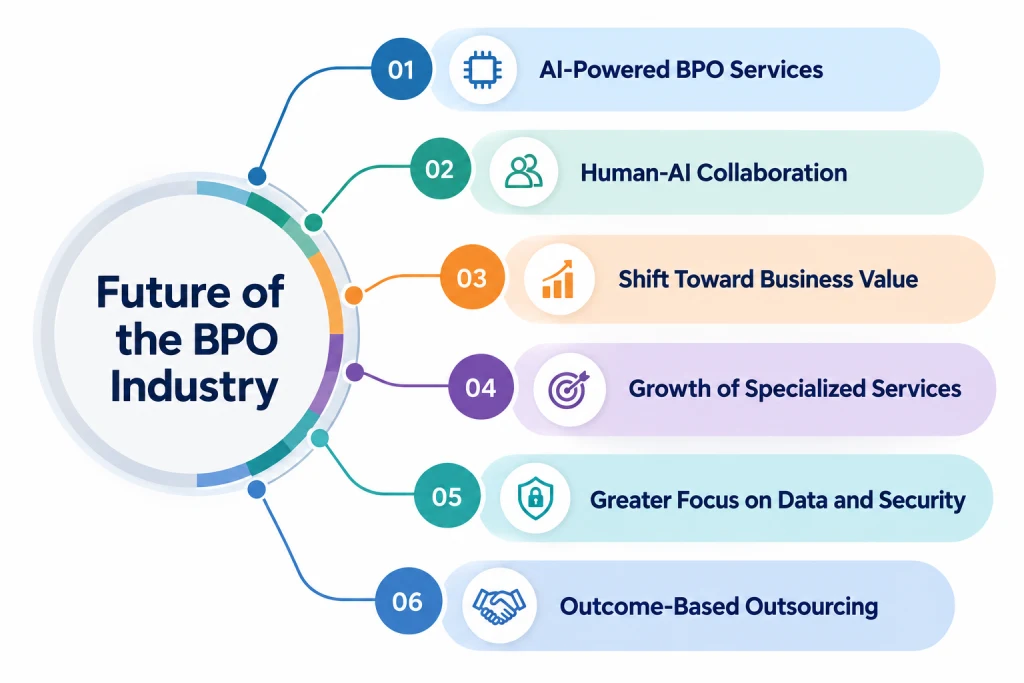
AI-Powered BPO Services
AI is becoming a key part of BPO operations, helping providers automate repetitive work, support customer interactions, analyze data, and improve workflows. Deloitte's Global Outsourcing Survey found that 83% of surveyed executives were already using AI as part of their outsourced services.
Human-AI Collaboration
The future of BPO will increasingly combine AI with human expertise. AI can handle repetitive and data-related tasks, while employees focus on problem-solving, communication, and decisions that require human judgment.
Shift Toward Business Value
BPO is moving from a model focused mainly on reducing costs to one focused on measurable business outcomes. Companies increasingly want providers that can improve efficiency, customer experience, innovation, and overall business performance.
Growth of Specialized Services
As routine processes become more automated, demand is likely to grow for specialized services such as data analytics, finance, healthcare, cybersecurity, compliance, and industry-specific support. BPO providers will need deeper technical and domain expertise to remain competitive.
Greater Focus on Data and Security
The growing use of AI and cloud technologies will also increase the importance of data quality, cybersecurity, privacy, and AI governance. Organizations will increasingly expect BPO providers to have strong controls in place before giving them access to sensitive business and customer data. Deloitte identifies data quality and governance as important barriers to realizing value from GenAI.
Outcome-Based Outsourcing
The BPO model is also moving toward contracts and partnerships based on business outcomes rather than the number of people or hours provided. This means providers will increasingly be evaluated on metrics such as customer satisfaction, process efficiency, revenue impact, and cost savings.
Simplify Workforce Management for BPO Teams with Time Champ
As BPO operations become more technology-driven, businesses need better visibility into how work gets done across teams and locations. Time Champ helps BPO companies track employee activity, monitor productivity, manage attendance, and understand how teams spend their working hours.
Key features include:
- Time Tracking: Accurately track employee working hours and time spent on tasks.
- Productivity Monitoring: Understand employee activity and identify productivity gaps.
- Attendance Management : Track attendance and work schedules across teams and locations.
- Detailed Reports: Get actionable insights into workforce performance and productivity.
- Employee Activity Tracking: Gain visibility into how employees spend their work time.
- Remote Workforce Management: Monitor distributed teams and maintain visibility across remote operations.
With these capabilities, Time Champ can help BPO managers improve workforce efficiency, identify areas for improvement, and make data-driven decisions.
Ready to make BPO workforce management easier?
Start your free trial with Time Champ today and manage your teams more efficiently.
Conclusion
The history of the business process outsourcing industry shows how outsourcing has evolved from basic administrative tasks into specialized, technology-driven business services. As technology continues to advance, BPO companies are adapting to new ways of working, from automation and AI to remote and distributed operations.

Guna Lakshmi

Table of Content
 How the BPO Industry Grew in India
- What Factors Drove the Growth of the BPO Industry?
- How Technology Changed the BPO Industry
- What Is the Future of the BPO Industry?
- Simplify Workforce Management for BPO Teams with Time Champ
- Conclusion
Related Blogs

Learn what the call center occupancy rate is, the formula, how to calculate it, what a good occupancy rate is, and how it differs from utilization.
Oct 28, 2026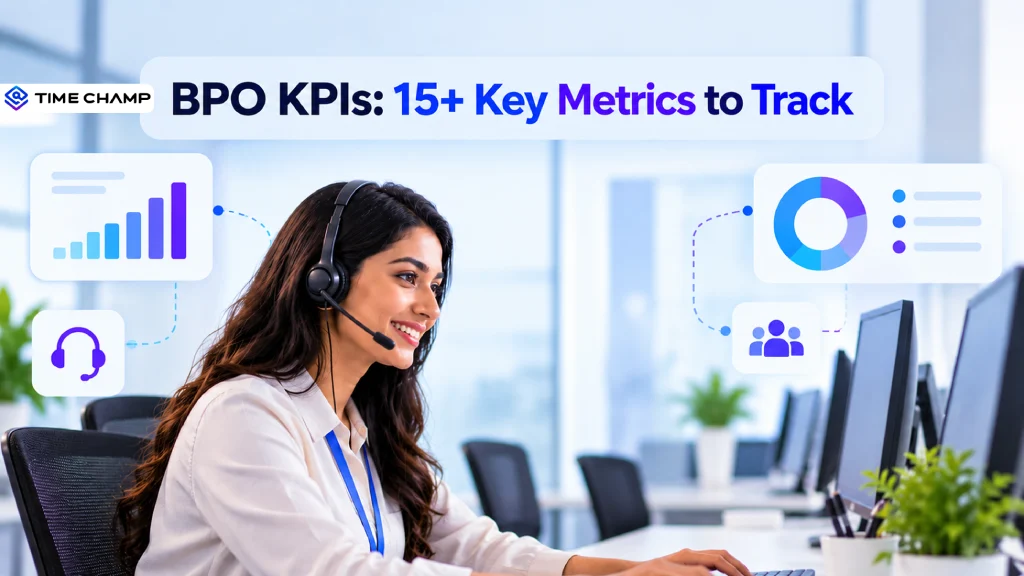
Track the most important BPO KPIs to measure agent performance, productivity, customer satisfaction, and overall contact center success in 2026.
Guna Lakshmi | Oct 02, 2026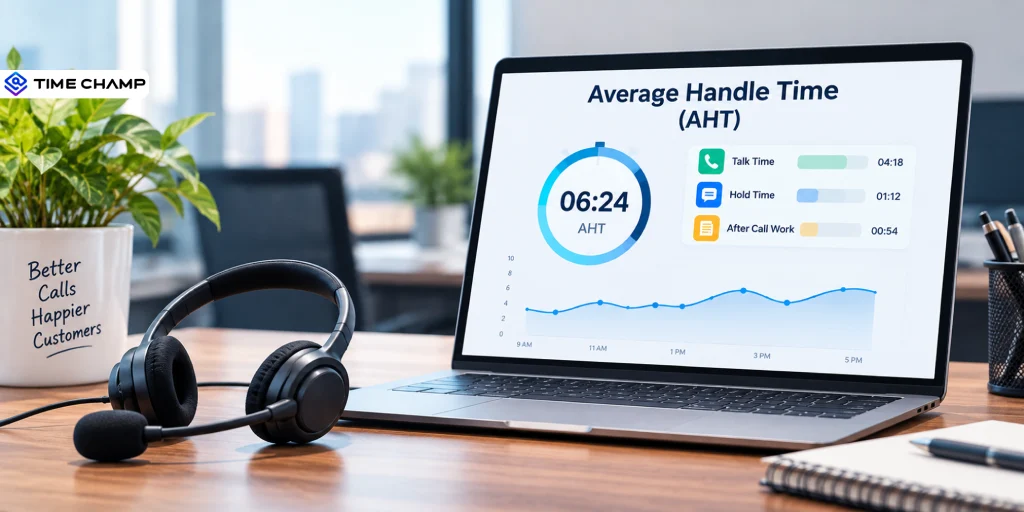
Learn what average handle time (AHT) is, the AHT formula, how to calculate it, and proven ways to reduce it without hurting service quality.
Guna Lakshmi | Oct 05, 2026
Contact center services help businesses manage customer support across multiple channels. Compare types, benefits, costs, technologies, and AI trends.
Thasleem Shaik | Aug 10, 2026
Discover the ultimate guide to call centre workforce management. Learn key functions, pros, cons, optimisation tips, and how real-time WFM boosts ROI.
Thasleem Shaik | Oct 01, 2025
Discover the 10 best call centre quality assurance software for 2025. Compare features, pricing, pros, and cons to boost service quality and performance.
Thasleem Shaik | Nov 07, 2025


 4.7/5 avg.
Ready to Manage Your Workforce Smarter?
Join our family of 1500+ companies using smart insights to redefine workforces!

Free Trial
No Credit Card Required