Average Handle Time (AHT): Formula & How to Reduce It
Learn what average handle time (AHT) is, the AHT formula, how to calculate it, and proven ways to reduce it without hurting service quality.
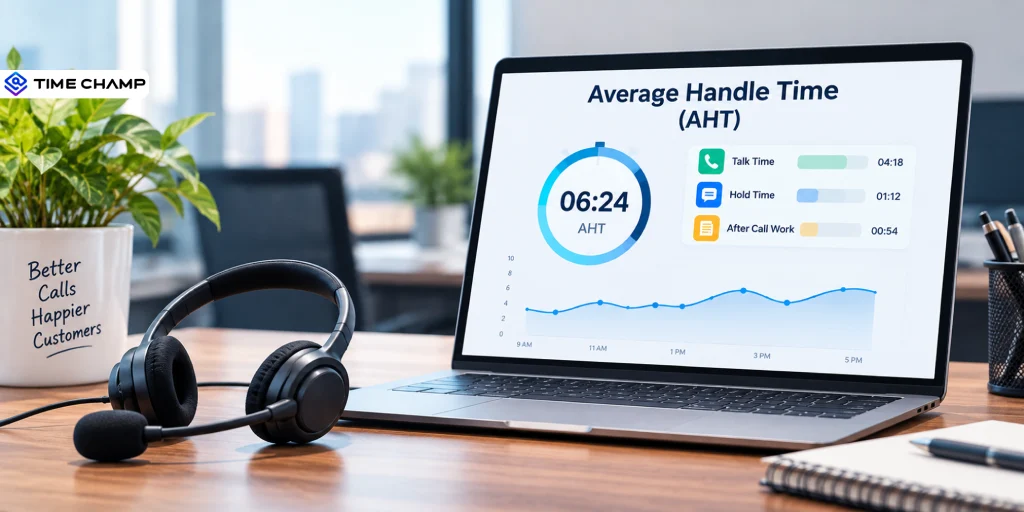
Are your customer support calls taking longer than expected? A high AHT can slow down your team, increase operational costs, and affect how many customers you can serve. The good news is that you can bring it down by identifying the factors that are adding unnecessary time to each interaction and making targeted improvements.
Let’s look at the AHT formula and practical ways to reduce it while keeping your service quality high.
What Is Average Handle Time?
Average Handle Time (AHT) is the average amount of time an agent spends handling customer interaction, including talk time, hold time, and the time spent completing post-interaction work. It is a key call center metric used to measure operational efficiency and understand how quickly your team resolves customer requests.
Average Handle Time Formula
Use the AHT formula to measure the average time needed to complete customer interaction. Tracking this metric over time helps you identify performance trends, compare results across teams, and spot opportunities to improve overall efficiency.
Formula: AHT = (Total Talk Time + Total Hold Time + Total After-Call Work Time) ÷ Total Number of Interactions
Here’s how the formula works in practice: The formula helps you calculate the average time your team spends handling each customer interaction. Here’s a simple example to see how it works:
Example: Suppose your team handles 500 calls in a day with:
- Total Talk Time = 2,000 minutes
- Total Hold Time = 300 minutes
- Total After-Call Work Time = 200 minutes
Step 1: Add all handling time
2,000 + 300 + 200 = 2,500 minutes
Your team spent a total of 2,500 minutes handling these calls.
Step 2: Divide the total time by the number of calls
2,500 ÷ 500 = 5 minutes
Step 3: Interpret the result
This means your team spends an average of 5 minutes handling each customer call, giving you an AHT of 5 minutes.
What Is a Good Average Handle Time?
A good AHT depends on the type of customer interaction and the complexity of the issue. Instead of using one fixed benchmark, you can compare AHT across different call types to understand what is reasonable for your team.
| Interaction Type | Typical AHT Range | Why It Varies |
|---|---|---|
| Simple inquiries | 2-4 minutes | Quick questions or basic information |
| Billing & payments | 4-7 minutes | May require account verification and transaction support |
| Technical support | 8-15 minutes | Often requires troubleshooting and guided assistance |
| Complex complaints | 10-20+ minutes | May involve investigation, escalation, or resolution steps |
The key is to balance speed with resolution quality. If reducing AHT leads to repeat calls, unresolved issues, or lower customer satisfaction, a shorter handle time may not actually mean better performance.
Want to reduce handle time without compromising service quality?
Try Time Champ to track agent productivity, identify time-consuming activities, and improve your team’s efficiency.
Why Average Handle Time Matters
Tracking AHT gives you valuable insight into how efficiently your team handles customer interactions. It can help you identify inefficiencies, manage resources, and improve service performance.
- Improves Agent Productivity: Helps you identify how productively your team is handling customer interactions.
- Controls Operating Costs: Lower unnecessary handle time can help you serve more customers with the same resources.
- Reduces Customer Wait Times: Efficient interactions can help your team move through queues faster.
- Helps With Workforce Planning: AHT data helps you estimate staffing needs and plan schedules more accurately.
- Highlights Process Inefficiencies: Unusually high AHT can point to slow workflows, complex processes, or gaps in agent support.
- Supports Better Customer Experiences: Monitoring AHT alongside quality and satisfaction metrics helps you improve efficiency without rushing customers.

Did You Know?
According to McKinsey, companies have used advanced analytics to reduce average handle time by up to 37% while also improving customer satisfaction and employee engagement.
What Affects Average Handle Time
Several factors can influence how long your team takes to handle each customer interaction. Understanding these factors helps you identify what is driving AHT and where you can improve efficiency.
Call Complexity
Simple requests can usually be resolved quickly, while complex issues may require more investigation, troubleshooting, or multiple steps. The type and difficulty of each interaction can therefore have a direct impact on your AHT.
Agent Experience and Training
Agents who are still learning processes or handling unfamiliar issues may take longer to resolve customer requests. Proper training and ongoing coaching can help agents build the knowledge and confidence needed to handle interactions more efficiently.
Did You Know?
According to McKinsey, 94% of customer-care executives expected the skill demands on contact-center agents to increase.
Customer Behavior
Some customers may need more explanation, ask multiple questions, or require additional assistance before their issue is resolved. These interactions naturally take longer and can increase your overall AHT.
Tools and Technology
Slow systems, frequent technical issues, or switching between multiple applications can add unnecessary time to each interaction. Giving agents reliable and easy-to-use tools can help them complete tasks faster.
Knowledge Base Accessibility
When agents struggle to find the right information, they may need to place customers on hold or spend additional time searching for answers. An accessible and well-organized knowledge base can help reduce this delay.
Did You Know?
According to Deloitte, only 15% of contact-center staff find information accessible, making easy access to the right information an important factor in improving handling time.
Call Transfers and Escalations
Transferring customers between agents or departments can extend handle time, especially when the customer has to repeat information. Clear escalation processes can help minimize unnecessary transfers.
After-Call Work
Agents may need to document the interaction, update customer records, or complete follow-up tasks after a call. If these processes are lengthy or repetitive, they can increase the overall time spent handling each interaction.
How to Reduce Average Handle Time
Reducing AHT is about helping your team resolve customer issues efficiently without rushing the conversation. Focus on removing unnecessary delays, simplifying workflows, and giving agents the right support to handle interactions confidently.
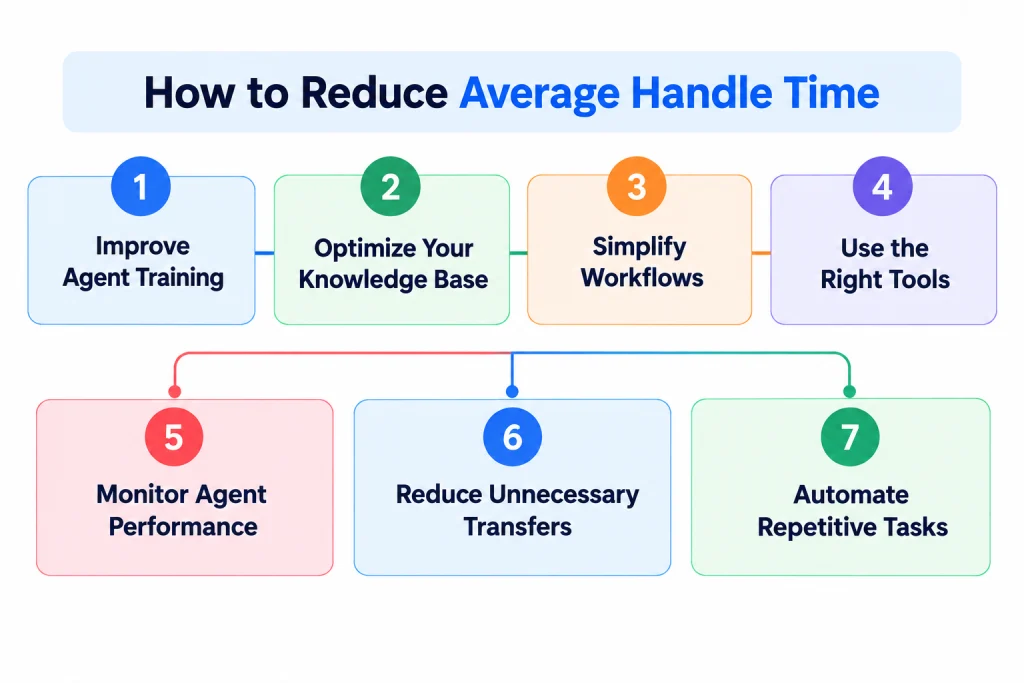
Improve Agent Training
Provide regular training on common customer issues, products, and support processes. Well-trained agents can find solutions faster and spend less time searching for answers during calls.
Optimize Your Knowledge Base
Create a centralized knowledge base with clear, easy-to-find information. This allows agents to quickly access accurate answers instead of putting customers on hold or asking for assistance.
Simplify Workflows
Review your support processes to identify repetitive or unnecessary steps. Simplifying workflows can help agents complete tasks faster and spend more time focusing on customer needs.
Use the Right Tools
Give agents tools that make it easier to access customer information, communicate, and complete tasks from one place. Reducing the need to switch between multiple systems can help shorten the handle time.
Use Time Champ to track agent activity and identify where unnecessary time is spent. This makes it easier to simplify workflows and reduce AHT without rushing customer interactions.
Monitor Agent Performance
Track AHT regularly to identify agents, call types, or processes that consistently take longer. Use these insights to provide targeted coaching and address specific performance gaps.
Reduce Unnecessary Transfers
Make sure agents have the information and authority needed to resolve common issues themselves. Fewer transfers mean less repetition for customers and a smoother path to resolution.
Automate Repetitive Tasks
Automate routine activities such as data entry, call notes, and follow-up workflows where possible. This reduces manual work and gives agents more time to focus on resolving customer issues.
Want to identify what’s slowing your team down?
Use Time Champ to uncover productivity gaps, identify workflow delays, and see where your team is losing valuable time.
Common AHT Mistakes to Avoid
AHT can be useful for measuring efficiency, but focusing on it the wrong way can create new problems. Avoid these common mistakes to ensure you improve handle time without hurting service quality.
Focusing Only on Lower AHT
Trying to reduce AHT at all costs can encourage agents to rush through conversations or end calls before fully resolving the customer’s issue. Look at AHT alongside customer satisfaction and first-call resolution to get a more complete picture of performance.
Comparing Different Call Types
Not every customer interaction requires the same amount of time. Comparing AHT for simple inquiries with complex technical issues can give you misleading results. Evaluate similar call types to make meaningful comparisons.
Ignoring High AHT Causes
A high AHT does not always mean an agent is performing poorly. Slow systems, complicated processes, or difficult customer issues can all increase handle time. Identify the underlying cause before taking corrective action.
Overlooking After-Call Work
Focusing only on conversation time can hide delays that happen after the customer disconnects. Include post-call tasks when reviewing AHT to understand the full workload involved in each interaction.
Using AHT as the Only Performance Metric
AHT should not be used in isolation to evaluate your team. Combine it with metrics such as customer satisfaction, first-call resolution, and quality scores to make better performance decisions.
Boost Agent Productivity and Optimize AHT With Time Champ
Reducing AHT starts with understanding where your team is spending unnecessary time. Time Champ is a workforce intelligence platform for call centers that gives you clear visibility into employee activity, workflows, and productivity.
It helps you identify inefficiencies, track how your team spends its time, and find opportunities to improve handle time without compromising service quality.
- Track Agent Productivity: Monitor how your agents spend their work hours and identify productivity gaps that may affect AHT.
- Monitor App and Website Usage: See which tools your agents use and identify activities that may slow down workflows.
- Analyze Employee Performance: Use productivity insights to spot performance gaps and provide targeted coaching.
- Track Active and Idle Time: Understand active and idle periods to identify potential productivity gaps.
- Automate Time Tracking: Automatically capture work hours and activity data without manual time entries.
- Get Detailed Reports: Get clear productivity data to compare performance and make informed decisions.
- Identify Workflow Bottlenecks: Spot recurring delays and simplify workflows to help reduce unnecessary handle time.
Ready to Improve Your Call Center Performance?
Start using Time Champ to improve productivity, reduce unnecessary delays, and manage your team’s time better. Try it now!
Conclusion
Reducing AHT is about helping your team resolve customer issues faster without lowering service quality. Track AHT, find the causes of longer interactions, and improve the processes that slow your team down.
If you’re looking for a time tracking and employee monitoring tool to improve productivity and manage your team’s time, Time Champ can be a great solution. It helps you track work activity, identify delays, and make better decisions to improve overall performance.

Guna Lakshmi

Table of Content
 What Is Average Handle Time?
- What Is a Good Average Handle Time?
- Why Average Handle Time Matters
- What Affects Average Handle Time
- How to Reduce Average Handle Time
- Common AHT Mistakes to Avoid
- Boost Agent Productivity and Optimize AHT With Time Champ
- Conclusion
Instant Signup
Thank you for your request!
We have received your signup request and our team will get back to you soon. In the meantime, you can book a demo to see Time Champ in action.
Book a DemoFree trial. No credit card required. Prefer a walkthrough? Book a demo.
Related Blogs

Business process outsourcing (BPO) vs Knowledge process outsourcing (KPO). Discover definitions of BPO and KPO, key functions, similarities, and use cases.
Guna Lakshmi | Apr 02, 2026
Discover the 18 global best call center outsourcing companies to optimize customer support. Choose from leading names for exceptional service and efficiency.
Mounika Sai | Nov 16, 2023
Contact center services help businesses manage customer support across multiple channels. Compare types, benefits, costs, technologies, and AI trends.
Thasleem Shaik | August 10, 2026
Discover the ultimate guide to call centre workforce management. Learn key functions, pros, cons, optimisation tips, and how real-time WFM boosts ROI.
Thasleem Shaik | Oct 01, 2025
Discover the 10 best call centre quality assurance software for 2025. Compare features, pricing, pros, and cons to boost service quality and performance.
Thasleem Shaik | Nov 07, 2025
How to start a call center using a complete setup process covering costs, software, staffing, compliance, operations, and business planning.
Thasleem Shaik | Jul 29, 2026


 4.7/5 avg.
Ready to Manage Your Workforce Smarter?
Join our family of 1500+ companies using smart insights to redefine workforces!

Free Trial
No Credit Card Required