HIPAA Compliance in BPO: Rules, Risks, and Best Practices
HIPAA compliance in BPO requires more than a signed BAA. See the rules, safeguards, PHI controls, breach duties, checklist, and key risks to address.
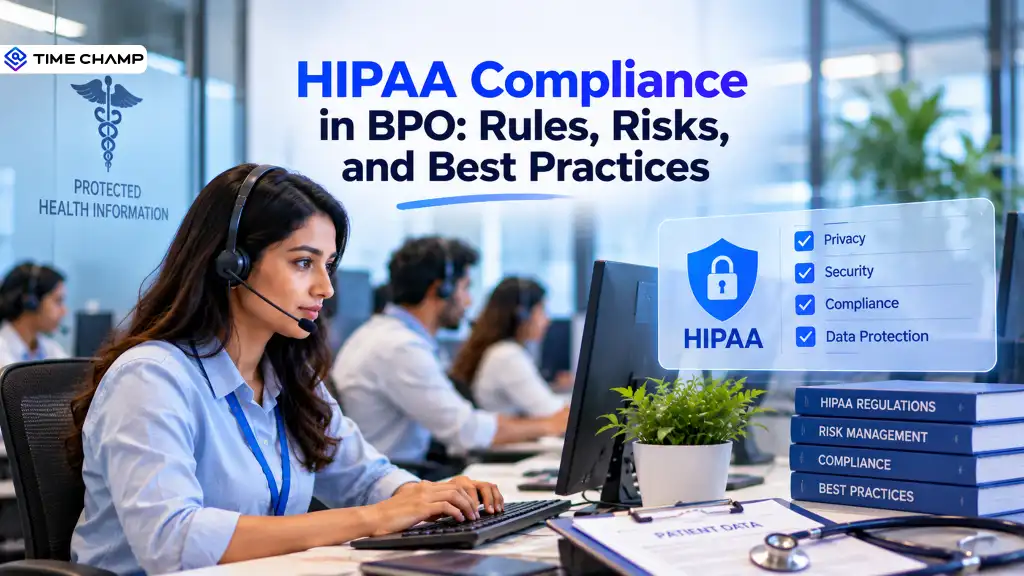
Healthcare companies outsource to BPOs for speed, support, and efficiency. But when patient information is involved, efficiency alone is not enough. Data must be handled carefully, shared securely, and protected at every step.
This is where HIPAA compliance becomes important for BPO operations. It helps teams understand what is allowed, what must be protected, and what can go wrong if safeguards are missing. In this blog, we will explore the rules, safeguards, risks, and practical steps that help BPOs protect patient data and build lasting trust.
What Is HIPAA Compliance in BPO?
HIPAA compliance in BPO means following the Health Insurance Portability and Accountability Act when handling protected health information for a healthcare client. If your BPO handles patient data for tasks such as claims processing or telehealth support, HIPAA requirements may apply to your business, not only to the healthcare provider.
Two important terms are PHI and ePHI. PHI means protected health information that identifies a patient and relates to their health, treatment, or payment. ePHI is the electronic form of this information, such as data stored in a CRM, call recording, chat system, or claims platform.
Your location does not determine whether HIPAA applies. If you process, store, or send PHI for a US healthcare client, you may need to follow HIPAA requirements whether your BPO operates in the US or another country.
When Is a BPO a HIPAA Business Associate?
Your BPO becomes a HIPAA business associate when you create, receive, maintain, or transmit protected health information on behalf of a healthcare client while providing a service. The key factor is your contact with PHI, not the size of your team or how often someone opens a patient record.
You typically become a business associate when you provide any of these services:
- Patient support or a medical answering service for a hospital, clinic, or health plan
- Medical billing, coding, or claims processing
- Appointment scheduling or reminder calls that include care details
- Data entry, transcription, or back-office work related to patient records
- IT or technical support that provides access to systems storing PHI
When you provide any of these services for a covered entity, you have important legal responsibilities under HHS guidance about who qualifies as a business associate. This can apply even if your agents only see a patient’s name and callback number.
If your call center operates outside the United States but handles PHI for a US covered entity, HIPAA can still apply. HIPAA follows the data, not the location of your office.
Your responsibilities also extend to subcontractors. If you give any part of the work to a subcontractor, staffing partner, or another vendor, that organization may also become a business associate. The same contract and privacy requirements must then flow down to that organization.
The main exception is incidental contact that is not part of the service you were hired to provide. For example, a courier may briefly see a name on an envelope without handling PHI as part of the courier service. However, if access to PHI is a central part of the service you provide, you are generally a business associate.
Finding it hard to maintain clear workforce visibility across your BPO operations?
Use Time Champ to clearly see work patterns and activity while keeping your daily operations on track.
What Are the Three HIPAA Rules and Safeguards?
If your BPO handles PHI, you need to know both the HIPAA rules that govern the data and the safeguards that protect it. The three rules below cover privacy, security, and breach notification. The three safeguards then show how you put the Security Rule into practice when your BPO handles ePHI.
1. The Three HIPAA Rules
These three HIPAA rules explain how to protect health information, secure electronic data, and respond to data breaches.
| HIPAA Rule | What It Requires |
|---|---|
| Privacy Rule | Controls how you may use and disclose PHI. It also gives patients certain rights over their health information and requires you to limit certain uses and disclosures to the minimum necessary. |
| Security Rule | Requires you to protect ePHI through appropriate administrative, physical, and technical safeguards. |
| Breach Notification Rule | Obligates you to report a breach of unsecured PHI. Breaches affecting 500 or more individuals must reach HHS, the affected individuals, and sometimes the media, and smaller breaches still need annual reporting. Timelines are strict, so your incident response plan needs to move fast once a breach is confirmed. |
2. The Three HIPAA Safeguards
The Security Rule groups its safeguards into three categories. Your BPO needs to address each category based on the risks in your environment.
| Safeguard | Examples in a BPO |
|---|---|
| Administrative Safeguards | Run regular risk assessments, appoint a dedicated security officer, train your workforce on PHI handling, and set clear access management policies so only the right agents can reach the right records. |
| Physical Safeguards | Control access to facilities and workstations, secure devices that handle ePHI, maintain clean-desk practices, and dispose of devices and media securely. |
| Technical Safeguards | Assign unique logins so every action ties back to one agent, encrypt ePHI both in transit and at rest, keep audit logs running, and secure every transmission channel your agents use. |
HIPAA Compliance Checklist for BPOs
A HIPAA compliance checklist gives you a practical way to review how your BPO handles PHI. Use it to check your agreements, policies, workforce practices, physical safeguards, technical controls, and incident procedures. Your exact controls should match the risks in your environment and the systems that handle ePHI.
Before You Handle Any PHI
- Get a signed BAA in place with every covered entity you work with and with any subcontractor you bring in. Never accept PHI on a verbal promise or a pending contract.
- Appoint a dedicated HIPAA security officer and privacy officer. HIPAA requires named individuals in these roles, not a shared responsibility across your team.
- Run a documented risk assessment before you go live on a healthcare account, and write down the policies and procedures that come out of it.
- Give every agent HIPAA training before they touch a single record, and require them to log the completion.
While You Run the Account
- Build your administrative, physical, and technical safeguards into daily operations instead of treating them as a one-time setup.
- Encrypt ePHI both in transit and at rest, and back that up with role-based access controls and multi-factor authentication so only the right agents reach the right records.
- Apply the minimum necessary standard. Agents should see only the PHI they need for the task in front of them, nothing more.
- Keep audit logs running continuously, and refresh agent training at least once a year with records to prove it happened.
When Something Goes Wrong
- Have a tested incident-response plan ready before you need it, not after.
- Know your breach-notification timeline. You must notify the covered entity without unreasonable delay, and no later than 60 days after you discover the breach.
- Dispose of PHI securely once you no longer need it, and revisit your entire compliance posture on a regular schedule rather than waiting for an audit to force it.
Common HIPAA Compliance Challenges in BPO
Knowing the rules is one thing. Applying them in a busy, high-volume operation is another. Here are the common challenges you may face when building and running a HIPAA-compliant BPO.
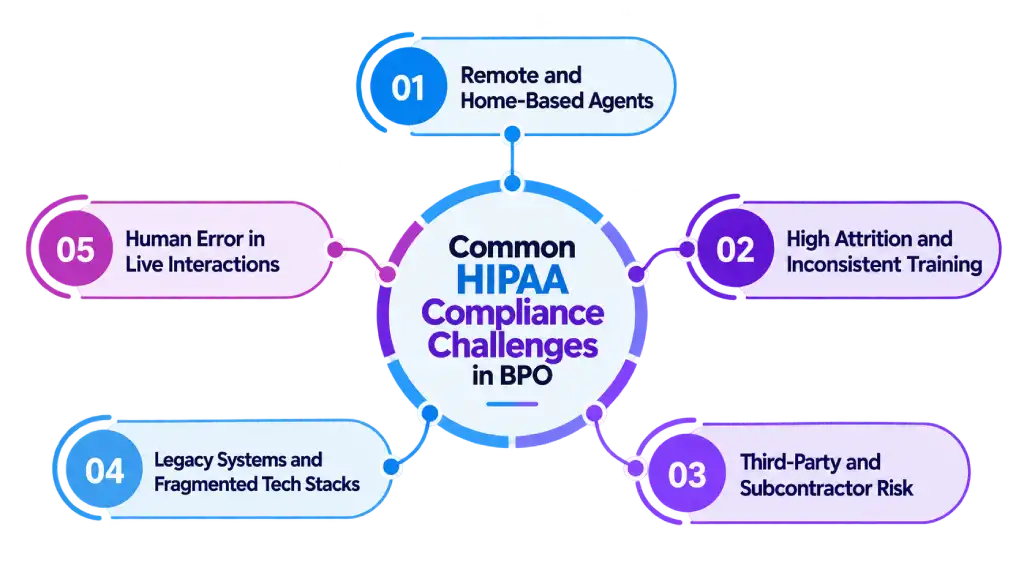
1. Remote and Home-Based Agents
Distributed teams make PHI harder to contain. A screen left visible during a video call, a personal device used to check a ticket, or a household member overhearing a patient conversation can all count as a disclosure. You need workstation and screen privacy controls, secure VPN or remote access tools, and clear rules on where agents can work from, not just a policy that says "keep it confidential."
2. High Attrition and Inconsistent Training
Call center turnover is often high, and each departure means you must start the training process again. New hires who have not fully learned HIPAA rules may skip verification steps or share more information than necessary. High turnover also increases onboarding costs and puts extra pressure on your compliance team.
Retraining employees takes time away from training agents on products and processes. This is why employee turnover and compliance risk often increase together in a BPO. See our breakdown of BPO attrition to learn how turnover increases operational risk.to learn how turnover increases operational risk.
3. Third-Party and Subcontractor Risk
Your BPO’s compliance is only as strong as its weakest subcontractor. If a vendor outsources part of the workflow, every subcontractor that handles PHI needs its own BAA with the same protections you agreed to. If you skip this step, you may take on risks you cannot see.
According to HIPAA Journal, third-party vendor relationships are involved in over 85% of reported healthcare data breaches. This is why vendor mapping and subcontractor visibility should remain a permanent part of your compliance checklist, not a one-time review.
4. Legacy Systems and Fragmented Tech Stacks
Many BPOs run PHI through a patchwork of phone systems, CRMs, EHR integrations, and chat platforms, some of which weren't built with HIPAA in mind. Legacy tools often lack proper encryption, audit logging, or granular access controls, which forces you to bolt on safeguards rather than build them in from the start.
5. Human Error in Live Interactions
Call centers work quickly, and this can lead to mistakes. Common errors include failing to confirm a caller’s identity, sending a fax or email to the wrong person, or sharing information with a family member before confirming that they are authorized to receive it. These mistakes are more likely when agents are rushed, lack proper training, or do not have a clear verification script.
Best Practices to Stay HIPAA Compliant
Getting your HIPAA controls in place is only the starting point. Your BPO also needs to keep those controls aligned with changing workflows, systems, access needs, and security risks. The following practices can help you maintain stronger protection for PHI and ePHI across your day-to-day operations.
1. Give Agents Only the Access They Need
Don't give every agent full access to your systems. Use role-based access so billing agents can see billing data, while support agents can see only the information needed for their queue. This follows the minimum necessary standard and limits the damage if one account is compromised. Review access whenever an agent changes roles or leaves, rather than waiting for an annual audit.
2. Make Training a Habit, not a One-Time Event
A single onboarding session on PHI handling is easy to forget. Provide short refresher training every quarter. Use real situations your agents may face, such as a caller asking to leave a voicemail with a diagnosis or a family member requesting someone else’s records. Keep attendance records for every session. If HHS asks how you train your workforce, saying “we did it once in 2023” will not be enough.
3. Keep Every BAA Current and Reviewed
Review every BAA regularly, including agreements with your clients and agreements with your subcontractors and vendors. An old BAA may not cover changes to a vendor’s systems or services. Update each BAA whenever a system, service, or data flow changes.
4. Run Regular Risk Assessments
Your security risks can change when you add a new application, introduce remote work, change a workflow, or connect another system to your environment. A risk assessment helps you identify those changes and decide which safeguards you need.
Penalties for HIPAA Non-Compliance
HIPAA violations can create financial and legal consequences for your BPO, especially when you handle PHI as a business associate. The penalty depends on factors such as what happened, what you knew, and whether you corrected the violation. The current penalties for HIPAA violations are shown in the table below:
| Penalty Tier | Level of Culpability | Minimum Penalty per Violation | Maximum Penalty per Violation | Annual Penalty Limit |
|---|---|---|---|---|
| Tier 1 | Reasonable Efforts | $145 | $73,011 | $2,190,294 |
| Tier 2 | Lack of Oversight | $1,461 | $73,011 | $2,190,294 |
| Tier 3 | Neglect – Rectified within 30 days | $14,602 | $73,011 | $2,190,294 |
| Tier 4 | Neglect – Not Rectified within 30 days | $73,011 | $2,190,294 | $2,190,294 |
Source: HIPAA Journal
Pro Tip: This is a general overview, not legal advice. Talk to a HIPAA compliance professional or legal counsel before making decisions that affect how you handle PHI.
How Time Champ Supports HIPAA-Focused BPO Operations
Time Champ supports the operational side of your HIPAA-focused BPO by giving you clearer visibility into attendance, work patterns, and workforce activity. You can use these insights to review daily operations, identify workflow gaps, and maintain better oversight across your teams.
This visibility works alongside your HIPAA processes by helping you understand how work happens across your BPO. Your dedicated HIPAA controls, security measures, access policies, and compliance processes continue to manage your specific HIPAA requirements.
Managing HIPAA-focused operations while struggling to see how work gets done?
Try Time Champ to bring clearer visibility to employee attendance, activity, and work patterns.
Conclusion
HIPAA compliance in BPO operations needs to be part of your everyday processes, not just a policy you review once. Clear access controls, regular risk assessments, workforce training, secure systems, and a strong incident response plan can help protect PHI and ensure your BPO meets the requirements that apply to its healthcare services.
If you also want better visibility into daily workforce activity, Time Champ can help you understand work patterns, attendance, and operational gaps while your HIPAA processes handle the compliance requirements.

Thasleem Shaik

Table of Content
 What Is HIPAA Compliance in BPO?
- When Is a BPO a HIPAA Business Associate?
- What Are the Three HIPAA Rules and Safeguards?
- HIPAA Compliance Checklist for BPOs
- Common HIPAA Compliance Challenges in BPO
- Best Practices to Stay HIPAA Compliant
- Penalties for HIPAA Non-Compliance
- How Time Champ Supports HIPAA-Focused BPO Operations
- Conclusion
Related Blogs
Ensure remote work compliance with our guide on key areas, common challenges, and best practices for your team.
Shabana Shaik | Jan 10, 2025
Compliance is like following the rules to be sure that the company does things right. These regulations can be from government or inside the corporation.
Vijaya Lakshmi | Apr 16, 2024
Understand employee monitoring legal compliance, key laws, and best practices to track work activity while protecting privacy and avoiding legal risks.
Thasleem Shaik | Apr 14, 2026
Employee screen recording helps you meet compliance and security requirements. See which regulations apply and when your team needs them.
Guna Lakshmi | Apr 24, 2026
Learn the essentials of hybrid work compliance, including labor laws, employee tax obligations, data protection rules, & best practices for modern workplaces.
Jahnavi Pulluri | Jun 24, 2026
Protect sensitive data and simplify DLP compliance with practical strategies to meet GDPR, HIPAA, and PCI DSS requirements while reducing security risks.
Anjali | Aug 29, 2026


 4.7/5 avg.
Ready to Manage Your Workforce Smarter?
Join our family of 1500+ companies using smart insights to redefine workforces!

Free Trial
No Credit Card Required