BPO Attrition: What It Is, Causes, and How to Reduce It
BPO attrition affects staffing, productivity, and service quality. See how to calculate the rate, identify key causes, and build stronger retention strategies.

BPO attrition measures how often employees leave your BPO during a specific period. A few departures may seem manageable, but constant churn can quietly drain productivity, increase hiring pressure, and make it harder to keep service quality consistent.
The bigger question is not just how many employees leave. It is why they leave and what you can change before turnover becomes a recurring operational problem. Let’s look at what drives attrition and how you can bring it under control.
What Is Attrition in BPO?
Attrition in BPO is the rate at which employees leave a business process outsourcing company within a specific period, such as a month, quarter, or year. It includes employees who resign as well as those whose employment ends because of termination or layoffs.
For example, if 20 employees leave a team of around 200 during a quarter, those departures contribute to the attrition rate for that quarter. BPO teams track this figure because frequent employee departures can reduce process knowledge, disrupt staffing, and make service delivery less consistent.
In simple terms, attrition shows how quickly a BPO is losing employees. The number itself is important, but the pattern behind it matters even more. This includes understanding who is leaving, when they leave, and whether the departures are voluntary, involuntary, or concentrated among new hires.
Types of Attrition in BPO
Not every employee exit tells the same story. Someone who resigns after months of burnout needs a different response from someone who leaves during the first few weeks or someone you let go after repeated performance issues. When you separate attrition types in BPO, you can see where your workforce is losing employees and what each pattern may point to.
Here are the main types you should track in your BPO.
| Type Of Attrition | What It Means | What It May Indicate |
|---|---|---|
| Voluntary Attrition | An employee chooses to leave your BPO | Pay, workload, burnout, career growth, shifts, or employee experience |
| Involuntary Attrition | You end an employee’s employment | Performance issues, policy violations, layoffs, restructuring, or business changes |
| Early Attrition | A new hire leaves during training, nesting, or the first few months | Hiring expectations, onboarding, training, role fit, or early support |
| Late Attrition | An experienced employee leaves after staying for an extended period | Career growth, compensation, recognition, workload, or limited advancement |
| Demographic Attrition | Employees from a specific demographic group leave at a higher rate | Differences in workplace conditions, scheduling, support, or growth opportunities |
| Skill-based Attrition | Employees with specific skills or experience leave | Risk to critical capabilities, hiring needs, training, or succession planning |
1. Voluntary Attrition
Voluntary attrition happens when an employee chooses to leave your BPO. Better pay, career opportunities, difficult shifts, burnout, limited growth, or dissatisfaction with the role can all influence the decision.
For example, an experienced agent may resign after receiving a better offer from another BPO. A high voluntary attrition rate can signal issues with compensation, workload, career growth, or the overall employee experience.
2. Involuntary Attrition
Involuntary attrition happens when you end an employee’s employment. Common reasons include persistent performance problems, policy violations, layoffs, restructuring, or changes in business requirements.
This type does not always indicate a retention problem. Some exits may follow necessary performance or business decisions. However, a sudden increase in involuntary attrition can also prompt you to review hiring, training, coaching, or workforce planning.
3. Early Attrition
Early attrition happens when new hires leave soon after joining your BPO. You may see it during training, nesting, or within the first few months of employment. First-day no-shows also fall into this category.
Early exits often point to a gap between what candidates expected and what the role actually involves. Weak onboarding, unrealistic job previews, difficult schedules, or poor role fit can make new hires leave before they become fully productive. This type deserves close attention because you can often prevent it by improving hiring expectations, onboarding, training, and early support.
4. Late Attrition
Late attrition happens when employees leave after staying with your BPO for an extended period. At this stage, the reasons may differ from those behind early exits.
An experienced agent may leave because they want career growth, a new role, better compensation, or a change in their personal circumstances. When late attrition rises among experienced agents, you should look closely at career progression, recognition, workload, and opportunities to move into new roles.
5. Demographic Attrition
Demographic attrition refers to employee exits within a specific demographic group, such as age, gender, location, education level, or employment status. For example, if employees from one location or age group leave more often than others, the pattern may indicate that their needs or work experience differ from those of the wider workforce.
Track this type carefully and use the data responsibly. A demographic pattern does not prove that a particular group is causing attrition. It helps you identify whether certain groups may be facing different workplace conditions, scheduling challenges, support levels, or growth opportunities.
6. Skill-Based Attrition
Skill-based attrition occurs when employees with particular skills, qualifications, or levels of experience leave the organization. In a BPO, this may include multilingual agents, technical support specialists, quality analysts, team leaders, or employees trained for complex accounts.
This type can affect operations more severely than general attrition because skilled employees may be harder to replace. Monitor exits by role, certification, language ability, account assignment, and experience level. This can help you identify which capabilities are most at risk and plan hiring, training, and succession needs more effectively.

Did You Know?
NiCE’s latest research reports that agent attrition has climbed to 49%. The same research found that more than half of contact-center agents handle multiple channels, with 76% managing that concurrency most or all of the time. This supports the point that workload and increasing job complexity remain important issues for retention.
How to Calculate the BPO Attrition Rate
Calculating the attrition rate in BPO is straightforward once you have two numbers. You need the number of employees who left during the period and the average number of employees during that same period. Use both figures together to get a rate that reflects the size of your workforce.
BPO Attrition Formula:
Attrition Rate (%) = (Employees Who Left During the Period ÷ Average Number of Employees) × 100
Your average headcount can come from the opening and closing headcount for the period.
Average Headcount = (Opening Headcount + closing Headcount) ÷ 2
This approach accounts for changes in workforce size during the period instead of relying on only the headcount from one day.
What Numbers Do You Need?
Before you calculate your BPO attrition formula, collect these three figures
- Opening headcount for the period
- Closing headcount for the period
- Total employees who left during the period
Keep the measurement period consistent. If you count departures for a quarter, calculate the average headcount for that same quarter.
BPO Attrition Rate Example
Suppose your BPO starts a quarter with 1,000 employees and ends with 1,000 employees. During those three months, 30 employees leave.
First, calculate the average headcount
Average Headcount = (1,000 + 1,000) ÷ 2 = 1,000
Then apply the attrition formula in BPO
Attrition Rate = (30 ÷ 1,000) × 100 = 3%
Your BPO has a 3% quarterly attrition rate for that period.
If your opening and closing headcounts differ, use both figures rather than assuming the workforce stayed the same. For example, if you start with 1,000 employees and end with 900, your average headcount becomes 950. If 30 employees leave during the quarter, your calculation becomes
Attrition Rate = (30 ÷ 950) × 100 = 3.16%
This gives you a more representative rate for the period.
You can calculate attrition in BPO for a month, quarter, or year. The important part is to match your employee departures and average headcount to the same measurement period.
Monthly tracking can help you spot sudden changes quickly. Quarterly tracking can give you a broader view of workforce movement, while annual tracking helps you assess your overall workforce trend.
Struggling to spot workload issues before they lead to employee exits?
Use Time Champ to see workforce patterns clearly and act before problems grow.
What Are the Main Causes of High BPO Attrition
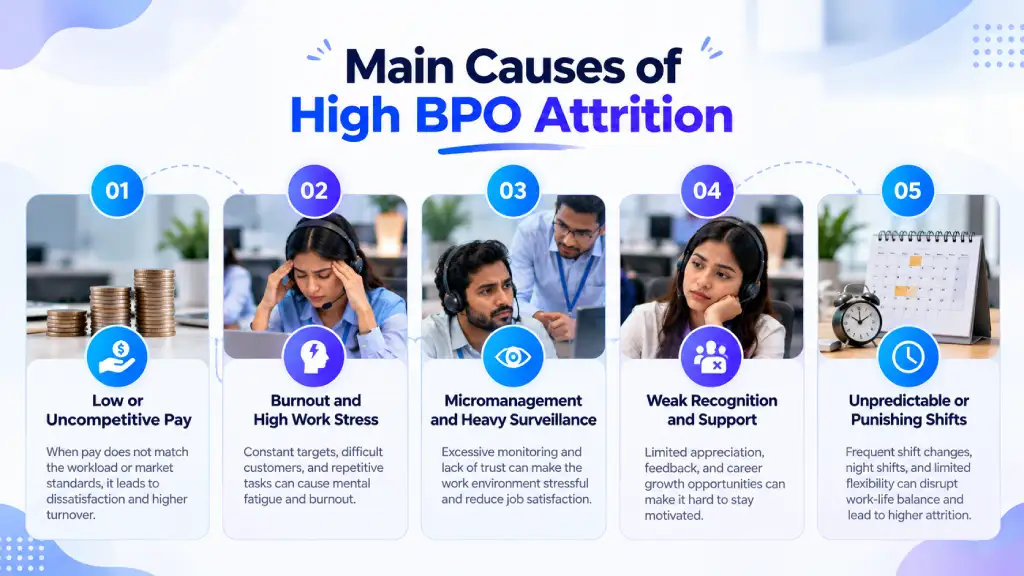
High attrition in BPO does not usually happen because of one problem. It often results from a mix of low pay, burnout, poor onboarding, and a work culture that makes agents feel watched instead of supported. Here are the main reasons your best agents may leave.
1. Low or Uncompetitive Pay
Pay remains a major factor when employees compare their current role with other opportunities. If your compensation does not match the workload, skills, schedule, or local market, employees have a stronger reason to consider another job.
2. Burnout and High Work Stress
Burnout is a widespread challenge among call center agents and is recognized by the World Health Organization as an occupational phenomenon. BPO work can involve continuous customer interactions, demanding targets, repetitive tasks, and periods of heavy workload. When that pressure continues without enough recovery or support, work can become exhausting.
3. Micromanagement and Heavy Surveillance
Agents who feel watched all the time instead of supported may start looking for another job. Too much screen tracking, strict script rules, and a focus on finding mistakes instead of helping employees improve can quickly push people away. Tools that are meant to improve performance can also increase attrition when they are used in the wrong way.
4. Weak Recognition and Support
Doing demanding work without meaningful feedback or recognition can gradually reduce commitment. Employees want to know when their work makes a difference, especially when they handle difficult customers, meet demanding targets, or take on extra responsibility.
5. Unpredictable or Punishing Shifts
Night shifts, rotating schedules, and last-minute roster changes can affect agents’ health and personal lives. Without a regular schedule or enough notice, even agents who enjoy the job may start looking for work with better hours.
What Are the Effects of High BPO Attrition?
Losing agents faster than you can replace them affects more than your HR reports. High BPO attrition increases costs, disrupts service delivery, and can affect how clients view your operation. Here is what can happen when attrition in BPO rises above a healthy level.
1. Higher Recruitment and Training Costs
Every departure starts another hiring cycle. You need to spend time and resources on sourcing candidates, screening applications, conducting interviews, onboarding new hires, and training them for the role. When exits happen frequently, these costs keep returning instead of becoming occasional expenses.
2. Lower Productivity During Ramp-Up
New hires need time to become comfortable with your processes, tools, customers, and performance expectations. During this period, they may need more guidance and take longer to complete tasks.
When high attrition constantly brings new hires into your operation, a larger share of your workforce may remain in the learning and ramp-up stage. That can pull down overall productivity and make it harder to maintain consistent output.
3. Loss of Experience and Process Knowledge
Experienced agents carry knowledge that goes beyond training material. They know your processes, understand common customer issues, and can handle unusual situations with less guidance.
When experienced agents leave, you lose some of that knowledge with them. New hires then need time to build the same level of familiarity, which can affect how quickly your team handles complex work.
4. Greater Workload for the Remaining Team
An employee leaving does not remove the work that employee handled. Your existing team still needs to cover customer demand while you recruit and train a replacement.
That can mean additional workload, extra shifts, or tighter schedules for the remaining workforce. If this continues, the added pressure can affect morale and create another risk of turnover.
5. Higher Risk to Client Relationships
Your clients expect stable delivery, consistent quality, and reliable service. Frequent workforce changes can make those expectations harder to meet.
If service quality drops, response times increase, or SLA performance becomes inconsistent, you may need to spend more time explaining performance gaps and addressing client concerns. Over time, repeated delivery problems can weaken client confidence in your operation.
Not sure where your workforce is losing time or productivity?
Try Time Champ to see work patterns clearly and find areas that need attention.
How to Reduce Attrition in BPO
You cannot eliminate attrition completely, but you can reduce much of it. Many early resignations, burnout from heavy workloads, and employees leaving because they see no growth can be prevented when you understand what needs to change.
Here are practical steps for building an attrition management plan that works for the long term.
1. Set Realistic Expectations Before You Hire
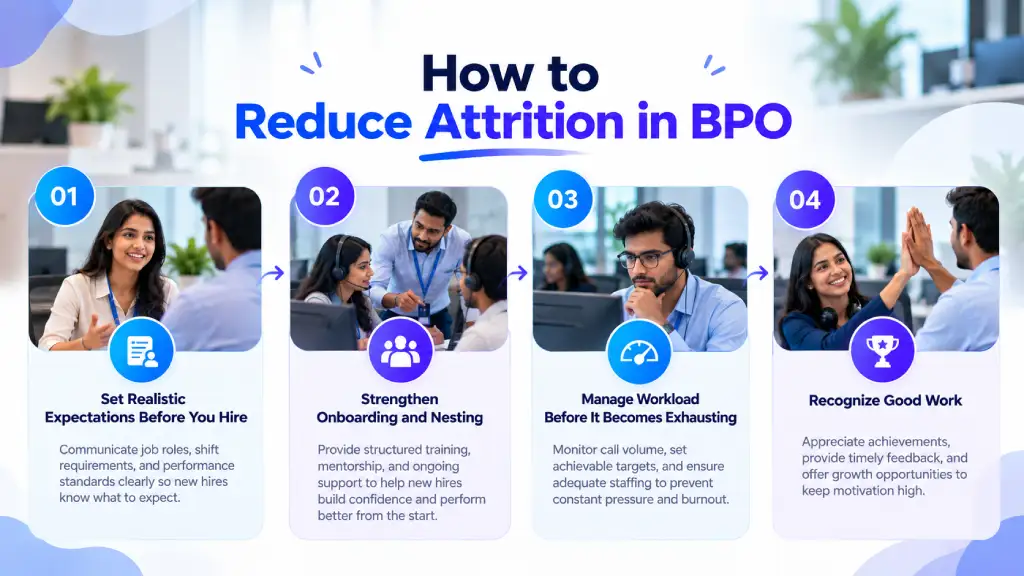
Many early resignations happen because the job is different from what candidates expected. Before making an offer, explain the actual shift patterns, call volume, and types of customers they will handle. This helps you find candidates who are a better fit and reduces the chance of losing them in the first few weeks.
2. Strengthen Onboarding and Nesting
Do not treat onboarding as a quick introduction before sending new hires into live operations. Give them enough training, practice, coaching, and support to build confidence before they handle the full workload. A structured nesting period can help new agents apply what they learned while experienced team members guide them through real customer interactions.
3. Manage Workload Before It Becomes Exhausting
Do not wait until your team starts struggling to review workload. Watch for persistent overtime, overloaded shifts, uneven task distribution, and teams that consistently carry more work than others.
Then adjust staffing, schedule adherence, or workload distribution where you can. The goal is not simply to increase output. It is to create a workload your team can sustain over time.
4. Recognize Good Work
Recognition does not always need to come through financial rewards. Acknowledge strong performance, improvement, difficult customer interactions handled well, and contributions that help the wider team. Make recognition specific and timely. When you connect recognition to real contributions, your team can see that good work does not go unnoticed.
How Time Champ Helps Identify Early Attrition Risks in BPO
Reducing attrition starts with identifying potential problems before they lead to resignations. BPO time tracking software helps you monitor attendance, workload, productivity, and work patterns across your teams. This visibility can reveal changes that may require attention and support better workforce decisions.
Time Champ can help you turn these insights into action by highlighting workload imbalances, productivity changes, and other early warning signals. Instead of relying on assumptions, you can use this information to start meaningful conversations, rebalance work, and support employees before pressure builds.
Here are the Time Champ capabilities that can support earlier action.
- Monitor Burnout and Overwork Patterns: Track long hours, heavy workloads, fewer breaks, and changes in productive time. These signs can help you spot burnout early and plan better workloads.
- Identify Attrition Risk Indicators: Monitor changes in productivity, attendance, activity, and work habits. Such patterns can help you identify employees who may be at risk of attrition and need support.
- Improve Workforce Management: Compare productivity, availability, attendance, and workloads across teams to improve workforce management. This helps you distribute work more evenly, manage schedules efficiently, and maintain a balanced workload.
- Plan Capacity with Real Data: Use time, workload, and availability data to plan staffing and resources. This helps prevent capacity gaps and ongoing overwork.
- Track Attendance and Shift Patterns: Review late logins, absences, breaks, and shift patterns. These changes can help you identify scheduling or workload issues early.
Finding it hard to balance workloads, shifts, and productivity across your BPO?
Try Time Champ to manage your workforce with clearer data and real-time visibility.
Conclusion
BPO attrition can affect your staffing, productivity, service quality, and costs, so reducing it requires attention to the everyday experience of your workforce. Start with the areas where your attrition data shows the biggest problems and take practical steps to improve workload, scheduling, support, and growth opportunities.
If you want better visibility into how your teams work, Time Champ can help you track attendance, workload, productivity, and work patterns. These insights can help you spot potential issues early and make better workforce decisions.

Thasleem Shaik

Table of Content
 What Is Attrition in BPO?
- Types of Attrition in BPO
- How to Calculate the BPO Attrition Rate
- What Are the Main Causes of High BPO Attrition
- What Are the Effects of High BPO Attrition?
- How to Reduce Attrition in BPO
- How Time Champ Helps Identify Early Attrition Risks in BPO
- Conclusion
Related Blogs
Learn simple ways to measure and boost call center productivity, helping your team work more efficiently and improve customer service.
Jahnavi Pulluri | Jan 10, 2025
Discover the 18 global best call center outsourcing companies to optimize customer support. Choose from leading names for exceptional service and efficiency.
Mounika Sai | Nov 16, 2023
Discover the 10 best call centre quality assurance software for 2025. Compare features, pricing, pros, and cons to boost service quality and performance.
Thasleem Shaik | Nov 07, 2025
How to start a call center using a complete setup process covering costs, software, staffing, compliance, operations, and business planning.
Thasleem Shaik | Jul 29, 2026
Contact center services help businesses manage customer support across multiple channels. Compare types, benefits, costs, technologies, and AI trends.
Thasleem Shaik | Aug 10, 2026
Explore the essential metrics to accurately measure and enhance your sales productivity, helping your team work smarter and achieve higher results.
Jahnavi Pulluri | Jan 11, 2025


 4.7/5 avg.
Ready to Manage Your Workforce Smarter?
Join our family of 1500+ companies using smart insights to redefine workforces!

Free Trial
No Credit Card Required