Hybrid Work Compliance: Labor, Data & Tax Guide
Learn the essentials of hybrid work compliance, including labor laws, employee tax obligations, data protection rules, & best practices for modern workplaces.

Hybrid work gives employees more flexibility, but it also creates new responsibilities for employers. When people work from different locations, labor laws, tax requirements, and data security obligations can change depending on where the work is performed, making hybrid work compliance a growing priority for organizations.
Even seemingly small changes, such as an employee relocating, working while traveling, or using a personal device for work, can create compliance risks. This blog explores the key labor law, data protection, and tax considerations of hybrid work, along with practical steps to help organizations stay compliant and audit-ready.
What Are the Main Compliance Risks in a Hybrid Work Environment?
Hybrid work compliance risks typically fall into five areas. Each one is influenced by where employees are physically working, which means obligations can change even if roles don’t.
Here’s a quick breakdown of where issues usually arise:
| Risk Area | What It Covers | What Can Go Wrong |
|---|---|---|
| Labor law | Wages, overtime, breaks, expense reimbursement, leave | Underpaid overtime, missed entitlements, and unpaid claims |
| Data protection | Security of data on home networks, devices, and across borders | Data breaches, regulatory violations, and exposed company or customer data |
| Tax | State or regional withholding, corporate nexus, cross-border taxation | Penalties, unfiled returns, unexpected tax liabilities |
| Worker classification | Employee vs contractor status | Misclassification penalties, back taxes, and benefit disputes |
| Health and safety | Ergonomics and home working conditions | Workplace injury claims, liability exposure |
Among these, labor law, data protection, and tax create the most immediate and widespread impact for most organizations, and they’re the focus of this blog. Let’s look at them one by one.
Labor Law Compliance: Which Workplace Rules Follow Your Employees Home?
In hybrid work, most labor laws apply based on where the employee is physically working, not where the company is based. This means wage rules, overtime, breaks, and expense reimbursement can vary by location, and a distributed team may end up subject to multiple sets of labor regulations.
Wage Hour, and Overtime: The Fair Labor Standards Act (FLSA) sets baseline requirements, but states can impose stricter rules. For non-exempt employees, all working time must be tracked accurately, including after-hours communication. Incomplete records are a common source of wage disputes.
Meal and Rest Breaks: Requirements differ significantly by jurisdiction. For example, California mandates specific meal and rest breaks and imposes penalties when they are not provided. If an employee works from such a state, those rules apply to their work.
Expense Reimbursement: Some states, including California, Illinois, and Massachusetts, require employers to reimburse necessary work-related expenses. For hybrid employees, this may include internet, phone usage, or home office costs. If the organization fails to reimburse where required, it may face employee claims, legal action, or regulatory penalties.
Worker Classification: Hybrid work can increase classification risk if contractors are used. Misclassification may result in back taxes, penalties, and benefit obligations. In most cases, classification depends on the level of control over the work, not the job title or contract wording.
Health and Safety: Remote work environments can still fall under workplace safety considerations. While obligations vary, employers may still face liability for certain work-related injuries that occur in home offices.
In short, labor compliance is tied to where work is performed, not where the company is registered. For hybrid teams, this makes employee location tracking and clear internal policies essential.
Data Protection Compliance: How to Secure Information You Can’t See?
In hybrid work, data protection compliance means securing company and personal data as it moves across home networks, personal devices, and sometimes international borders. Regulations like GDPR, CCPA, and similar privacy laws still apply even when employees work remotely on personal setups.

Key areas to focus on include:
Understand Which Laws Apply: Data protection obligations depend on where individuals and data processing activities occur. For example, GDPR may apply to employees working from the EU or UK, even if the company is based elsewhere. Similar state-level privacy laws in the U.S. apply based on employee location.
Control Access, Not Just Devices: Security depends more on access than on location. Least-privilege access, encryption, VPNs, and multi-factor authentication help reduce risk if a device is compromised.
Manage Personal Devices (BYOD): If employees use personal devices, clear policies are needed for data access, storage, and removal, especially when employment ends.
Prepare for Distributed Breach Response: Incident response plans must work across locations and time zones, since breach notification timelines apply regardless of where employees are working.
Data protection laws carry significant penalties, for example, GDPR fines can reach up to €20 million or 4% of global annual turnover in serious cases. Regulators also expect consistent security standards across both office and remote environments.
The goal isn’t to control every device perfectly, but to keep data protected wherever work happens.
Tax Implications: How Does Hybrid Work Change Where You Owe Taxes?
Hybrid work affects taxation because tax obligations generally depend on where work is physically performed. When employees work across states, it can create multi-state withholding requirements and even trigger “nexus,” which may require a company to register and file taxes in new jurisdictions.
Key areas to watch include:
Multi-State Withholding: If employees work in more than one state, income tax may need to be withheld in each jurisdiction where work is performed. This requires accurate tracking of employee work locations, not just payroll totals.
Corporate Nexus: A remote employee can create tax “nexus” in a state, meaning the business may need to register and file corporate or franchise tax returns there, even without a physical office or sales presence.
Convenience-of-The-Employer Rules: Some U.S. states, including New York, Connecticut, Delaware, Nebraska, New Jersey, Oregon, and Pennsylvania, apply variations of this rule. In certain cases, wages may still be taxed in the employer’s state even if the employee works elsewhere. New York has consistently upheld this approach, making dual-state taxation scenarios possible.
International Work: Employees working from another country, even temporarily, can trigger permanent establishment risks, potentially creating tax and registration obligations abroad.
| Scenario | Possible Tax Impact | What Employers Need |
|---|---|---|
| Employee moves to another state | New withholding + possible nexus | Payroll registration + location tracking |
| Employee works across state lines | Multi-state withholding | Accurate day/location records |
| Convenience-rule state applies | Possible double taxation risk | Clear tax jurisdiction setup |
| Employee works internationally | Permanent establishment risk | Pre-approval + tax guidance |
Across all scenarios, the key requirement is the same: knowing where work is physically performed and for how long. That location data becomes the foundation for payroll, withholding, and corporate tax compliance in hybrid teams.
The Monitoring Paradox: When Your Compliance Tool Becomes a Compliance Risk
The monitoring paradox is that tools used to support labor, tax, and productivity compliance, such as time tracking and employee monitoring software, are regulated. In many jurisdictions, employers must notify employees (and sometimes obtain acknowledgment) before monitoring begins. If this step is missed, a compliance tool can quickly become a legal risk.
Key considerations include:
Monitoring Notice Laws: Several U.S. states require written notice before electronic monitoring. For example, New York’s Civil Rights Law 52-c requires disclosure of email, internet, and phone monitoring along with employee acknowledgment. Connecticut and Delaware have similar requirements. Non-compliance can lead to fines per violation.
Consent Is Not Always Enough: Under GDPR and similar frameworks, monitoring must have a lawful basis, be proportionate, and be tied to a clear purpose. Due to the employer-employee power imbalance, consent alone is often insufficient.
Biometric Data Rules: If monitoring includes biometrics such as fingerprints or facial recognition, laws like Illinois’ BIPA impose strict consent and handling requirements, with significant penalties for violations.
To manage monitoring safely, organizations should:
- Clearly inform employees what is tracked, why, and how it is used before implementation
- Obtain and document acknowledgment where required
- Limit tracking to work-related activity and working hours
- Ensure data collection is necessary and proportionate
When it is implemented transparently, monitoring can support compliance rather than undermine it. Properly maintained activity data can help with wage compliance, classification decisions, and tax location tracking in hybrid work.
How To Build a Hybrid Work Compliance Strategy?
Hybrid work compliance isn’t managed through one policy, it’s built through clear rules, consistent tracking, and location-aware processes.
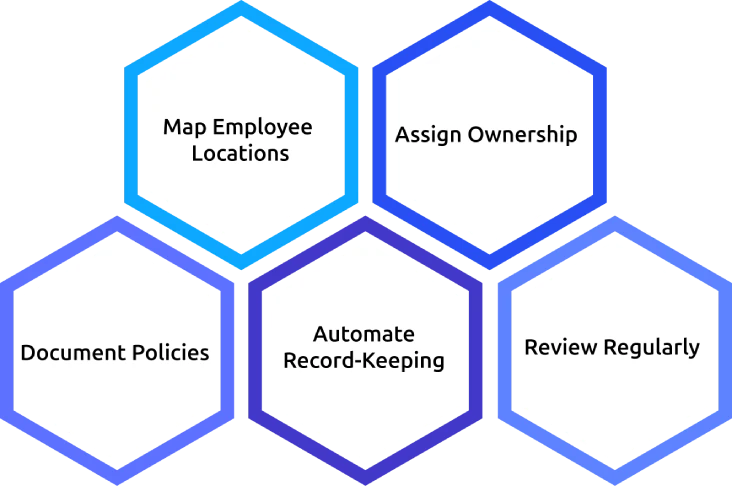
1. Map Employee Locations
Start by maintaining an up-to-date record of where employees are physically working, not just where they were originally hired. Employee location data forms the foundation for tax, labor law, and data protection compliance decisions.
2. Assign Ownership
Clearly define who is responsible for each area of compliance. HR should oversee labor policies, IT should manage data security controls, Finance should handle payroll and tax obligations, and Legal should interpret regulatory requirements and monitor legal changes.
3. Document Policies
Create a comprehensive hybrid work policy that outlines approved work locations, working hours, expense reimbursement rules, security requirements, and employee monitoring practices. Well-documented policies reduce ambiguity and support consistent compliance.
4. Automate Record-Keeping
Implement automated systems to track employee time, work locations, and relevant work activities. Automation improves accuracy, reduces administrative burden, and ensures compliance records are readily available for audits.
5. Review Regularly
Review your hybrid work compliance framework on a regular basis. Assess employee relocations, business travel patterns, policy adherence, and regulatory updates at least quarterly to identify and address potential compliance gaps.
Across all five steps, the core requirement is visibility. Without knowing where work is actually happening, it becomes impossible to apply the correct legal, tax, or data rules consistently.
What Are the Benefits of Getting Hybrid Work Compliance Right?
Compliance is often seen as a defensive requirement, but it also improves how hybrid teams function. When employees know how they are paid, what is tracked, and how their data is handled, uncertainty decreases and trust increases.
Key benefits include:
- Reduce Legal and Financial Risk: Prevent penalties, back taxes, and claims caused by inconsistent or unclear compliance practices.
- Audit Readiness: Maintain accurate records so audits and regulatory checks are simple rather than disruptive.
- Easier Expansion: Enter new states or countries with a clearer understanding of legal, tax, and data requirements.
- Stronger Hybrid Adoption: Preserve the benefits of flexible work without introducing hidden compliance exposure.
In practice, compliance is not just about avoiding problems. It creates the structure that allows hybrid work to scale safely and consistently.
How Does Time Champ Support Hybrid Work Compliance?
Most monitoring tools focus solely on activity tracking. Time Champ is an employee monitoring software that combines tracking with workforce intelligence, helping organizations turn workplace data into actionable compliance records and operational insights.
For Labor Law Compliance: Automated time and attendance tracking helps maintain accurate records of hours worked, making it easier to manage overtime, attendance, and wage-related requirements.
For Tax Compliance: Work activity records provide visibility into when and where work is performed, supporting location-based payroll, withholding, and reporting requirements.
For Data Protection and Monitoring Compliance: Transparent tracking and reporting support employee notification and documentation processes, helping organizations align monitoring practices with applicable regulations.
The purpose of monitoring is to maintain reliable records for compliance and auditing, while providing a clear view of work activity when needed.
Simplify hybrid work compliance
Track work hours, maintain compliance records, and gain visibility with Time Champ
Conclusion
Hybrid work doesn't eliminate compliance obligations, it expands them across multiple locations, regulations, and jurisdictions. Organizations that take a proactive approach to hybrid work compliance are better positioned to manage labor laws, data protection requirements, and tax obligations while avoiding costly risks and penalties. Maintaining accurate records, clear policies, and strong oversight can help businesses stay audit-ready while supporting a flexible workforce. Ultimately, effective compliance creates the foundation for sustainable and scalable hybrid work.

Jahnavi Pulluri

Table of Content
 What Are the Main Compliance Risks in a Hybrid Work Environment?
- Labor Law Compliance: Which Workplace Rules Follow Your Employees Home?
- Data Protection Compliance: How to Secure Information You Can’t See?
- Tax Implications: How Does Hybrid Work Change Where You Owe Taxes?
- The Monitoring Paradox: When Your Compliance Tool Becomes a Compliance Risk
- How To Build a Hybrid Work Compliance Strategy?
- What Are the Benefits of Getting Hybrid Work Compliance Right?
- How Does Time Champ Support Hybrid Work Compliance?
- Conclusion
Related Blogs
Create a compliant and effective GPS tracking policy. Download a free, customizable template and explore best practices for ethical operation and compliance.
Chetana Choudary | July 24, 2025
Discover how to create an effective contingent workforce policy. Learn its importance, key steps, and what to include to ensure compliance & efficiency.
Guna Lakshmi | September 25, 2025
What is a Company Policy? Learn how to create clear and effective policies that improve workplace structure, productivity, and overall business efficiency.
Sai Keerthi Uppala | Apr 04, 2024
Discover how to create an effective employee monitoring policy with our comprehensive guide. Enhance productivity while respecting privacy. Learn best practices today!
Jahnavi Pulluri | Jul 31, 2024
Create a clear and effective Remote Work Policy with our guide and template. Set expectations, boost productivity, and ensure smooth communication.
Tarun Kumar Reddy | Nov 13, 2024
Create a clear time tracking policy to boost productivity and ensure accurate work-hour reporting. Download a free customizable template.
Thasleem Shaik | Oct 04, 2024


 4.7/5 avg.
Ready to Manage Your Workforce Smarter?
Join our family of 1500+ companies using smart insights to redefine workforces!

Free Trial
No Credit Card Required