Hybrid Work: How a Pandemic Pivot Became the New Standard
Explore the rise of hybrid work from a pandemic response to a lasting modern workplace model, reshaping collaboration, flexibility, and business success.

A few years ago, most employees showed up at the office as part of their daily work routine. Remote work existed, but it wasn't widely adopted. The pandemic changed that, forcing businesses to quickly adapt and embrace new ways of working.
What started as a temporary response soon proved to be a viable long-term approach. As teams stayed connected and productive, both employers and employees began to see the benefits of greater flexibility. Today, hybrid work has become the preferred work model for many organizations, blending remote work with in-person collaboration.
In this blog, we’ll explore how that shift happened and what it means for the future of work.
Why Hybrid Work Is Now a Standard Operating Model
Hybrid work functions as a core workplace model, not just a flexible add-on or temporary setup. It has become the default way many organizations operate.
Hybrid work has moved from something companies experimented with to something they now design around. Roles, tools, office usage, and performance expectations are built on the assumption that employees will split time between remote and in-office work.
From Exception to Default
A few years ago, hybrid work needed justification. Companies had to explain why employees weren’t in the office full-time.
Now, the situation has reversed. Fully in-office setups are increasingly the ones that require explanation, especially in knowledge-based roles. Flexibility is no longer seen as a perk, it has become the baseline.
How Organizations Have Adapted
Companies have reshaped how work gets done. Office spaces now focus on collaboration, meetings are designed for both remote and in-person participation, and digital tools have become core infrastructure. Work policies are evolving to support multiple environments instead of a single fixed setup.
The Scale of the Shift
This is not a passing trend. Millions of employees across Europe and North America now work in hybrid models, marking a structural change in how modern organizations operate. What began as a crisis response has become a lasting operating reality.
How Hybrid Work Became the Workplace Standard After the Pandemic
Hybrid work evolved through a series of clear phases: the 2020 emergency shift to remote work, a 2021–2022 period of experimentation, a 2023–2024 phase of return-to-office discussions and adjustments, and a more recent stage where hybrid has become the practical default across many roles. Each stage emerged in response to the challenges of the one before it.
Here’s how it unfolded.
2020: The Emergency Shift
This wasn’t a planned model, it was an urgent response.
Offices closed quickly, and organizations that had long relied on in-person work moved to remote work almost overnight. Work setups were improvised, routines were disrupted, and teams adapted on the fly.
Despite the disruption, most work continued. That experience changed long-held assumptions about where and how work could happen.
2021–2022: The Experimentation Phase
As organizations stabilized, attention shifted to structure. Questions around office usage, flexibility, and team coordination became central.
Companies tested different approaches, like fully remote, structured hybrid schedules, and partial returns to the office. Policies were adjusted multiple times as organizations tried to balance productivity, collaboration, and employee expectations.
This period helped establish hybrid work as a recognizable model, even if definitions varied widely.
2023–2024: Adjustment and Realignment
In this phase, many organizations revisited office attendance expectations and introduced more structured return-to-office policies.
At the same time, employees continued to expect flexible work options. This led to a constant balance between set office schedules and the flexibility people had gotten used to in earlier years.
Most organizations ultimately settled into hybrid arrangements rather than fully reversing earlier changes.
2024 Onwards: Hybrid as the Default Model
Over time, hybrid work has become a standard operating approach in many industries, particularly in knowledge-based roles.
New roles are often designed with hybrid expectations from the start, and workplace systems are built to support both remote and in-office collaboration within a single operating structure.
Rather than being treated as a special arrangement, hybrid work is now widely considered a normal part of how modern organizations function.
Clean Timeline View
| Phase | Trigger | Work pattern | Outcome |
|---|---|---|---|
| 2020 | Emergency response | Rapid remote transition | Proved distributed work is possible |
| 2021–22 | Stabilization | Mixed experiments | Hybrid model takes shape |
| 2023–24 | Policy adjustment | Structured hybrid + RTO shifts | Balanced workplace expectations |
| 2024+ | Normalization | Hybrid as default in many roles | Embedded operating model |
The Hybrid Work Maturity Model: What Stage Is Your Company In?
The hybrid work maturity model describes how organizations evolve from reacting to hybrid work to intentionally designing it. It has five stages: Reactive, Tolerated, Structured, Measured, and Standardized. Most companies sit somewhere in the middle, running a permanent model with temporary habits. Identifying your stage helps clarify what needs to change next.
Stage Breakdown
| Stage | What It Looks Like |
|---|---|
| 1. Reactive | Hybrid happens by default because people stopped coming in five days a week. There are no clear rules, and managers decide on a case-by-case basis, leading to inconsistent experiences across teams. |
| 2. Tolerated | Leadership allows hybrid work but treats it as temporary or conditional. Policies often include “for now” language, so employees can’t fully rely on it for long-term planning. |
| 3. Structured | Clear policies exist, such as anchor days, core hours, and attendance expectations, but success is still judged more by compliance than outcomes. |
| 4. Measured | Performance is evaluated based on outcomes, workload, and collaboration rather than physical presence, with growing use of data to guide decisions. |
| 5. Standardized | Hybrid work is fully embedded in how the organization operates. Roles, onboarding, tools, and performance systems are designed around it as the default model. |
Refer to the stages above to assess where your organization stands and take steps to improve accordingly.
Why Hybrid Work Became the Lasting Model
Hybrid work stayed because real-world results finally matched what people were experiencing. Large studies showed that it did not reduce productivity, helped reduce employee turnover, and improved job satisfaction. Once this became clear, companies found it harder to justify going fully back to the office.
For a long time, the debate around hybrid work was based more on opinions than data. Employees liked flexibility, while some leaders saw it as a comfort preference rather than a real work model. That changed when proper research started to support it.
A well-known Stanford study by economist Nicholas Bloom, involving 1,612 employees and published in Nature, found that hybrid workers performed just as well as full-time office employees and were equally likely to be promoted. At the same time, resignation rates dropped by 33%.
The job market also reflects this shift. Hybrid job postings rose from about 21% in early 2023 to around 24% by late 2025, and most US companies now offer some form of flexible work.
Together, these findings show how hybrid work has moved from a temporary response to a lasting workplace model.
Hybrid Work Is Here to Stay, Make It Work Better
Track work patterns, improve collaboration, and support flexible teams
The Future of Hybrid Work
The next phase of hybrid work is built on a simple idea: focus on results, not location or working hours. Hybrid work is not expected to disappear, instead, it is becoming the baseline for how modern organizations operate. Around it, new approaches are emerging, including shorter workweek experiments, wider adoption of outcome-based management, and growing use of AI in daily workflows.
Hybrid work has never been only about where people work. It reflects a shift away from tying work to a fixed place or schedule. As that link weakens, work models continue to evolve.
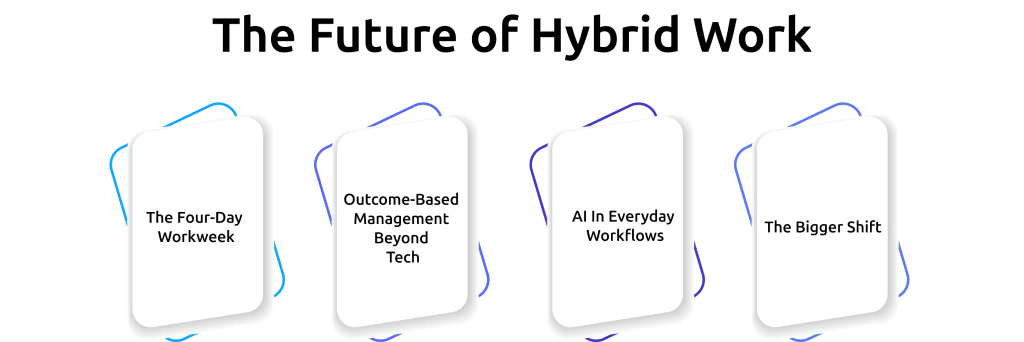
1. The Four-Day Workweek
As organizations focus more on outcomes than hours, some are testing shorter workweeks. Four-day workweek trials are being explored in select companies and regions as productivity experiments.
2. Outcome-Based Management Beyond Tech
More companies outside the digital space are starting to shift from managing by presence to managing by results, especially where work can be clearly measured.
3. AI In Everyday Workflows
As AI handles more routine tasks, human work is shifting toward decision-making, problem-solving, and creativity. This makes outcome-based measurement even more important.
4. The Bigger Shift
Organizations that have adapted well to hybrid work already follow these principles: trust employees, define clear outcomes, and measure performance by results. The next phase of work builds on this foundation.
How Time Champ Supports Hybrid Work
Hybrid work needs visibility without micromanagement, and Time Champ helps address that gap.
Time Champ is an employee monitoring software that helps organizations understand how work flows across teams through clear visibility into time usage, focus patterns, and workload balance.
It brings structure through capabilities like:
- Understanding productive vs idle time trends
- Tracking workload distribution across teams
- Identifying focus patterns in hybrid schedules
- Improving visibility without physical presence
- Monitoring team productivity trends over time
- Helping you balance workloads more effectively
- Supporting fair performance evaluation across remote and in-office employees
- Giving insights into how work hours are actually spent
This helps hybrid teams stay aligned and accountable without changing how or where people work.
Ready To Bring More Clarity to Your Hybrid Workplace?
See how Time Champ helps you track productivity, balance workloads, and keep hybrid teams connected.
Conclusion
Hybrid work started as a quick response during the pandemic and has now become a long-term way of working. It has changed how companies view flexibility, teamwork, and performance. What began as a temporary solution is now a common model across many industries. As work continues to change, the focus is shifting more toward results, trust, and flexibility. Companies that adapt to this change are better prepared for the future of work.

Jahnavi Pulluri

Table of Content
 Why Hybrid Work Is Now a Standard Operating Model
- How Hybrid Work Became the Workplace Standard After the Pandemic
- The Hybrid Work Maturity Model: What Stage Is Your Company In?
- Why Hybrid Work Became the Lasting Model
- The Future of Hybrid Work
- How Time Champ Supports Hybrid Work
- Conclusion
Related Blogs
Explore the challenges and benefits of hybrid work and discover strategies for effective team management to enhance flexibility, productivity, and smooth communication.
Thasleem Shaik | Oct 25, 2024
Discover how hybrid remote work blends flexibility with productivity. And explore key benefits, challenges, and tips for managing a successful hybrid workplace.
Sai Keerthi Uppala | Oct 25, 2024
Explore the pros and cons of remote vs. hybrid work models, and learn how to choose the best setup for your team's productivity and work-life balance.
Tarun Kumar Reddy | Oct 25, 2024
Discover ways to overcome communication challenges in remote work and boost collaboration. Find solutions for miscommunication, time zone issues, more!
Tarun Kumar Reddy | Oct 25, 2024
Discover 12 key tips for successful remote work, including simple strategies to stay productive, organized, and connected while working from home.
Jahnavi Pulluri | Dec 05, 2024
Protect your remote team's data with essential remote work security policies, risk mitigation strategies, and trends. Boost your setup and keep data safe.
Tarun Kumar Reddy | Oct 16, 2024


 4.7/5 avg.
Ready to Manage Your Workforce Smarter?
Join our family of 1500+ companies using smart insights to redefine workforces!

Free Trial
No Credit Card Required