Back Office Outsourcing: Services, Benefits and Best Practices
Discover how back office outsourcing can reduce costs, improve efficiency, and simplify operations. Explore services, challenges, and best practices.

Businesses handle many routine tasks such as processing invoices, managing payroll, updating records, and handling administrative work. The problem is that these small tasks can quickly eat up hours that teams could spend on bigger priorities. Back office outsourcing allows businesses to hand off routine work to specialized providers, reduce costs, improve efficiency, and keep teams focused on growth.
In this guide, we’ll explore back-office outsourcing services, their benefits, common challenges, and best practices to help you understand how outsourcing can support your business.
What Is Back Office Outsourcing?
Back office outsourcing is the practice of hiring an external service provider to handle internal business tasks such as data entry, payroll, accounting, HR administration, and document processing. It allows businesses to delegate routine work to specialized teams while reducing costs, improving efficiency, and allowing in-house employees to focus on core business activities.
It can cover anything from simple administrative work to specialized processes that require specific skills and expertise.

Did You Know?
According to a Parseq and Censuswide survey of UK businesses, 57% of businesses planned to start or increase back-office outsourcing in 2025. Highlighting the growing demand for outsourced operational support.
Back Office vs. Front Office Outsourcing
Front office and back office outsourcing serve different business needs. While one focuses on customers, the other keeps internal operations running smoothly. Here are the main differences between back office and front office outsourcing:
| Aspect | Back Office Outsourcing | Front Office Outsourcing |
|---|---|---|
| Main Focus | Internal business operations and support | Customer-facing activities |
| Type of Work | Administrative and operational tasks | Sales, customer service, and support |
| Customer Interaction | Usually little to no direct interaction | Frequent direct interaction with customers |
| Common Tasks | Data entry, payroll, accounting, HR, and document processing | Customer support, telemarketing, sales, and lead generation |
| Primary Goal | Improve efficiency and reduce operational workload | Improve customer experience and increase sales |
| Key Benefits | Lower costs, better productivity, and access to specialized skills | Better customer service, wider coverage, and increased sales capacity |
| Typical Teams | Finance, HR, administration, and data management teams | Sales, customer service, and marketing teams |
What Services Can Be Outsourced to a Back Office Provider?
Businesses can outsource several internal processes to a back office provider, depending on their operational needs. Common back-office outsourcing services include:
- Accounting and Finance: Bookkeeping, invoice processing, accounts payable, accounts receivable, payroll, and financial reporting.
- Data Entry and Processing: Entering, updating, organizing, and validating business data and records.
- HR Administration: Employee record management, payroll support, onboarding paperwork, benefits administration, and attendance records.
- Administrative Support: Document processing, scheduling, email management, file management, and other routine office tasks.
- Procurement Support: Purchase order processing, supplier records, invoice matching, and procurement administration.
- Order Processing: Managing orders, updating order records, processing returns, and maintaining customer order data.
- Document Management: Data extraction, document verification, digital filing, and record maintenance.
- Claims and Transaction Processing: Processing insurance claims, financial transactions, applications, and other high-volume business processes.
Get Better Visibility into Outsourced Teams
Track work hours, attendance, productivity, and employee activity across outsourced teams with Time Champ.
Why Companies Outsource Back Office Operations
Back office outsourcing helps businesses manage routine internal processes without putting extra pressure on their in-house teams. It provides several benefits that can improve daily operations and support business growth.
1. Reduces Operating Costs
Outsourcing reduces expenses related to hiring, training, salaries, infrastructure, and technology needed to manage back office tasks internally. It also helps businesses manage their budgets more efficiently as operational needs change.
2. Improves Operational Efficiency
Specialized providers use established processes and experienced teams to complete routine tasks faster and with fewer errors. This creates smoother workflows and helps businesses maintain consistent service quality.
3. Provides Access to Specialized Skills
Outsourcing provides access to skilled professionals with expertise in accounting, payroll, data processing, HR administration, and other back-office functions. This allows businesses to handle specialized work without building every skill in-house.
4. Increases Focus on Core Activities
Outsourcing reduces the administrative workload for in-house teams, allowing employees to spend more time on core business activities and strategic priorities. This helps teams direct their time toward work that contributes more directly to business growth.
5. Supports Business Scalability
Outsourcing makes it easier to scale back office operations as workloads change, without requiring businesses to continuously hire or restructure internal teams. It gives businesses greater flexibility when handling seasonal demand or periods of rapid growth.
6. Increases Team Productivity
Outsourcing repetitive tasks helps employees focus on higher-value responsibilities and improves overall productivity. It also reduces the time teams spend on routine work that can otherwise slow down daily operations.
Did You Know?
The global back-office support BPO market was valued at $13.1 billion in 2025 and is projected to reach $26.2 billion by 2033, reflecting strong market growth.
How Much Does Back Office Outsourcing Cost?
The cost of Back Office Outsourcing depends on the type of service, workload, team size, location, and level of expertise required. Routine tasks such as data entry usually cost less, while specialized services such as accounting, payroll, and compliance support may require higher rates.
As a general benchmark, back office outsourcing services can cost around $4 to $25 per hour, depending on the service and outsourcing location.
| Back Office Service | Typical Hourly Cost |
|---|---|
| Data Entry and Processing | $4–$12 |
| HR Administration | $6–$15 |
| Bookkeeping and Accounting | $7–$25 |
| Payroll Processing | $7–$20 |
| Document Management | $5–$15 |
| Procurement Support | $7–$18 |
| Compliance and Documentation | $12–$20 |
Don’t Let Unproductive Hours Increase Outsourcing Costs
Track how outsourced teams spend their working hours and identify opportunities to improve productivity with Time Champ.
How to Choose the Right Back Office Outsourcing Company
Choosing the right back office outsourcing company can have a direct impact on cost, productivity, and service quality. Businesses should evaluate more than just pricing and look at the provider’s expertise, security, flexibility, and ability to meet their specific requirements.
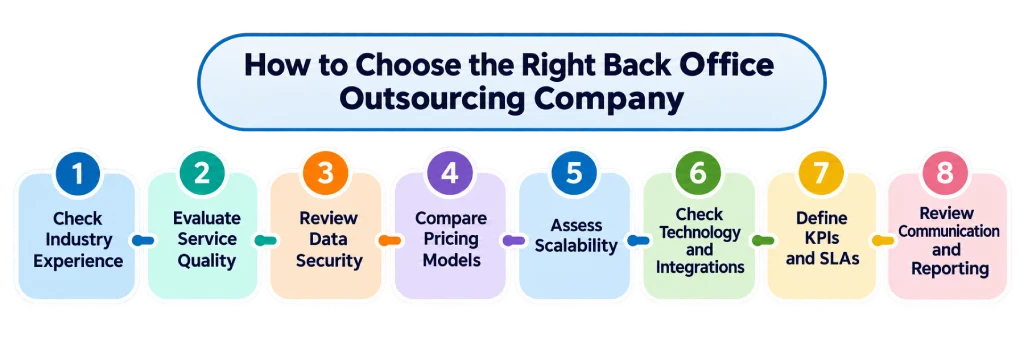
1. Check Industry Experience
Choose a provider with experience handling back-office processes similar to those required by the business. Industry knowledge can help reduce errors and make the transition smoother.
2. Evaluate Service Quality
Review the provider’s quality control processes, performance records, and client feedback. Strong quality standards help ensure that outsourced tasks are completed accurately and consistently.
3. Review Data Security
Back office teams may handle sensitive financial, employee, or business information. Businesses should check the provider’s security measures, data protection policies, and relevant compliance standards.
4. Compare Pricing Models
Compare providers based on their pricing structure, not just the quoted rate. Businesses should consider whether hourly, per-task, monthly, or fixed pricing offers the best value for their workload.
5. Assess Scalability
Choose a provider that can adjust its services as business needs change. This makes it easier to handle growing workloads, seasonal demand, or expansion into new markets.
6. Check Technology and Integrations
Review the provider's tools and technology and confirm they can integrate with your existing business systems. Good technology integration can reduce manual work and improve process efficiency.
7. Define KPIs and SLAs
Set clear key performance indicators and service-level agreements before starting the partnership. These measures make it easier to track turnaround time, accuracy, productivity, and overall service performance.
8. Review Communication and Reporting
Choose a provider that offers clear communication and regular performance reports. Consistent updates give businesses better visibility into outsourced operations and help identify issues early.
Common Challenges of Back Office Outsourcing and How to Overcome Them
Back office outsourcing can reduce costs and improve efficiency, but businesses may face a few challenges when working with external teams. Here are the common challenges and practical ways to overcome them.
1. Communication Gaps
Challenge: Different locations, time zones, or unclear responsibilities can cause communication delays and misunderstandings. This can affect task coordination and slow down daily operations.
How to Overcome: Set clear communication channels, assign responsibilities, and schedule regular meetings to keep internal and outsourced teams aligned.
2. Data Security Risks
Challenge: Outsourced teams may have access to sensitive financial, employee, or business information, which can increase security risks. A data breach can also lead to financial and reputational damage.
How to Overcome: Choose providers with strong security practices, use role-based access controls, and regularly review how sensitive data is accessed and handled.
3. Quality and Accuracy Issues
Challenge: Errors can occur when outsourced employees are unfamiliar with business processes or quality expectations. Frequent mistakes can affect productivity and create additional work for internal teams.
How to Overcome: Provide proper training, document processes clearly, and set measurable quality standards with regular performance checks.
4. Limited Visibility Into Work
Challenge: Businesses may struggle to see how outsourced teams spend their working hours or track their productivity. This can make it harder to identify delays, workload issues, or unproductive activities.
How to Overcome: Use time tracking and productivity monitoring tools to gain visibility into work hours, employee activity, and productivity levels.
5. Poor Knowledge Transfer
Challenge: Incomplete information about processes can make it difficult for an outsourced team to perform tasks correctly. This may result in repeated questions, delays, and inconsistent work.
How to Overcome: Create detailed process documentation, provide structured training, and allow sufficient time for knowledge transfer before the work begins.
6. Time Zone Differences
Challenge: Different working hours can delay communication and make it harder to resolve urgent issues. Important tasks may also be held up when teams are not available at the same time.
How to Overcome: Establish overlapping working hours, define response-time expectations, and create clear escalation procedures for urgent matters.
7. Difficulty Scaling Operations
Challenge: Changes in workload can make it difficult to maintain the right number of outsourced employees. Businesses may struggle to respond quickly when demand suddenly increases or decreases.
How to Overcome: Partner with a provider that offers flexible staffing and can quickly adjust team capacity as business requirements change.
8. Unexpected Costs
Challenge: Extra charges for additional services, technology, or increased workloads can push outsourcing costs beyond the original budget. These unexpected expenses can make it difficult to measure the actual value of outsourcing.
How to Overcome: Review the contract carefully and confirm pricing, service limits, additional fees, and payment terms before starting the partnership.
Overcome Back Office Outsourcing Challenges with Time Champ
Time Champ helps businesses address productivity, workload, and time management challenges across outsourced teams.
How Time Champ Supports Back Office Outsourcing
Managing outsourced back office teams requires visibility into working hours, attendance, and productivity. Time Champ helps businesses monitor outsourced teams and understand how their work time is being used, especially when teams work remotely or across different locations.
Key ways Time Champ supports back office outsourcing include:
- Time Tracking: Records employee working hours and tracks time spent on tasks.
- Productivity Monitoring: Provides insights into employee productivity and work patterns.
- Attendance Management: Tracks attendance, work schedules, and employee availability.
- Employee Activity Monitoring: Helps managers understand activity levels during working hours.
- Remote Team Monitoring: Provides visibility into teams working across different locations.
- Productivity Reports: Generates reports on working hours, attendance, activity, and productivity.
- Screenshot Monitoring: Captures periodic screenshots to provide visibility into work activity.
- App and Website Tracking: Shows which applications and websites employees use during work hours.
Ready to Make Back Office Outsourcing More Efficient?
Manage outsourced teams, track productivity, and simplify daily operations with Time Champ. Try now!
Conclusion
Back office outsourcing can help businesses reduce costs, improve efficiency, and take routine work off their internal teams. However, outsourcing works best with the right provider, clear processes, strong data security, and proper performance tracking.
With the right approach and tools like Time Champ, businesses can maintain better visibility into outsourced teams while keeping operations productive and focused on growth.

Guna Lakshmi

Table of Content
 What Is Back Office Outsourcing?
- Back Office vs. Front Office Outsourcing
- What Services Can Be Outsourced to a Back Office Provider?
- Why Companies Outsource Back Office Operations
- How Much Does Back Office Outsourcing Cost?
- How to Choose the Right Back Office Outsourcing Company
- Common Challenges of Back Office Outsourcing and How to Overcome Them
- How Time Champ Supports Back Office Outsourcing
- Conclusion
Related Blogs

Discover the 12 benefits of outsourcing, including cost savings, access to global talent, and practical tips for managing outsourced teams effectively.
Guna Lakshmi | Jul 10, 2026
Work piling up faster than your inbox messages? Explore 20 types of outsourcing to help your business stay productive without the chaos.
Guna Lakshmi | Jul 15, 2026
Compare the best online outsourcing websites for 2026, including real fees, hiring tips, platform features, and proven ways to manage freelancers easily.
Jahnavi Pulluri | Aug 13, 2026
Learn about the top 10 outsourcing risks and how to manage them effectively, protecting your business from potential challenges and disruptions
Mounika Sai | Nov 27, 2023
Strategic outsourcing involves delegating specific tasks to external experts for efficiency. Explore its types, advantages, and how it optimizes operations.
Mounika Sai | Nov 24, 2023
In-house vs outsourcing explained with key differences, pros, cons, costs, and practical tips to help you choose the best approach for your organization.
Anjali | Jul 02, 2026


 4.7/5 avg.
Ready to Manage Your Workforce Smarter?
Join our family of 1500+ companies using smart insights to redefine workforces!

Free Trial
No Credit Card Required