What Does Fully Remote Work Mean? Pros, Cons & Tips to Make It Work
What does fully remote work mean? A clear definition, how it differs from hybrid, honest pros and cons, and practical tips to make working remotely work.
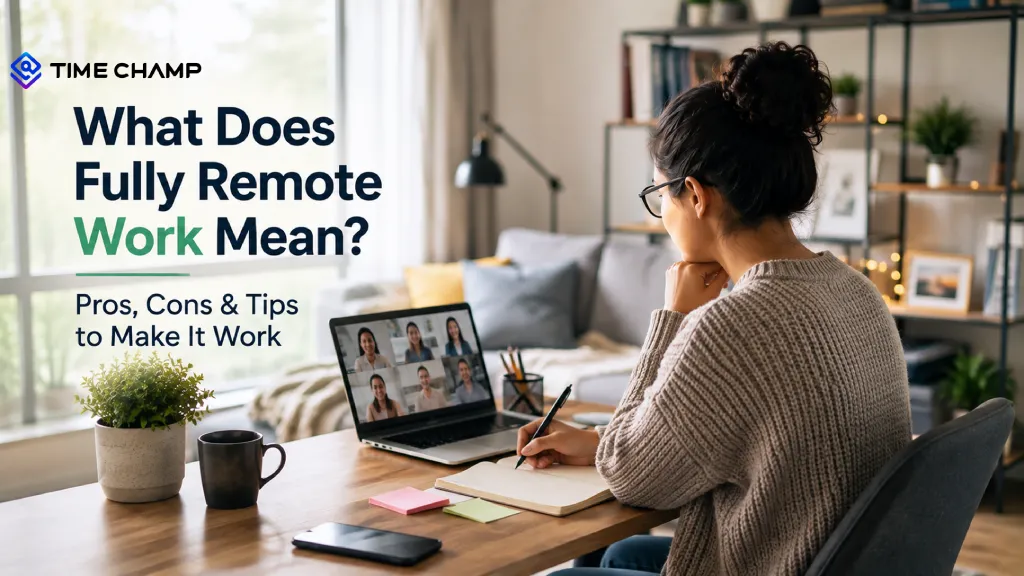
Gen-Z loves fully remote work, almost two-thirds of Gen-Z employees opt for it, but what exactly is it?
It’s comfort for employees and cost optimization for companies.
Let me brief it, when an employee or an entire team works from home or any place with a good internet connection, in other words, the employee does not need to come to the designated office to work everyday, they can do it from the comfort of their home, a coffee shop, or a coworking space.
This is entirely remote, so they can work from any country or region and never need to visit the company.
What Does Fully Remote Work Mean?
Fully remote work means an employee does their entire job from a location of their choice, with no obligation to work from a company office. It is also called 100% remote, exclusively remote, or work from anywhere. The office is not the default and never becomes one. Communication, collaboration, and delivery all happen through digital tools instead of a shared physical space.
So how common is it, really?
More common than the return-to-office headlines suggest. According to Gallup, as of mid-2025, 28% of remote-capable U.S. employees work exclusively remotely, while 52% are hybrid and 21% are fully on-site. In other words, fully remote is a permanent arrangement for roughly one in four people who can do their job from anywhere, and it has held steady rather than disappeared.
Fully Remote vs Hybrid vs Work From Home: What's the Difference?
I have seen so many people get confused between these three, so here’s a comparison so that you don’t end up thinking the same.
- Fully remote means no office, ever.
- Hybrid means a planned split between office and home.
- Work from home usually describes an occasional arrangement inside an office-based job.
Here is the clean version:
| Aspect | Fully Remote | Hybrid | Work From Home |
|---|---|---|---|
| Where you work | Anywhere, no office required | Split between office and home | Home, often occasionally |
| Office days | None | Usually, 2 to 3 a week | Varies, sometimes ad hoc |
| Best for | Independent, focus-heavy roles | Roles needing some in-person time | Everyday flexibility within an office job |
| Biggest upside | Maximum flexibility, no commute | Balance of focus and face time | Convenience on specific days |
| Biggest challenge | Isolation and staying visible | Coordinating everyone's schedule | Blurring into always available |
Key Insights: Work from home is usually a perk, hybrid is a schedule, and fully remote is a way of working. If your contract does not tie you to a building at all, you are fully remote.
The Pros of Fully Remote Work
Fully remote work is a blessing when it comes to control: over your time, environment, and where you live. For the right person and the right role, that control turns into real gains in focus, well-being, and money saved. A few more pros:
- No Commute: You get back the hours and the cost that used to vanish on the road, and the day starts calmer.
- Deeper Focus: For focused work, a quiet home beats a noisy office and its endless interruptions.
- Real Flexibility: You can plan your day around when you work best instead of forcing your life around work.
- A Wider Map: You can live where you want, work for companies outside your city, and employers can hire from a much larger talent pool.
- Money Saved: Fuel, parking, eating out, and work clothes can add up to a decent amount of savings over the year.
The Cons of Fully Remote Work
There are downsides to almost everything, and for remote work as well, and most of them are about people, not productivity.
- Isolation: Going days without seeing people can wear you down, even if you prefer working alone.
- The Always-on Trap: When home becomes the office, work can easily spill into evenings and weekends, leading to burnout.
- Being Out of Sight: If your work is not visible, you may get overlooked during reviews even when you are doing really great work.
- Blurred Boundaries: Without a commute to mark the start and end of your day, switching off from work becomes harder.
- Collaboration Friction: Solving problems on your own across time zones and chat windows can be harder than doing it together at a whiteboard.
Is Fully Remote Work Right for You?
I wouldn’t say a big fat yes right off the bat, but if you tick yes to these questions, then it might just be your cup of coffee.
- Is your work measured by your output rather than by being seen at a desk? If yes, fully remote could be a good fit.
- Are you comfortable working independently and managing your own time?
- Can your role run smoothly with clear async updates instead of daily face-to-face collaboration?
- Do you have a quiet, dedicated space at home where you can focus on work?
If most answers point toward independent, output-driven work, fully remote is likely a strong fit.
If the role or the person leans on constant togetherness, hybrid may serve you better.
There is no universally right answer, only the one that fits the work and the human doing it.
Wondering why remote feels fine but deadlines keep slipping?
Time Champ tracks project time against plan, so drift shows up before the deadline does.
Tips to Make Fully Remote Work Actually Work
Fully remote work does not run all by itself. The people and teams that thrive are the ones that build a few simple, intentional habits. Here are the tips that matter most, based on which side of the setup you are on.
If you work fully remotely:
- Set Hard Start and Stop Times: Give yourself the boundaries a commute used to provide, and log off when the workday ends.
- Build a Real Workspace: A dedicated spot, even a small one, helps your brain know when it is time to work and when it is time to switch off.
- Make Your Work Visible: Share your progress, speak up in meetings, and make your results easy to see. Proven output matters more than desk time.
- Protect Connection: Make time for the social interaction you used to get naturally, and step outside every day.
If you manage a fully remote team:
- Measure Output, Not Activity: Judge people by what they deliver, not by a green dot or hours online.
- Default to Async, Meet with Purpose: Protect focus time and make every meeting worth the interruption.
- Watch for Burnout, Not Slacking: Remote teams are more likely to overwork. Look for people quietly logging on too much, not too little.
- Give Everyone Equal Visibility: Make sure quiet, off-camera contributors get the same credit as the loudest voice in the room.
How Time Champ Helps Fully Remote Teams Work Better
Let me be clear about who this part is for: managers and team leads, not for the solo remote worker.
Time Champ is employee monitoring and time-tracking software with a workforce intelligence layer, and for a fully remote team, it solves the two problems the cons list above screams: people going unseen, and people quietly burning out.
When your team is spread across homes and time zones, you obviously lose the informal signals an office provides. Time Champ gives you them back, in a way that respects the people it measures:
- Productivity and activity insightsso contribution is visible by output and focus, and quiet contributors are not overlooked at review time.
- Work-life balance and over-utilization signalsso you can spot the teammate logging on late every night before it becomes burnout, and step in early.
- Automated attendance and shift adherenceacross time zones, without chasing manual timesheets.
- Trends you can shareso remote reviews run on facts, not on who happened to be loudest in the last call.
And here is the part that really matters for remote teams, who can be wary of monitoring: this is visibility, not surveillance. Employees can see their own data, monitoring is transparent, and screenshots can be blurred to protect private information.
The end goal is simple: fairness and support, catching overworked employees before they burn out and giving unseen work its due, not watching over anyone’s shoulder. Unlike a green-dot presence tracker that only shows you are online, Time Champ shows how remote work actually happens, helping leaders support their teams instead of guessing.
Is Remote Work Here to Stay?
Fully remote work is definitely here to stay, even as some companies push a return to office. The Gallup data is telling: fully remote and hybrid together still account for around 80% of remote-capable employees, and that split has stayed remarkably stable. Fully remote is no longer an emergency measure or a pandemic hangover. It is one settled, permanent way of working, chosen by companies that hire for output and people who deliver it. The real issue everybody has lingering in their mind is how to do it well.
Want to see how your fully remote work is happening?
Time Champ gives you real-time visibility and utmost clarity on your team’s productivity!
A Few Final Words
Fully remote work is neither the perfect setup that joggers-and-coffee photos make it seem nor the productivity disaster its critics fear. It is simply a different way of working, with real trade-offs, that works well for some people and roles but not for others. The people and teams who succeed at it are the ones who go in with their eyes open: they keep work visible, prevent burnout, and build the connection that an office once provided naturally.

Shabana Shaik

Table of Content
 What Does Fully Remote Work Mean?
- Fully Remote vs Hybrid vs Work From Home: What's the Difference?
- The Pros of Fully Remote Work
- The Cons of Fully Remote Work
- Is Fully Remote Work Right for You?
- Tips to Make Fully Remote Work Actually Work
- How Time Champ Helps Fully Remote Teams Work Better
- Is Remote Work Here to Stay?
- A Few Final Words
Related Blogs

Struggling to stay productive? Discover 25 daily routines and habits that can improve focus, reduce distractions, and boost your productivity.
Guna Lakshmi | Jun 27, 2026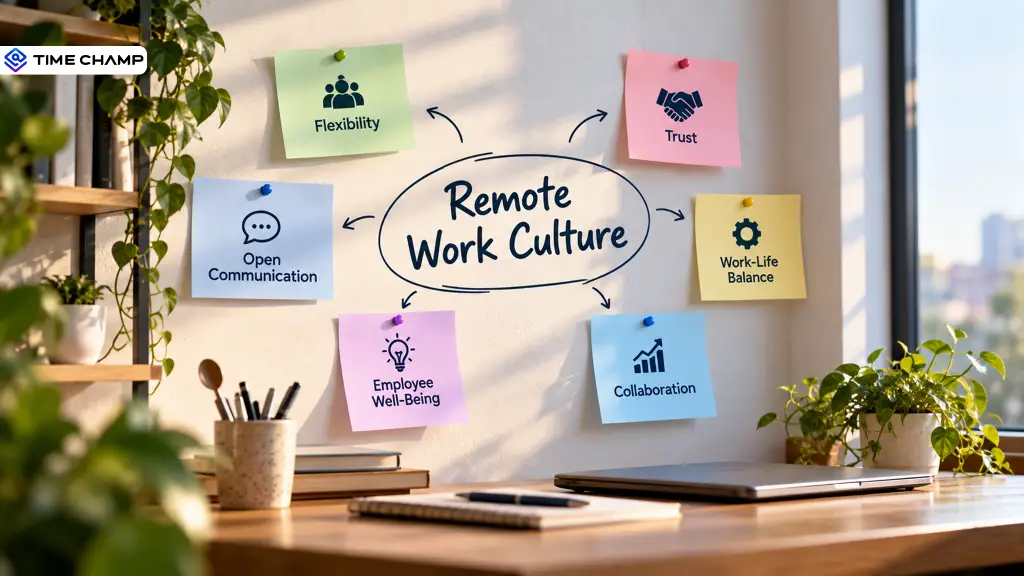
Build a strong remote work culture with practical strategies that improve communication, collaboration, accountability, and connection across your team.
Thasleem Shaik | Sep 29, 2026
Explore employee burnout detection software to help remote teams spot early warning signs, reduce turnover, and protect team well-being with the best tools.
Anjali | Apr 23, 2026
Misread messages, missed updates, endless pings? Learn how to overcome communication challenges in remote work and keep your team connected.
Guna Lakshmi | Jul 20, 2026
Discover if remote workers are truly less productive. Explore key insights, challenges, and benefits of remote work in boosting employee productivity.
Shabana Shaik | Mar 26, 2025
Performance evaluation in remote workforces: 7 metrics that matter, common biases to avoid, and how to run reviews your team trusts.
Guna Lakshmi | Apr 14, 2026


 4.7/5 avg.
Ready to Manage Your Workforce Smarter?
Join our family of 1500+ companies using smart insights to redefine workforces!

Free Trial
No Credit Card Required