What is Corporate Social Responsibility (CSR)? Explained
Learn what Corporate Social Responsibility (CSR) is, its types, key benefits, and why it’s essential for businesses striving for long-term success.

Corporate Social Responsibility (CSR) is now a key part of a business’s strategy, not just something to consider. It is expected that modern companies should be able to make a profit and contribute to social and environmental causes.
When public expectations change, CSR lets others in the community understand what a business's values and goals are. The three key areas, employee well-being, environmental impact and ethics, are determining how companies achieve a lasting success and maintain trust.
It shows why companies should understand what Corporate Social Responsibility (CSR) is and its rising significance to remain relevant in a fast-changing environment.
What is Corporate Social Responsibility (CSR)?
CSR shows that a company is willing to address its effects on the environment and the public. The idea is to earn profits and operate in an ethical, environmentally friendly and helpful way for people and the planet.
According to the CSR definition, companies engage in many tasks, including working to reduce carbon emissions, support local communities, ensure fair treatment of employees and promote openness. In brief, CSR means companies work towards both creating a difference and reaching their business goals.
Global guidelines help explain what CSR is and how it works. The ISO 26000 CSR framework guides companies in how to behave responsibly toward human rights, employees and the environment.
CSR is now considered usual in business planning, showing firms can generate earnings and social benefits simultaneously.
Key Benefits of Corporate Social Responsibility
CSR is beneficial to businesses as well as to society. Look at key benefits of Corporate Social Responsibility (CSR):

Enhances Brand Reputation
If companies behave ethically, people tend to pay attention. A solid CSR program helps increase a company’s positive reputation. It shows that the business stands for more than just making a profit.
Increases Employee Engagement
People prefer to work at companies that make a positive difference. CSR events make employees feel satisfied, happy and closely involved with their work.
Higher Customer Loyalty
Consumers prefer brands that act with purpose and responsibility. If companies work to improve social or environmental issues, consumers tend to remain with them.
Stronger Investor Relations
Investors prefer companies that are ethical and reliable. A company with a strong CSR approach looks to the future and reduces major threats.
Financial institutions prefer investing in businesses that are ethical and strong. Through CSR, a company can prepare for the future and stay out of significant trouble.
Long-Term Sustainability
CSR supports businesses in developing in a smart and secure manner. It leads to long-term victories when caring for people, profits and the planet.
Types of Corporate Social Responsibility
Companies can be responsible in many ways. Let’s look at the key types of Corporate Social Responsibility (CSR).
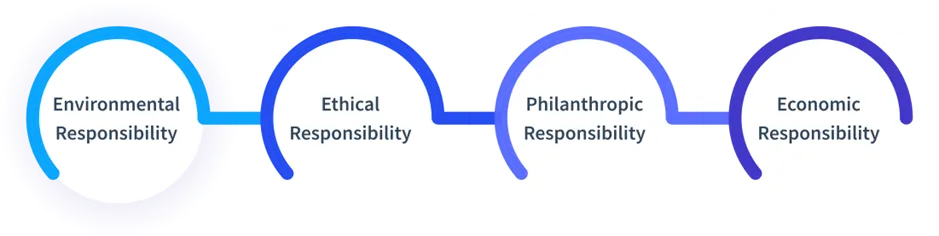
Environmental Responsibility
Organizations achieve this by cutting their energy use, consuming less plastic, recycling goods, adopting sustainable solutions like digital business cards and reducing pollution. They take actions to save nature and address climate challenges.
Ethical Responsibility
It’s about taking the correct path. This means maintaining fairness with employees, providing good wages and speaking honestly in business activities. It also covers avoiding businesses that are dishonest or unethical.
Philanthropic Responsibility
This involves offering support to those in need. Many companies support those in need by donating money, spending time, or providing essential goods. Their efforts help schools, hospitals, and charitable organizations. Employers in these firms sometimes let their employees volunteer during office hours.
Economic Responsibility
It’s about making money while still doing what’s right for people and the society. Businesses aim to benefit the community while also making money. They treat people fairly, offer reasonably priced products and put money into their teams and communities.
5 CSR Examples that are Making a Difference
The companies are illustrating that success and ethical practices can go along with each other. From tech to transportation, each CSR initiative creates meaningful social or environmental impact.
1. Microsoft – Bridging the Digital Divide
Microsoft is committed to helping people gain access to technology and learn. The company empowers non-profits with cloud technology; advances access for all and builds digital skills in underserved communities through its Tech for Social Impact and AI for Good initiatives.
2. Tata Group – Community-Centric Development
All the Tata Group companies put CSR into practice, focusing heavily on education, healthcare, and supporting rural areas in India. Tata Trusts, Tata Group’s social responsibility division, provides support for clean water, maternal health, education, and response to disasters. A major share of the group’s profits goes back into making a positive social impact.
3. Ben & Jerry’s – Advocacy and Social Justice
Ben & Jerry’s speaks up through its brand to defend racial equity, climate justice, and human rights. Starbucks helps grassroots causes, uses ethically certified products, and tries to educate its customers by sharing information about social topics through conducting campaigns and partnerships.
4. Coca-Cola – Water Stewardship and Women Empowerment
Coca-Cola works on issues including water conservation, supporting women in business and handling waste. The “5by20” program supported 5 million women entrepreneurs around the globe by 2020 and its water programs plan to return water used in the company’s activities to the environment and communities it affects.
5. Adobe – Diversity, Equity, and Education
Adobe supports CSR through STEM education, creative skill development, and diversity in tech. Adobe has embarked on an initiative to create a diverse workforce, adopted under the name "Adobe for All". Moreover, the Adobe Creativity Scholarships support financially students with underrepresented backgrounds so that they have an opportunity to develop careers in creative fields. Adobe gives free access to certain tools for both nonprofits and schools.
Conclusion: Why CSR is a Smart Business Strategy
Businesses benefit from Corporate Social Responsibility (CSR) regardless of whether it’s a current trend. When organizations value the welfare of people, the world and morality, customers become more loyal to them. Having a strong CSR program improves a company’s reputation, attracts employees’ interest and gains the attention of investors and customers.
CSR is an important aspect of long-term business success. It allows organizations to develop in a responsible manner, dealing with future challenges. When CSR becomes a core strategy, it enhances corporate performance as well as social well-being.

Chetana Choudary


Table of Content
-
 What is Corporate Social Responsibility (CSR)?
-
Key Benefits of Corporate Social Responsibility
-
Types of Corporate Social Responsibility
-
5 CSR Examples that are Making a Difference
-
Conclusion: Why CSR is a Smart Business Strategy
Related Blogs

Employee relations is a term that describes the kind of connections that exist between the employer and the employees of
Vijaya Lakshmi | 3 May 2024
It is the process which an employer evaluates the performance of their employees as well as their skills, competencies and
Vijaya Lakshmi | 30 April 2024
Employee referral can be defined as a recruitment method through which present employees of an organization refer or recommend candidates
Vijaya Lakshmi | 30 April 2024
Employer Identification Number (EIN) is a 9-digit unique number provided by the IRS (Internal Revenue Service) to businesses and other
Vijaya Lakshmi | 30 April 2024
The term due diligence means usually the process of collecting all available information about an investment opportunity, business deal, or acquisition and analyzing it before completing the transaction. It is
Vijaya Lakshmi | 30 April 2024
E-recruitment, also called online recruitment or internet recruitment, is the procedure of using digital technologies and online platforms to search,
Vijaya Lakshmi | 30 April 2024


 4.7/5 avg.
Ready to Manage Your Workforce Smarter?
Join our family of 1500+ companies using smart insights to redefine workforces!

Free Trial
No Credit Card Required