10 Smart Time Management Goals for Better Productivity
Setting the right time management goals can improve focus, organize priorities, and help you manage work with more clarity and consistency every day.
You do not usually lose time all at once. It slips away in small ways through constant task switching, vague priorities, and a day that starts before you decide what actually matters. That is why setting clear time management goals can change more than your schedule. It can change how your whole day feels.
When your goals are specific and realistic, time and goal management become much easier to handle. In this guide, you will see how smart goals for time management help you plan better, stay focused, and make steady progress with practical time management goal examples you can start using today.
What are Time Management Goals?
Time management goals are clear objectives that help you plan, organize, and use your time more effectively. Instead of working without direction, these goals give you a structured way to manage tasks, priorities, and deadlines throughout the day.
When these goals follow the SMART framework, they become easier to track and achieve. SMART goals are specific, measurable, achievable, relevant, and time-bound, which makes goal setting and time management more practical and realistic in everyday work.
10 Time Management Goals You Can Set
Good time management starts with small changes you can follow consistently every day. Be are practical goals that can help you stay focused, organize your workload better, and create a more structured daily routine without making your schedule feel overwhelming.
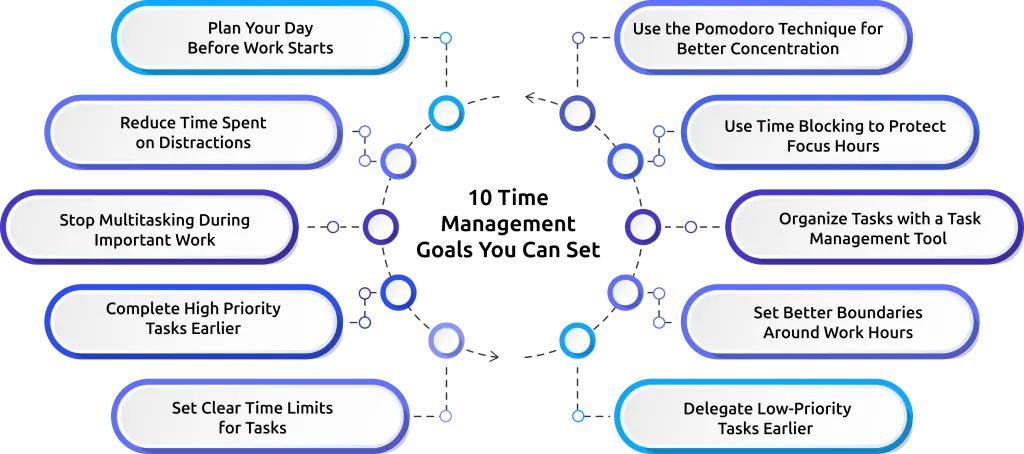
1. Plan Your Day Before Work Starts
One of the most effective ways to manage time better is starting the day with a clear plan instead of deciding tasks as you go. When you already know your priorities, it becomes easier to stay focused and avoid wasting time on low-value work.
A simple SMART goal for time management could be planning your top three tasks every morning before checking emails or messages. This creates structure and helps you stay in control of your schedule throughout the day.
2. Reduce Time Spent on Distractions
Small distractions can quietly take away hours from your day. A quick notification, unnecessary tab switching, or constantly checking messages can easily break concentration and slow down important work.
A practical time management goal is limiting distractions during focused work hours. For example, you can set a goal to silence notifications for one hour while working on high-priority tasks. Small changes like this improve concentration and help you finish work faster.
3. Stop Multitasking During Important Work
Multitasking often feels productive at first, but it usually leads to mistakes, unfinished tasks, and mental exhaustion. Research from the American Psychological Association shows that constant task switching can reduce productivity by up to 40%.
One of the best goals for time management is focusing on one task at a time during important work sessions. Even dedicating 30 to 45 minutes to uninterrupted work can improve accuracy, focus, and consistency over time.
4. Complete High Priority Tasks Earlier
Small tasks, messages, and quick requests can easily consume your entire morning before you even touch meaningful work. After a few hours of constant switching, your focus and energy naturally start to drop.
A strong time management goal-setting strategy is scheduling your most important task during your most productive hours. You make better progress when you finish meaningful work early, before your day becomes crowded with meetings, notifications, and unexpected tasks.
5. Set Clear Time Limits for Tasks
Without deadlines, even simple tasks can take much longer than necessary. You may revisit the same task repeatedly, switch attention midway, or spend extra time on things that do not need that much effort.
Setting realistic time limits is a simple time management technique that helps you stay more intentional with your work. For example, you can set a goal to complete weekly reports within one hour instead of letting them consume your entire afternoon. Clear limits improve focus and help you move through tasks more efficiently.
Ready to manage your time with more clarity and less daily chaos?
Time Champ helps you plan smarter, reduce distractions, and stay on top of tasks.
6. Use the Pomodoro Technique for Better Concentration
Some tasks feel difficult simply because they require long periods of attention. The Pomodoro technique makes work feel more manageable by breaking it into shorter, focused sessions with small breaks in between.
You can set a goal to work in focused 25-minute intervals while handling repetitive or pending tasks. Short work sessions often make it easier to stay consistent without feeling mentally drained.
7. Use Time Blocking to Protect Focus Hours
Constant interruptions can make even simple tasks feel exhausting. Time blocking is a smart goal that helps you give dedicated hours to important work instead of switching between tasks all day.
You can set fixed focus hours for specific tasks like planning, reporting, or project work, and avoid checking emails or messages during that time. Even two uninterrupted hours in the morning can help you finish more work with better concentration.
8. Organize Tasks with a Task Management Tool
Managing multiple tasks manually can easily create confusion, missed deadlines, and unnecessary stress. The more responsibilities you handle daily, the harder it becomes to stay organized without a proper system.
Using a task management tool like Time Champ helps you track tasks, organize priorities, manage deadlines, and monitor progress from one place. Features like reminders, task tracking, and automated updates reduce manual follow-ups and help you stay more consistent with your daily workload.
9. Set Better Boundaries Around Work Hours
Poor work-life balance often starts when work continues beyond your planned schedule every day. Constantly checking messages or replying to notifications late in the evening makes it difficult to properly disconnect and recharge.
Creating clear boundaries helps you protect both productivity and personal time. Simple habits like turning off notifications in the evening or avoiding late-night work can help you maintain a healthier and more balanced daily routine.
10. Delegate Low-Priority Tasks Earlier
Trying to handle every task by yourself can quickly fill your schedule and leave very little time for important work. Small urgent tasks often take more time and energy than expected when you keep delaying delegation.
A simple time management practice is reviewing your workload and identifying tasks that someone else can handle. Delegating repetitive or low-priority work earlier helps you focus more on planning, important decisions, and meaningful tasks.
Stop letting distractions and constant task switching control your day.
Start managing your time with more clarity, focus, and consistency using Time Champ.
Real-World Examples of SMART Time Management Goals
Good time management goals become much easier to follow when you see how they work in real situations. In fact, 94% people say better time management leads to higher productivity and improved focus at work.
Below are some real-world examples that show how successful professionals and companies use focus, prioritization, and better planning to manage time more effectively.
Example #1
Investor Warren Buffett is known for keeping his focus limited to only a few high-priority tasks instead of trying to handle everything at once. In a well-known story shared by James Clear, Buffett asked his longtime pilot, Mike Flint, to list 25 career goals and then choose only the top five that truly mattered most.
The interesting part was Buffett’s advice about the remaining goals. Instead of trying to manage all 25 at the same time, he suggested treating the remaining tasks as distractions until the top priorities were completed first. This is a powerful example of delegation and prioritization in time management. When you stop giving equal attention to every task, it becomes much easier to focus your time and energy on the work that actually creates meaningful progress.
Example #2
When Steve Jobs returned to Apple in 1997, the company had too many products, projects, and distractions competing for attention. Instead of trying to improve everything at once, he focused on simplifying the company’s priorities and removing work that was not essential. Jobs later explained that real focus comes from saying“no” to unnecessary things, not saying yes to everything.
That approach became one of the biggest reasons behind Apple’s recovery. Apple narrowed its focus by removing unnecessary products and spending more time and energy on the work that mattered most. It is a strong example of time management because trying to handle too many things at once often slows down meaningful progress.
Make Time Management Easier and More Consistent with Time Champ
Managing time becomes difficult when tasks, priorities, deadlines, and work updates keep coming from different tools and conversations. You end up spending more time switching between tabs, checking progress, and figuring out what needs attention instead of focusing on the work itself. Time Champ helps bring everything into one place, so your day feels more organized, structured, and easier to manage.
With Time Champ, you can track tasks, monitor work hours, organize priorities, manage workloads, and understand where time actually goes during the day. Features like task tracking, productivity insights, reminders, attendance monitoring, and automated reports help you stay focused without constantly managing everything manually. Instead of reacting to work all day, you get a clearer system that helps you plan better, work with more consistency, and build stronger time management habits over time.
Stop letting scattered tasks and constant follow ups slow down your workday.
Use Time Champ to manage time more clearly and keep work structured in one place.
Conclusion
Good time management does not come from working longer hours. It usually comes from making clearer decisions about what deserves your attention and what does not. The right SMART time management goals help you stay focused, build better routines, and use your time more effectively instead of constantly reacting to work throughout the day. Start with one small change, stay consistent with it, and your daily routine will gradually feel more focused and manageable.

Thasleem Shaik

Table of Content
 What are Time Management Goals?
- 10 Time Management Goals You Can Set
- Real-World Examples of SMART Time Management Goals
- Make Time Management Easier and More Consistent with Time Champ
- Conclusion
Related Blogs

Learn how to build a time management plan that aligns roles, goals, and schedules. A practical, step-by-step guide to lead your team with clarity.
Thasleem Shaik | May 25, 2026
What if your time management myths are holding you back? Find which beliefs are stopping you from becoming more productive and find other improved methods.
Thasleem Shaik | Mar 15, 2025
Discover the top 9 time management challenges and practical strategies to overcome them. Boost productivity with these smart solutions for better time control.
Shabana Shaik | Sep 19, 2024
Explore the essentials of project time management, its importance, best processes and top tips to meet deadlines without fail and boost workforce productivity.
Shabana Shaik | Oct 10, 2024
Learn what time management skills are, compare key skills, explore examples with stats, and see how they differ from time management techniques.
Thasleem Shaik | Apr 08, 2026
Discover the top 10 time management apps to boost productivity, stay organized, and achieve your goals efficiently. Try them today!
Shabana Shaik | Sep 17, 2024


 4.7/5 avg.
Ready to Manage Your Workforce Smarter?
Join our family of 1500+ companies using smart insights to redefine workforces!

Free Trial
No Credit Card Required