4 Risk Management Techniques to Reduce Business Risk
Learn the 4 core risk management techniques, supporting methods, and a 6-step process to choose the right approach for your business with best practices.
Over half of insider security incidents (53%) happen because of simple employee mistakes, not malicious actions. According to the 2026 Cost of Insider Risks report, these incidents cost organizations an average of $10.3 million every year. If your risk management plan only gets reviewed before an annual audit, your biggest risks could already be affecting your business.
Risk management techniques are the different ways businesses respond to risks after identifying them. Depending on the situation, a business may choose to avoid a risk, reduce its impact, transfer it to another party, or accept it. The goal is to make informed decisions before small issues turn into costly problems. In this blog, you'll learn the four core risk management techniques, the methods that support them, a simple six-step risk management process, and how to choose the right technique for your business.
What are Risk Management Techniques?
Risk management techniques are the different ways businesses handle risks after identifying and assessing them. The four core techniques are risk avoidance, risk reduction, risk transfer, and risk acceptance. Other risk management tools, such as a risk register, contingency plan, or risk assessment matrix, help you decide which technique best fits and how to apply it effectively.
| Term | What It Means | Example |
|---|---|---|
| Risk management technique | A specific way to respond to an identified risk. | Buying cyber insurance to transfer the cost of a data breach. |
| Risk management method | A tool or process used to identify, assess, or monitor risks. | Using a probability and impact matrix to prioritize risks. |
| Risk management strategy | An overall plan for managing risks across the business. | A company-wide policy that reduces data-access risks through role-based permissions. |
| Risk management approach | The organization's overall attitude toward taking and managing risk. | Avoiding expansion into untested markets because of a low risk appetite. |
The 4 Core Risk Handling Techniques (With Examples)
Once you've identified a risk, the next step is deciding how to deal with it. Each technique serves a different purpose, and businesses often combine more than one depending on the situation.
1. Risk Avoidance
Risk avoidance means eliminating a risk by avoiding the activity that creates it. It's the best option when a risk is too likely or too costly to justify taking.
Example:
An architecture firm is offered a fixed-fee project with unlimited revisions. After reviewing similar projects, the team realizes the contract could hurt profitability. Instead of accepting it, they negotiate a time-and-materials agreement, avoiding the financial risk.
Keep in Mind: Avoiding every risk can also mean missing valuable opportunities. Use this technique only when the risk outweighs the potential reward.
2. Risk Reduction (Mitigation)
Risk reduction, or risk mitigation, means lowering either the likelihood of a risk or its impact by putting controls in place. It's the most common technique because it lets businesses continue operating while managing risk.
Common ways to reduce risk include:
- Loss Prevention: Training employees, approval workflows, and access controls.
- Loss Reduction: Backups, encryption, and incident response plans.
- Separation: Distributing assets or operations across multiple locations.
- Duplication: Keeping backup systems or cross-trained employees ready.
Example:
A medical billing company handles sensitive patient records every day. To reduce the risk of data leaks, it blocks unauthorized USB devices, monitors file downloads, and reviews security logs regularly.
Keep in Mind: Controls reduce risk, but they rarely eliminate it. Any remaining residual risk should still be monitored.
3. Risk Transfer (Sharing)
Risk transfer moves the financial impact of a risk to another party through insurance, contracts, outsourcing, or similar agreements. It's useful when a potential loss would be expensive but unlikely.
Example:
A digital marketing agency buys professional indemnity insurance and includes liability clauses in client contracts. If a campaign mistake causes financial loss, part of the financial risk is covered by the insurer and the contract terms.
Keep in Mind: Risk transfer doesn't remove responsibility. Your business is still accountable for delivering quality work.
4. Risk Acceptance (Retention)
Risk acceptance means choosing to live with a risk because preventing it would cost more than the potential loss. This approach is suitable for low-impact or unavoidable risks.
Example:
A SaaS support team accepts the occasional one-hour outage of its ticketing system because maintaining a fully redundant platform isn't cost-effective. Instead, the team keeps a backup communication process ready.
Keep in Mind: Risk acceptance should always be documented and reviewed regularly, not treated as ignoring the risk.
Monitor Risks as Your Business Grows!
Keep track of employee activity, workloads, and compliance from one place
Risk Management Methods That Support Each Technique
Risk management methods are the tools and processes businesses use to identify, assess, monitor, and respond to risks.
Here are some of the most commonly used risk management methods:
| Method | The Question It Answers | Best Used For |
|---|---|---|
| Risk register | What risks do we have, who owns them, and how are we managing them? | Keeping all identified risks and responses in one place. |
| Probability and impact matrix | Which risks should we prioritize? | Ranking risks based on likelihood and impact. |
| Root cause analysis (RCA) & FMEA | Why did this happen, and how can we prevent it? | Identifying the source of recurring problems and process failures. |
| Scenario analysis & stress testing | What happens if the worst-case scenario occurs? | Testing business plans against major disruptions. |
| Key risk indicators (KRIs) | Is this risk becoming more serious? | Tracking early warning signs before incidents happen. |
| Contingency & business continuity planning | How will we respond if a risk becomes a reality? | Preparing for disruptions and minimizing downtime. |
| Diversification | Are we depending too much on one customer, supplier, or resource? | Reducing dependency and concentration risk. |
| Internal controls | Do we have enough checks to prevent mistakes or fraud? | Strengthening approvals, access controls, and accountability. |
How to Manage Risk: A 6-Step Process
Managing risk isn't something you do once and forget. As your business grows and changes, new risks appear. Following a simple process helps you find risks early, respond to them, and keep them under control.
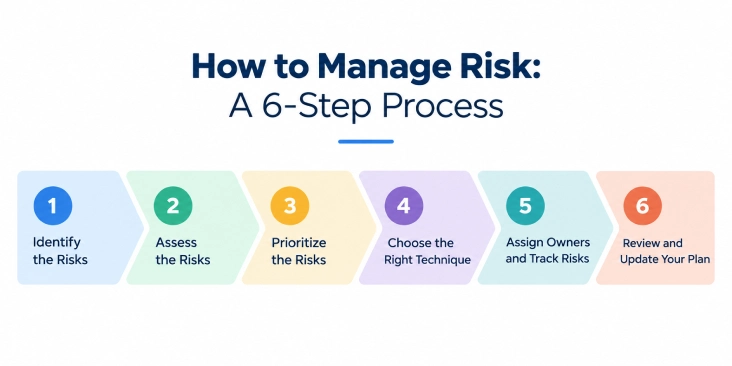
Start by listing the risks that could affect your business. Talk to people from different teams, such as operations, finance, IT, and HR, because they often notice different risks. You can also look at past incidents, customer complaints, audit reports, and project issues to find possible risks.
Step 2: Assess the Risks
Estimate how likely each risk is to happen and how much it could affect your business. A simple 1–5 scale for likelihood and impact is enough for most businesses. Use real data whenever possible instead of making guesses.
Step 3: Prioritize the Risks
Some risks need immediate attention, while others can wait. Use a probability and impact matrix to rank your risks and compare them with your risk appetite, the level of risk your business is willing to accept. Focus on the risks that could have the biggest impact.
Step 4: Choose the Right Technique
Decide how you'll handle each risk. You can avoid, reduce, transfer, or accept the risk, depending on what makes the most sense. In some cases, using more than one technique is the best approach.
Step 5: Assign Owners and Track Risks
Assign each important risk to a specific person or team. Track it using key risk indicators (KRIs) and review them regularly. This helps you find warning signs early and take action before the risk becomes a bigger problem.
Step 6: Review and Update Your Plan
Risk management is an ongoing process. Review your risks regularly and update your plan whenever your business changes, such as launching a new product, taking on a new client, or adopting new technology. This helps keep your risk management plan accurate and effective.
Effective Risk Management Strategies for People and Operational Risk
Managing people and operational risks is about finding small warning signs early and taking action before they turn into bigger issues.
Many workplace risks don't appear overnight. They build up over time through things like long working hours, repeated policy violations, unusual system activity, or missed deadlines. Paying attention to these early signs can help you prevent costly problems later.
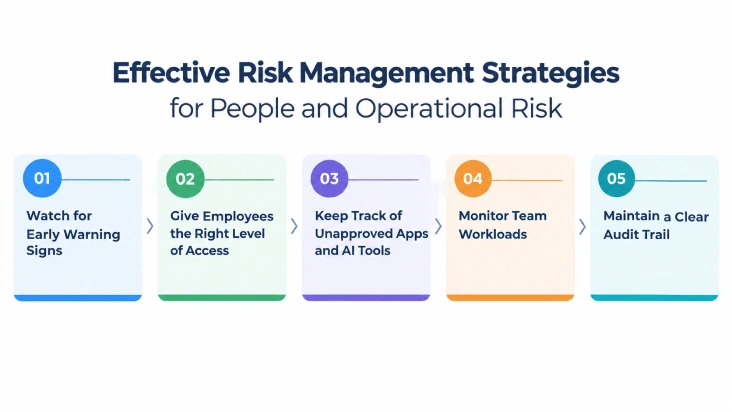
1. Watch for Early Signs
Don't wait for an incident to happen before taking action. Look for early warning signs like repeated failed login attempts, unusual file downloads, increasing overtime, or projects that keep falling behind schedule.
2. Give Employees the Right Level of Access
Not every employee needs access to every file or system. Limit access based on each person's role, so employees only have the information they need to do their jobs.
3. Keep Track of Unapproved Apps and AI Tools
Employees often try new apps or AI tools to save time, but some of these tools may not meet your company's security standards. Regularly review the software and websites being used so you can identify risks and make sure company data stays protected.
4. Monitor Team Workloads
When employees are overworked, mistakes become more common. Keep an eye on working hours, overtime, and task assignments to make sure workloads stay balanced.
5. Maintain a Clear Audit Trail
Keep a record of important activities, such as file access, policy violations, and system changes. If an issue comes up, these records make it easier to understand what happened, respond quickly, and meet compliance requirements.
How Time Champ Strengthens Risk Management
Using the right way to manage risks is easier when you have real-time data instead of guessing. Time Champ is an employee monitoring tool that helps businesses find risks early, watch for warning signs, and fix problems before they cost more.
1. Prevent Costly Risks
Reduce avoidable risks by restricting unauthorized access, controlling data usage, and enforcing workplace policies before issues occur.
2. Detect Risks Early
Find unusual file activity, unauthorized app usage, productivity drops, and other warning signs in real time so your team can respond quickly.
3. Simplify Compliance and Audits
Keep audit-ready records of employee activities, policy violations, and system events to support compliance and make investigations easier.
4. Monitor Accepted Risks
Track budgets, activity trends, and daily work summaries to monitor accepted risks and review them as business needs change.
5. Track Workforce Risk Indicators
Identify early signs of burnout, overwork, productivity decline, and attrition so you can take action before they affect business performance.
6. Protect Sensitive Data
Secure employee and business information with role-based access controls and encrypted storage while supporting your security and compliance goals.
Manage Risks with the Right Insights!
Track employee activity, monitor key risk indicators, and help your team respond faster to potential issues
Conclusion
Every business faces risks, but the right approach can keep them under control. Understanding the four core risk management techniques helps you respond to risks with confidence instead of reacting when it's too late. Regular reviews, early action, and the right tools can make risk management a part of your everyday operations. When risks are managed consistently, your business is better prepared to grow, adapt, and succeed.

Jahnavi Pulluri

Table of Content
 What are Risk Management Techniques?
- The 4 Core Risk Handling Techniques (With Examples)
- Risk Management Methods That Support Each Technique
- How to Manage Risk: A 6-Step Process
- Effective Risk Management Strategies for People and Operational Risk
- How Time Champ Strengthens Risk Management
- Conclusion
Related Blogs

Explore insider threat mitigation strategies to build a risk reduction program with UEBA, response playbooks, KPIs, and recovery plans for modern teams.
Anjali | May 08, 2026
SIEM monitoring systems collect, analyze, and alert on threats across your entire IT environment. Learn how SIEM works, what it detects, and how to choose one.
Jahnavi Pulluri | Apr 15, 2026
Stealth monitoring can expose your business to legal risks. Learn the key challenges, compliance issues, and how to monitor employees effectively.
Guna Lakshmi | Apr 28, 2026
Explore shift monitoring system benefits, key features, and set up tips to improve scheduling, track shifts accurately, and manage teams more efficiently.
Anjali | May 01, 2026
Learn the biggest shadow IT risks, how they expose your business to security threats, and the best strategies to detect, manage, and prevent them.
Guna Lakshmi | Aug 27, 2026
Change management makes employee monitoring adoption smoother. Learn strategies to reduce resistance, communicate transparently, and roll out in phases.
Anjali | Apr 15, 2026


 4.7/5 avg.
Ready to Manage Your Workforce Smarter?
Join our family of 1500+ companies using smart insights to redefine workforces!

Free Trial
No Credit Card Required