Overworked Employees: 12 Signs to Rebalance Workloads
Learn how to identify overworked employees, understand the causes, rebalance workloads, and prevent burnout with practical strategies.

If your employees are constantly working long hours, skipping breaks, or struggling to keep up with growing workloads, it may be a sign that they're overworked. While it might seem like extra effort leads to better results, consistently overworking employees can reduce productivity, increase burnout, and drive valuable employees to leave.
In this guide, you'll learn the common signs of overworked employees and understand how excessive workloads can affect your business to create a more productive workplace.
What Does It Mean to Be Overworked?
An overworked employee is someone who is regularly given too many tasks or responsibilities to handle within their regular workday. This may involve working extended hours, taking on excessive responsibilities, skipping breaks, or dealing with constant pressure to meet deadlines. Over time, these demands can affect an employee's physical health, mental well-being, job satisfaction, and overall productivity.
Being overworked doesn't always mean working the longest hours. It can also result from unrealistic expectations, inadequate staffing, frequent overtime, or a lack of work-life balance. Recognizing these signs early allows you to rebalance workloads, support your employees, and maintain a healthier, more productive workplace.
Want to spot employee overwork before it affects performance?
Try Time Champ free to monitor workloads, track productivity, and identify signs of overwork early.
12 Common Signs of Overworked Employees in the Workplace
Overworked employees don't always tell you they're struggling. Instead, the warning signs often show up through changes in their behavior, performance, and well-being. Recognizing these signs early allows you to rebalance workloads, prevent burnout, and create a healthier, more productive workplace.
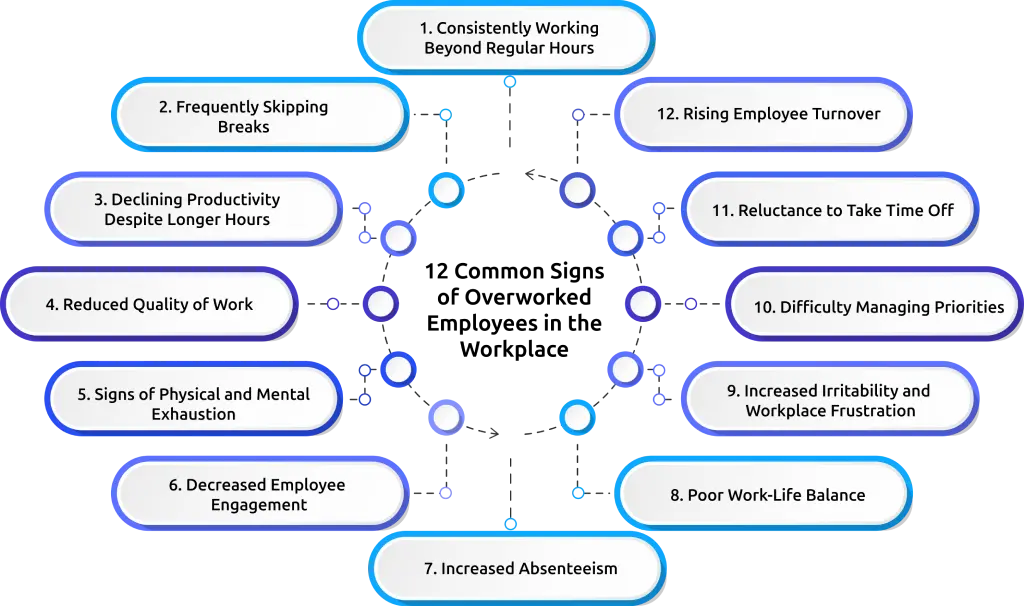
1. Consistently Working Beyond Regular Hours
If your employees consistently stay late, start early, or work on weekends, it may indicate that their workload is too heavy. While occasional overtime is normal, relying on long hours to complete everyday tasks suggests that expectations exceed available time. Tracking how to calculate overtime pay can also help you quantify how often this is happening. Over time, this can reduce productivity and increase fatigue.
2. Frequently Skipping Breaks
If you notice your overworked employees skipping lunch or skipping breaks, they may feel they don't have enough time to step away from their tasks. Although this may seem productive, working without rest reduces focus, increases stress, and makes mistakes more likely. Encouraging regular breaks helps your employees stay energized and perform at their best.
3. Declining Productivity Despite Longer Hours
When your employees work longer hours but accomplish less, overwork may be affecting their performance. Mental fatigue makes it harder to concentrate, solve problems, and make good decisions. Instead of expecting more hours, look for ways to balance workloads so your employees can work more efficiently.
4. Reduced Quality of Work
If you begin seeing more errors, missed deadlines, or incomplete tasks, your employees may be struggling with excessive workloads. When people are overwhelmed, they often prioritize finishing work quickly instead of maintaining quality. Reviewing workloads with employee performance tracking software and setting realistic expectations can help improve both accuracy and performance.
5. Signs of Physical and Mental Exhaustion
Overwork often affects your employees' health before it affects results. Persistent fatigue, headaches, poor sleep, and irritability are all warning signs of overworked employees. Paying attention to these symptoms allows you to step in before they develop into burnout.

Did You Know?
Employees with poor well-being are more likely to experience burnout, take more sick days, and leave their jobs. Gallup estimates that burnout contributes to about $322 billion in global turnover and lost productivity.
6. Decreased Employee Engagement
If your employees become less involved in meetings, contribute fewer ideas, or seem disconnected from their work, excessive workloads may be taking a toll. When people spend all their energy trying to keep up, they have little capacity left to collaborate or innovate. Reducing unnecessary pressure can help improve motivation and engagement.
7. Increased Absenteeism
If your employees begin taking more sick days or requesting unexpected time off, it could be a sign that they're physically or mentally exhausted. Frequent absences often indicate that employees need time to recover from ongoing workplace stress. Monitoring attendance trends can help you identify workload issues before they worsen.
8. Poor Work-Life Balance
If your overworked employees regularly respond to emails after work, stay online late, or work during weekends, they may not be getting enough time to recharge. When work consistently spills into personal time, stress builds, and overall well-being suffers. Encouraging healthy work boundaries helps your employees remain productive over the long term.
9. Increased Irritability and Workplace Frustration
Employees who are under constant pressure may become more impatient, frustrated, or emotionally reactive than usual. You may notice more workplace conflicts, communication issues, or negative attitudes. Recognizing these behavioral changes early allows you to address workload concerns before they affect team morale.
10. Difficulty Managing Priorities
When your employees have too many responsibilities, they may struggle to determine which tasks deserve immediate attention. As a result, important deadlines may be missed, and work may become increasingly disorganized. Helping your employees apply time blocking and other prioritization techniques can improve both efficiency and focus.
11. Reluctance to Take Time Off
If your employees rarely use their vacation days or hesitate to request leave, they may worry that work will pile up while they're away. Others may feel that no one else can handle their responsibilities. When you encourage employees to take regular time off, you help them recover, reduce stress, and return to work with renewed energy.
12. Rising Employee Turnover
Companies that overwork employees often experience higher turnover, lower engagement, and greater recruitment costs because talented professionals seek healthier work environments. Consistently excessive workloads can reduce job satisfaction and encourage employees to seek healthier work environments.
Want to know who's overloaded before burnout takes over?
Use Time Champ to identify workload imbalances, reduce burnout risks, and create a healthier workplace.
Main Causes of Employee Overwork
One of the biggest consequences of overworking employees is reduced productivity, higher absenteeism, increased burnout, and rising employee turnover. Identifying the top factors affecting productivity in the work environment can help you reduce excessive workloads and create a healthier, more sustainable work environment.
- Excessive Workloads: Assigning more tasks than your employees can reasonably complete during regular working hours often leads to long hours and constant pressure.
- Unrealistic Deadlines: Tight deadlines can force employees to rush through work, skip breaks, and work overtime to meet expectations.
- Understaffing: When your team doesn't have enough people, existing employees must take on additional responsibilities, increasing their workload and stress.
- Poor Workload Distribution: Unevenly assigning work can leave some employees overwhelmed while others have capacity, creating unnecessary pressure. Learn more about effective workload management strategies to fix this.
- Lack of Clear Priorities: Without clear direction, employees may treat every task as urgent, making it difficult to focus on high-impact work.
- Limited Automation and Outdated Processes: Relying on manual, repetitive work increases the time employees spend on routine tasks instead of high-value activities.
- Employee Shortages Due to Absences or Turnover: When employees leave or take extended leave, the remaining team often absorbs the additional workload until replacements are found.
- Pressure to Meet Performance Targets: Aggressive KPIs, sales quotas, or productivity goals can overwork employees to work longer hours at the expense of their well-being.
Along with balancing workloads and supporting employee well-being, employers should stay informed about overworking employee laws to ensure they meet labor regulations and maintain a healthy workplace.
Did You Know?
Long working hours caused an estimated 745,000 deaths from stroke and heart disease in a single year, making overwork one of the largest occupational health risks globally.
6-Step Workload Rebalancing Framework
Finding effective solutions for overworked employees starts with understanding where workloads become unmanageable. Follow these six steps to create a more balanced and sustainable workload for your team.
Step 1: Assess Current Workloads
Start by reviewing how work is distributed across your team. Look at employee schedules, project assignments, overtime hours, and task completion rates to identify who is consistently overloaded and who has available capacity. Using workload or time tracking data can help you make decisions based on facts
Step 2: Prioritize High-Impact Work
Not every task has the same level of importance. Work with your employees to identify critical projects and separate them from lower-priority or non-essential tasks. This helps your team focus on work that delivers the greatest value while reducing unnecessary pressure.
Step 3: Redistribute Responsibilities
Once you've identified workload imbalances, reassign tasks more evenly across your team. If certain employees are consistently overloaded while others have capacity, redistribute work based on skills, availability, and priorities. A balanced workload, supported by clear roles and responsibilities, improves collaboration and reduces the risk of burnout.
Step 4: Eliminate or Automate Repetitive Tasks
Review your team's daily activities and identify repetitive or manual processes that consume valuable time. Automating tasks such as time tracking, reporting, approvals, or data entry allows your employees to spend more time on meaningful work and less on administrative tasks.
Step 5: Set Realistic Expectations
Review deadlines, project scope, and performance goals to ensure they're achievable. Avoid assigning urgent deadlines for every task, and communicate clear priorities so your employees know where to focus their efforts. Realistic expectations reduce unnecessary stress and improve the quality of work.
Step 6: Monitor Workloads Continuously
Regularly review employee capacity, overtime trends, productivity reports, and well-being through one-on-one meetings and performance data. Continuous monitoring allows you to identify workload issues early and make adjustments before they affect employee engagement or business performance.
Overworked vs Burned Out vs Stressed vs Engaged
Understanding the differences between overworked, burned-out, stressed, and engaged employees can help you identify problems early and take the right steps to support your employees.
| Aspect | Overworked | Burned Out | Stressed | Engaged |
|---|---|---|---|---|
| Meaning | Has more work than can be handled comfortably. | Feels emotionally, mentally, and physically exhausted due to prolonged stress. | Experiences temporary pressure from deadlines or challenges. | Feels motivated, committed, and energized at work. |
| Primary Cause | Excessive workload, long hours, or unrealistic expectations. | Long-term unmanaged stress and chronic overwork. | Tight deadlines, heavy workload, or unexpected changes. | Meaningful work, recognition, growth opportunities, and a supportive environment. |
| Duration | Can be short-term or ongoing. | Usually develops over weeks or months. | Typically temporary and situation-specific. | Consistent over time when the work environment is positive. |
| Energy Level | Tired but still trying to keep up. | Constantly exhausted with little motivation. | Fluctuates depending on the situation. | High energy and enthusiasm. |
| Productivity | May decline as workload increases. | Significantly reduced due to exhaustion. | Can remain stable or even increase temporarily. | Consistently high with quality work. |
| Emotional State | Frustrated, overwhelmed, or fatigued. | Detached, cynical, and emotionally drained. | Anxious, worried, or under pressure. | Positive, confident, and committed. |
| Work-Life Balance | Frequently works overtime and skips breaks. | Often struggles to disconnect from work. | May temporarily sacrifice personal time. | Maintains a healthy balance between work and personal life. |
| Recovery | Reducing workload and taking breaks usually helps. | Requires extended recovery, support, and workload changes. | Improves once the stressful situation ends. | Sustained through recognition, manageable workloads, and career development. |
How Time Champ Helps You Catch Overwork Early
You can't prevent overworking employees if you don't know it's happening. That’s where Time Champ helps you. Time Champ is an employee monitoring and time tracking software that gives you real-time visibility into employee workloads, working hours, and productivity, helping you identify signs of overwork before they lead to burnout.
Instead of relying on guesswork, you can use data-driven insights to create a healthier and more productive workplace.
Key Features of Time Champ
Here are the main features of Time Champ that helps you find out overwork employees early and prevent burnout.
1. Productivity Tracking
Monitor your employees' productivity in real time to quickly identify workload-related performance declines before they become bigger problems.
2. Time Tracking
Automatically track work hours and overtime to identify employees who are consistently working beyond their scheduled time.
3. Project & Task Time Tracking
Measure the time spent on each project and task to identify overloaded employees and rebalance workloads effectively.
4. Employee Activity Monitoring
Gain visibility into employee work patterns and activity levels to detect signs of excessive workloads and reduced focus.
6. Reports & Analytics
Use detailed workforce reports to uncover workload trends, productivity patterns, and areas that need immediate attention.
7. Workforce Capacity Planning
Plan and distribute work based on employee capacity to prevent overload and keep workloads balanced across your team.
Ready to build a healthier and more productive workforce?
Try Time Champ to gain real-time workforce insights, improve team performance, and support employee well-being.
Conclusion
Overworked employees don't become overwhelmed overnight. When you recognize the signs early and address workload issues before they grow, you can improve productivity, support employee well-being, and build a stronger team.
With clear workload management and tools like Time Champ, you can prevent overworking employees, identify overwork early, rebalance tasks, and create a healthier, more productive workplace.

Guna Lakshmi

Table of Content
 What Does It Mean to Be Overworked?
- 12 Common Signs of Overworked Employees in the Workplace
- Main Causes of Employee Overwork
- 6-Step Workload Rebalancing Framework
- Overworked vs Burned Out vs Stressed vs Engaged
- How Time Champ Helps You Catch Overwork Early
- Conclusion
Related Blogs

Learn what time tracking is, why it matters in 2026, the best methods, and how to implement it without team pushback. A practical guide for modern teams.
Jahnavi Pulluri | May 19, 2026
Discover the pros and cons of time tracking software, its key features, and how it can improve productivity, accountability, and overall team performance.
Jahnavi Pulluri | Jun 05, 2026
Looking for the best freelance time tracking software? Explore the top free and paid tools to track work hours, manage projects, and improve productivity.
Guna Lakshmi | May 18, 2026
Learn how time tracking improves remote team productivity through better visibility, accountability, performance tracking, and smarter team management.
Anjali | May 16, 2026
Explore the top benefits of productivity tracking software for better visibility, balanced workloads, smarter planning, and improved business decisions.
Guna Lakshmi | Apr 30, 2026
A practical guide to choosing productivity tracking software for your team, with comparisons of features, pricing, privacy, security, and rollout risks.
Jahnavi Pulluri | May 01, 2026


 4.7/5 avg.
Ready to Manage Your Workforce Smarter?
Join our family of 1500+ companies using smart insights to redefine workforces!

Free Trial
No Credit Card Required