Future of Employee Monitoring and AI: 8 Trends for 2026
Explore how AI is reshaping employee monitoring in 2026, including key trends, opportunities, risks, legal changes, and responsible workforce intelligence.

In 2026, AI-powered employee monitoring moved from niche technology to mainstream practice. High-profile reports of companies tracking keystrokes, video calls, and workplace activity have intensified debates over privacy, productivity, and trust. This shift is reflected in broader AI use: Gallup reports that frequent use of AI in the workplace continued to rise in Q4 2025–2026, with about half of U.S. workers now using AI at work. As a result, the question is no longer whether AI belongs in workforce management, but how it can be used responsibly.
This blog explores eight emerging trends, the biggest opportunities and risks, the evolving legal landscape, and a practical framework for responsible workforce intelligence.
What is AI-Powered Employee Monitoring?
AI-powered employee monitoring is the use of artificial intelligence, machine learning, and data analytics to automatically collect, analyze, and interpret workplace data to measure productivity, identify patterns, detect anomalies, enhance security, and generate insights for workforce management.
Unlike traditional monitoring, which primarily records activities, AI-powered systems provide predictive analytics and contextual recommendations based on employee behavior and work trends.
The State of AI in Employee Monitoring
AI-powered employee monitoring is growing, but adoption comes with a trade-off. Many organizations are embracing AI to improve productivity and security, while employees are increasingly concerned about privacy, trust, and constant surveillance.
1. Adoption Is Accelerating
Employee monitoring is now mainstream, with most organizations using digital tracking tools and large enterprises investing heavily in AI-powered workforce analytics. As hybrid work expands, the employee monitoring market continues to grow into a multi-billion-dollar industry.
2. Worker Trust Is Declining
Employee acceptance has not kept pace with adoption. Surveys show many workers oppose AI-driven monitoring and are more likely to consider leaving organizations that increase workplace surveillance, highlighting a widening trust gap.
3. The Productivity Paradox
AI promises greater efficiency, but early research suggests mixed outcomes. While automation streamlines routine tasks, it can also increase communication overload and reduce uninterrupted focus time, demonstrating that AI alone does not guarantee higher productivity.
8 Trends Reshaping AI-Powered Employee Monitoring
AI is transforming employee monitoring from a surveillance tool into a workforce intelligence platform. At the same time, new regulations and employee expectations are forcing organizations to prioritize transparency, privacy, and fairness.
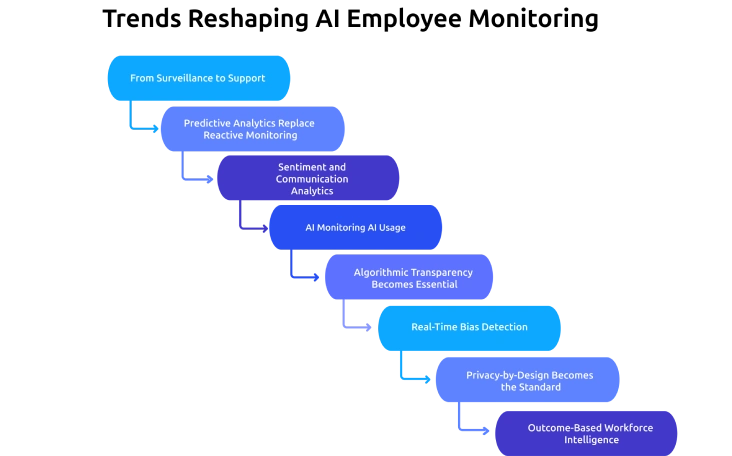
1. From Surveillance to Support
Employee monitoring is moving beyond tracking activity to improving how people work. Instead of measuring keystrokes or idle time, AI identifies workflow inefficiencies, repetitive tasks, and collaboration issues that slow teams down. The goal is to help employees work better, making AI a support tool instead of a surveillance system.
2. Predictive Analytics Replace Reactive Monitoring
AI is enabling organizations to anticipate problems before they affect business outcomes. It will analyze historical patterns and real-time data to identify early signs of burnout, disengagement, attrition, and productivity decline, allowing you to intervene before problems escalate.
3. Sentiment and Communication Analytics
Modern employee monitoring tools do more than track activity. They also analyze communication across workplace apps to identify changes in team morale, response times, meeting overload, and collaboration patterns. This helps you find potential issues early while making it important to be transparent about what data is collected and how it is used.
4. AI Monitoring AI Usage
As AI tools become a regular part of daily work, many organizations are starting to track how employees use them. However, counting prompts or AI interactions does not show how productive someone is. Instead, companies are shifting their focus to whether AI helps employees produce better work, save time, and achieve better business results. Tracking AI usage statistics can help organizations understand how frequently employees rely on AI tools and identify patterns that may be linked to productivity and business outcomes.
5. Algorithmic Transparency Becomes Essential
Governments and regulators want companies to be more open about how AI is used in the workplace. Employers are increasingly expected to tell employees what is being monitored, explain how AI influences decisions, and regularly check these systems for risks and bias. As a result, transparency is becoming a basic requirement for responsible AI use.
6. Real-Time Bias Detection
AI systems can sometimes make unfair decisions by repeating existing workplace biases. To prevent this, organizations are regularly checking their AI tools for bias, testing them, and keeping people involved in important decisions. These steps help ensure employee monitoring and performance evaluations remain fair and consistent for everyone.
7. Privacy-by-Design Becomes the Standard
Instead of collecting as much employee data as possible, companies are shifting to privacy-first monitoring. This means only collecting the data they truly need, keeping it for a limited time, and using it for a specific purpose. Many organizations are also allowing employees to see what data is being collected about them. These practices help improve legal compliance and build trust at work.
8. Outcome-Based Workforce Intelligence
Instead, AI focuses on real outcomes such as completed projects, work quality, collaboration effectiveness, customer impact, and overall business results. This gives a clearer picture of actual performance and reduces the pressure to “look busy” rather than do meaningful work.
Benefits of AI in Employee Monitoring
When designed and deployed responsibly, AI-powered employee monitoring can deliver real business value that goes beyond traditional tracking tools.
1. Pattern Recognition Across Workforce Data
AI can analyze large volumes of workforce data to find productivity patterns, workflow bottlenecks, and inefficiencies that would be difficult for humans to detect. Instead of depending on delayed reports, you can identify trends in real time and make faster, more informed workforce decisions.
2. Predictive Burnout and Attrition Risk Identification
AI can detect early warning signs of burnout or employee turnover by analyzing signals such as increased after-hours work, communication changes, and calendar overload. This allows you to step in early with support, workload adjustments, or check-ins, often preventing resignations and reducing hiring costs.
3. Automation of Compliance and Policy Enforcement
AI systems can continuously monitor for policy violations, security risks, and compliance issues in real time. This is especially valuable in regulated industries like finance and healthcare, where early detection of risks such as data misuse or unauthorized access can significantly reduce legal and reputational damage.
4. Reduction in Manual Reporting Overhead
Traditional workforce reporting is time-consuming and often repetitive. AI can automatically generate reports, dashboards, and written summaries, reducing administrative workload for you. This frees up more time for coaching, planning, and strategic decision-making.
5. Workflow Optimization at Scale
AI can identify inefficiencies across teams, such as unnecessary meetings, redundant processes, or underused tools. These insights can be applied across entire organizations, leading to large-scale productivity gains. Even small improvements in workflow design can compound into significant time savings over time.
6. More Equitable Performance Evaluation
Human evaluations are often influenced by bias and inconsistency. AI, when properly designed and regularly audited, can provide more consistent performance assessments across employees. However, without transparency and bias checks, these systems can also reinforce existing inequalities, making responsible design essential.
6 Risks and Ethical Challenges of AI in Employee Monitoring
The same technologies that improve productivity also create serious risks. Responsible organizations address these trade-offs by building safeguards to prevent misuse, mistrust, and regulatory issues.
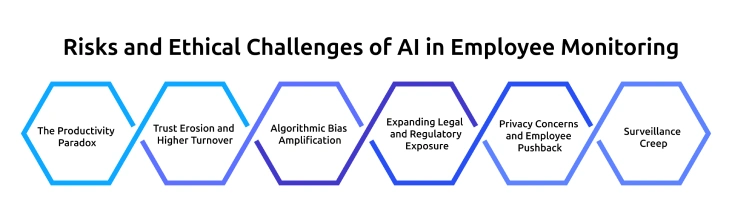
1. The Productivity Paradox
AI monitoring tools can sometimes reduce productivity instead of improving it. When employees feel closely watched, they may spend more time on visible tasks like email and less time on deep, focused work. This shift from real output to surface-level activity can ultimately undermine efficiency.
2. Trust Erosion and Higher Turnover
Excessive monitoring can damage trust between employees and employers. Many employees report discomfort with increased surveillance, and a significant share says they would consider leaving if monitoring becomes too intrusive. Over time, this can lead to lower engagement, reduced creativity, and higher attrition costs that outweigh productivity gains.
3. Algorithmic Bias Amplification
AI systems trained on past workplace data can unintentionally repeat and strengthen existing biases in hiring, performance reviews, and promotions. This creates legal and ethical risks when certain groups are unfairly disadvantaged by patterns in the data.
4. Expanding Legal and Regulatory Exposure
AI workplace monitoring is becoming heavily regulated across regions like the EU and parts of the US. New rules require transparency, employee notice, risk assessments, and bias audits. Companies that deploy AI monitoring without compliance planning risk future legal challenges as regulations continue to evolve.
5. Privacy Concerns and Employee Pushback
Highly intrusive monitoring can lead to employee resistance and public backlash. Recent controversies show that excessive tracking is not just an internal issue, it can also harm a company’s reputation, damage its employer brand, and make it harder to attract and retain talent.
6. Surveillance Creep
A key risk is that monitoring can slowly expand beyond its original purpose. Tools first used for security or productivity may gradually be used for performance evaluation and behavior tracking. Without clear limits, this can lead to overly invasive surveillance that reduces trust and employee autonomy.
The 8-Point Ethical Framework for Responsible AI Employee Monitoring
The 2026 ethical framework for AI employee monitoring defines eight principles for responsible use. It helps you balance productivity, privacy, and fairness while aligning with regulations and building employee trust.
1. Proportionality
Only collect data that is necessary for a clearly defined business purpose. If you cannot explain what problem the data solves, you should not collect it. This principle helps prevent unnecessary surveillance and limits overreach.
2. Define the Business Problem First
Start with the problem, not the technology. Identify what needs to be solved, such as missed deadlines or burnout risk, before deciding whether AI monitoring is even required. Many issues can be solved without surveillance tools.
3. Outcome Over Activity
Focus on results rather than activity. Measure meaningful outputs like completed work, customer outcomes, or collaboration quality instead of keystrokes, clicks, or screen time, which are easy to manipulate and often misleading.
4. Data Minimization
Collect only the minimum amount of data needed and delete it once its purpose is fulfilled. This reduces privacy risks, legal exposure, and security vulnerabilities while improving overall data governance.
5. Employee Involvement
Include employees in defining monitoring policies. When employees understand and help design these systems, acceptance and trust increases significantly compared to top-down implementation.
6. Transparency
Clearly explain what data is collected, why it is collected, and how it is used. Employees should also be able to access their own data and challenge inaccuracies to ensure fairness and accountability.
7. Human Oversight
AI should support, not replace, human decision-making. Important employment decisions like hiring, promotion, or termination must always include human review and the ability to override AI recommendations.
8. Regular Bias Audits
Continuously test systems for bias and unequal outcomes across employee groups. Regular audits help detect and correct unfair patterns early, reducing legal risk and improving system reliability over time.
How Time Champ Supports AI-Powered Workforce Intelligence
Time Champ is an employee monitoring and time tracking software with workforce intelligence features. It provides automated time and attendance tracking, productivity tracking, app and website usage detection, and data loss prevention across Windows, Mac, and Linux.
It is designed for a responsible workforce intelligence, focusing on outcome-based measurement rather than just activity tracking. The platform also improves transparency and supports compliance with evolving global regulations.
Outcome-Based Productivity Monitoring
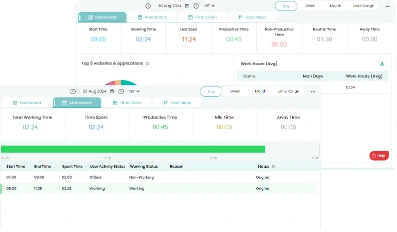
Time Champ focuses on productivity patterns rather than just keystrokes or screen activity. It allows you to categorize apps and websites as productive, neutral, or non-productive, and it helps you understand how work time is actually spent. This shifts the focus from surveillance to insight-driven decision-making.
Transparent Reporting Employees Can Access
The platform provides dashboards and reports that are accessible to both you and your employees. This ensures employees can view their own productivity data, supporting transparency, accountability, and compliance with emerging legal expectations.
Audit Trail for Regulatory Compliance
Time Champ maintains detailed logs of data collection, access, and usage. These audit trails help you respond quickly to regulatory or legal inquiries by clearly showing what data was collected, when, and by whom, supporting compliance with frameworks like GDPR and CCPA.
Data Loss Prevention Aligned with Security Needs
Its data loss prevention features focus on legitimate security concerns such as unauthorized data transfers or suspicious system access. This allows you to address real risks without expanding into unnecessary employee surveillance.
Native Integrations with Workflow and Project Tools
Time Champ integrates with project management, HR, and communication tools to connect time data with real work outcomes. This enables deeper workforce intelligence, such as project-level time analysis and team productivity insights, rather than isolated activity tracking.
Build Smarter Workforce Intelligence with Time Champ
Gain AI-powered productivity insights, transparent reporting, and data-driven analytics to measure outcomes
Conclusion
AI is changing employee monitoring from simply tracking activity to helping organizations understand how work gets done. When used responsibly, it can improve productivity, support employees, and simplify workforce management. The key is to use AI in a fair, transparent, and privacy-friendly way. Organizations that focus on trust and meaningful outcomes will be better prepared for the future of work.

Jahnavi Pulluri

Table of Content
 What is AI-Powered Employee Monitoring?
- The State of AI in Employee Monitoring
- 8 Trends Reshaping AI-Powered Employee Monitoring
- Benefits of AI in Employee Monitoring
- 6 Risks and Ethical Challenges of AI in Employee Monitoring
- The 8-Point Ethical Framework for Responsible AI Employee Monitoring
- How Time Champ Supports AI-Powered Workforce Intelligence
- Conclusion
Related Blogs

Explore common employee monitoring myths and learn what
Anjali | Apr 14, 2026
Find answers to the top 20 most asked questions about employee monitoring, including how it works, its benefits, legal concerns, and practices for businesses.
Jahnavi Pulluri | May 07, 2026
Learn the pros and cons of employee monitoring and discover when monitoring improves productivity and when it creates workplace risks.
Guna Lakshmi | May 06, 2026
Understand whether employee monitoring a Boon or Bane for Modern Workplaces. Discover how it impacts productivity, privacy, and the overall work environment.
Jahnavi Pulluri | Aug 06, 2024
Choose the right employee monitoring tool for your team with this 2026 guide. Explore types, key features, a 5-step framework, and top software options.
Jahnavi Pulluri | Apr 13, 2026
Understand employee monitoring legal compliance, key laws, and best practices to track work activity while protecting privacy and avoiding legal risks.
Thasleem Shaik | Apr 14, 2026


 4.7/5 avg.
Ready to Manage Your Workforce Smarter?
Join our family of 1500+ companies using smart insights to redefine workforces!

Free Trial
No Credit Card Required