Deep Work vs Shallow Work: Which One Matters More?
Deep work vs shallow work explained with key differences, practical examples, productivity tips, and strategies to improve focus and achieve better results.
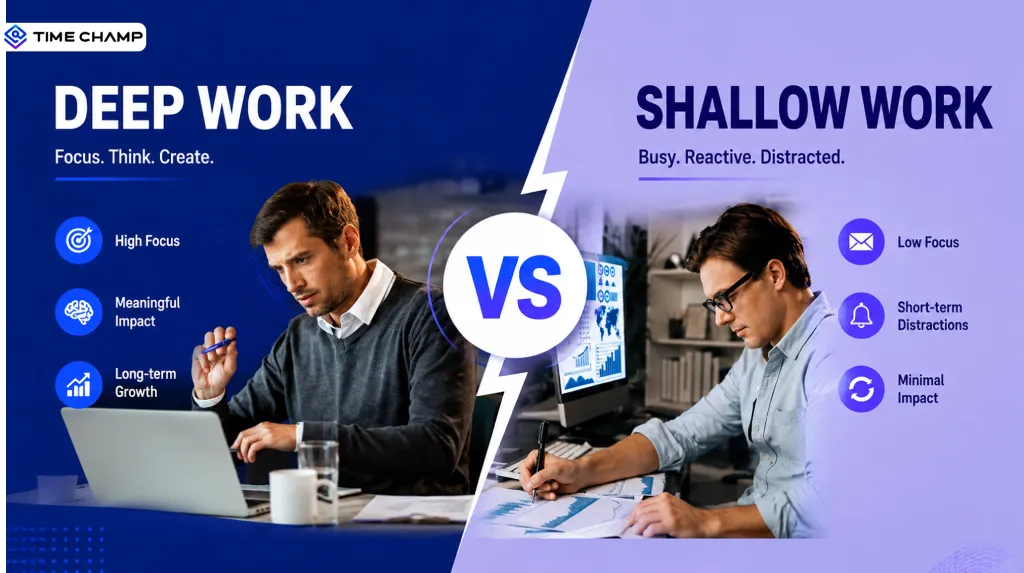
You can spend your entire day responding to messages, attending meetings, handling updates, and solving small issues, yet still wonder why your most important work remains unfinished. The difference often comes down to how you divide your time between deep work and shallow work.
Understanding deep work vs shallow work helps you recognize which tasks deserve your full attention and which ones simply keep your day moving. Deep work allows you to focus on activities that require clear thinking, problem-solving, and careful decision-making, while shallow work supports routine responsibilities that keep operations running smoothly.
When you know how to balance both, you can protect time for meaningful work without overlooking essential daily tasks. In this guide, you'll learn the key differences between deep work and shallow work, when each one matters, and practical ways to create more time for focused work that drives real progress.
What Is Deep Work?
Deep work is the ability to focus on a cognitively demanding task without distractions. The concept was introduced by Cal Newport in his book Deep Work: Rules for Focused Success in a Distracted World, where he defines it as focused work that challenges your thinking, builds valuable skills, creates meaningful outcomes, and produces results that are difficult to replicate
When you engage in deep work, you give your full attention to a single task instead of constantly switching between emails, messages, meetings, and notifications. This level of focus helps you solve complex problems, think critically, learn faster, and produce high-quality work in less time.
Key Characteristics of Deep Work
- Sustained Focus: Focus remains on one task at a time without switching to emails, messages, or other activities.
- High Cognitive Effort: Requires careful thinking, problem-solving, analysis, decision-making, or creativity.
- Meaningful Output: Results contribute directly to important goals, projects, or desired outcomes.
- Minimal Distractions: Work takes place in an environment with few interruptions, allowing better concentration.
- Requires Specialized Skills: Completion depends on knowledge, expertise, and the ability to handle complex tasks.
Common examples of deep work are writing a research paper, developing software, analyzing complex data, creating a business strategy, studying a difficult subject, or solving challenging problems that require sustained focus.
What Is Shallow Work?
Shallow work refers to routine tasks that require little mental effort and do not demand your full attention. These activities help keep daily operations running smoothly, but they typically contribute less value than work that requires deep focus and critical thinking.
Key Characteristics of Shallow Work
- Low Cognitive Demand: Shallow work involves routine activities that require little analysis, critical thinking, or problem-solving
- Easy to Replicate: Most tasks follow predefined processes that others can handle with minimal guidance.
- Frequent Interruptions: Work often continues alongside emails, messages, calls, or meetings.
- Routine in Nature: Activities follow predictable steps and rarely involve complex decision-making.
- Short Completion Time: Tasks usually take minutes rather than hours to complete.
Common examples of shallow work include responding to emails, scheduling meetings, updating spreadsheets, organizing files, preparing routine reports, and handling administrative tasks.
See how much of your team's day is shallow work.
Time Champ tracks app usage and shows how time is spent during work.
Deep Work vs Shallow Work: The Key Differences
When comparing deep work vs shallow work, the distinction comes down to how much concentration a task requires and the impact it has on your long-term goals. The table below breaks down the core differences, so you can see exactly where any given task falls.
| Aspect | Deep Work | Shallow Work |
|---|---|---|
| Focus Level | Requires complete attention on a single task. | Allows frequent switching between tasks. |
| Mental Effort | Involves critical thinking, analysis, creativity, or problem-solving. | Requires minimal concentration and mental effort. |
| Value Created | Produces meaningful outcomes that support long-term goals. | Supports routine operations and short-term needs. |
| Distraction Tolerance | Interruptions reduce effectiveness and slow progress. | Tasks can continue despite interruptions. |
| Skill Development | Strengthens expertise and builds valuable skills over time. | Offers limited opportunities for skill growth. |
| Time Requirement | Often requires extended periods of uninterrupted focus. | Usually takes a short amount of time to complete. |
| Impact on Goals | Contributes directly to significant business and professional outcomes. | Keeps day-to-day work organized and running smoothly. |
How Do You Know If a Task Is Deep Work or Shallow Work?
At first glance, it can be difficult to tell whether a task falls under deep work or shallow work. Some tasks feel important simply because they demand immediate attention, while others may seem less urgent even though they contribute far more value. A simple way to identify the difference is to look at the level of focus, expertise, and impact the task requires.
Use the following questions to evaluate your work more accurately.
- Does It Require Your Full Attention? If the task demands sustained concentration without interruptions, it is likely deep work.
- Does It Involve Complex Thinking? Tasks that require analysis, problem-solving, planning, decision-making, or creativity usually fall into deep work.
- Can Someone Else Easily Do It? If the task follows a routine process and requires little specialized knowledge, it is generally shallow work.
- Does It Contribute to Long-Term Goals? Work that directly supports major projects, business growth, or skill development often qualifies as deep work.
- Can You Complete It While Checking Emails or Messages? If you can perform the task alongside other activities, it is usually shallow work.
- Does It Create Significant Value? Deep work produces outcomes that have a lasting impact, while shallow work mainly supports day-to-day operations.
- Does It Require Context Switching? Tasks that involve constant switching between emails, chats, meetings, and tools often fall into the shallow work category. Research conducted by psychologists Joshua Rubinstein, David Meyer, and Jeffrey Evans revealed that task-switching can take up to 40% of an individual's productive time.
A simple rule to remember is this. If a task requires focus, expertise, and concentrated effort to create meaningful results, it is deep work. If it mainly involves coordination, communication, administration, or routine execution, it is shallow work.
Want to know where your work hours go and which tasks take the most time?
Try Time Champ to track time clearly, identify productive and routine tasks, and manage your time more effectively.
How to Balance Deep Work and Shallow Work
The goal is not to eliminate shallow work from your day. Emails, meetings, updates, and coordination tasks still play an important role in keeping work moving. The real challenge is making sure these activities do not consume the time you need for high-value work. A balanced schedule gives you enough time to focus on meaningful tasks while still handling daily responsibilities effectively.
Here are some practical ways to balance deep work and shallow work.
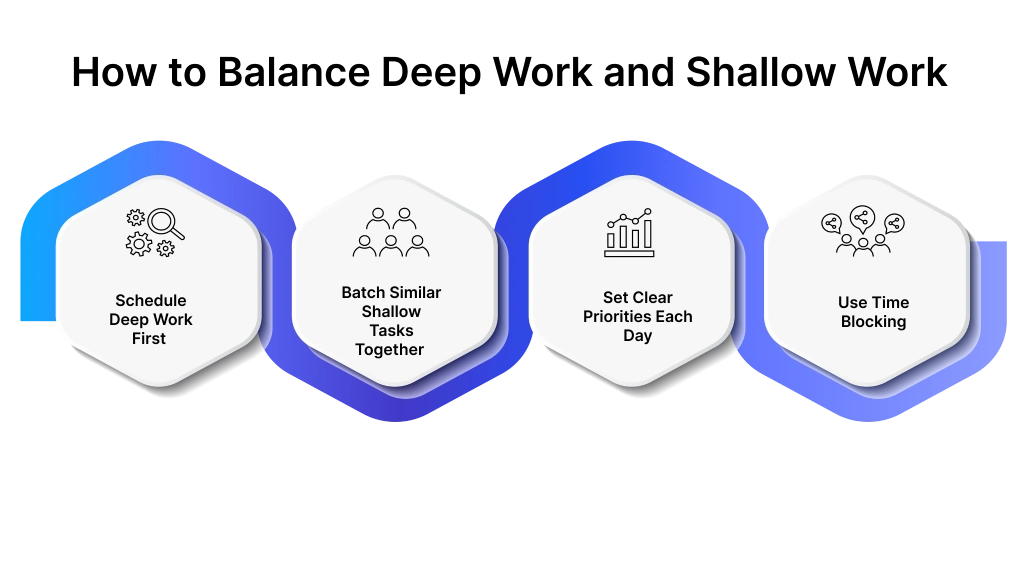
1. Schedule Deep Work First
Set aside dedicated time for your most important and mentally demanding tasks before the day becomes crowded with meetings, emails, and unexpected requests. This approach helps protect your focus and allows you to make meaningful progress on work that requires concentration. Strong time management often starts with giving priority to high-value tasks.
2. Batch Similar Shallow Tasks Together
Group routine activities such as emails, messages, approvals, and administrative work into specific periods of the day. Handling these tasks in planned time blocks reduces frequent interruptions and helps maintain a smoother workflow. This allows you to dedicate more time to work that creates meaningful results.
3. Set Clear Priorities Each Day
Begin each day with a clear understanding of what needs the most attention. Selecting one or two key objectives helps direct your energy toward meaningful outcomes instead of reacting to every incoming task. A simple priority system can make daily planning more effective and less overwhelming.
4. Use Time Blocking
Time blocking helps you organize your schedule by assigning specific periods for different types of work. Dedicated blocks for focused projects and routine responsibilities create a balanced structure throughout the day. This method supports better planning and ensures that important work receives the attention it deserves.
Common Obstacles That Prevent Deep Work
Deep work sounds simple in theory. You set time aside, focus on an important task, and make meaningful progress. In reality, maintaining that level of concentration can be challenging. Many distractions compete for your attention throughout the day, making it difficult to stay focused for long periods.
Let's look at some of the most common obstacles that can prevent deep work.
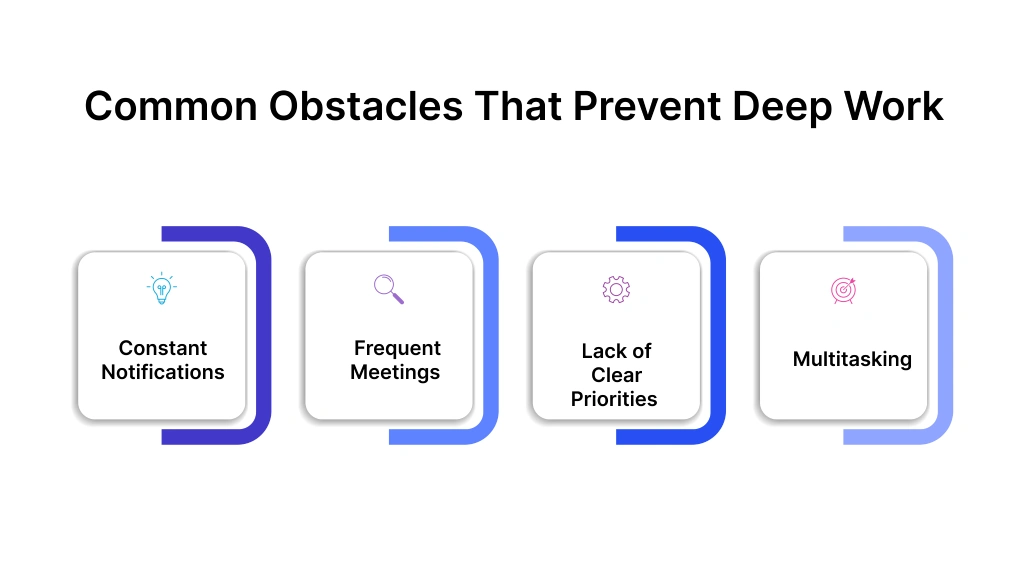
1. Constant Notifications
Emails, chat messages, app alerts, and phone notifications can break your concentration within seconds. Even a quick glance at a notification can interrupt your thought process and make it harder to return to the task at hand.
2. Frequent Meetings
Meetings often split the day into small chunks of time, leaving little room for uninterrupted work. When your calendar fills with back-to-back meetings, finding enough time for deep work becomes difficult.
According to Microsoft, meetings play a major role in disrupting employees’ focus during the workday. Meetings and other work-related activities interrupt employees every 2 minutes. Microsoft also found that 60% of meetings are ad hoc rather than scheduled, making it harder to plan focused work time.
3. Lack of Clear Priorities
When everything feels urgent, it becomes difficult to identify what deserves your full attention. Without clear priorities, shallow work often takes over the day while important tasks remain unfinished.
4. Multitasking
Handling multiple activities at the same time may feel productive, but it often reduces the quality of your work. Deep work requires full attention, while multitasking divides it across several tasks.
Deep Work Strategies Recommended by Cal Newport
Understanding the difference between deep work and shallow work is only the first step. The next challenge is creating enough space in your schedule for focused work to happen consistently. In the book Deep Work, Cal Newport outlines several approaches that can help you protect your attention and spend more time on meaningful work. The best approach depends on your role, responsibilities, and work environment.
1. Monastic Approach
This approach involves eliminating as many distractions as possible and dedicating long periods of time to deep work. It works best when your most valuable work requires intense concentration and minimal communication.
Example: Eliminating non-essential meetings and notifications to focus exclusively on high-value work.
2. Bimodal Approach
The bimodal approach divides your schedule into separate periods for deep work and routine responsibilities. During deep work blocks, you focus exclusively on important tasks. Outside those blocks, you handle meetings, emails, and routine responsibilities.
Example: Reserving mornings for focused work and afternoons for collaboration and communication.
3. Rhythmic Approach
This strategy turns deep work into a regular habit by scheduling it at the same time every day. Consistency reduces the effort required to start working and helps make focused work part of your routine.
Example: Setting aside the first two hours of every workday for uninterrupted focus.
4. Journalistic Approach
The journalistic approach involves switching into deep work whenever an opportunity appears. Instead of following a fixed work schedule, you take advantage of available time throughout the day.
Example: Using an unexpected free hour between meetings to work on a high-priority project.
How Can Time Champ Help You Increase Deep Work Hours?
Protecting time for deep work becomes much easier when you clearly understand how you spend time during the workday. Many professionals believe they spend most of their time on important tasks, but emails, meetings, context switching, and other routine activities often take up a larger share of the day than expected. The first step toward increasing deep work hours is gaining visibility into where your time actually goes. This is where Time Champ can help.
Time Champ is an employee monitoring software that helps you track work hours, monitor activity, measure productivity, and understand work patterns across teams. Instead of relying on assumptions, it provides data that helps you identify distractions, reduce time waste, and create more opportunities for focused work.
- Track How You Spend Time Throughout the Day: Knowing where your time goes helps you find opportunities for deep work. It tracks tasks, meetings, apps, and websites so you can see what takes up most of your day.
- Identify Productivity Gaps: Busy does not always mean productive. Productivity insights help you spot activities that reduce focus and make it easier to improve your work habits.
- Reduce Context Switching: Activity and app usage insights help you identify frequent task switching, reduce unnecessary interruptions, and protect more time for deep work.
- Understand Team Work Patterns: Workforce analytics show how teams spend their time and manage workloads. This helps you create schedules that support focused and productive work.
- Make Better Decisions with Real-Time Insights: Real-time data helps you understand work patterns and use your time more effectively. With better visibility, you can reduce distractions and increase deep work hours.
When you use Time Champ to clearly see how you spend your time, it becomes easier to identify distractions, reduce unnecessary shallow work, and create more space for deep work. With simple and actionable insights, you can make better decisions about your workday and stay focused on what matters most.
Too many distractions stealing your focus every day?
Try Time Champ to create more time for deep work.
Conclusion
When it comes to deep work vs shallow work, the answer is not about choosing one over the other. Deep work helps you make meaningful progress on important goals, while shallow work supports the activities that keep work moving forward.
The key is to spend less time reacting to distractions and more time focusing on tasks that create lasting value. When you strike the right balance, you can improve the quality of your work, make better use of your time, and achieve more meaningful results.
With Time Champ, you can easily see where your time goes during the workday and understand how you spend your working hours. It helps you spot time-wasting activities, stay focused on important tasks, and build better work habits so you can spend more time on meaningful, productive work.

Thasleem Shaik

Table of Content
 What Is Deep Work?
- What Is Shallow Work?
- Deep Work vs Shallow Work: The Key Differences
- How Do You Know If a Task Is Deep Work or Shallow Work?
- How to Balance Deep Work and Shallow Work
- Common Obstacles That Prevent Deep Work
- Deep Work Strategies Recommended by Cal Newport
- How Can Time Champ Help You Increase Deep Work Hours?
- Conclusion
Related Blogs

Discover the top time wasters at work, their causes, and smart ways businesses can reduce distractions and improve workplace productivity across teams.
Anjali | May 23, 2026
Learn how employee monitoring supports work-life balance by detecting overwork, protecting boundaries, and helping teams build sustainable work patterns.
Anjali | Apr 23, 2026
Learn what work management is, why it matters, how it differs from project management, its types, process, benefits, and workforce challenges.
Thasleem Shaik | Feb 11, 2026
Examine the evidence-based strategies to overcome work fatigue to include its causes, as well as the practical day-to-day ways to improve productivity.
Hima Bindhu Nara | Feb 22, 2024
Learn what a work schedule is, its types, benefits, challenges, legal factors, and how to create effective employee schedules with practical tips.
Guna Lakshmi | Apr 13, 2026
Know the top 5 factors affecting productivity in the workplace. Learn how the environment, technology, communication, manpower, and training are essential.
Hima Bindhu Nara | Feb 19, 2024


 4.7/5 avg.
Ready to Manage Your Workforce Smarter?
Join our family of 1500+ companies using smart insights to redefine workforces!

Free Trial
No Credit Card Required