Call Center PCI DSS Compliance: Requirements and Checklist
Learn how call center PCI DSS compliance works, including key requirements and a practical checklist to protect payment data and reduce security risks.
When customers share card details over the phone, call centers must take extra care to protect their payment information. Call center PCI DSS compliance helps businesses follow security practices that reduce the risk of data breaches and protect cardholder data.
Even a small gap in payment security can put sensitive information at risk. That’s why having the right processes, controls, and employee practices in place is essential.
In this guide, we’ll cover the key PCI DSS requirements for call centers, common compliance challenges, and a practical checklist to help you stay compliant.
What Is PCI DSS Compliance for Call Centers?
PCI DSS compliance for call centers means following the security standards set by the Payment Card Industry Data Security Standard (PCI DSS) when handling customers’ payment card information. These standards help protect cardholder data from unauthorized access, theft, or misuse during phone-based transactions.
For call centers, compliance covers how agents collect, process, transmit, and protect payment information. This can include securing call recordings, limiting access to cardholder data, training agents, and using secure payment methods that prevent sensitive card details from being exposed.
Why PCI DSS Compliance Matters in a Call Center
PCI DSS compliance is important for call centers because agents often handle sensitive cardholder information during customer interactions. Without proper security measures, this data can be exposed through call recordings, agent access, systems, or other weak points.
Following PCI DSS requirements helps call centers:
- Protect Cardholder Data: Reduces the risk of payment information being exposed or misused.
- Reduce Security Risks: Helps identify and address weaknesses in systems and payment processes.
- Build Customer Trust: Shows customers that their payment information is handled securely.
- Avoid Costly Consequences: Helps reduce the risk of data breaches, penalties, and other compliance-related costs.
- Improve Payment Security: Encourages call centers to use secure processes and technologies when handling card payments.
Overall, PCI DSS compliance helps call centers create a safer payment environment while protecting both customer information and the business.

Did You Know?
According to IBM's 2026 Cost of a Data Breach Report, the average global cost of a data breach reached $4.99 million. This shows why strong controls for protecting sensitive customer and payment data matter.
The 12 PCI DSS Requirements Applied to Call Centers
Call centers that store, process, or transmit payment card data need controls to protect this information across their people, systems, and processes. PCI DSS organizes these security practices into 12 core requirements, covering areas such as network security, access control, data protection, monitoring, testing, and security policies.
The table below breaks down each requirement in simple terms and shows what it can look like in a call center environment.
| Aspect | PCI DSS Requirement | What It Means in a Call Center |
|---|---|---|
| 1 | Install and maintain network security controls | Use firewalls, segmentation, and other network controls to protect systems that handle cardholder data. |
| 2 | Apply secure configurations to all system components | Change vendor-supplied defaults and use secure configurations for agent devices, payment systems, and other in-scope technology. |
| 3 | Protect stored account data | Minimize stored cardholder data and protect stored PAN when retention is necessary. Avoid storing sensitive authentication data such as CVV after authorization. |
| 4 | Protect cardholder data with strong cryptography during transmission over open, public networks | Encrypt cardholder data when it is transmitted across open, public, or otherwise applicable networks. |
| 5 | Protect all systems and networks from malicious software | Use appropriate anti-malware and other controls to protect agent endpoints and relevant systems from malware. |
| 6 | Develop and maintain secure systems and software | Keep systems and applications secure through vulnerability management, patching, and secure development practices where applicable. |
| 7 | Restrict access to system components and cardholder data by business need to know | Give agents and other employees only the access they need to perform their jobs. |
| 8 | Identify users and authenticate access to system components | Use unique user IDs and appropriate authentication controls, including MFA where required. |
| 9 | Restrict physical access to cardholder data | Control physical access to payment areas, systems, and media, and prevent unauthorized people from viewing or obtaining cardholder data. |
| 10 | Log and monitor all access to system components and cardholder data | Record and review relevant user activity, system events, and access to cardholder data to help detect suspicious activity. |
| 11 | Test security of systems and networks regularly | Conduct required vulnerability scans, penetration testing, and other security tests to identify weaknesses. |
| 12 | Support information security with organizational policies and programs | Maintain security policies, train employees, manage third-party risks, and prepare procedures for responding to security incidents. |
Important Note:
Some examples above are security best practices, not direct PCI DSS requirements. For example,PCI DSSdoes not completely prohibit storing card numbers (PAN); if stored, they must be properly protected. Physical access to cardholder data must also be restricted to prevent unauthorized exposure.
Protect your call center with better visibility.
Monitor employee activity, improve security oversight, and support your internal policies with Time Champ.
Key Controls for Protecting Card Data Over the Phone
When customers share payment details during a call, call centers need controls that prevent card data from being recorded, viewed, or accessed by unauthorized people. Here are the key controls to focus on:
Pause or Stop Call Recording
Automatically pause or stop call recordings when customers provide card details. This helps prevent sensitive payment information from being stored in audio files. It also reduces the risk of card details being accessed if recordings are compromised.
Use Secure Payment Methods
Use secure payment solutions that allow customers to enter their card details through their phone keypad or a secure payment page without revealing the information to agents. This keeps sensitive payment details hidden while allowing the transaction to continue smoothly.
Limit Agent Access
Give agents access only to the payment information they need to complete a transaction. Role-based access can help prevent unnecessary exposure of card data. Regularly review access permissions to ensure they remain appropriate.
Encrypt Cardholder Data
Use strong encryption to protect payment information while it is being transmitted between systems. This helps prevent unauthorized parties from intercepting the data during transmission.
Monitor and Log Access
Track access to payment systems and cardholder data. Regularly reviewing these logs can help identify unusual or unauthorized activity. Set up alerts where appropriate so suspicious activity can be investigated quickly.
Train Call Center Agents
Train agents on how to handle cardholder data, follow payment procedures, and recognize situations that could expose sensitive information. Regular training helps agents follow security practices consistently.
Want More Control Over Call Center Activity?
With Time Champ, you can see how employees use apps and websites, giving you clearer oversight of daily activity.
Call Center PCI Compliance Checklist
Use this checklist to quickly review whether your call center has the essential controls in place for protecting cardholder data.
| PCI DSS Area | Call Center Checklist | Status |
|---|---|---|
| Network Security | Firewalls and network security controls are in place | ☐ |
| Secure Configuration | Default passwords and settings have been changed | ☐ |
| Card Data Protection | Stored cardholder data is minimized and properly protected | ☐ |
| Data Encryption | Card data is encrypted during applicable transmissions | ☐ |
| Malware Protection | Agent devices and systems are protected against malware | ☐ |
| System Security | Security patches and updates are applied regularly | ☐ |
| Access Control | Access to card data is limited based on job responsibilities | ☐ |
| Authentication | Agents use unique IDs and required authentication controls | ☐ |
| Physical Security | Physical access to systems and cardholder data is restricted | ☐ |
| Monitoring | System activity and access to card data are logged and reviewed | ☐ |
| Security Testing | Required vulnerability scans and security tests are completed | ☐ |
| Security Policies | Security policies are documented, and agents receive regular training | ☐ |
Common PCI Compliance Challenges in Call Centers
Maintaining PCI DSS compliance can be challenging for call centers because agents handle payment information while working across different systems, devices, and customer interactions. Some common challenges include:
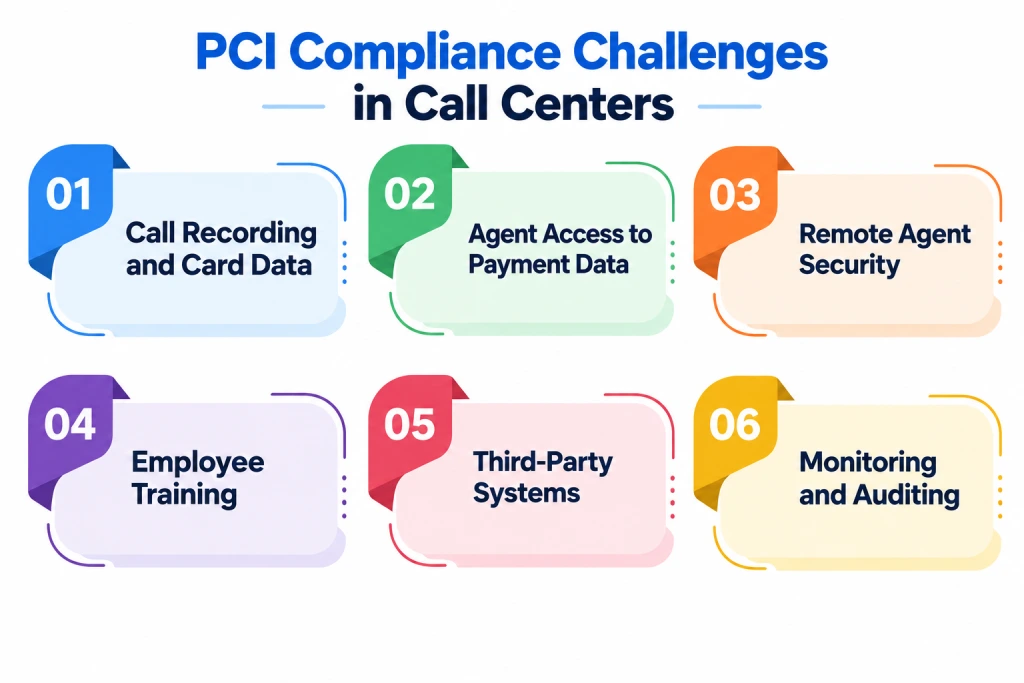
Call Recording and Card Data
Call recordings can accidentally capture card numbers and other sensitive information. Without proper recording controls, these files can become a security risk.
Agent Access to Payment Data
Giving agents more access than they need can increase the risk of unauthorized exposure. Managing permissions across teams and systems can also become difficult as employees change roles.
Remote Agent Security
Remote agents may work from different locations and networks, making it harder to maintain consistent security controls and prevent unauthorized access to payment information.
Employee Training
Agents need to understand exactly how to handle cardholder data during customer calls. Inconsistent training can lead to mistakes that put sensitive information at risk.
Third-Party Systems
Call centers often rely on payment providers, CRM platforms, and other third-party tools. Ensuring these providers follow appropriate security practices can add another layer of compliance management.
Monitoring and Auditing
Tracking access, reviewing logs, conducting security tests, and maintaining compliance records requires ongoing effort. Call centers can struggle to keep these activities consistent as their operations grow.
How Time Champ Helps Support Call Center PCI DSS Compliance
Keeping a call center PCI DSS compliant requires more than securing payment systems. You also need visibility into how employees use company devices and systems, especially when agents work remotely. Time Champ helps businesses monitor employee activity, improve workforce visibility, and support internal security policies, making it a useful addition to a broader PCI DSS compliance strategy.
Key Time Champ Features:
- Employee Activity Monitoring: Track employee activity during work hours for better visibility.
- App & Website Tracking: See which applications and websites employees use during work hours.
- Remote Workforce Monitoring: Maintain visibility across remote and distributed call center teams.
- Activity Reports: Review employee activity and work patterns through detailed reports.
Ready to strengthen your call center security?
Get better visibility into employee activity, identify potential risks, and support your security policies with Time Champ.
Conclusion
PCI DSS compliance is essential for call centers that handle payment card data. Securing call recordings, limiting access, protecting systems, and training agents can help reduce security risks.
Use the checklist in this guide to review your current controls and find areas that need improvement. Tools like Time Champ can also support your security efforts by giving you better visibility into employee activity.

Guna Lakshmi

Table of Content
 What Is PCI DSS Compliance for Call Centers?
- Why PCI DSS Compliance Matters in a Call Center
- The 12 PCI DSS Requirements Applied to Call Centers
- Key Controls for Protecting Card Data Over the Phone
- Call Center PCI Compliance Checklist
- Common PCI Compliance Challenges in Call Centers
- How Time Champ Helps Support Call Center PCI DSS Compliance
- Conclusion
Related Blogs

What the nesting period in BPO means, where it fits in call center training, what happens during nesting, the metrics to track, and best practices.
Guna Lakshmi | Oct 19, 2026
Understand what vanity metrics are, why they matter, examples, and how they differ from actionable metrics for measuring real business performance.
Thasleem Shaik | Nov 13, 2025
Learn what call abandonment rate is, the formula to calculate it, industry benchmarks for a good rate, the top causes, and ways to reduce abandoned calls.
Guna Lakshmi | Oct 06, 2026
Learn what the call center occupancy rate is, the formula, how to calculate it, what a good occupancy rate is, and how it differs from utilization.
Guna Lakshmi | Oct 21, 2026
Track the most important BPO KPIs to measure agent performance, productivity, customer satisfaction, and overall contact center success in 2026.
Guna Lakshmi | Oct 02, 2026
BPO workforce management guide: the six-stage cycle, shrinkage and adherence formulas, real benchmarks, and 8 best practices that protect service levels.
Shabana Shaik | Sep 11, 2026


 4.7/5 avg.
Ready to Manage Your Workforce Smarter?
Join our family of 1500+ companies using smart insights to redefine workforces!

Free Trial
No Credit Card Required