BPO Workforce Management: A Practical Guide for 2026
BPO workforce management guide: the six-stage cycle, shrinkage and adherence formulas, real benchmarks, and 8 best practices that protect service levels.

BPO’s are at their peak with the advancement of AI, many of them are applying in-house tools to up the efficiency game.
According to Deloitte's Global Outsourcing Survey, 70% of executives said they have pulled outsourced work back in-house within the past five years.
Work rarely leaves a BPO because the team stopped trying. It leaves because service levels wobbled, the cost story stopped adding up, and nobody could explain why, and all three of those are workforce management outcomes before they are anything else.
So, in this blog, I am going to take you through the six-stage WFM cycle, the metrics and formulas that matter, the challenges that are specific to BPOs, eight best practices, and what to look for in software, including where a workforce intelligence layer fits.
What is BPO Workforce Management?
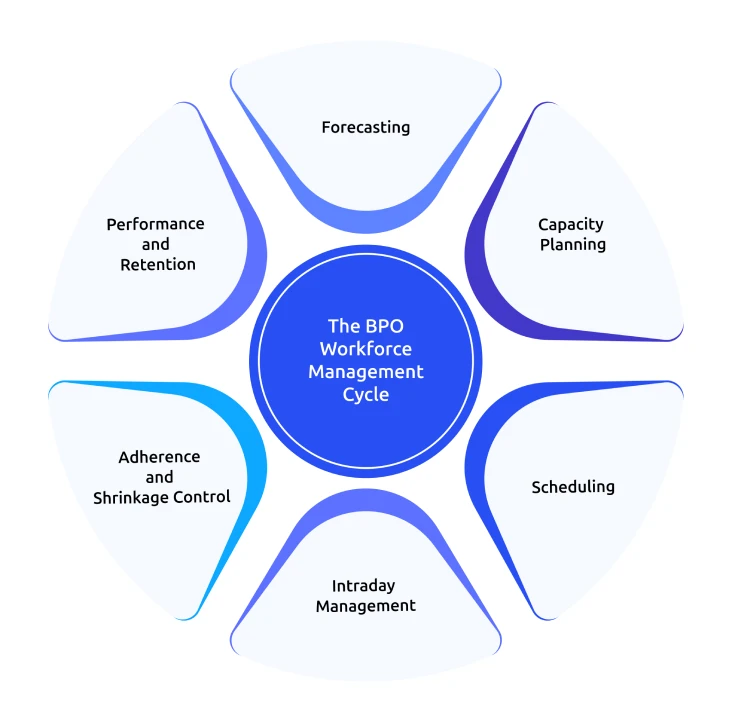
BPO workforce management means having the right number of agents, with the right skills, on the right shifts, at the right cost, for each client program. It covers these six key activities: forecasting contact volume, planning capacity, creating schedules, managing intraday changes, controlling shrinkage and adherence, and improving performance and retention.
It is different from two things it is often confused with.
- HR owns hiring, policy, and payroll.
- WFM owns whether the people HR hired are in the right place at the right time.
- Operations owns the queue and client relationship.
WFM gives operations the staffing plan and numbers to support those decisions.
In a small BPO, one person might handle all three roles.
In a large BPO, WFM is usually a team of forecasters, schedulers, and real-time analysts working between HR, operations, and finance.
Why Workforce Management is Harder in a BPO Than Anywhere Else
Workforce management is a lot harder in a BPO because three challenges come together: strict client service levels and penalties, high shrinkage and agent turnover, and multiple clients competing for the same staff.
Contact-center shrinkage means the paid hours agents are not available to handle contacts. It typically ranges from 30% to 35%, with Dimension Data reporting an average of 35%. Agent turnover is also high, at around 30–40% a year, and replacing one agent costs roughly $20,800.
When you put these together (I mean the shrinkage and annual turnover), the pressure becomes much clearer. For every 100 agents scheduled, only 65-70 may be available at a given time, and around 30-40 may leave within a year. Add a client SLA, such as answering 80% of calls within 20 seconds, with penalties for missing it. Suddenly, a forecasting mistake, late arrival, or poorly timed break can hit the bottom line.
This pressure is only growing: India’s tech industry expects 6.1% revenue growth in FY26 with just 2.3% headcount growth, meaning more output from roughly the same workforce. Also, the Philippines is shifting its workforce plans toward AI-enabled workers.
Gartner expects AI agents to handle 80% of common customer-service issues by 2029, leaving human agents with more complex cases.
That makes WFM more important than ever. When you have fewer hours to work with, how well you use them directly affects your profit margins.
Shrinkage you can see is shrinkage you can fix!
Get visibility into every scheduled hour by shift, team, and cause, not one number at month-end.
The BPO Workforce Management Cycle: Six Stages
The BPO workforce management cycle has six stages: forecasting, capacity planning, scheduling, intraday management, adherence and shrinkage control, and performance and retention. Each stage feeds the next, and the last one feeds back into the first, unplanned attrition leaves you with more work than people to handle it.
1. Forecasting: Predicting the Work
Forecasting estimates how many customer contacts will come in, through which channels, at what times, and how long each interaction will take.
Good business process outsourcing forecasts use at least 12 months of client history, account for known events such as billing cycles, campaigns, product launches, and public holidays in the client's country, and are updated weekly rather than quarterly.
- Forecast by interval and by channel - a chat forecast is not a voice forecast divided by two.
- Track forecast accuracy at interval level. A monthly average of 95% can hide 40% misses every Monday morning.
- Ask clients for their marketing and release calendars in the contract. Farida's Friday email is a forecasting failure only if nobody asked.
2. Capacity Planning: Turning the Forecast into Headcount
Capacity planning turns forecasted workload into the number of agents needed for each interval, and then into hiring requirements. It uses a service-level model (such as Erlang C or simulation), along with shrinkage and occupancy targets.
The simplest calculation is: required staffed hours ÷ (1 − shrinkage) = hours you need to roster.
Then, hours you need to roster ÷ productive hours per FTE = the number of FTEs you need to hire.
In a multi-client BPO, calculate this for each program, then check the total against your recruiting pipeline and available seat count, the two constraints that usually matter most.
3. Scheduling: Building Rosters People Can Live With
Scheduling assigns agents to shifts that match the forecasted workload while considering labor laws, contract rules, skills, and, if you want them to stay, their preferences too. BPOs deal with some of the most complex scheduling challenges: 24/7 coverage, split shifts, rotating nights, and changing time zones.
For example, a shift supervisor in Davao City managing split shifts for a UK utilities account can lose an hour of coverage twice a year when British clocks change. The roster is built in Philippine time, but the tool does not account for the client's calendar.
It is a small example of a larger rule: schedule in the client's time zone, publish in the agent's, and use a tool that understands both.
- Publish rosters at least two weeks in advance, late schedules are a very common reason for avoidable absences.
- Plan breaks and lunches for each interval, A schedule may look fully staffed for the day but still leave you short at 2 p.m.
- Let agents share their availability and swap shifts within set rules, considering employee preferences takes little effort and can help improve retention.
4. Intraday Management: Running the Day
Intraday management means checking actual volume, handle time, and staffing against the plan in real time and making quick adjustments. This generally includes moving cross-skilled agents between queues, offering time off when volume is low, adding overtime when it is high, or pausing training when queues spike.
This is where the plan meets reality. It determines whether unexpected volume, like Monday’s recall surge, gets handled or causes any service issues.
Two key rules for you to follow:
- Decide the actions and thresholds before the day starts.
- Record every change so the next forecast can learn from it.
5. Adherence and Shrinkage Control: Protecting the Hours You Paid For
Schedule adherence shows whether agents are really following their schedules at the right time. Shrinkage covers paid time when agents are not available to handle contacts, such as training, meetings, leave, sickness, lateness, absence, or system downtime. Adherence is managed in the moment, and shrinkage is managed through better planning.
An HR operations head in Jaipur had a 4 a.m. cab roster that looked absolutely fine on paper, but unplanned absence remained high. When she checked login data by route, she found that most no-shows came from the same three pickup routes every month, and the real issue was irregular transport, not attendance.
That is why a monthly shrinkage percentage is not enough. You need to see it by shift, team, cause, and time to find the exact problem.
6. Performance and Retention: Keeping the People You Scheduled
The final stage closes the loop with coaching, quality, and engagement efforts that help good agents stay instead of becoming next quarter’s vacancies. The data supports this focus: New agents can take six months or more to reach average performance (SQM Group), while AI support can improve novice agents’ productivity by 34% compared with 14% overall. This makes new agents both costly to lose and easier to support. (NBER)
Early signs such as rising idle time, lower activity, and continued overload often appear weeks before someone resigns. This gives team leads time to step in early, address the issue, and change the outcome for the better.
BPO Workforce Management Metrics and Formulas
BPO workforce management metrics fall into three groups: forecast accuracy, staffing efficiency, and business outcomes. This table explains the formula for each metric and what it tells you. Benchmarks are included only when reliable sources are available. Other metrics vary based on your channel mix and client requirements.
| Metric | Formula | What it Tells You |
|---|---|---|
| Forecast accuracy | 1 − |forecast − actual| ÷ actual, per interval | Whether your plan can be trusted. Measure at interval level, not monthly. |
| Shrinkage | (External shrinkage hours + internal shrinkage hours) ÷ total paid hours × 100 (Call Centre Helper) | How much of what you pay for reaches the queue, norm: 30-35%. |
| Schedule adherence | Time in scheduled state ÷ scheduled time × 100 | Whether the plan is being followed in the moment - manage daily. |
| Occupancy | Contact handling time ÷ (handling + available time) × 100 | How busy agents are while logged in. Sustained very high occupancy predicts burnout and attrition. |
| Utilization | Productive (billable) hours ÷ paid hours × 100 | What the client is actually getting for the seat, the number in every QBR. |
| Service level | % of contacts answered within X seconds (e.g, 80/20) | The contractual promise, misses often carry credits or penalties. |
| Average handle time (AHT) | (Talk + hold + wrap-up) ÷ contacts handled | Feeds capacity, expect it to rise as AI takes the simple contacts. |
| Attrition | Leavers in period ÷ average headcount × 100 | Norm 30-40% a year (SQM Group); your highest hidden cost. |
| Absenteeism | Unplanned absent shifts ÷ scheduled shifts × 100 | The unplanned half of shrinkage; look at it by shift, team, and route. |
Common BPO Workforce Management Challenges and How to Fix Them
These are the most common BPO workforce management challenges and also tips on how to fix them:
| Challenge | Why it Hurts in a BPO | What Works |
|---|---|---|
| Multi-client capacity conflicts | Agents are dedicated by contract, so one client's spike can't borrow another's slack, while both charge you for idle time. | Negotiate cross-skilled 'flex pools' into contracts; plan capacity per client but review the total weekly against seats and pipeline. |
| 24/7, split and rotating shifts across time zones | Coverage gaps at hand-over, clock changes and local holidays, rosters that grind people down. | Schedule in the client's time zone, publish in the agent's, time zone-aware scheduling; publish two weeks ahead; alert on coverage gaps before the shift, not after. |
| Remote and hybrid agents | Adherence, idle time, and break patterns are invisible from the floor; team leads manage by chat message. | Automated attendance for WFH and WFO, the same activity timeline for every agent regardless of location, and clear, published monitoring policies. |
| Shrinkage stuck above 35% | Every point of shrinkage is headcount you hire and pay for but can't sell. | Separate planned from unplanned absence: track it by shift, team, and cause. Schedule training during known low-demand periods, and fix root causes like transport and rota fairness. |
| Attrition at 30-40% | A 500-seat floor rehires 150–200 people a year at ~USD 20,800 each. (SQM Group) | Watch early signals (idle time, overload, declining activity); preference-aware rosters; protect new hires' first 90 days with coaching evidence, not opinions. |
| AI changing the queue | Routine contacts leave first; the human queue gets harder and longer per contact. (Gartner) | Re-baseline AHT and occupancy targets; move capacity into quality and coaching; measure output per hour, not seats. |
Eight Workforce Management Best Practices for BPOs
These are the practices that separate BPOs that hit service levels at a 12% margin from those that hit them at 6%. None of these best practices need a new tool to start, you just need one efficient tool to get started:
1. Forecast by Interval and Re-forecast Weekly: Monthly forecasts hide the Monday-morning misses that cost you the month.
2. Put Shrinkage in the Plan, Not the Excuse Column: Budget 30-35% and track it by cause so you can drive it down deliberately.
3. Schedule in the Client's Time Zone, Publish in the Agent's: Make sure your tool knows both calendars.
4. Decide Intraday Levers Before the Day: Who moves, at what threshold, who approves, write these down prior, not after the day has already started.
5. Measure Adherence Daily and Shrinkage Weekly, Both at Team Level: Averages across a 1,200-seat floor tell you nothing you can act on.
6. Treat the First 90 Days as a Retention Program: New agents take six months to reach average performance, losing them at month three is the most expensive outcome ever. (SQM Group)
7. Give Agents Visibility of Their Own Numbers: Adherence, productive hours, and quality scores an agent can see are coaching tools, the same numbers seen only by a manager are grievances waiting to happen.
8. Report to Clients on Utilization and Quality, Not Headcount: With 70% of buyers selectively insourcing and 78% running their own in-house centers, your data has to be as good as theirs. (Deloitte)
How Time Champ Adds a Workforce Intelligence Layer to BPO Workforce Management
Time Champ is employee monitoring software with a workforce intelligence layer: it captures attendance, shifts, activity, audio, and early attrition signals across a BPO floor and turns them into decisions WFM, delivery, and HR can act on the same day. Unlike a planning tool that stops when the roster is published, Time Champ starts there, it shows what the scheduled hours actually became, agent by agent, interval by interval, on-site or at home.
| WFM Stage | What Time Champ Gives You |
|---|---|
| Scheduling | Shift scheduling with time zone and availability awareness, work-from-home / work-from-office scheduling; custom break configurations; flexible shift compliance tracking for WFH, WFO and non-working users. |
| Intraday management | Real-time attendance dashboard (present, absent, on leave); late-login alerts; proactive alerts for missed check-ins, shift changes and coverage gaps; real-time work status (active, idle, offline). |
| Adherence and shrinkage | Automated attendance capturing login, logout, breaks, shifts and overtime; idle-time detection with configurable thresholds; an hour-by-hour timeline of every agent's day; team vs individual productivity comparison, so shrinkage has a shift, a team and a cause. |
| Performance and retention | Productive / non-productive / neutral activity classification; work-life balance overview (focus time, breaks, over-utilization); over-utilization and burnout-risk alerts; a unified attrition risk index built from activity signals; audio tracking with downloadable recordings for coaching and QA. |
| Client reporting and finance | Billable-hour tracking by client and project, client-level billing transparency reports, utilization and profitability reports, and payroll-ready timesheet exports from approved time. |
| HR operations | Leave and time-off management with real-time visibility, shift and schedule management, headcount planning and recruitment insights. |
Note:
Now coming back to Farida's Monday: Her forecasting tool told her what she needed. A workforce intelligence layer tells her what she has, who logged in on which program, who is idle on the quiet client and could move, where breaks are stacking at 11 a.m., and which of last month's new hires are showing the overload pattern that usually ends in a resignation. The plan handles the volume. The visibility handles the day.
Want to manage your BPO workforce efficiently?
Time Champ gives you visibility and insights you need to make efficiency a reality!
Conclusion
BPO workforce management is a cycle, and the second half of it intraday, adherence, shrinkage, retention- is where most operations lose the margin the first half planned for. Forecast by interval, plan with shrinkage in the budget, schedule in the client's time zone, decide your levers before the day, and watch the early signals that tell you who is about to leave.

Shabana Shaik

Table of Content
 What is BPO Workforce Management?
- Why Workforce Management is Harder in a BPO Than Anywhere Else
- The BPO Workforce Management Cycle: Six Stages
- BPO Workforce Management Metrics and Formulas
- Common BPO Workforce Management Challenges and How to Fix Them
- Eight Workforce Management Best Practices for BPOs
- How Time Champ Adds a Workforce Intelligence Layer to BPO Workforce Management
- Conclusion

Related Blogs
Learn simple ways to measure and boost call center productivity, helping your team work more efficiently and improve customer service.
Jahnavi Pulluri | Jan 10, 2025
Explore top workforce analytics tools for 2026 to monitor productivity, attendance, and team performance in real-time.
Guna Lakshmi | Apr 21, 2026
In-house vs outsourcing explained with key differences, pros, cons, costs, and practical tips to help you choose the best approach for your organization.
Anjali | Jul 02, 2026![What Is Business Process Automation (BPA)? - Guide [2026]](https://www.timechamp.io/images/business-process-automation.webp)
Learn what business process automation (BPA) is, why it matters, examples, how it works, implementation steps, challenges, benefits & BPM differences.
Chethana Choudary | Feb 18, 2026
Learn what workforce engagement management (wem) is, why it matters in contact centres, components, benefits, and how to choose the right software.
Shabana Shaik | October 01, 2025
The future of outsourcing is changing with AI, nearshoring, and outcome-based models. Explore the latest trends, predictions, and what you should expect.
Thasleem Shaik | July 31, 2026


 4.7/5 avg.
Ready to Manage Your Workforce Smarter?
Join our family of 1500+ companies using smart insights to redefine workforces!

Free Trial
No Credit Card Required