Call Center Agent Performance Review: How to Evaluate Agents
A step-by-step guide to call center agent performance reviews with key metrics, evaluation criteria, templates, feedback examples, and common mistakes.
Performance reviews should not feel like a score handed down at the end of the month. For call center agents, they should act as a clear mirror that shows what is working, where performance needs attention, and what can help them improve with confidence.
A call center agent performance review gives you a structured way to look at both results and the quality behind them. In this guide, we’ll cover what to measure, how to give meaningful feedback, and how to turn each review into a practical step toward stronger agent performance and better customer service.
What Is a Call Center Agent Performance Review?
A call center agent performance review is a structured check-in that shows how well an agent is handling customer interactions during a specific period. It looks at both the numbers, such as response time, resolution rate, and customer satisfaction, and the human side of the job, such as communication, patience, product knowledge, and problem-solving.
The goal is not only to score an agent but to understand their overall performance clearly. A good review helps you recognize strengths, identify skill gaps, give useful feedback, and set practical goals that improve both agent confidence and customer experience.
Key Metrics to Include in a Call Center Agent Performance Review (Call Center KPIs)
The right metrics help you see more than just how busy your agents are. You can use them to spot patterns in speed, resolution, customer experience, quality, and reliability. Here are the key metrics you can include in your review.
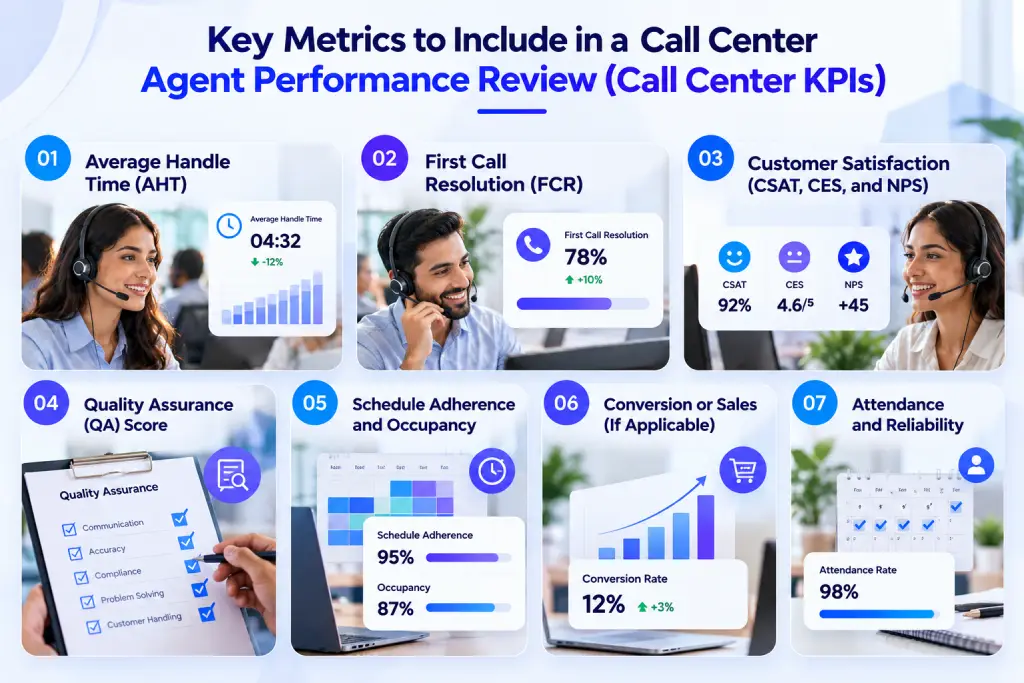
1. Average Handle Time (AHT)
Average Handle Time measures the average time an agent spends handling a customer interaction. It typically includes talk time, hold time, and after-call work.
Use AHT to understand how efficiently your agents handle calls, but do not treat a lower number as an automatic sign of better performance. An agent who rushes through a call may lower AHT while leaving the customer without a proper resolution. Compare AHT with quality, resolution, and customer feedback to get the full picture.
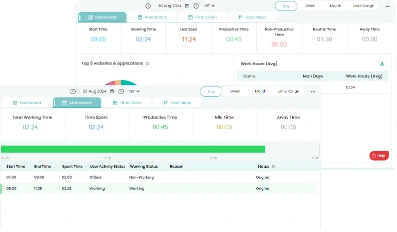
If you run a BPO time-tracking software alongside your phone system, you already have clean, time-stamped data for this metric instead of guessing from spot checks.
2. First Call Resolution (FCR)
First Call Resolution shows how often an agent resolves a customer's issue during the first interaction without requiring another contact or follow-up. A strong FCR rate can indicate that your agents have the knowledge, tools, and authority to solve issues effectively. When you see a low rate, look at the reasons behind repeat contacts. Your agents may need better product knowledge, clearer processes, or more support for complex issues.
3. Customer Satisfaction (CSAT, CES, and NPS)
These three scores measure the customer’s experience, and each one answers a different question.
- CSAT asks how satisfied the customer felt with that specific call. You calculate it by dividing positive responses by total responses, then multiplying by 100.
- Customer Effort Score (CES) asks how much effort the customer had to put in to get their issue resolved. Unlike most other metrics on this list, a lower effort score is the goal.
- Net Promoter Score (NPS) asks how likely the customer is to recommend your business to someone else. It focuses more on overall loyalty than on a single call. asks how likely the customer is to recommend your business to someone else. It focuses more on overall loyalty than on a single call.
Pull all three where you can. An agent may score well on one and poorly on another, and that gap can show you exactly where coaching can help.
4. Quality Assurance (QA) Score
A QA score comes from a supervisor or QA team scoring recorded or live calls against a checklist. The checklist can cover areas such as the greeting, verification steps, tone, and issue handling. This is where the best call center quality assurance software earns its place in your stack, since manual call sampling only captures a small portion of an agent’s overall work.
5. Schedule Adherence and Occupancy
Schedule adherence tracks how closely an agent follows their planned shift, breaks, and login times. Occupancy tracks how much of their logged-in time goes toward handling contacts versus sitting idle between calls.
Both numbers matter more than most agents realize. An agent can hit every quality target and still affect floor coverage if they consistently log in late or extend their breaks. This is exactly the kind of pattern a call center workforce management setup can catch automatically, since it flags gaps in real time instead of showing them later in a spreadsheet.
6. Conversion or Sales (If Applicable)
For outbound or sales-focused teams, add conversion rate, upsell rate, or revenue per call to the scorecard. Skip this section for pure support roles, since adding sales metrics to a service agent's review can make the evaluation less relevant.
7. Attendance and Reliability
Attendance shows whether your agents consistently show up for their scheduled shifts. Reliability also includes patterns such as late arrivals, early departures, and consistent schedule adherence. Workforce management systems like Time Champ commonly track attendance, lateness, early departures, overtime, and adherence alongside other performance data.
Use this information to identify recurring patterns rather than judge an isolated absence. When you connect attendance with productivity and schedule data, you get a clearer view of how reliably your operation runs.
Still relying on manual reports to see how your agents spend their time?
Try Time Champ for real-time visibility into productivity, attendance, and work hours.
What Should You Evaluate Beyond Call Center KPIs?
Numbers show you what happened, but they do not always explain why. An agent may have strong productivity metrics and still struggle with communication, while another may take longer calls because they handle complex issues carefully.
For a balanced call center evaluation, look at the skills and behaviors behind the numbers. Your review should cover communication, knowledge, compliance, problem-solving, ownership, and teamwork alongside the KPIs you already track. Here are the key areas to review beyond the metrics.
1. Communication and Soft Skills
The way an agent communicates can shape the entire customer experience. Evaluate how clearly they explain information, how well they listen, and how they respond when a customer feels frustrated.
Look for:
- Clear and easy-to-follow explanations
- Active listening without unnecessary interruptions
- A calm and professional tone
- Empathy when handling concerns
- Appropriate use of holds and transfers
- Ability to de-escalate difficult conversations
2. Product and Process Knowledge
Your agents need more than good communication skills. They also need to give accurate answers and follow the right process.
Evaluate whether an agent can:
- Explain products or services accurately
- Find the right information when they do not know an answer
- Follow the correct workflow
- Use required tools and resources properly
- Give customers accurate next steps
3. Compliance and Script Adherence
Some steps in a call are not optional. Your agents may need to verify customer information, provide required disclosures, follow security procedures, or use specific language during certain interactions.
Check whether your agents:
- Complete required verification steps
- Follow mandatory disclosures
- Protect customer information
- Follow approved processes
- Document the interaction correctly
- Use scripts where your process requires them
4. Problem-Solving and Ownership
A strong agent does not simply move a difficult call to someone else. They take responsibility for finding the right solution and know when an escalation actually makes sense.
During your review, look at whether the agent:
- Asks the right questions to identify the issue
- Uses available information to solve the problem
- Takes responsibility for the customer's concern
- Offers a practical solution
- Explains the next steps clearly
- Escalates only when the situation requires it
5. Attitude and Teamwork
Your review should also consider how an agent contributes beyond individual calls. Reliability, coachability, collaboration, and adaptability can affect the wider team's performance.
Look for whether the agent:
- Accepts feedback and applies it
- Works well with teammates
- Helps when the team faces higher demand
- Adapts when processes change
- Takes initiative when appropriate
- Maintains a professional attitude
Together, these five areas give you the human side of the review. Pair them with your KPI scores to get a fairer view of agent performance and the customer experience, instead of focusing only on speed.

Did You Know
The average first response time (FRT) for call centers is 28 seconds. This gives you a useful benchmark for how quickly customers typically receive an initial response. A lower response time can help reduce waiting, but you should also consider whether the agent provides a clear and helpful response. response. A lower response time can help reduce waiting, but you should also consider whether the agent provides a clear and helpful response.
How to Conduct a Call Center Agent Performance Review (Step by Step)
A good review starts before the actual conversation. You need reliable performance data, clear evaluation criteria, and specific examples so your feedback reflects what actually happened during the review period.
Here is a simple process you can follow to make each performance review for call center agents consistent, fair, and useful.
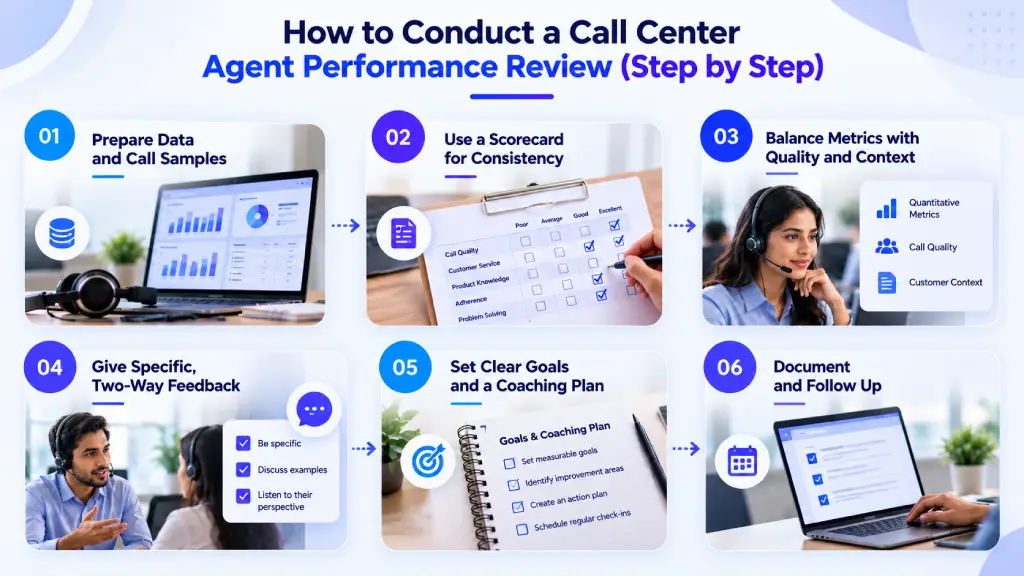
1. Prepare Data and Call Samples
Start by gathering the agent's performance data for the review period. Pull the relevant KPIs, QA results, customer feedback, and a small selection of real calls.
Do not rely on one call or a recent interaction to judge the full review period. Review calls from different points in time and look for patterns across the data. This gives you stronger evidence for both positive feedback and improvement areas. This mix of numbers and real calls makes your call center evaluation more accurate and less based on guesswork.
2. Use a Scorecard for Consistency
Use the same core criteria when you evaluate each agent in the same role. Your scorecard can include KPIs, call quality, communication, knowledge, compliance, and other criteria that matter to your operation. Clear criteria help you apply the same standards across reviews. They also show your agents exactly what you expect and make feedback easier to support with evidence.
3. Balance Metrics with Quality and Context
Do not let one KPI decide the outcome of the review. Look at what the numbers show, then consider the reasons behind them.
For example, a higher AHT may come from handling complex customer issues, while a low AHT may come from rushed conversations. Compare the metric with FCR, CSAT, QA results, and call examples before drawing a conclusion.
This gives you a more complete call center evaluation instead of judging performance from numbers alone.
4. Give Specific, Two-Way Feedback
Start the review with clear examples of what the agent does well. Then move to the areas that need improvement. Avoid vague comments such as "improve your communication." Point to a specific behavior and explain what the agent can do differently. Give the agent time to share their perspective too. They may have context behind a result that your data does not show. A useful review should feel like a conversation, not a one-sided judgment.
5. Set Clear Goals and a Coaching Plan
End the review with a small number of clear improvement goals. Focus on one to three areas rather than giving the agent a long list of things to fix.
Make each goal specific and measurable. For example, instead of saying "improve FCR," you could set a target to increase FCR from the current level to an agreed-upon target by the next review period.
Then decide what support will help the agent reach that goal. You might use targeted coaching, additional training, call shadowing, or regular check-ins.
6. Document and Follow Up
Record the key results, feedback, agreed goals, and next steps after the review. Keep the information clear enough that you can refer back to it later.
Then check progress before the next formal review. A quick follow-up can show whether the agent has improved, whether the goal still makes sense, or whether they need different support.
Your review should not be the only time you discuss performance. Regular check-ins keep feedback timely and help you address small issues before they become larger performance gaps.
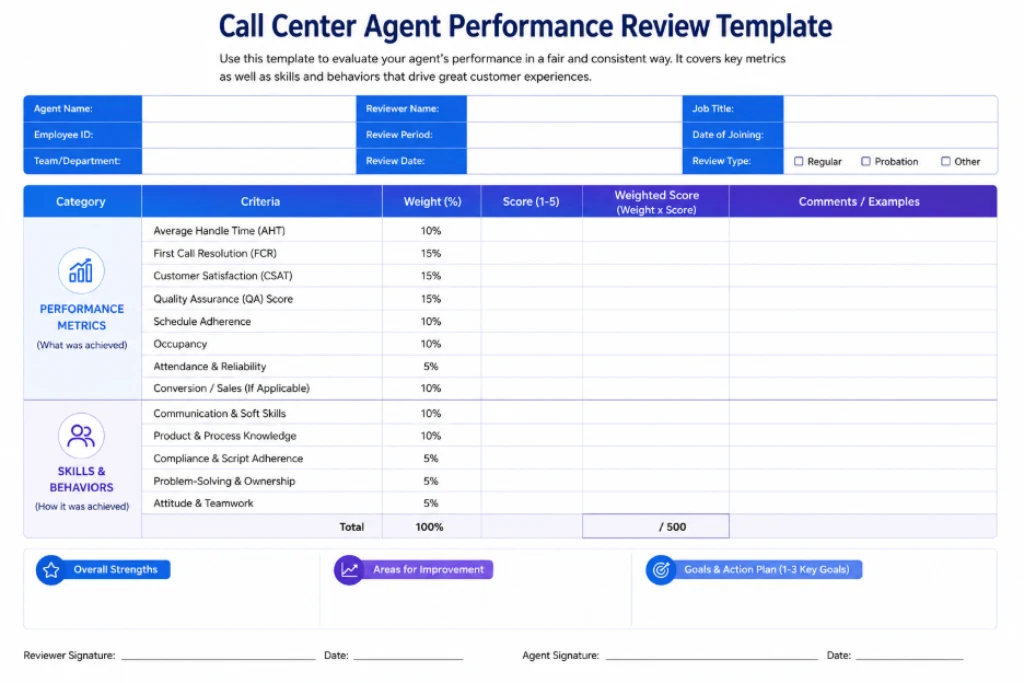
Call Center Agent Performance Review Template
A call center agent performance review template takes the guesswork out of scoring. Instead of judging each agent from memory or gut feel, you score every agent against the same weighted criteria, so results are consistent and defensible from one review to the next.
Use the call center performance scorecard below as your starting point. Weight each criterion based on what matters most for your team, score the agent from 1 to 5 on each line, and let the sheet calculate the weighted total for you. Download it, adjust the weights to fit your team, and reuse it for every review cycle.
Call Center Performance Review Phrases and Examples
Generic praise doesn't help much. “Great job this month” tells an agent nothing they can repeat, while “needs to improve communication” doesn't tell them what they can fix. The phrases below give you a starting point for both sides of the conversation. You can then add the specific number, call, or moment that supports the feedback. That level of detail is what separates real customer service evaluation examples from a form letter.
1. Positive Feedback Examples
Tie the praise to a number or a moment whenever you can. It lands harder than a compliment on its own.
- Point to the shift directly. "Your first call resolution went from 68% to 82% this month, and customers noticed. Three separate comments mentioned how quickly you sorted things out."
- Call out a specific save. "The way you handled that billing dispute on Tuesday, staying calm while the customer vented, then walking them through the fix step by step, is exactly the kind of call we want on record."
- Recognize consistency, not just a good day. "Your QA scores have stayed above 90% for three reviews running. That's not luck; that's a habit, and it shows."
- Name the behavior behind the number. "You ask one or two extra questions before wrapping up a call. That's a big part of why your resolution rate holds steady even on the tricky ones."
2. Constructive Feedback Examples
Frame these around what changes next, not what went wrong. An agent who leaves with a plan improves faster than one who leaves with a scolding.
- Name the gap and the fix in the same breath. "Your average handle time is running about ninety seconds over target. A lot of that comes from re-explaining the same policy, so let's build you a quick-reference card for the three you hit most."
- Use a specific call as the example, not a pattern you're guessing at. "On the call with the delayed shipment, the customer had to repeat their order number twice. A quick confirm-back early on would have caught that."
- Connect the behavior to what it costs the customer, not just the metric. "When a call gets transferred without context, the customer has to start over. Try a thirty-second handoff note before you pass it along."
- Close with ownership, not a directive. "What's one thing from this list you'd want to work on first?"
3. A Simple Formula for Writing Better Review Phrases
When you write your own feedback, avoid vague statements such as “You are doing a good job” or “You need to improve your performance.”
Instead, connect three things:
What happened → Why it matters → What comes next
For Example:
“Your CSAT has remained strong while your average handle time has improved. That shows you are becoming more efficient without losing focus on the customer experience. Keep using the same call structure on complex interactions.”
This approach makes the review specific, fair, and useful. It also keeps the conversation focused on observable performance and clear next steps, rather than vague judgments.
Common Call Center Agent Performance Review Mistakes to Avoid
A performance review can lose its value when you focus on the wrong things or wait too long to address problems. Avoid the common mistakes below to keep your reviews fair, useful, and focused on improvement.
- Judging Performance Only by KPIs: KPIs show results, but they do not always explain what caused them. Look at call quality, communication, customer feedback, and the situation behind the numbers before making a judgment.
- Waiting Until the Review to Give Feedback: Do not wait until the formal review to mention a problem. Give feedback throughout the review period so your agents have time to make changes and improve.
- Using the Same Criteria for Every Role: A sales-focused agent and a support agent may have different goals. Set review criteria that match the work, responsibilities, and outcomes expected from each role.
- Giving Vague Feedback: Comments like “improve your communication” do not tell an agent what to change. Point to a specific behavior, explain why it matters, and give a clear next step.
- Turning the Review into a Two-Way Conversation: A review should be a conversation, not a speech. Give your agents room to explain their results, share challenges, and respond to the feedback you provide. This helps you build a more complete and fair review.
Losing valuable context between daily activity and performance reviews?
Use Time Champ to capture the activity behind the numbers and make better-informed decisions.
Conclusion
A strong call center agent performance review looks beyond a single score. When you combine KPIs with call quality, communication, customer feedback, and clear coaching, you get a fairer view of performance and a clearer path for improvement.
If you also want better visibility into attendance, productive time, and schedule adherence, Time Champ can give you the workforce data that supports the metrics side of your review. It helps you replace guesswork with clearer performance insights.

Thasleem Shaik

Table of Content
 What Is a Call Center Agent Performance Review?
- Key Metrics to Include in a Call Center Agent Performance Review (Call Center KPIs)
- What Should You Evaluate Beyond Call Center KPIs?
- How to Conduct a Call Center Agent Performance Review (Step by Step)
- Call Center Agent Performance Review Template
- Call Center Performance Review Phrases and Examples
- Common Call Center Agent Performance Review Mistakes to Avoid
- Conclusion
Related Blogs

BPO stands for Business Process Outsourcing and it entails the hiring of external companies to perform certain jobs.
Vijaya Lakshmi | Apr 02, 2024
Contact center services help businesses manage customer support across multiple channels. Compare types, benefits, costs, technologies, and AI trends.
Thasleem Shaik | Aug 10, 2026
How to start a call center using a complete setup process covering costs, software, staffing, compliance, operations, and business planning.
Thasleem Shaik | Jul 29, 2026
Discover the 18 global best call center outsourcing companies to optimize customer support. Choose from leading names for exceptional service and efficiency.
Mounika Sai | Nov 16, 2023
Learn simple ways to measure and boost call center productivity, helping your team work more efficiently and improve customer service.
Jahnavi Pulluri | Jan 10, 2025
Explore the various types of Business Process Outsourcing (BPO) services, their benefits, and how they streamline operations for businesses.
Mounika Sai | Nov 21, 2023


 4.7/5 avg.
Ready to Manage Your Workforce Smarter?
Join our family of 1500+ companies using smart insights to redefine workforces!

Free Trial
No Credit Card Required