What are the Challenges and Benefits of Hybrid Work?
Explore the challenges and benefits of hybrid work and discover strategies for effective team management to enhance flexibility, productivity, and smooth communication.
Struggling to balance employee needs and productivity with a traditional office setup? Hybrid work models offer a way out of this dilemma, but without careful implementation, they can also lead to confusion and inefficiencies. By addressing these issues, hybrid work can transform your business. In this section, we’ll discuss the benefits and challenges of hybrid work and show you how to harness its potential for a more effective and satisfied workforce.
What is Hybrid Work?
Hybrid work is a flexible work model where employees work both from home and from the office at different proportions. This approach enables employees to work from home or some other place for a few days in the week and then come to the office to attend meetings or engage in collaborative activities. Hybrid work is an attempt to create two environments that would provide flexibility and meet different needs at work.
Benefits of Hybrid Work
Surprisingly, 83% of workers are more comfortable with the hybrid work model than the traditional office arrangements. This change in the working environment is transforming how companies work, redesigning the dynamics of the team and productivity. Now let’s take a closer look at the benefits of hybrid work and how it can change your business.
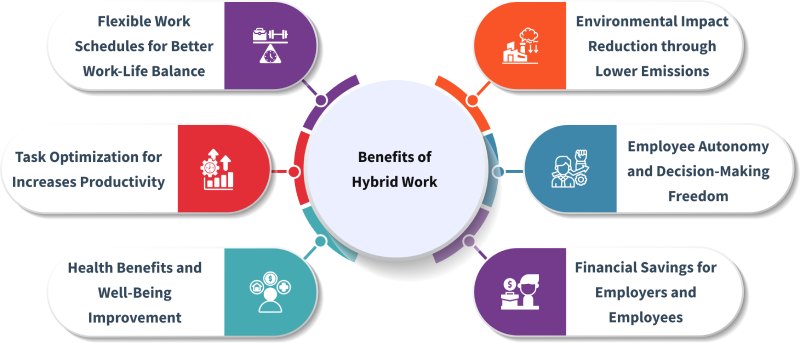
1. Flexible Work Schedules for Better Work-Life Balance
Hybrid work provides employees with the freedom to select their working environment and the time they want to work. This flexibility enables them to balance family commitments like childcare or doctor’s appointments without having to stick to a fixed working schedule. This means that the employees can be able to work according to their most productive hours, hence increasing their productivity and satisfaction. It also assists in addressing the differences in working preferences and styles, which is beneficial in creating a diverse workplace.
2. Task Optimization for Increases Productivity
Flexible work arrangements increase overall productivity because employees work in environments that are most conducive to their tasks. Remote work is ideal for tasks that require minimal distractions and interruptions, while office time is ideal for group work. This balance enables the employees to work smart in their processes, which may result in better quality and shorter time to deliver the projects. Also, the freedom to select the appropriate environment for various activities can minimize interferences and enhance productivity.
3. Health Benefits and Well-Being Improvement
Offers a positive effect on the health of the employees in many aspects. Employees can save more time that would have been spent commuting hence reducing daily stress levels and being able to exercise, do other activities, or even take rest. The ability to work from home also means that employees are not under immense pressure to stick to their office hours and therefore, they can take breaks when they feel like their bodies need it. Consequently, the workers are likely to be more energetic, healthier prepared to undertake their duties. Healthy employees are always happy, and this makes them work harder, thus creating a virtuous cycle for the employees and companies.
4. Environmental Impact Reduction through Lower Emissions
Reduces the daily traffic to and from work, which implies that there are fewer vehicles on the road and hence less pollution. Since employees are allowed to work from home for a few days a week, there is less use of fuel-powered vehicles, therefore, less air pollution and greenhouse gases. This change is in line with minimizing the effects of climate change and encouraging sustainability.
5. Employee Autonomy and Decision-Making Freedom
Another benefit of hybrid work is it enables employees to have more control over their work arrangements. Employees can decide where they want to work and when they want to work, thus having more control over their productivity and working habits. This autonomy can lead to higher motivation.since the employees feel that they are being trusted to deliver the results on their own. More decision-making freedom also promotes discipline and personal accountability for work results.
6. Financial Savings for Employers and Employees
Hybrid working can also result in cost benefits for both the employee and the employer. Employees are relieved of transportation expenses, meals, and other costs incurred in commuting to work. Some of the overhead costs that can be minimized include office space, utility bills, and office stationery. Furthermore, the possibility of having fewer cases of absenteeism and lower turnover rates can also add to the cost-saving factor, which makes the hybrid work model financially beneficial.
Potential Challenges of Hybrid Work and Solutions
“The only way to deal with change is to plunge into it, move with it, and join the dance.” — Alan Watts. Since hybrid work is becoming the new norm in our working environment, it is important to accept this change with positive approaches. Now let us look at the challenges of hybrid work and how to effectively address them.
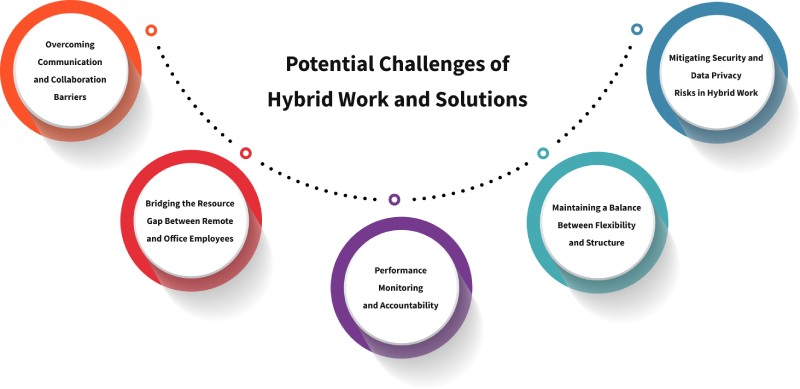
1. Overcoming Communication and Collaboration Barriers
One of the main challenges that arise when employees are working in a hybrid environment is the lack of effective communication and collaboration between the office and remote workers. Remote employees may not feel as close to their colleagues and may have conflicts or limited communication with the other members of the team.
Solution: To address these communication challenges, various communication and collaboration tools can be applied in the workplace, such as Slack, Microsoft Teams, Zoom, Trello, or Asana. This is where daily check-ins, virtual meetings, and clear communication structures can come in handy. This means that to promote teamwork, it is important to make sure that employees who work from home and employees who work in the office have equal opportunities to be involved in decision-making processes.
2. Bridging the Resource Gap Between Remote and Office Employees
Remote employees may not have access to some of the resources available in the office such as fast internet, quality equipment, or required software. This can create an imbalance in productivity between remote and office-based employees.
Solution: Employers should equip their remote employees with the right equipment such as laptops, monitors, high-speed internet allowance, and quality ergonomic office equipment. Also, providing all the employees with cloud-based software and systems will contribute to the equal distribution of resources.
3. Performance Monitoring and Accountability
A hybrid work model poses a problem in terms of performance monitoring and ensuring accountability. Managers may also find it difficult to know how efficient the employees are and whether everyone is working as required especially when they are not physically present in the workplace.
Solution: Employers can set specific goals and objectives and then use project management or time-tracking software like Time Champ to track the productivity of the employees. The performance reviews and goal setting will ensure that the remote and in-office employees are on their toes without micromanagement. It is important to remember that productivity should be measured by the results achieved rather than the hours spent at the desk.
4. Maintaining a Balance Between Flexibility and Structure
On the one hand, hybrid work allows for flexibility, but on the other hand, it can be challenging to create a clear boundary between work and personal life. If not well managed, some employees may work too hard or too little, which is unhealthy for the company.
Solution: Measures like the determination of working hours and making sure that the employees stick to the working hours can help in preventing work-life imbalance. Managers should ensure that employees do not work extra hours and that the organization should embrace a result-oriented working culture. Other resources for time management and well-being can also be useful to improve this balance.
5. Mitigating Security and Data Privacy Risks in Hybrid Work
Remote work increases security risk because an employee can plug into an insecure network or use an insecure device. This may lead to data privacy issues, particularly when handling sensitive information outside the workplace.
Solution: To ensure that the company information is safe, it is essential to put measures like VPNs, two-factor authentication, and data encryption into practice. Security risks can also be reduced by offering the employees training on security best practices and updating the software frequently. Employers should encourage the use of the company’s recommended devices and tools to avoid information leakage.
6. Ensuring Fairness in Recognition and Advancement Opportunities
In a hybrid work model, there may be unintentional proximity bias, which means that the managers have favoritism for those workers who are present physically in the office against those working remotely. This can lead to feelings of isolation and low morale among remote employees, which even affects their careers or involvement in the organization.
Solution: Organizations should establish transparent criteria for recognition and promotion that apply equally to all employees, regardless of their work location. The use of regular feedback forums can ensure that remote workers stay valued through inclusion recognition programs. Structured mentorship and development programs have to be available to all the staff members in a way that acts to bridge the gap and creates an equitable workplace culture.
Also Read: 10 Hybrid Workforce Best Practices for Achieving Success
Conclusion
Hybrid work is a forward-thinking solution that allows businesses to stay agile in a rapidly changing work environment. Therefore, the hybrid model of work organization can be regarded as a means of building a more flexible and open future for organizations and their employees. It fosters innovation and collaboration, which are crucial for organizations to be ready for the new environment. Additionally, it enhances employee well-being by offering greater work-life balance and helps businesses attract top talent by promoting flexibility. With careful planning, hybrid work can become a competitive advantage that drives growth and resilience.
Unlock the full potential of hybrid team with Time Champ
Enhance your team productivity today! Start the 7-day free trail.

Thasleem Shaik

Table of Content
-
 What is Hybrid Work?
-
Benefits of Hybrid Work
-
Potential Challenges of Hybrid Work and Solutions
-
Conclusion
Related Blogs

Avoid common remote team management mistakes that hurt productivity. Learn how to handle communication, collaboration, and efficiency challenges effectively.
Jahnavi Pulluri | 15 March 2025
Productivity Tracking Software helps remote teams stay on top, track progress, streamline workflows & boost efficiency effortlessly. Learn more!
Shabana Shaik | 15 March 2025
Why remote work is becoming more popular in the last few years? Check out our 4 reasons companies are using
Shabana Shaik | 14 March 2025
Wondering why meetings are essential in remote work? Uncover 10 key reasons they improve communication, teamwork, and efficiency for your
Tarun Kumar | 14 March 2025
Struggling to keep your remote team connected? Explore 10 proven strategies to boost engagement, strengthen teamwork, and build a thriving
Tarun Kumar | 14 March 2025
Struggling to improve your remote workplace? Uncover six powerful strategies to boost productivity, enhance collaboration, and keep your team engaged!
Tarun Kumar | 14 March 2025


 4.7/5 avg.
Ready to Manage Your Workforce Smarter?
Join our family of 1500+ companies using smart insights to redefine workforces!

Free Trial
No Credit Card Required