Remote Work Agreement Template: Free Word & PDF (2026)
Download a free remote work agreement template in Word and PDF. Learn what to include, see a completed sample, and avoid common mistakes after signing.
A remote work agreement might seem like just another HR document, until expectations start to change. One person assumes they're expected to be online from 9 to 5, another believes flexible hours mean working whenever they want. Questions about equipment, expense reimbursements, data security, and communication quickly arise, and small misunderstandings can turn into bigger problems.
That's where a well-written remote work agreement makes a difference. In this blog, you'll learn what it is, what it should include, how it differs from a remote work policy, and the common mistakes to avoid. You'll also get a free template in Word and PDF, plus a filled sample you can customize for your organization.
What is a Remote Work Agreement?
A remote work agreement is a written document between an employer and an employee that defines the terms of working outside the office. It outlines work hours, communication expectations, equipment, data security, and other responsibilities, giving both sides a clear understanding of how remote work will operate.
Remote Work Agreement vs. Policy vs. Contract
The terms remote work agreement, remote work policy, and employment contract are often used interchangeably, but they're not the same thing. Each serves a different purpose, and understanding the difference helps you avoid conflicting documents and unclear expectations.
| Document | Purpose | Applies to | Signed? |
|---|---|---|---|
| Remote work agreement | Defines an individual employee's remote work schedule, responsibilities, equipment, communication, and expectations. | One employee | Yes |
| Remote work policy | Establishes company-wide rules for remote or hybrid work, including eligibility, security, and conduct. | Entire organization | No (internal policy) |
| Employment contract | Covers the overall employment relationship, including role, compensation, benefits, and legal terms. | One employee | Yes |
If your organization doesn't already have a remote work policy, create that first. It provides the foundation for every remote or hybrid employee. The individual remote work agreement can then build on that policy by documenting role-specific expectations without creating conflicting rules.
To learn more in detail about remote work policy, click here.
Why Do You Need a Remote Work Agreement?
When people stop sharing the same office, they also stop sharing the little cues that keep work running smoothly. Questions like When should I be online?, Which channel should I use?, or Who pays for the equipment? can quickly lead to confusion if they're never written down. A remote work agreement answers those questions upfront, giving both you and employees a clear reference point.

1. Everyone Agrees on What "Available" Means
One person's "flexible hours" can be another person's "always online." A remote work agreement defines working hours, time zones, core availability, and response expectations, so everyone has the same understanding from day one.
2. Communication Stops Slipping Through the Cracks
Remote teams don't struggle because people aren't communicating, they struggle because expectations aren't clear. The agreement defines which communication channels to use, expected response times, meeting schedules, and check-in routines, helping everyone stay aligned.
3. Your Company Data Stays Protected
Remote work often means using home networks, personal devices, and cloud-based tools, all of which increase security risks. A remote work agreement can outline device requirements, VPN usage, password practices, and procedures for reporting lost or compromised data.
4. Accountability Without Hovering
Instead of monitoring every minute of the workday, a good agreement focuses on expectations and outcomes. Employees know what's expected of them, while you have a clear framework for measuring performance without micromanaging.
5. It Protects Both Sides If Things End
If a remote role comes to an end, a written agreement helps avoid unnecessary disputes. It can outline how company equipment should be returned, when system access will be removed, and each party's responsibilities during the offboarding process.
Bring More Transparency to Your Remote Team with Time Champ!
What to Include in a Remote Work Agreement Template
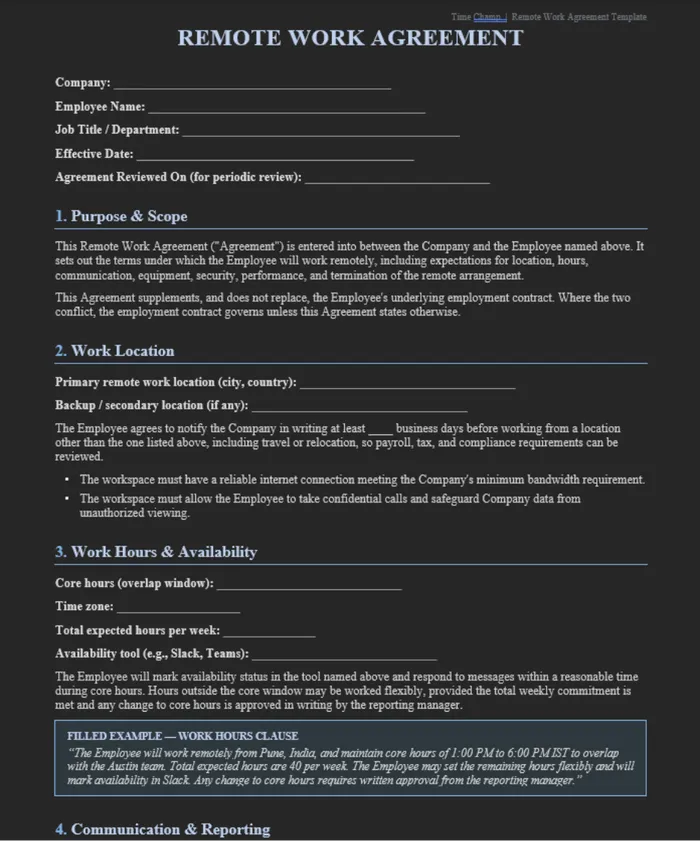
A good remote work agreement should answer the questions that commonly confuse later. Use the checklist below when creating or reviewing your agreement.
| Clause | What to Include |
|---|---|
| Work hours & time zone | Core working hours, employee's time zone, weekly hours, availability, and flexibility. |
| Communication | Communication channels, response time expectations, meeting schedule, and escalation process for urgent issues. |
| Performance expectations | Goals, deliverables, performance metrics, review frequency, and reporting requirements. |
| Equipment & reimbursement | Company-provided equipment, expense reimbursement, internet or home office stipend, ownership, and return policy. |
| Data security | Approved devices, VPN requirements, password policies, file storage, and incident reporting procedures. |
| Health & safety | Workspace requirements, ergonomic expectations, and reporting process for work-related incidents. |
| Duration | Whether the arrangement is permanent, temporary, or a trial period, along with review dates. |
| Termination | Notice requirements, reasons for ending the arrangement, equipment return, and access revocation. |
Pay extra attention to the work hours and equipment clauses. Instead of writing vague terms like "normal business hours," specify the exact working hours and time zone. Likewise, clearly state who owns company equipment, when it must be returned, and who is responsible for its condition. These small details prevent many of the disputes that arise in remote work arrangements.
Free Remote Work Arrangement Template (Word & PDF)
What Happens After Everyone Signs?
Signing the agreement isn't the finish line, it's where the real work begins. To keep the agreement effective, both you and your employees should:
- Review Expectations Regularly: Check that working hours, availability, communication, and responsibilities still match the role.
- Track Agreed Working Hours: Make sure actual work schedules align with the hours defined in the agreement.
- Monitor Communication and Collaboration: Confirm that response times, meetings, and check-ins are happening as expected.
- Ensure Security Practices are Followed: Verify that employees are using approved devices, VPNs, and secure file-sharing methods.
- Watch for Signs of Overwork: If employees consistently work beyond their agreed hours, address workload before burnout becomes an issue.
- Use Workforce Insights: Tools like Time Champ provide visibility into attendance, work hours, and productivity trends, helping you ensure the agreement is being followed without depending on assumptions.
- Update the Agreement When Needed: Revise the document whenever responsibilities, schedules, work locations, or company policies change.
Make Your Remote Work Agreements Work in Practice!
Monitor work hours, attendance, and productivity with Time Champ
Common Remote Work Agreement Mistakes to Avoid
Even the best template won't help if it's filled with vague or outdated information. Most remote work agreement issues stem from a few avoidable mistakes. Before sending the agreement for signature, check for these common red flags:

- Using Vague Availability: Avoid phrases like "normal business hours." Clearly specify working hours, the employee's time zone, and any required overlap with the team.
- Ignoring the Employee's Location: Working from another state or country may affect tax, employment, and labor law obligations. Make sure the agreement reflects the employee's actual work location.
- Leaving Out Equipment Terms: State who provides company equipment, who owns it, and when it must be returned if the arrangement ends.
- Copying the Same Template for Every Country: Employment laws vary by jurisdiction. Review and adapt the agreement for local legal requirements instead of reusing it unchanged.
- Misclassifying Workers: Don't use the same agreement for employees and independent contractors. Each relationship has different legal and tax implications.
- Never Updating the Agreement: Review the agreement whenever job responsibilities, work schedules, company policies, or legal requirements change.
A remote work agreement should evolve with the role. Reviewing it regularly helps ensure it remains accurate, compliant, and useful for both you and your employees.
Conclusion
A well-written remote work agreement sets clear expectations before misunderstandings have a chance to arise. Defining responsibilities, communication, work hours, security, and equipment policies creates a smoother experience for both you and employees. Use the free remote work agreement template as a starting point, customize it to fit your organization, and review it regularly as roles and business needs evolve.

Jahnavi Pulluri

Table of Content
 What is a Remote Work Agreement?
- Remote Work Agreement vs. Policy vs. Contract
- Why Do You Need a Remote Work Agreement?
- What to Include in a Remote Work Agreement Template
- Free Remote Work Arrangement Template (Word & PDF)
- What Happens After Everyone Signs?
- Common Remote Work Agreement Mistakes to Avoid
- Conclusion
Related Blogs

Learn about employee rights in hybrid work, including pay, benefits, overtime, privacy, workplace safety, promotions, accommodations, and compliance laws.
Anjali | Jun 05, 2026
See what the data says about hybrid work productivity gains, including productivity, retention, engagement, cost savings, and long-term business impact.
Thasleem Shaik | Jun 08, 2026
Hybrid work offers savings, but hidden costs can erode ROI. Explore 9 expenses and practical ways to identify them before they grow.
Guna Lakshmi | Jun 06, 2026
Protect sensitive business data in hybrid work environments with strong security controls and practical strategies to prevent data breaches.
Guna Lakshmi | Jun 10, 2026
Hybrid work tax implications can affect payroll, tax residency, employer compliance, and multi-state obligations. Get key insights and risks in one guide.
Thasleem Shaik | Jun 11, 2026
Discover the best hybrid work tools in 2026 to improve collaboration, communication, productivity, and team management across your distributed teams.
Anjali | Jun 13, 2026


 4.7/5 avg.
Ready to Manage Your Workforce Smarter?
Join our family of 1500+ companies using smart insights to redefine workforces!

Free Trial
No Credit Card Required