Hybrid Work Tax Implications: Rules, Risks, and Compliance
Hybrid work tax implications can affect payroll, tax residency, employer compliance, and multi-state obligations. Get key insights and risks in one guide.

Hybrid work offers flexibility, but it can also create unexpected tax challenges when work happens across different states, regions, or countries. Even a simple work arrangement can affect hybrid work tax implications related to payroll withholding, tax residency, compliance requirements, and reporting obligations.
As tax rules often depend on where you perform work, even small location changes can lead to added complexity. This guide breaks down the key hybrid work tax implications, common risks, and practical compliance considerations to help you navigate them with greater confidence.
Why Hybrid Work Multiplies Your Tax Footprint
Most businesses think about taxes in terms of where the company is located. Hybrid work tax implications break that assumption completely. Here is why that matters at scale.
- Tax Obligations Follow the Worker, Not the Office: You must withhold state income tax based on where work is actually performed, regardless of where your company is headquartered. If a hybrid employee splits their week between your office in one state and their home in another, you may need to withhold taxes in both. That applies even if they only work from home one day a week.
- Nexus Expands with Every New Work Location: Nexus is the legal connection that gives a state the right to tax your business. Traditional nexus required physical offices or storefronts. Remote employees now create nexus in any state where they regularly work, which can trigger corporate income tax, sales tax, and unemployment insurance obligations.
- The Landscape Shifted Again: The One Big Beautiful Bill Act (OBBBA), signed into law on July 4, 2025, permanently extended the individual tax rates introduced under the 2017 TCJA, preventing a tax increase that would have affected an estimated 62% of filers. While the law introduced new federal tax deductions, states may not adopt these changes uniformly. For hybrid workers and employers operating across multiple states, tax reporting and compliance requirements can still vary significantly depending on where employees perform work and where taxpayers owe taxes.
If your team has grown or shifted to a hybrid model in the last two years, your multi-state hybrid work tax exposure has almost certainly grown with it, whether you planned for it or not.
Create a more structured hybrid workplace with clear visibility into attendance and work patterns.
Use Time Champ to manage and see how work happens across hybrid teams clearly.
7 Hybrid Work Tax Obligations You're Legally Responsible For
Here are the seven key tax obligations that can arise in a hybrid work environment and what each one means for payroll and compliance.
1. State Income Tax Withholding
This is the most common compliance gap in hybrid employee tax withholding. The rule is straightforward. You must withhold state income tax based on where the work happens, not where your office is. If a hybrid employee splits their week between a home state and your office in another state, you may owe withholding in both states. Some states calculate this on a pro-rata basis tied to the number of days worked in each state, while others use different methods.
Pro Tip: Tax withholding rules vary by state. Consult a qualified tax professional or your state's department of revenue for withholding requirements specific to your workforce.
2. Unemployment Insurance Registration
Every state where your employees regularly work requires you to register for unemployment insurance (UI) tax in that state. The dollar amounts involved are usually smaller than income tax withholding, so many employers overlook this requirement. However, penalties for late or missing registration can be significant, and most states require you to register before issuing the first paycheck.
If you have five hybrid employees working across four different states, you may need UI registration in all four. Check each state's department of labor for registration timelines and rates.
3. Local City and County Taxes
State taxes are the most visible requirement, but many US cities and counties also impose their own income or wage taxes. Cities such as Philadelphia, New York City, and Detroit, along with many cities in Ohio and Kentucky, require local wage tax withholding. If an employee works from one of these locations, even on a part-time basis, your business may have local tax obligations even without a physical office there.
This is often overlooked in hybrid work payroll tax compliance. In many cases, payroll systems do not automatically identify these requirements.
4. Corporate Income Tax Nexus
This is one of the most important obligations on the list. When an employee regularly works in a state, their presence can create nexus, which is the legal connection that gives a state the right to tax their business income. Once an employee creates nexus, your business may need to pay corporate income tax in that state, in addition to payroll taxes.
Some states apply economic nexus or factor presence rules, which means they can impose these tax obligations more easily than many businesses expect. If you plan to hire hybrid employees in a new state, it is best to consult a CPA before making the hire rather than after.
5. Sales Tax Nexus
A remote or hybrid employee working in a state can also create sales tax nexus in that state, which means you may need to collect and remit sales tax on transactions with customers there. This applies to product-based businesses and, in many states, to SaaS and service companies as well.
The tax implications of hybrid work extend further than most finance teams account for in their initial nexus mapping. If you have not audited sales tax exposure by employee location, that is a gap worth addressing with your tax counsel.
6. Workers' Compensation Coverage
Workers' compensation requirements vary by state, and they apply wherever your employees work. If a hybrid employee works from a state where your current coverage does not apply, you will generally need to obtain workers' compensation coverage that meets that state's requirements.
Many businesses overlook this requirement because they set up workers' compensation coverage once and do not review it regularly. When employees work across multiple states, you need coverage that matches their actual work locations, not just your company headquarters address.
7. State Disability and Paid Leave Programs
Several states require participation in state-run disability insurance or paid family leave programs. States such as California, New York, New Jersey, Massachusetts, Washington, and Connecticut have mandatory requirements that may involve payroll deductions, employer contributions, or both. If a hybrid employee works in one of these states, your business may need to comply with that state's program requirements, even if your home state does not have a similar program.
Pro Tip: State programs and contribution rates change year to year. Verify current requirements directly with the relevant state agency or your payroll provider.
A Note on All Seven Obligations: These rules apply in every state where your hybrid employees actually perform work. The compliance exposure grows as your team's work locations multiply, which is exactly why tracking real work location data matters for your hybrid workforce tax compliance process, not just home addresses. For the checklist that ties all of this together, jump to the 5-step compliance audit section below.
What Changed Under OBBA and How It Affects Your Hybrid Workforce
The One Big Beautiful Bill Act (Public Law 119-21), signed into law on July 4, 2025, is the most consequential federal tax change for hybrid employers since the TCJA. Key provisions affecting hybrid workforces:
1. Individual Tax Rates Made Permanent
The OBBBA permanently extended the individual tax rates introduced under the 2017 TCJA. For employees, this helps maintain current take-home pay levels. For businesses, payroll withholding calculations remain more predictable and consistent.
2. New Below-the-Line Deductions on Schedule 1-A
OBBBA introduced new deductions on the new Schedule 1-A targeting overtime pay, tips, and vehicle loan interest. These deductions mainly affect how employees file their federal tax returns. However, businesses may need to review how they record overtime pay and tips to maintain accurate tax records.
3. Home Office Deduction (Still Suspended for W-2 Employees)
Many hybrid employees ask about claiming home office expenses. Important clarification: the federal home office deduction for W-2 employees is not available because the TCJA suspended it, and the OBBBA continues that suspension. Only self-employed individuals and 1099 contractors can claim home office deductions, and only if they meet the IRS regular-and-exclusive-use tests (IRS Publication 587). Employers should not advise W-2 hybrid employees that they can deduct home office expenses federally.
4. State Conformity Variation
States vary in how they adopt federal tax law changes. Some adopt OBBBA provisions automatically, while others require legislative action. Businesses in hybrid arrangements across multiple states must track conformity state-by-state.
Managing hybrid attendance and work patterns without the right visibility is a constant struggle.
Time Champ gives you that visibility and keeps tracking simple.
Reciprocity Agreements That Simplify Withholding
Reciprocity agreements are bilateral arrangements between states that allow employees to pay taxes only to their resident state, even when they work in the partner state. This dramatically simplifies multi-state withholding for hybrid workforces operating across reciprocal state lines.
Current major reciprocity agreements include:
| State | Reciprocity States |
|---|---|
| Arizona | California, Indiana, Oregon, and Virginia |
| Illinois | Iowa, Kentucky, Michigan, and Wisconsin |
| Indiana | Kentucky, Michigan, Ohio, Pennsylvania, and Wisconsin |
| Iowa | Illinois |
| Kentucky | Illinois, Indiana, Michigan, Ohio, Virginia, West Virginia, and Wisconsin |
| Maryland | Pennsylvania, Virginia, Washington, D.C., and West Virginia |
| Michigan | Illinois, Indiana, Kentucky, Minnesota, Ohio, and Wisconsin |
| Minnesota | Michigan and North Dakota |
| Montana | North Dakota |
| New Jersey | Pennsylvania |
| North Dakota | Minnesota and Montana |
| Ohio | Indiana, Kentucky, Michigan, Pennsylvania, and West Virginia |
| Pennsylvania | Indiana, Maryland, New Jersey, Ohio, Virginia, and West Virginia |
| Virginia | Kentucky, Maryland, Pennsylvania, Washington, D.C., and West Virginia |
| Washington, D.C. | Maryland and Virginia |
| West Virginia | Kentucky, Maryland, Ohio, Pennsylvania, and Virginia |
| Wisconsin | Illinois, Indiana, Kentucky, and Michigan |
Source: Thomson Reuters
5-Step Hybrid Workforce Tax Compliance Checklist
Run this checklist to quickly review your current payroll tax obligations and identify any compliance gaps that need attention this quarter.
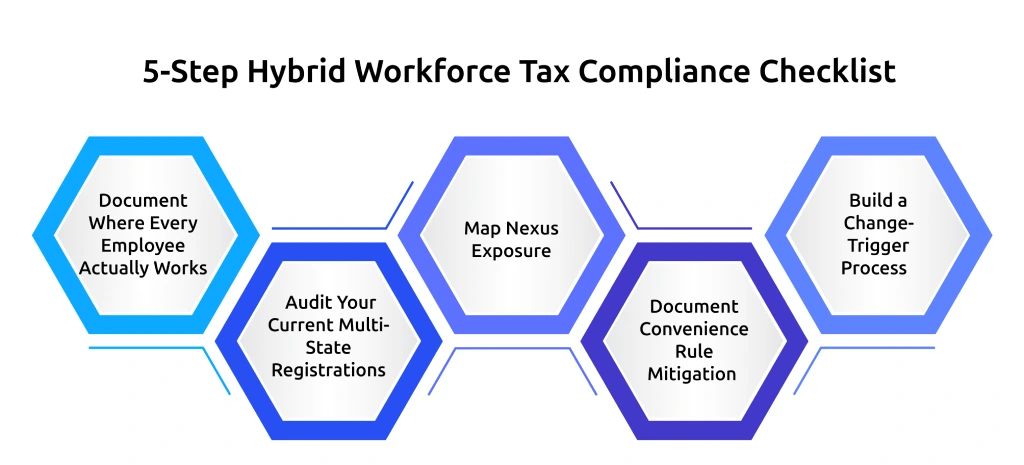
Step 1: Document Where Every Employee Actually Works
You cannot comply with multi-state tax rules if you don't know where employees are working. Build a clear record of each employee's home state, primary work state, secondary work states, and days worked in each. Tools like Time Champ help track work locations accurately, making it easier to maintain reliable records and reduce dependence on manual employee updates.
Step 2: Audit Your Current Multi-State Registrations
For each state where employees work, verify you have registered for state income tax withholding, unemployment insurance, workers' compensation coverage, and any state disability/paid leave program. List the registrations you have and the ones you don't. Prioritize and complete any missing registrations within 30-60 days.
Step 3: Map Nexus Exposure
For each state with an employee, evaluate whether you have created a corporate income tax nexus or a sales tax nexus. This usually requires a Certified Public Accountant's (CPA) input because nexus thresholds vary significantly. Obtain a written opinion from a qualified tax professional.
Step 4: Document Convenience Rule Mitigation
Employees in convenience-rule states (New York, Pennsylvania, Delaware, Nebraska, and Arkansas) should have the business necessity of their remote work documented. A short-written record stating "employee X performs role Y remotely because [specify business reason]" is the kind of documentation tax professionals typically advise. Get current legal advice on what documentation you must provide and what it should include.
Step 5: Build a Change-Trigger Process
Tax compliance is not a one-time audit. Establish a process for new hires in new states, employees who move, employees who switch primary work locations, and changes in state tax law (OBBBA showed how quickly the landscape moves). Quarterly reviews of work location data flag changes before they become liabilities.
Track Hybrid Work More Clearly with Time Champ
Clear hybrid work records start with knowing where work happens and how each workday is structured. When you track office days, remote days, attendance, and shift patterns in one place, it becomes easier to stay organized and reduce confusion across your hybrid setup.
That is where Time Champ fits well. Time Champ is an employee monitoring and time tracking software with workforce intelligence features. It helps you track work locations, attendance, and shifts with more visibility, so you can see who is working remotely and who is in the office without depending on scattered updates. It also gives you a clearer view of daily work patterns, which supports better planning in a hybrid work environment.
Know who is working remotely, who is in the office, and where work happens.
Get the visibility you need to manage hybrid teams with Time Champ.
Conclusion
Hybrid work gives employees more flexibility, but it also creates tax responsibilities for both employers and workers. Payroll withholding, tax residency, nexus, and reporting requirements can change when employees work from different locations. To avoid compliance issues, keep accurate records, track where employees work, and review your tax obligations regularly as your hybrid workforce grows and changes.
Imp Note: This article provides general educational guidance only. Tax laws change frequently and vary by state. Consult a qualified CPA or tax attorney for advice specific to your business.

Thasleem Shaik

Table of Content
 Why Hybrid Work Multiplies Your Tax Footprint
- 7 Hybrid Work Tax Obligations You're Legally Responsible For
- What Changed Under OBBA and How It Affects Your Hybrid Workforce
- Reciprocity Agreements That Simplify Withholding
- 5-Step Hybrid Workforce Tax Compliance Checklist
- Track Hybrid Work More Clearly with Time Champ
- Conclusion
Instant Signup
Thank you for your request!
We have received your signup request and our team will get back to you soon. In the meantime, you can book a demo to see Time Champ in action.
Book a DemoFree trial. No credit card required. Prefer a walkthrough? Book a demo.
Related Blogs

Learn about employee monitoring laws, what they mean for businesses, and how they protect employee privacy and rights.
Shabana Shaik | Jul 10, 2024
Get answers to the most asked questions about employee monitoring laws, including legal considerations and privacy rights for compliant workplace monitoring.
Thasleem Shaik | Aug 17, 2024
Stay informed on employee GPS tracking laws and policies, including state regulations, device compliance rules, and how to create a legal tracking policy.
Thasleem Shaik | October 09, 2025
Understand how employee monitoring privacy laws in the U.S. affect your business, what you can track, the rules to follow, and how to stay compliant.
Thasleem Shaik | Apr 15, 2026
What is legal and what is risky when monitoring employee personal devices? A 2026 compliance guide covering consent, BYOD law, state notices, and global rules.
Shaik Shabana | May 14, 2026
Learn how to create and implement a successful hybrid work policy with our top 7 tips. Boost productivity and keep your team engaged.
Sai Keerthi Uppala | Nov 14, 2024


 4.7/5 avg.
Ready to Manage Your Workforce Smarter?
Join our family of 1500+ companies using smart insights to redefine workforces!

Free Trial
No Credit Card Required