6 Common Productivity Tracking Mistakes to Avoid in 2026
Avoid common productivity tracking mistakes that disrupt rollouts. Get practical fixes, self-audit checklist, and clear guidance for successful implementation.

Many teams find that productivity tracking seems simple in the beginning. They set up a system, start monitoring work patterns, and expect clear insights into performance. But in practice, many teams struggle to get real value from it. The problem usually isn’t the tool itself, but the common productivity tracking mistakes that shape how tracking is introduced, used, and understood across your team.
In this blog, you’ll learn the most common productivity tracking mistakes and how to avoid them effectively. You’ll see where things go wrong, how to fix them with simple steps, and how to make your productivity tracking more clear, effective, and reliable.
If you’re looking for a step-by-step approach, read our introduction guide.
Best Ways to Introduce Productivity Monitoring to an Organization

Did You Know?
According to Forbes , around 60% of companies use monitoring software to track remote employees. This shows how common productivity tracking has become, but many teams still struggle to get meaningful results from it.
What are the Most Common Productivity Tracking Mistakes?
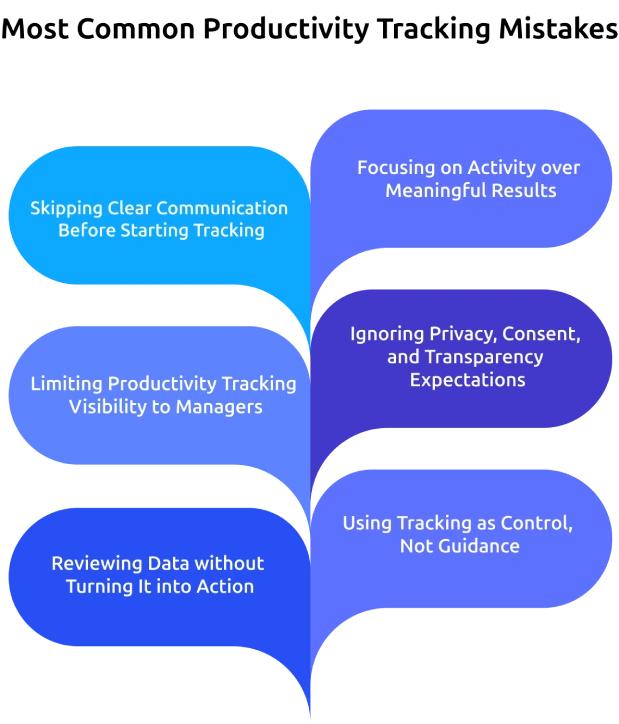
Many teams adopt productivity tracking with clear goals, but the results often fall short because of a few common productivity tracking mistakes. These issues don’t always appear immediately, but they affect how your data is interpreted and how your team responds to tracking. Understanding these common productivity tracking mistakes helps you avoid confusion, build trust, and get more accurate insights from your system.
Mistake 1: Skipping Clear Communication Before Starting Tracking
When productivity tracking is introduced without proper communication, employees will make their own assumptions. This often creates confusion, resistance, or even concern about how the data will be used. Without clarity, even well-intended tracking can feel uncomfortable and reduce trust across the team.
Clear communication sets the foundation for successful productivity tracking. When you explain the purpose, what will be tracked, and how it benefits both the team and the business, employees are more likely to accept and engage with the system. This level of transparency helps to build trust and keeps everyone aligned from the start.
Mistake 2: Focusing on Activity over Meaningful Results
Many teams rely heavily on activity data like active time, clicks, or hours worked. While this data is easy to capture, it doesn’t always reflect real productivity or actual progress. Employees may appear busy without contributing to meaningful outcomes.
Effective productivity tracking focuses on results that matter, such as completed tasks, project progress, or goal achievement. When you prioritize outcomes, you get a clearer view of performance and avoid misleading conclusions. This shift helps your team stay aligned with real business goals.
Mistake 3: Limiting Productivity Tracking Visibility to Managers
When only managers can access productivity tracking data, it creates an imbalance in the workplace. Employees may feel constantly monitored, which can reduce trust and engagement. This one-sided visibility often leads to misunderstandings during performance discussions.
Giving employees access to their own data changes how they interact with productivity tracking. It encourages accountability, self-improvement, and more open conversations. When everyone sees the same information, tracking becomes a shared tool not just a control mechanism which supports stronger employee engagement.
Did You Know?
According to American Psychological Association , 56% of employees who are monitored at work report feeling tense or stressed. This shows how productivity tracking can impact on employee experience when not handled carefully.
Mistake 4: Ignoring privacy, consent, and transparency expectations
Productivity tracking without clear privacy practices can quickly create discomfort among employees. When they are unsure about what is being tracked or how their data is handled, it leads to hesitation and lack of trust. This is one of the most common productivity tracking mistakes teams make.
Setting clear policies around privacy, gaining consent, and being transparent about data usage builds confidence. When employees know their boundaries are respected, they become more comfortable with the system. Strong privacy practices can also protect your organization from potential risks.
Mistake 5: Reviewing data without turning it into action
Collecting data is only the first step in productivity tracking. Many teams review dashboards regularly but fail to act on the insights they see. Over time, this makes tracking feel pointless and reduces its impact on performance improvement.
Productivity tracking becomes valuable when it leads to decisions and improvements. Using insights to adjust workflows, support employees, or improve planning makes the data meaningful. Taking consistent action on these insights helps to drive real progress.
Mistake 6: Using tracking as control, not guidance
When productivity tracking is used mainly to control or monitor employees, it creates pressure without any improvement. Employees may focus on appearing productive while meaningful work gets less attention. This approach can harm employee morale and reduce long-term effectiveness.
Using productivity tracking as a guide helps to create a more supportive environment. It allows you to identify patterns, offer help, and improve performance over time. When tracking is positioned as a tool for growth, it strengthens both trust and results.
Finding it hard to turn productivity tracking data into meaningful decisions?
Start using Time Champ to simplify tracking and drive real improvements across your team.
How to Avoid Common Productivity Tracking Mistakes in the future?
Avoiding the common productivity tracking mistakes depends on how you set up and use system from the beginning. When your approach is clear, practical, and aligned with your team’s workflow, productivity tracking becomes easier to adopt and more effective in delivering real insights.
Start with a clear rollout plan
Take time to plan how productivity tracking will be introduced across your team. Define your goals, outline the process, and communicate how it will be implemented. A clear rollout helps to reduce uncertainty and ensures everyone understands what to expect from the start.
Define what productivity means for your team
Productivity is not the same for every role. Identify what meaningful output looks like for each team, so your tracking reflects actual performance. Clear and relevant explanations make your data more accurate and easier to use.
Build visibility and trust in the system
Ensure that your team has access to the same data and understands how it is being used. When visibility is shared, employees feel more involved and confident in the process. This transparency supports stronger engagement with productivity tracking.
Set clear boundaries around data and usage
Be clear about what data is collected and how it will be used. When expectations and limits are defined early, employees feel more comfortable with the system. This clarity helps to maintain trust and keeps the process transparent.
Create a habit of using insights regularly
Make productivity tracking part of your regular workflow by reviewing insights consistently. Use the data to guide decisions, improve processes, and support your team. Regular use ensures that the system continues to add value.
Keep improving your tracking approach over time
As your team and workflows evolve, your productivity tracking approach should adapt as well. Review what is working, adjust, and refine your setup when needed. Ongoing improvements keep your tracking relevant and effective.
How does Time Champ help avoid these common productivity tracking mistakes?
You may already have a productivity tracking system in place, but the results still feel unclear or inconsistent. Data gets collected, but it doesn’t always translate into better decisions. Teams may feel disconnected from the process, and over time, tracking becomes something you manage not something that helps you. This is where having the right system makes a real difference, not just in what you track, but in how your team experiences it. That’s where Time Champ, an employee monitoring software with a productivity tracking layer, fits in as a more structured and practical solution.
Time Champ is built to help you avoid these common productivity tracking mistakes by making tracking clear, transparent, and actionable. It offers two-way dashboards by default, so everyone works with the same data, improving visibility and trust. Privacy controls and policy templates help you define clear boundaries, while outcome-friendly reporting keeps the focus on meaningful work. With role-based metric setup, each team is measured based on what matters to their work. This way, productivity tracking becomes easier to manage and more effective in driving real improvements.
Struggling with unclear insights, low adoption, or confusion in productivity tracking?
Start using Time Champ to bring clarity, transparency, and real results to your team.
Conclusion
Productivity tracking works best when it is implemented with clarity, purpose, and consistency. Many teams struggle not because of the tools they use, but because of how the system is introduced and managed. Through avoiding the common productivity tracking mistakes, you can create a setup that supports your team, improves visibility, and delivers meaningful insights. When tracking is transparent, outcome-focused, and used regularly, it becomes a reliable part of your workflow. The goal is not just to collect data, but to use it in a way that drives better decisions and steady improvement across your team.

Anjali

Table of Content
-
 What are the Most Common Productivity Tracking Mistakes?
-
How to Avoid Common Productivity Tracking Mistakes in the future?
-
How does Time Champ help avoid these common productivity tracking mistakes?
-
Conclusion
Related Blogs
Explore how to implement employee monitoring software effectively with clear steps, legal tips, best practices, ROI metrics, and key pitfalls to avoid.
Anjali | April 15, 2023
Discover the best ways to introduce productivity monitoring in your organization smoothly and effectively.
Thasleem Shaik | March 18, 2025
Boost team productivity and performance with effective tracking methods. Enhance productivity through data-driven insights and actionable strategies.
Shabana Shaik | March 17, 2025
Understand employee monitoring legal compliance, key laws, and best practices to track work activity while protecting privacy and avoiding legal risks.
Thasleem Shaik | April 14, 2026
Learn how to boost productivity by finding the right balance in employee monitoring, focusing on key indicators, and maintaining transparency for a driven team.
Tarun Kumar | March 14, 2025
Want to boost productivity? Uncover 20 time tracking best practices that can transform your workflow and help you achieve more with less effort.
Guna Lakshmi | July 1, 2025


 4.7/5 avg.
Ready to Manage Your Workforce Smarter?
Join our family of 1500+ companies using smart insights to redefine workforces!

Free Trial
No Credit Card Required