ITO vs BPO: Key Differences and How to Choose the Right One
Compare ITO vs BPO, understand the key differences, benefits, and costs, and choose the right outsourcing model for your business.
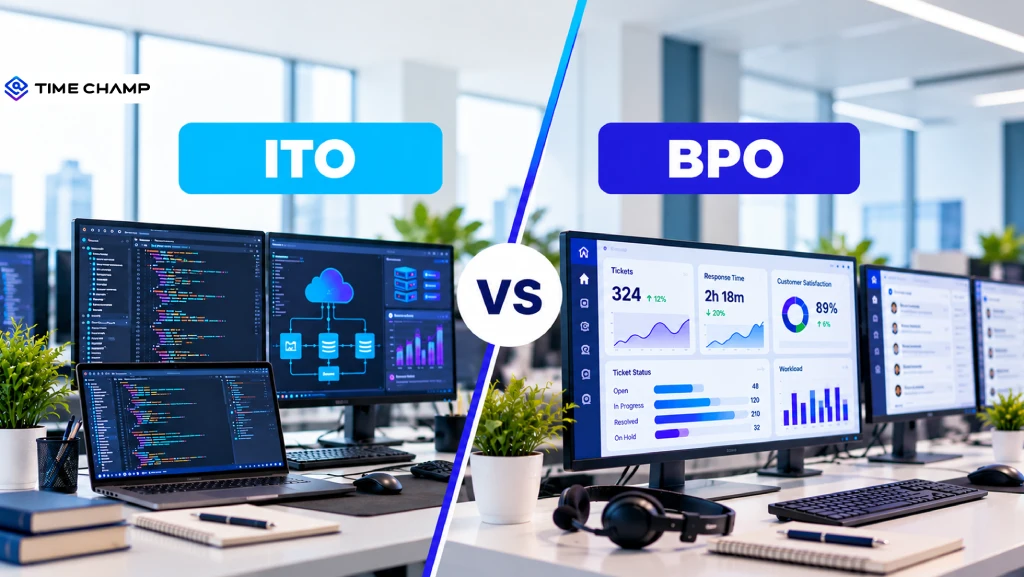
When you’re looking to outsource business operations, choosing between ITO (Information Technology Outsourcing) and BPO (Business Process Outsourcing) can be challenging. Understanding ITO vs BPO can help you see which model better fits your business goals. Both can help you reduce costs, improve efficiency, and access specialized expertise, but they serve different needs.
In this guide, you’ll learn the key differences between ITO and BPO, their benefits, common use cases, and what you should consider when choosing the right outsourcing model for your business.
What Is ITO (IT Outsourcing)?
Information Technology Outsourcing (ITO) is the practice of hiring an external provider to handle specific IT functions or services instead of managing them entirely in-house. It can include services such as software development, cloud management, cybersecurity, IT support, infrastructure management, and data management.
This allows you to access specialized technical expertise, reduce IT costs, and focus your internal teams on core business priorities.

Did You Know?
Grand View Research estimates that the global IT services outsourcing market was worth $797.4 billion in 2025 and projects it to reach $1.5 trillion by 2033.
What Is BPO (Business Process Outsourcing)?
Business Process Outsourcing (BPO) is the practice of hiring an external provider to manage specific business processes or non-core operations on your behalf. These services can include customer support, payroll, accounting, human resources, data entry, and back-office operations. BPO helps you reduce operational costs, improve efficiency, and allow your internal teams to focus on core business activities.
Want to measure BPO performance more effectively? Explore our guide on BPO KPIs to learn which metrics matter most.
Want better visibility into your outsourced workforce?
Explore how Time Champ can help you track time, productivity, and attendance in one place.
ITO vs BPO: Key Differences
ITO and BPO may both involve outsourcing work to external providers, but they differ in what they handle and the value they provide. ITO focuses primarily on IT and technology-related functions, while BPO focuses on specific business processes and operations. The table below highlights the key differences to help you understand which model may better suit your business needs.
| Factor | ITO (IT Outsourcing) | BPO (Business Process Outsourcing) |
|---|---|---|
| Primary Focus | IT functions and technology services | Business processes and operations |
| Main Objective | Improve IT capabilities, technology, and infrastructure | Improve operational efficiency and reduce costs |
| Typical Services | Software development, cloud management, cybersecurity, IT support, and infrastructure management | Customer support, payroll, accounting, HR, data entry, and back-office operations |
| Skills Required | Technical and IT expertise | Process-specific and business expertise |
| Technology Dependency | High | Moderate to high, depending on the process |
| Common Users | Businesses needing specialized IT expertise or support | Businesses looking to outsource routine or non-core business processes |
| Key Benefits | Access to specialized IT talent, improved technology capabilities, and lower IT costs | Lower operational costs, improved efficiency, and access to specialized process expertise |
Where ITO and BPO Overlap
Although ITO and BPO focus on different areas, they can overlap when business processes rely heavily on technology. Both models allow you to delegate non-core work to external providers, access specialized expertise, reduce costs, and improve operational efficiency.
- Cost Savings: Both help you reduce the cost of managing functions in-house.
- Specialized Expertise: You can access skilled professionals without hiring and training large internal teams.
- Technology Use: Both often rely on tools such as automation, cloud platforms, analytics, and collaboration software.
- Scalability: You can easily scale outsourced services based on changing business needs.
- Operational Efficiency: Both can simplify processes and allow your internal teams to focus on core business activities.
- Customer Support: ITO can manage the technology behind support systems, while BPO providers can handle customer interactions.
Manage Your Outsourced Teams More Effectively
Whether you use ITO, BPO, or both, Time Champ helps you track productivity, attendance, and work activity with ease.
What Services Does KPO Include?
Knowledge Process Outsourcing (KPO) involves outsourcing tasks that require specialized knowledge, analytical skills, and professional expertise. Unlike BPO, which often focuses on routine business processes, KPO handles more complex, knowledge-intensive work.
Common KPO services include:
- Market Research and Analysis: Gathers and analyzes market trends, competitors, and customer insights.
- Data Analytics and Business Intelligence: Turns complex data into insights that support better business decisions.
- Financial Research and Analysis: Analyzes financial data, markets, investments, and business performance.
- Legal and Compliance Research: Researches laws, regulations, and compliance requirements.
- Content and Technical Research: Creates and researches specialized content, reports, and technical information.
- Healthcare and Pharmaceutical Research: Supports research related to healthcare, medicines, clinical data, and industry trends.
In simple terms, ITO focuses on technology, BPO focuses on business processes, and KPO focuses on knowledge-intensive work that requires specialized expertise.
Did You Know?
The global KPO market was valued at $102.2 billion in 2025 and is projected to reach $275.4 billion by 2033, growing at a 13% CAGR.
How to Choose Between ITO and BPO (or Use Both)
Selecting the right outsourcing model requires a clear understanding of your business requirements, objectives, and available resources. Follow these steps to make an informed decision:
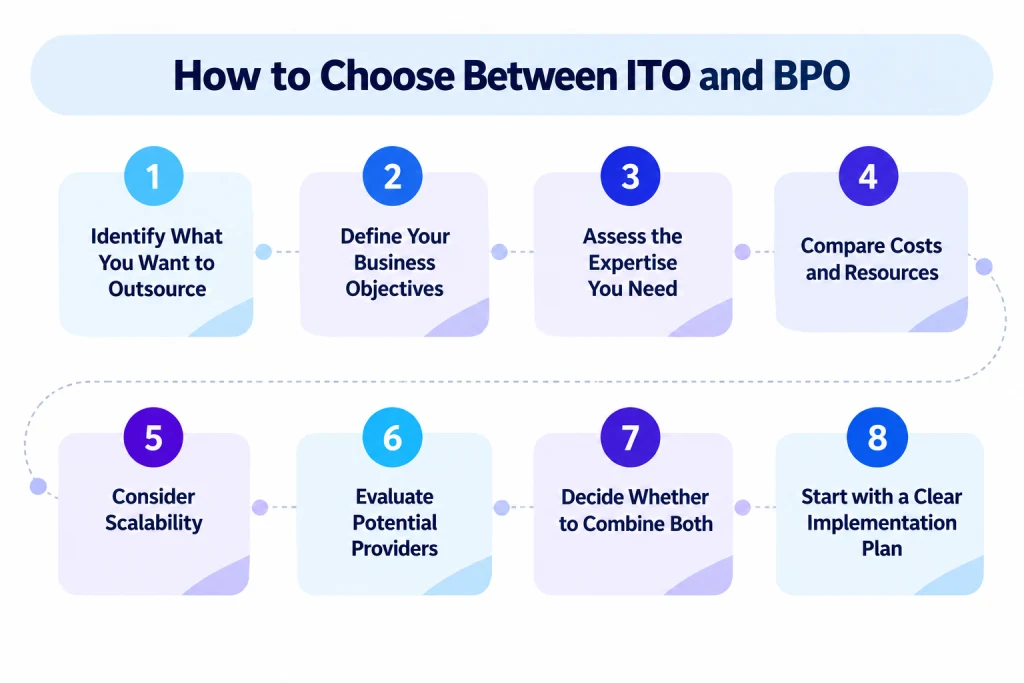
1. Identify What You Want to Outsource
Begin by identifying the functions, processes, or tasks you want to outsource. IT infrastructure, software development, and cybersecurity typically align with ITO, while customer service, payroll, accounting, and administrative processes are common BPO functions.
2. Define Your Business Objectives
Determine what you want to achieve through outsourcing, whether it is reducing operational costs, improving efficiency, accessing specialized expertise, or increasing scalability. Clear objectives will help you evaluate providers and measure the success of your outsourcing strategy.
3. Assess the Expertise You Need
Evaluate the skills and expertise required to manage the functions you plan to outsource. Technology-focused requirements generally point toward ITO, while process management and operational expertise are more closely associated with BPO.
4. Compare Costs and Resources
Compare the expected outsourcing costs with the expenses involved in managing the function internally. Consider hiring, training, technology, infrastructure, and ongoing management costs to understand the overall financial impact.
5. Consider Scalability
Assess whether the outsourcing model can adapt to changes in your business requirements and workload. A scalable provider should be able to increase or reduce resources as your operational needs change.
6. Evaluate Potential Providers
Assess providers based on their industry experience, technical capabilities, service quality, security measures, pricing, and track record. You should also review their communication processes and ability to align with your business requirements.
7. Decide Whether to Combine Both
You do not always have to choose between ITO and BPO. If you need technology support alongside outsourced business operations, combining both models can help you address different business requirements through specialized providers.
8. Start with a Clear Implementation Plan
Once you select a model or provider, establish clear responsibilities, performance expectations, timelines, and communication channels. A well-defined implementation plan can make the transition smoother and minimize disruptions to your existing operations.
Choose the right outsourcing model with better workforce visibility.
Time Champ helps you track productivity, attendance, and work activity across your outsourced teams.
Manage Your Outsourced Workforce with Time Champ
Once you choose the right outsourcing model, managing productivity, attendance, and work patterns across your outsourced teams becomes equally important. Time Champ can help you gain better visibility into how your remote and distributed teams spend their work time without relying on manual tracking.
With Time Champ, you can:
- Track work hours and attendance across remote and distributed teams.
- Monitor productivity trends to understand how teams are performing.
- Identify workload patterns and potential productivity gaps.
- Track application and website usage to understand work activity.
- Generate detailed reports to support workforce management decisions.
- Improve accountability while giving you better visibility into daily work.
Whether you use ITO, BPO, or both, Time Champ can help you manage workforce performance more effectively and make data-driven decisions about your outsourced teams.
Ready to Improve Your Outsourced Team’s Performance?
Make smarter workforce decisions with Time Champ. Start your free trial today and improve team productivity.
Conclusion
Choosing between ITO vs BPO depends on your business needs, goals, and the type of work you want to outsource. ITO focuses on technology, while BPO focuses on business processes, and using both can help you address different operational needs.
With Time Champ, you can also track productivity, attendance, and work patterns across your outsourced teams. This helps you improve visibility, accountability, and workforce efficiency while keeping your focus on core business priorities.

Guna Lakshmi

Table of Content
 What Is ITO (IT Outsourcing)?
- What Is BPO (Business Process Outsourcing)?
- ITO vs BPO: Key Differences
- Where ITO and BPO Overlap
- What Services Does KPO Include?
- How to Choose Between ITO and BPO (or Use Both)
- Manage Your Outsourced Workforce with Time Champ
- Conclusion
Related Blogs

Business process outsourcing (BPO) vs Knowledge process outsourcing (KPO). Discover definitions of BPO and KPO, key functions, similarities, and use cases.
Guna Lakshmi | Apr 02, 2026
Explore top BPO companies offering tailored solutions. Find the right partner to boost efficiency, cut costs, and drive your business growth!
Mounika Sai | Nov 24, 2023
Learn what the call center occupancy rate is, the formula, how to calculate it, what a good occupancy rate is, and how it differs from utilization.
Oct 27, 2026
Track the most important BPO KPIs to measure agent performance, productivity, customer satisfaction, and overall contact center success in 2026.
Guna Lakshmi | Oct 02, 2026
Explore the various types of Business Process Outsourcing (BPO) services, their benefits, and how they streamline operations for businesses.
Mounika Sai | Nov 21, 2023
BPO stands for Business Process Outsourcing and it entails the hiring of external companies to perform certain jobs.
Vijaya Lakshmi | Apr 02, 2024


 4.7/5 avg.
Ready to Manage Your Workforce Smarter?
Join our family of 1500+ companies using smart insights to redefine workforces!

Free Trial
No Credit Card Required