What Is Double Time Pay? Rules, Calculation, and Examples
Learn what double time pay is, when it applies, how to calculate it, and explore the differences between double time pay and overtime pay.

If you're responsible for managing payroll, scheduling employees, or ensuring labor law compliance, understanding double time pay is essential. Miscalculating double time can lead to payroll errors, employee disputes, and compliance risks.
In this guide, you'll learn how double-time pay works, when you're required to pay it, and how to calculate it accurately to prevent compliance issues and unexpected payroll costs.
What Is Double Time Pay?
Double time pay is additional compensation paid to employees at twice their regular hourly rate when they work under certain conditions, such as extended shifts, consecutive workdays, or designated holidays. The rules can vary based on state labor laws, union agreements, and employer policies.
Understanding when double time pay applies can help you ensure accurate payroll, maintain compliance, and avoid costly wage disputes.
Double Time Pay = Regular Hourly Rate × 2 × Hours Eligible for Double Time
How to Calculate Double Time Pay
Calculating double-time pay is simple once you know the employee's regular hourly rate and the hours that qualify. Follow these four steps to calculate it accurately.
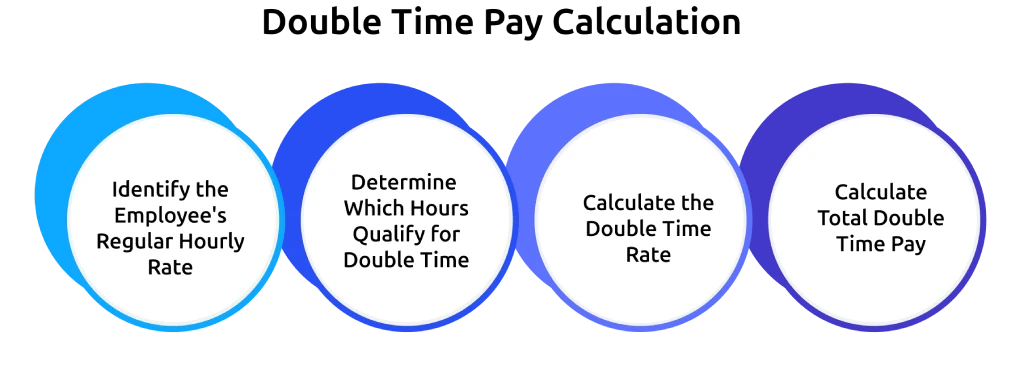
Step 1: Identify the Employee's Regular Hourly Rate
Start by determining the employee's regular hourly wage. For hourly employees, this is their standard hourly rate. For salaried employees, divide their weekly salary by the number of hours they typically work in a week.
Formula:
Regular Hourly Rate = Weekly Salary ÷ Total Hours Worked Per Week
Example: If an employee earns $1,200 per week and works 40 hours, their regular hourly rate is calculated as:
$1,200 ÷ 40 = $30 per hour.
Step 2: Determine Which Hours Qualify for Double Time
Next, identify the hours that are eligible for double time pay. The qualifying hours depend on applicable labor laws, union agreements, or company policies.
Example: In California, employees may qualify for double time after working more than 12 hours in a workday or more than 8 hours on the seventh consecutive workday.
Step 3: Calculate the Double Time Rate
Multiply the employee's regular hourly rate by 2 to calculate their double time rate.
Formula:
Double Time Rate = Regular Hourly Rate × 2
Example: If the regular hourly rate is $30, the double time rate is $60 per hour.
Step 4: Calculate Total Double Time Pay
Multiply the double time rate by the number of double time hours worked.
Formula:
Double Time Pay = Double Time Rate × Double Time Hours
Or:
Double Time Pay = Regular Hourly Rate × 2 × Double Time Hours
Add this amount to the employee's regular pay and any applicable overtime pay to determine total earnings for the pay period.
Double Time Pay Example
Understanding the formula is important but seeing it in action makes double time pay easier to calculate. Here's a practical example that shows how regular pay, overtime pay, and double time pay work together.
Example: Employee Works a 14-Hour Shift in California
Let's assume an employee earns $25 per hour and works 14 hours in a single workday.
Under California overtime rules:
- First 8 hours = Regular pay
- Hours 9–12 (the 4 hours worked after the first 8 hours) = Time and a half (1.5x)
- Hours 13–14 (the final 2 hours worked after 12 hours in the same day) = Double time (2x)
Step 1: Calculate Regular Pay
Formula: Regular Pay = Regular Hours Worked × Hourly Rate
8 hours × $25 = $200
Step 2: Calculate Overtime Pay (1.5x)
Overtime pay is an additional wage earned when an employee works beyond standard working hours and is typically paid at 1.5 times the regular hourly rate. The formula is:
Formula: Overtime Pay = Overtime Hours × (Regular Hourly Rate × 1.5)
4 hours × ($25 × 1.5) = $150
Step 3: Calculate Double Time Pay
Formula: Double Time Hours × (Regular Hourly Rate × 2)
2 hours × ($25 × 2) = $100
Total Earnings for the Day:
| Pay Type | Hours | Rate | Total |
|---|---|---|---|
| Regular Pay | 8 | $25 | $200 |
| Overtime Pay (1.5x) | 4 | $37.50 | $150 |
| Double Time Pay (2x) | 2 | $50 | $100 |
| Total Pay | 14 | $112.50 | $450 |
In this example, the employee earns$450 for the 14-hour shift, including $100 in double time pay. This demonstrates why accurately tracking regular, overtime, and double time hours is essential for payroll accuracy and labor law compliance.
Double Time Pay vs Overtime
While overtime and double time both increase employee pay for extra work, they apply at different rates and under different conditions. Understanding the distinction helps you calculate employee pay accurately and stay compliant with labor laws.
| Factor | Overtime Pay (Time and a Half) | Double Time Pay |
|---|---|---|
| Pay Rate | 1.5× the employee's regular hourly rate | 2× the employee's regular hourly rate |
| Purpose | Compensates employees for working beyond standard hours | Provides additional compensation for extended hours or special circumstances |
| Typical Trigger | Working more than the standard daily or weekly hours | Working beyond higher overtime thresholds, certain holidays, or consecutive workdays (depending on applicable rules) |
| Example Rate | Employee earning $20/hour receives $30/hour | Employee earning $20/hour receives $40/hour |
| Payroll Cost | Higher than regular pay | Higher than both regular pay and overtime pay |
| Federal Requirement | Required for eligible employees under the Fair Labor Standards Act (FLSA) after 40 hours in a workweek | Generally not required under federal law; depends on state laws, union agreements, or employer policies |
| Common Use Cases | Extra shifts, extended workweeks, peak workloads | Long shifts, seventh consecutive workdays, or holiday work where applicable |
| Calculation Formula | Regular Hourly Rate × 1.5 × Overtime Hours | Regular Hourly Rate × 2 × Double Time Hours |
Common Double Time Pay Mistakes You Make
Even small mistakes in double time calculations can lead to payroll errors, compliance issues, and employee disputes.
Here are some of the most common mistakes employers make when managing double-time pay:
- Paying regular overtime (1.5x) when employees actually qualify for double time (2x).
- Missing employees who work more than the daily double-time threshold, such as 12+ hours in a day.
- Assuming all salaried employees are exempt from overtime and double-time rules.
- Failing to track employee hours accurately results in missed double time payments.
- Calculating double time using the wrong hourly rate.
- Treating holiday work as double time without verifying company policy or legal requirements.
- Using manual spreadsheets for payroll calculations increases the risk of costly errors.
- Not reviewing state-specific labor laws that may require double time pay.
- Waiting until payroll processing to identify double time hours instead of tracking them in real time.
How Time Champ Helps With Double Time and Overtime Tracking
Managing overtime and double time pay manually can be time-consuming and prone to errors. Time Champ provides a smarter way to monitor employee work hours and payroll-related activities.
Time Champ is an employee monitoring and time tracking software that helps you accurately track work hours, monitor overtime and double time, and simplify payroll management.
- Automatic Time Tracking: Track employee work hours in real time without relying on manual timesheets, ensuring accurate records for payroll calculations.
- Identify Overtime and Double Time Hours: Automatically monitor work hours and quickly identify when employees approach or exceed overtime and double-time thresholds.
- Accurate Payroll Calculations: Reduce payroll errors by using precise time data to calculate regular pay, overtime pay, and double time pay.
- Simplify Compliance Management: Maintain detailed attendance and work-hour records to support labor law compliance and simplify audits.
- Generate Automated Timesheets: Get accurate timesheets based on tracked work hours, making it easier to calculate overtime and double time, and process payroll faster.
- Detailed Reports and Insights: Access reports on attendance, overtime hours, and workforce utilization to improve productivity and control labor expenses.
Simplify Double Time Tracking and Reduce Compliance Risks with Time Champ
Conclusion
Managing double time pay accurately helps you prevent payroll errors, ensure compliance with labor laws, and maintain employee trust. Understanding when double time applies and calculating it correctly helps you simplify payroll and reduce costly mistakes.
Automating time tracking and payroll processes with tools like Time Champ makes it easier to manage overtime, double time, and compliance with confidence.

Guna Lakshmi

Table of Content
 What Is Double Time Pay?
- How to Calculate Double Time Pay
- Double Time Pay Example
- Double Time Pay vs Overtime
- Common Double Time Pay Mistakes You Make
- How Time Champ Helps With Double Time and Overtime Tracking
- Conclusion
Related Blogs

Learn what time tracking is, why it matters in 2026, the best methods, and how to implement it without team pushback. A practical guide for modern teams.
Jahnavi Pulluri | May 19, 2026
Discover the pros and cons of time tracking software, its key features, and how it can improve productivity, accountability, and overall team performance.
Jahnavi Pulluri | Jun 05, 2026
Looking for the best freelance time tracking software? Explore the top free and paid tools to track work hours, manage projects, and improve productivity.
Guna Lakshmi | May 18, 2026
Learn how time tracking improves remote team productivity through better visibility, accountability, performance tracking, and smarter team management.
Anjali | May 16, 2026
Explore the top benefits of productivity tracking software for better visibility, balanced workloads, smarter planning, and improved business decisions.
Guna Lakshmi | Apr 30, 2026
A practical guide to choosing productivity tracking software for your team, with comparisons of features, pricing, privacy, security, and rollout risks.
Jahnavi Pulluri | May 01, 2026


 4.7/5 avg.
Ready to Manage Your Workforce Smarter?
Join our family of 1500+ companies using smart insights to redefine workforces!

Free Trial
No Credit Card Required