Break Time Policy: Essentials, Types & Free Template
A complete guide to creating a break time policy, covering break types, legal requirements, best practices, common challenges, and a free template.

A clear break time policy can make the difference between a productive workday and a workplace filled with confusion. Without clear guidelines, breaks may be taken inconsistently, some employees may skip them altogether, while others may take longer than expected. Over time, this can lead to fatigue, scheduling issues, compliance concerns, and frustration across your team.
Creating a well-defined employee break policy helps set clear expectations, supports employee well-being, and keeps daily operations running smoothly. In this guide, you'll learn what a break time policy should include, the different types of workplace breaks, key legal considerations, and how to use a free break time template to build a policy that works for your organization.
What Is a Break Time Policy?
A break time policy is a set of guidelines that explains when employees can take breaks during the workday, how long those breaks should be, and whether they are paid or unpaid. It helps create clear expectations around meal breaks, rest breaks, restroom access, and other workplace breaks, so daily work stays organized and consistent.
A well-defined employee break policy also helps support employee well-being while reducing confusion about break schedules and break entitlements. Depending on your location, a workplace break policy may also need to align with federal, state, or local labor requirements. When written clearly, it becomes easier to apply the policy fairly across in-office, remote, and hybrid teams.
Why a Break Time Policy Matters?
A study found that microbreaks of at least 10 minutes can meaningfully improve employee performance by supporting focus, motivation, and recovery from work-related stress. A clear policy helps make these benefits a consistent part of the workday through structured and well-defined break practices. Here are the key reasons why every workplace needs a well-defined employee break policy.
- Supports Employee Health and Well-Being: Regular breaks give employees time to rest, recharge, and return to work with better focus and energy. They also help reduce fatigue and support overall well-being throughout the day.
- Improves Job Satisfaction and Workplace Experience: When break expectations are clearly defined, employees know when and how they can take their allotted breaks. This creates a more balanced work environment and helps employees feel supported in their daily work.
- Helps Maintain Compliance with Break Laws: Break requirements can vary depending on federal, state, and local labor laws. A clear workplace break policy helps you document break rules, communicate expectations, and reduce the risk of compliance issues related to meal breaks, rest breaks, or special accommodations.
- Prevents Extended or Inconsistent Breaks: Without clear guidelines, break times can become inconsistent across teams. Some employees may skip breaks, while others may take longer breaks than intended. A well-defined break time policy helps create consistency and keeps daily schedules running more smoothly.
- Creates Better Workforce Planning: Clear break schedules support effective workforce planning by helping you maintain smooth operations throughout the workday. This reduces disruptions, prevents staffing gaps, and makes it easier to coordinate workloads across teams and shifts.
Looking for a simpler way to manage employee breaks?
Try Time Champ to track break times, maintain accurate records, and keep your policy on track.
Free Break Time Policy Template
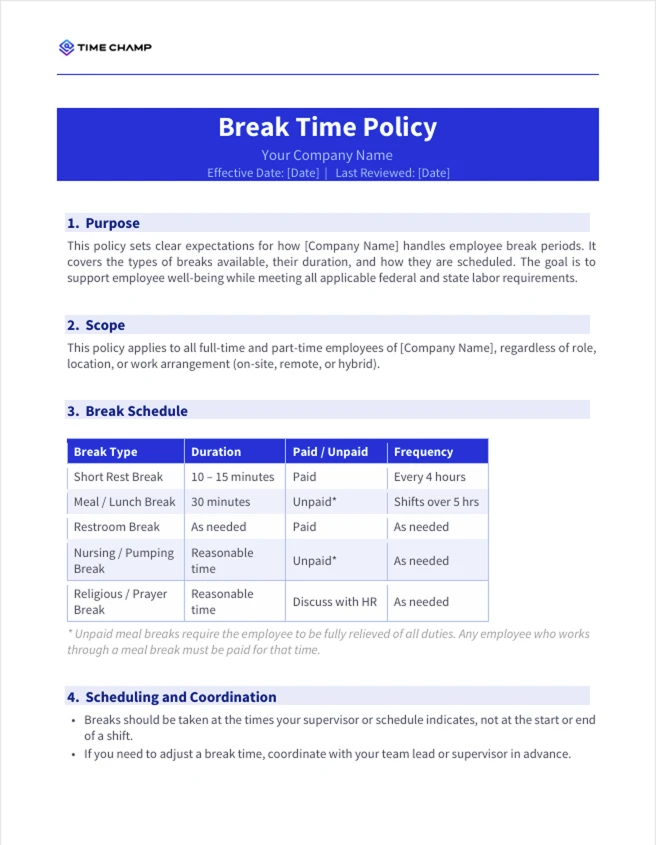
A written break time policy does not have to be complicated. It just needs to be clear. Your team should understand what breaks they receive, how long those breaks last, whether they are paid, and what to do when a break falls outside the standard schedule. Keeping this information in one document reduces confusion, promotes consistency across the workplace, and provides a clear record if compliance questions arise.
The break time policy template below includes the key elements needed to create a clear and effective policy. Fill in the bracketed fields with your company's information, adjust the break durations to align with your state's requirements, and share the policy with your team before it takes effect. If you operate in a state with specific meal or rest break rules, such as California or Minnesota, review the schedule section carefully and update it to match those requirements before implementation.
Types of Breaks at Work
Employees take breaks to rest, eat meals, attend to personal needs, manage health requirements, or observe religious practices. Understanding these different break types can help you create a break time policy that supports employee well-being while maintaining consistency across the workplace.
Here are the most common types of breaks at work.

1. Lunch Breaks
Lunch breaks give employees time to eat, rest, and step away from work during the day. These breaks typically last between 30 minutes and one hour. While lunch breaks are not always required by law, many workplaces provide them for longer shifts to help reduce fatigue and support better focus.
2. Short Breaks
Short breaks usually last 10 to 15 minutes and give employees time to rest, grab a snack, or recharge between tasks. These breaks are often paid and can help maintain energy levels and concentration throughout the workday.
3. Essential Restroom Breaks
Restroom breaks are necessary for employee health, comfort, and hygiene. Employees should have access to restroom facilities whenever needed. OSHA standards require reasonable restroom access to support employee well-being in the workplace. Restricting restroom access can affect both employee health and workplace morale.
4. Accommodating Smoke Breaks
Smoke breaks allow employees to step away from work briefly to smoke during the workday. If you allow smoke breaks, it is important to create a fair approach that treats all employees consistently. One study estimated that spending just eight minutes per workday on smoking breaks could cost businesses around $1,641.14 per smoker each year, showing why clear break guidelines are important.
5. Health Breaks
Health breaks give employees time to manage medical needs during working hours. These breaks may be used for taking medication, attending a medical appointment, stretching, or addressing other health-related requirements that support overall well-being. Depending on company policies and legal requirements, health breaks may be paid or unpaid.
6. Honoring Religious Breaks
Religious breaks allow employees to take time for prayer or participate in other religious practices during the workday. Title VII of the Civil Rights Act requires reasonable accommodations for religious practices, helping employees meet their religious obligations while at work.
7. Breastfeeding Breaks
Breastfeeding breaks provide nursing employees with time to express breast milk during working hours. The Fair Labor Standards Act and the Affordable Care Act require reasonable break time and a private space other than a restroom for this purpose. These accommodations help employees balance their work and parenting responsibilities more effectively.
Want a simpler way to manage every type of employee break?
Use Time Champ to track breaks accurately, stay organized, and keep your break policy easy to follow.
Challenges in Implementing a Break Time Policy
Creating a break time policy is only the first step. Applying it consistently across different teams, schedules, and work environments can be more challenging. Here are common obstacles you may face when putting a break policy into practice.
1. Keeping Up with Labor Law Requirements
Break laws can vary from one state to another, making it challenging to maintain a consistent employee break policy across different locations. Requirements related to meal breaks, rest breaks, and workplace accommodations may differ, and regulations can change over time. Regularly reviewing your policy against current labor laws can help you stay compliant and reduce the risk of legal issues or workplace disputes.
2. Balancing Breaks with Daily Operations
Balancing employee breaks with daily operations can be difficult, especially during busy periods when workloads are high and schedules are tight. According to an ezCater Lunch Report, 51% of workers skip lunch at least once a week, while 33% skip it multiple times a week, often because of heavy workloads and packed schedules. When breaks are regularly delayed or missed, your policy becomes harder to follow in practice, making it important to build realistic break times into daily schedules.
3. Addressing Employee Resistance
Not everyone will follow a new break policy in the same way. Some employees may skip breaks, while others may take longer breaks than allowed. Resistance often happens when employees do not understand the purpose of the policy or view it as an unnecessary restriction. Clearly explaining the reasons behind the policy and applying it consistently can encourage better acceptance and reduce confusion across the workplace.
4. Monitoring and Enforcing the Policy
A break policy only works when you apply it consistently across the workplace. Tracking break times manually can become difficult as teams grow or work across multiple locations. Without proper oversight, missed breaks, extended break times, and inconsistent enforcement can create confusion and fairness concerns. Using automated time tracking software like Time Champ can make it easier to track breaks accurately and maintain consistency across your workforce.
Best Practices for Managing Break Time Policies
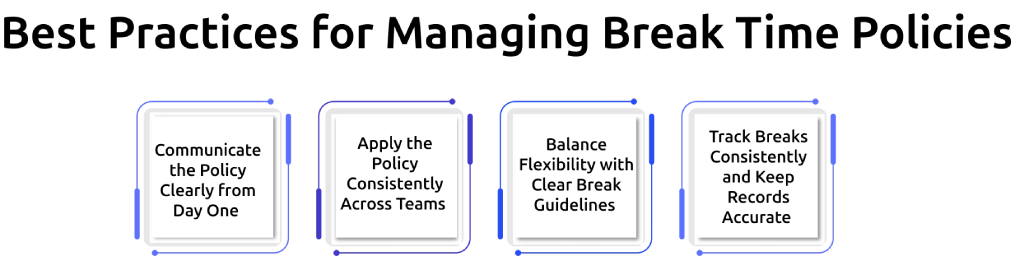
A good break time policy only works if you follow through on it. Writing it down is the easy part. The harder part is communicating it clearly, applying it fairly, and updating it when workplace needs or regulations change. These best practices can help you manage your policy more effectively.
1. Communicate the Policy Clearly from Day One
Most break-related issues start when employees do not have clear guidance on break rules and expectations. Share your workplace break policy with every new hire from day one, include it in your employee handbook, and make it easy to access whenever needed. When employees understand when to take breaks and what counts as paid time, they are more likely to follow the policy consistently.
2. Apply the Policy Consistently Across Teams
Inconsistent enforcement is one of the fastest ways to lose trust. If one team follows flexible break schedules while another team follows stricter rules, employees will quickly notice the difference. Whatever your employee break policy says, apply it consistently to employees in similar roles and situations. This also matters from a legal standpoint because inconsistent enforcement can increase the risk of wage disputes or discrimination claims.
3. Balance Flexibility with Clear Break Guidelines
Rigid break schedules do not work for every team, especially in remote or hybrid work environments. Instead of setting exact break times, define clear time ranges for when employees should take their breaks. For example, a short rest break sometime in the first half of a shift, and a meal break within a set range around midday. This gives employees more flexibility while maintaining the consistency and structure defined in your break policy template.
4. Track Breaks Consistently and Keep Records Accurate
Manual tracking often leads to missing records and makes audits more difficult. Using time tracking tools to record break times automatically creates more accurate records based on actual activity rather than manual entries. Accurate records can support compliance efforts and help resolve questions about employee break times.
How Time Champ Helps Manage Break Policies
Managing breaks across different teams, schedules, and work environments can quickly become difficult without accurate visibility into employee activity. Time Champ is an employee monitoring and time tracking software that helps you track attendance, break activities, and work hours from a single platform. Employees can clock in and clock out easily, while automated alerts notify you about late logins and attendance irregularities that may affect daily operations.
Time Champ tracks break time, idle time, away time, productive time, and non-productive time in real time, giving you a complete view of employee activity throughout the workday. With accurate records and actionable insights, you can identify missed breaks, extended breaks, unusual inactivity, and productivity patterns while maintaining consistency across remote, hybrid, and in-office teams.
Struggling to manage breaks across multiple teams?
Use Time Champ to gain better visibility into break activity and attendance patterns.
Conclusion
A thoughtful break time policy gives employees clarity without making the workday feel rigid. When expectations are simple, fair, and easy to follow, it becomes easier to support employees, reduce confusion, and maintain consistency across the workplace. A well-structured policy also creates a stronger foundation for compliance, improves the overall work experience, and makes break management more straightforward as your workforce grows and evolves.

Thasleem Shaik

Table of Content
 What Is a Break Time Policy?
- Why a Break Time Policy Matters?
- Free Break Time Policy Template
- Types of Breaks at Work
- Challenges in Implementing a Break Time Policy
- Best Practices for Managing Break Time Policies
- How Time Champ Helps Manage Break Policies
- Conclusion
Instant Signup
Thank you for your request!
We have received your signup request and our team will get back to you soon. In the meantime, you can book a demo to see Time Champ in action.
Book a DemoFree trial. No credit card required. Prefer a walkthrough? Book a demo.
Related Blogs

Track employee Paid Time Off effectively with PTO tracking software. Discover top solutions for well-being and company success.
Hima Bindhu Nara | Feb 16, 2024
Struggling with employee shift scheduling? Explore the best types, benefits, and strategies to streamline shifts, boost productivity, and keep your team happy!
Tarun Kumar Reddy | Mar 13, 2025
Discover practical ways to maintain work-life balance in the era of remote work, reduce burnout, and build healthier remote work habits.
Guna Lakshmi | Sep 29, 2026
Learn the benefits of a work time tracker, from boosting productivity to improving accuracy and streamlining workflow for better efficiency.
Thasleem Shaik | Mar 13, 2025
Setting the right time management goals can improve focus, organize priorities, and help you manage work with more clarity and consistency every day.
Thasleem Shaik | May 27, 2026
Track time across multiple devices without missing a second and learn key features, common challenges, and smarter tracking methods.
Guna Lakshmi | May 22, 2026


 4.7/5 avg.
Ready to Manage Your Workforce Smarter?
Join our family of 1500+ companies using smart insights to redefine workforces!

Free Trial
No Credit Card Required