Attrition vs Turnover: What Are the Key Differences
Understand attrition vs turnover, learn key differences, types, and rate calculations, and discover how workforce insights can help reduce employee loss.
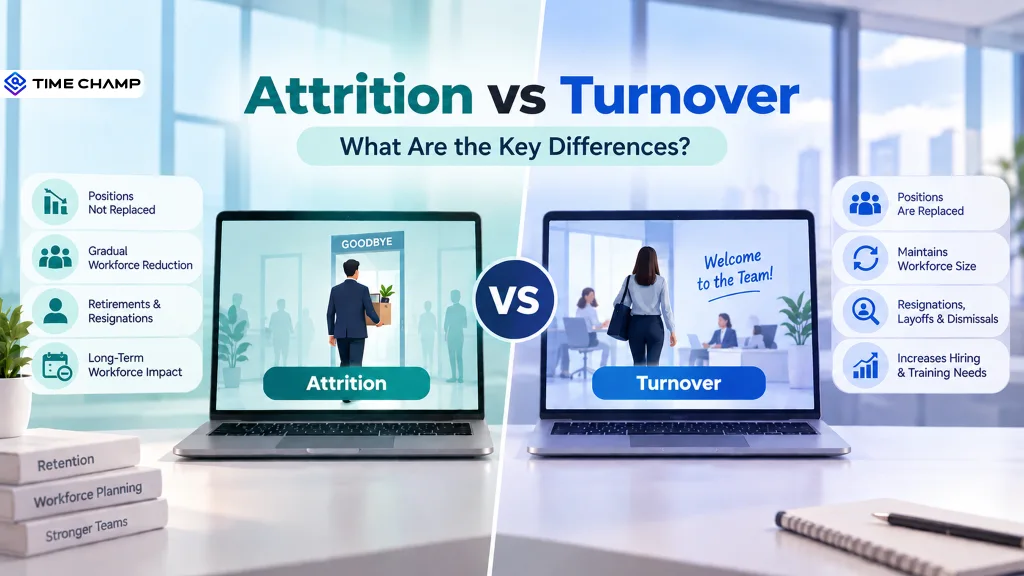
Employee exits can affect your workforce in very different ways, depending on why the employee leaves and whether the role is filled again. When these two are mixed up, you often end up misreading retention patterns and making reactive hiring decisions. Understanding attrition vs turnover helps you correctly interpret employee exits and their impact on your workforce.
Here you’ll understand the key differences, types, calculation methods, and ways to track these workforce metrics effectively.
What is Employee Attrition?
Employee attrition refers to the gradual reduction of your workforce when employees leave, and their positions are not immediately replaced. It can happen through resignations, retirements, or other natural departures, helping you assess long-term workforce stability and retention patterns.
What is Employee Turnover?
Employee turnover refers to the rate at which employees leave your organization during a specific period. It includes voluntary exits, such as resignations, and involuntary departures, such as dismissals or layoffs. Tracking turnover helps you understand workforce stability, anticipate hiring needs, and identify patterns that may affect employee retention.

Did You Know?
According to the U.S. Bureau of Labor Statistics, U.S. employers recorded 62.8 million employee separations in 2025, with quits accounting for 60.6% of them.
Attrition vs Turnover: What Is the Difference?
Although attrition and turnover both involve employees leaving your organization, they do not always describe the same workforce situation. The main difference comes down to what happens to the vacant position after an employee leaves.
| Factor | Employee Attrition | Employee Turnover |
|---|---|---|
| Meaning | Employees leave, and their positions are not replaced. | Employees leave, and their positions are filled by new employees. |
| Impact on workforce | Gradually reduces your overall headcount. | Usually maintains your workforce size through replacement hiring. |
| Replacement need | No immediate replacement is planned. | A replacement is typically needed to maintain staffing levels. |
| Common examples | Retirement, resignation, or role elimination where the position remains vacant. | Resignation, dismissal, or termination followed by replacement hiring. |
| Business impact | Can affect workload, capacity, and long-term workforce planning. | Can increase recruitment, onboarding, and training requirements. |
| What it tells you | Helps you understand workforce shrinkage and long-term staffing changes. | Helps you identify employee movement and recurring replacement needs. |
| HR response | Focus on workforce planning, succession, and capacity management. | Investigate why employees leave and improve retention where needed. |
How to Calculate Attrition and Turnover Rates
Knowing how many employees are leaving is only the first step. Calculating these rates helps you measure workforce movement consistently and compare trends across different periods. Both metrics generally use average headcount as the denominator, but the employees counted as departures can differ based on how your organization defines attrition and turnover.
Attrition Rate Formula (with example)
The attrition rate shows the percentage of employees who leave during a specific period and are not replaced. A common approach divides unreplaced departures by the average number of employees during that period and multiplies the result by 100.
Formula:
Attrition Rate (%) = (Number of Unreplaced Employee Departures/Average Number of Employees) × 100
For example, suppose your organization has an average of 500 employees during a year. If 25 employees leave and their positions are not replaced, your attrition rate would be:
(25/500) × 100 = 5%
This means your workforce experienced a 5% attrition rate during that period. Tracking this rate over time can help you identify workforce shrinkage and plan staffing needs more effectively.
Turnover Rate Formula (with example)
The turnover rate measures employee separations during a specific period against the average number of employees. It is calculated by dividing the number of employee separations by the average number of employees and multiplying the result by 100.
Formula:
Turnover Rate (%) = (Number of Employee Separations/Average Number of Employees) × 100
To calculate average headcount, you can use:
Average Number of Employees = (Employees at Start of Period + Employees at End of Period)/ 2
For example, if your organization has 450 employees at the beginning of the year and 550 at the end, the average headcount is 500. If 60 employees leave during the year, your turnover rate would be:
(60/ 500) × 100 = 12%
This gives you a 12% turnover rate for the year. Reviewing this metric by department, location, role, or time period can help you spot areas with unusually high employee movement. It is generally recommended to choose a measurement period and employee population that best fit the purpose of your analysis.
Finding it difficult to track workforce changes accurately?
Time Champ gives you clear insights into employee time, productivity, and workforce trends.
What are the Types of Employee Attrition and Turnover
Employee attrition and turnover can happen for different reasons and affect your workforce in different ways. Understanding each type helps you identify why employees leave, where workforce gaps may occur, and what action your HR team should take.
Types of Employee Turnover
- Voluntary Turnover: Employees choose to leave your organization for reasons such as better opportunities, compensation, career growth, or personal needs. Tracking these exits can help you identify patterns that may affect retention.
- Involuntary Turnover: The organization ends an employee’s employment because of performance issues, policy violations, layoffs, or restructuring. A high level of involuntary turnover may signal changes in business needs or workforce requirements.
- Functional Turnover: Lower-performing employees leave the organization, creating an opportunity to improve overall team performance. Replacing these employees with stronger talent can support better productivity and results.
- Dysfunctional Turnover: High-performing or highly skilled employees leave the organization, which can create knowledge gaps and disrupt team performance. Frequent dysfunctional turnover may also increase hiring, training, and replacement costs.
- Internal Turnover: Employees move to different roles, teams, or departments within the same organization. Although the employee remains with the company, the movement can create vacancies that require workforce planning.
Types of Employee Attrition
- Voluntary Attrition: Employees leave the organization by choice, but their positions are not filled after they depart. This can gradually reduce workforce size and may affect team capacity over time.
- Involuntary Attrition: The organization eliminates an employee’s position because of restructuring, downsizing, or changing business needs. Since the role is not refilled, the departure can lead to a permanent reduction in headcount.
- Retirement Attrition: Employees leave the workforce after reaching retirement age or choosing to retire. Planning for these departures helps you manage succession, knowledge transfer, and future staffing needs.
- Internal Attrition: Employees move out of a particular team or department while continuing to work elsewhere in the organization. This can reduce headcount within one area and require you to adjust workloads or staffing plans.
Did You Know?
According to the State of Company Culture Report, nearly half of U.S. employees were considering looking for a new job within three months. This highlights the importance of monitoring employee retention and identifying workplace factors that may contribute to attrition and turnover.
How Time Champ Helps Reduce Employee Attrition and Turnover
Reducing employee attrition and turnover starts with understanding the work patterns behind employee disengagement and performance changes. Time Champ is an employee monitoring software with workforce analytics features that gives you workforce visibility, productivity trends, workload insights, and early attrition signals. These can help you identify issues and take action before they lead to employee exits.
Here are the key features of Time Champ that help you identify workforce issues early and improve employee retention:
- Attrition Risk Signals: Highlights early signs of potential attrition through behavioral and workforce patterns, helping you spot disengagement risks early and take timely action to improve employee retention.
- Workload Management: Helps you identify workload imbalances and redistribute tasks across your team, reducing excessive workloads, preventing burnout, and creating healthier working patterns.
- Productivity Tracking: Tracks productive hours, focus time, idle time, and app usage to reveal changes in employee productivity, helping you identify performance gaps and provide the right support before issues grow.
- Attendance Tracking: Monitors attendance patterns, late arrivals, absences, and working hours, giving you a clearer view of workforce consistency and helping you address recurring attendance issues.
- Time Tracking: Records work hours across tasks and projects without manual entries, allowing you to use accurate time data to understand workload distribution and identify overworked or underutilized employees.
- Workforce Analytics: Brings productivity, attendance, workload, and workforce stability insights together, enabling you to compare trends across teams and identify changes that may require HR or managerial attention.
Struggling to spot employee retention risks early?
Time Champ helps you identify workforce patterns and take timely action.
Conclusion
Understanding attrition vs turnover helps you interpret employee exits and make better workforce decisions. While both metrics track employee movement, they can affect your workforce differently based on whether vacant roles are replaced. Start by tracking attrition and turnover rates consistently, then examine the patterns behind employee departures. Use workforce insights to identify workload issues, attendance concerns, productivity changes, and retention risks early. Take action before these issues lead to unnecessary employee loss. With the right monitoring approach, you can strengthen workforce planning, improve employee retention, and build a more stable and productive team over time.

Anjali

Table of Content
 What is Employee Attrition?
- What is Employee Turnover?
- Attrition vs Turnover: What Is the Difference?
- How to Calculate Attrition and Turnover Rates
- What are the Types of Employee Attrition and Turnover
- Types of Employee Turnover
- Types of Employee Attrition
- How Time Champ Helps Reduce Employee Attrition and Turnover
- Conclusion
Related Blogs

Attrition rate refers to the percentage or numerical representation of employees who leave a company over a specified period
Vijaya Lakshmi | Feb 13, 2024
Discover 10 ways HR teams can use workforce intelligence to improve hiring, retention, performance management, and drive smarter data-driven HR decisions.
Anjali | Feb 11, 2026
Learn what employee retention is, why it matters, and discover proven strategies to retain top talent, reduce turnover, and build a more engaged workforce.
Guna Lakshmi | Jul 22, 2026
Learn workforce intelligence's role in employee experience & retention, how it redefines engagement, and key strategies to reduce turnover effectively.
Chethana Choudary | Feb 11, 2026
Learn how employee monitoring supports work-life balance by detecting overwork, protecting boundaries, and helping teams build sustainable work patterns.
Anjali | Apr 23, 2026
Learn what employee satisfaction is, its benefits, the 7 key factors that drive it, and proven ways to measure and improve it at your workplace effectively.
Sai Keerthi Uppala | Jul 29, 2026


 4.7/5 avg.
Ready to Manage Your Workforce Smarter?
Join our family of 1500+ companies using smart insights to redefine workforces!

Free Trial
No Credit Card Required