Time Champ > Blog > 10 Ways HR Teams Use Workforce Intelligence Effectively > Content
10 Ways HR Teams Use Workforce Intelligence Effectively
Discover 10 ways HR teams can use workforce intelligence to improve hiring, retention, performance management, and drive smarter data-driven HR decisions.

HR teams can no longer rely on intuition as work becomes complex, distributed, and faster than ever. According to the U.S. Bureau of Labor Statistics, labor productivity in the U.S. declined in recent years, highlighting growing inefficiencies in how organizations plan and execute work.
Workforce intelligence provides clarity through transforming your daily workforce data into actionable insights. This helps teams to act faster, minimize inefficiencies, and develop a more engaged and productive workforce.
This blog will help you understand 10 effective ways HR departments use workforce intelligence to improve hiring, retention, and performance. You can understand how data-driven insights help to remain proactive, reduce challenges, and make smarter decisions about the workforce.
What are the 10 Ways HR Teams Can Use Workforce Intelligence?
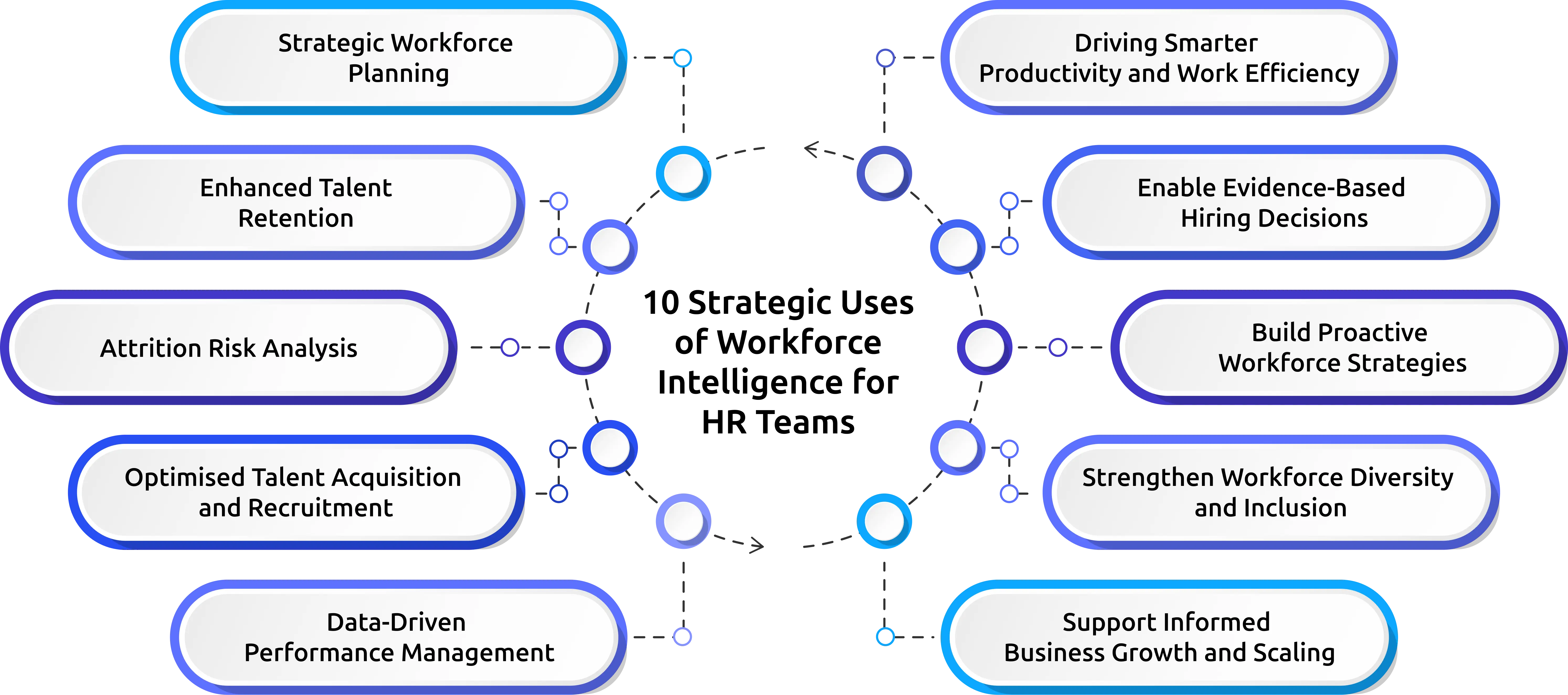
More than one-third of U.S employees now work in hybrid models or remotely. This transition changes how work actually happens and makes it more challenging for you to monitor employee engagement and productivity.
You can no longer depend on visibility alone to understand the workforce behavior. Workforce intelligence shows what truly drives collaboration, performance, and efficiency. This section will help you know how HR teams utilize insights to make accurate, smart, and impactful workforce decisions.
Strategic Workforce Planning
Workforce intelligence helps you to forecast future workforce needs with confidence and accuracy. You can analyze the skills demand trends and capacity to plan effectively and prevent talent shortages. This transparency helps you to align the workforce strategies with long-term business objectives.
You can mitigate workforce risks and eliminate last-minute hiring stress by understanding the current workforce capabilities and future demand. This strategy will keep your organization agile, prepared for growth and respond to any market disruptions.
Enhanced Talent Retention
Workforce intelligence helps you to understand what makes employees remain engaged and motivated. You can recognize the workload imbalances, employee engagement issues, and growth concerns before attrition rises. This insight can help you take immediate action and strengthen your employees’ loyalty.
When you react instantly to engagement signals, you can build credibility and prove that employee experience is important. This effective focus minimizes turnover costs and builds a more stable and committed workforce.
Attrition Risk Analysis
With workforce intelligence, you can identify the early warning signs of potential employee exits. Real-time data highlights the employee disengagement patterns, behavioral changes, and burnout risks. This effective approach helps you to retain critical talents and minimize unexpected turnover.
When you understand why employees disengage, you can design specific retention strategies that deliver meaningful impact. This data-driven strategy enables you to preserve institutional knowledge and continuity.
Optimized Talent Acquisition and Recruitment
Workforce intelligence enables you to hire candidates using proven performance information, reducing reliance on assumptions. You can easily recognize the skills, role demands, and successful employee traits. This approach can help to enhance the hiring quality, reduce time-to-hire, and support long-term workforce success.
You can minimize hiring mismatches and enhance new hiring productivity when the recruitment integrates with real workforce insights. This shows the robust onboarding results and accurate role effectiveness.
Data-Driven Performance Management
Workforce intelligence helps you to evaluate performance using real-time data. You can set accurate expectations, monitor the progress continuously, and support the employee’s growth by providing timely feedback. This creates fairness, transparency and better performance results across the teams.
The continuous performance insights replace the subjective reviews with quantifiable results. This allows you to facilitate objective, consistent, and growth-oriented development conversations.
Driving Smarter Productivity and Work Efficiency
Workforce intelligence reveals how employees utilize their work time, tools, and resources every day. You can identify the performance gaps, minimize the wasted efforts, and enable high-impact and focused work. This transparency will help you enhance efficiency while supporting sustainable well-being and performance.
You can enhance employee productivity without increasing burnout and stress, through optimizing how work is actually done. This balance helps both employee satisfaction and long-term success.
Enable Evidence-Based Hiring Decisions
Workforce intelligence helps you to validate hiring decisions with real-time performance information. This approach helps you to minimize the bias, enhance candidate quality, and increase long-term success. You can accurately hire employees with confidence by aligning the talent choices with proven workforce trends.
Evidence-based hiring helps you to build teams that work consistently and respond more accurately. The practice helps to empower workforce quality and contributes to fair and non-discriminatory recruitment.
Build Proactive Workforce Strategies
Workforce intelligence enables you to predict the workforce needs before any challenges arise. You can identify the trends early and create effective strategies which support business continuity. This effective approach strengthens workforce readiness, improves adaptability, and ensures that your teams remain prepared for change.
Proactive plans can help you to act instantly to organizational change, market shifts or workforce disruptions. This vision makes you a strategic business partner.
Strengthen Workforce Diversity and Inclusion
Analyze the workforce data to identify the gaps in equity and representation. This insight can help you build effective hiring procedures, growth, and promotion practices with more clarity. You can develop an effective workforce that facilitates innovation and sustained success.
Data-driven diversity practices ensure inclusion initiatives by providing quantifiable impact. This enhances culture, improves teamwork, and innovation across your teams.
Support Informed Business Growth and Scaling
Workforce intelligence aligns workforce capacity with your business expansion plans. You can forecast the talent requirements and assign the resources with high accuracy. This clarity will help you to scale operations while protecting performance, culture, and employee experience.
You can grow sustainably without compromising the quality of work or employees' interests by combining the workforce data with growth objectives. This helps to keep growth in control and aligned with organizational values.
Make Smarter HR Decisions with Real Workforce Insights.
Explore how Time Champ empowers data-driven HR teams today.
Conclusion
Workforce intelligence gives you the power to guide HR in a clear, confident, and controlled way in the current work environment. You can make hiring, retention, performance and productivity better by transforming workforce data into actionable insights. These strategies can make your teams proactive, manage risks, and create an effective workforce that can drive your organization towards long-term sustainable growth and business success.
When you lead with workforce intelligence, you don’t just manage people - you build stronger processes that support consistent growth and long-term business success.

Anjali

Table of Content
-
 What are the 10 Ways HR Teams Can Use Workforce Intelligence?
-
Conclusion
Related Blogs
Find the 10 best workforce intelligence software for 2026. Compare features, pricing, pros, cons to boost operational clarity and team performance.
Thasleem Shaik | February 11 2026
Learn what talent strategy is in workforce intelligence, how to create, implement & manage it effectively for a future-ready talent workforce.
Chethana Choudary | February 11 2026
Learn workforce intelligence's role in employee experience & retention, how it redefines engagement, and key strategies to reduce turnover effectively.
Chethana | February 11 2026
Learn why trust matters in workforce intelligence, how a privacy-first approach builds it, the key benefits, and how it protects company culture.
Thasleem Shaik | February 11 2026
Discover how workforce intelligence improves workload distribution, balances team capacity, prevents burnout & how to manage it with data effectively.
Tarun Kumar Reddy | February 11 2026
Learn what productivity intelligence is, why it's important, how it works, ways it transforms team performance, pros & cons, and how to measure it.
shabana Shaik | February 11 2026


 4.7/5 avg.
Ready to Manage Your Workforce Smarter?
Join our family of 1500+ companies using smart insights to redefine workforces!

Free Trial
No Credit Card Required