How to Stay Focused While Working From Home in 2026
Learn how to stay focused while working from home in 2026, with 8 research-backed tactics, the real cost of an interruption, and what fixes each distraction.

Working from home is peaceful and cost-efficient, but it brings in a lot of chaos and distractions. Those distractions come in the form of chores, kids, pets, or even simply noise.
Amid so many distractions, it becomes hard for you to stay focused when most of the distractions demand your presence.
So, in this blog, I am going to share a few effective tips that help you ace remote work.
Why Is It So Hard to Focus While Working From Home?
It is hard to focus while working from home because most interruptions are self-generated, and a home setup removes the social friction that used to stop them. A 2025 CHIWORK study found workers deviated from their main task every 3.5 minutes on average, with self-initiated interruptions accounting for nearly 60% of off-task time.
Almost every article on this topic treats distraction as something that happens to you: the doorbell, the flatmate, the mobile notification, a random noise, a surprise guest. The data says most of it is you, quietly deciding to check one thing. And it is a small study with only 15 participants, so treat it as a signal rather than a settled fact. But it matches what most remote workers will recognize in themselves.
Also, the same study found the average attention span within a single working sphere has dropped to about 6 minutes of focused work. In an office, standing up to get coffee is a visible act. At home, switching tabs costs nothing, and nobody really sees it. That is the real difference, and it is why how remote work impacts employee productivity looks so different depending on how the day is structured.
How Long Does It Actually Take to Refocus After an Interruption?
When knowledge workers were interrupted and returned to the same task later that day, it took them an average of 25 minutes and 26 seconds to get back to it, according to Mark, González, and Harris (CHI 2005). The study observed 24 knowledge workers across more than 700 hours. Before returning to the original task, they had worked on an average of 2.26 other tasks.
You have probably seen a different number.
"23 minutes and 15 seconds" appears in a large share of the articles written about focus. It cannot be traced to any published paper. The CHI 2008 study most often cited for it does not contain the number 23 and does not measure refocus time at all. What that study did find is more interesting anyway: interrupted people finished tasks slightly faster, but with significantly higher stress, frustration, and effort.
A Key Insight
Interruption does not just cost you time. It costs you roughly 25 minutes of re-entry, and it makes the same work feel harder. Which means protecting a two-hour block is not really a luxury, it is the difference between finishing something and paying the re-entry tax four times.
What Are the Biggest Distractions When Working From Home?
Generally, work-from-home distractions fall into five types, and they need genuinely different fixes. Most advice fails because it prescribes one solution, usually a dedicated workspace, for all five.
| Type | What it Looks Like | What Actually Fixes it |
|---|---|---|
| Self-interruption | Checking your phone, opening a new tab, "just looking something up" | Friction, not willpower. Phone in another room, one-tab rule, a written parking list for stray thoughts |
| Digital pings | Slack, Teams, email, meeting bots, AI summaries | Scheduled notification windows rather than permanent Do Not Disturb, which people always turn off |
| Household | Family, deliveries, flatmates, pets, chores in your eyeline | A visible signal others can read: closed door, headphones on, a stated finish time |
| Structural | Back-to-back calls, no protected block, unclear priorities | A calendar change, not a personal one. This is the one you cannot fix alone |
| Physiological | Poor sleep, no movement, skipped meals, an uncomfortable chair | Basic maintenance. This is unglamorous, and it beats every productivity app |
Before you fix anything, work out which two of these you actually have. For example, if your problem is structural, buying a better desk lamp will change nothing. And on the digital side, the load is heavier than it feels: Microsoft telemetry shows the average worker receives 117 emails and 153 Teams messages a weekday, with 57% of meetings being ad hoc calls that never appeared on a calendar.
Not sure which part of your day is actually costing you focus?
Time Champ shows where your hours went, so you can fix the right problem instead of guessing.
8 Ways to Stay Focused While Working From Home
I have ordered these best ways by how much difference they make, not by how easy they are. If you only do two, do the first two.
1. Protect One Two-hour Block Before You Open Anything Else
Pick your hardest task and start it before email, chat, or the news. This works because of the re-entry cost above: two protected hours produce more than five interrupted ones. Worklytics benchmarks put median daily focus time at 3.2 hours, with people reporting higher productivity above 3.5 hours, so one solid block is most of the target.
2. Put Your Phone in a Different Room, Not Face-down
Putting your mobile phone face down still means it’s reachable in one second, and self-intended interruptions are the largest category of WFH distractions. Moving your phone away creates a moment to decide whether you really need it. It’s the cheapest change on this list, yet most people skip it because it feels unnecessary.
3. Keep a Parking List for Stray Thoughts
When something unrelated comes to mind, write it down in one line and move on. Most self-interruptions happen because your brain is trying to simply not forget something. A simple list handles that better than opening another browser tab.
4. Give Your Notifications a Schedule Instead of a Switch
Keeping Do Not Disturb on all day often fails because people turn it off when they get anxious about missing something. Try three or four scheduled check-ins instead, and let your team know when you check messages. People are usually fine with a delayed reply when they were already warned about.
5. Make Your Workspace Boring on Purpose
A dedicated desk helps, but the real benefit is having nothing around that you would rather do. If you only have a corner of your bedroom, clear everything unrelated to work from that space. You do not need a spare room to make it work.
6. Take Breaks for Energy, and Do Not Expect Them to Fix Output
The evidence is more nuanced than the usual Pomodoro claim. A PLOS ONE meta-analysis of 22 samples found that micro-breaks improved vigour and reduced fatigue, but did not significantly improve performance. Longer breaks had a stronger effect than shorter ones, so take those well-deserved breaks, and make them proper ones.
7. Give the Workday an Ending
Slack's research found employees who log off at the end of the day have 20% higher productivity scores, while those who feel obliged to work after hours report twice the burnout. Tomorrow's focus starts with how well you switch off today.
8. Measure Two Weeks Before You Change Five Things
Track where your time actually goes for ten straight working days before changing your routine completely all over again. Most people are wrong about their own work patterns, especially when they do their best work. Two weeks of honest data beats a year of guessing, and it is more likely to help productivity habits stick.
How to Protect Your Focus on Hybrid Days
Most people who advise on focus assume you work from home five days a week, but modern working methods have changed that, and most people no longer work just from home, hybrid working model made its entry long ago. Gallup's latest data shows 52% of remote-capable employees are hybrid compared to 26% fully remote, which means the real question for most readers is how to protect two home days, not five.
So, What Usually Goes Wrong?
Home days quietly turn into meeting days.
Calls nobody wanted to schedule in the office get pushed to Tuesday and Thursday because “you are at home anyway,” and the two days meant for deep work become more broken up than the three in the office.
I suggest you call your home days focus days and protect them like how you would protect a client meeting. Gallup found that 64% of hybrid employees say the biggest benefit is using their time more efficiently through the week. But that only works when the split is intentional. If you manage people, watch whose home days are packed with meetings. It can be an early sign of burnout.
Focus Is a Design Problem, Not a Willpower Problem
No individual can out-discipline an environment that interrupts them constantly. Microsoft's 2025 Work Trend Index found employees are interrupted 275 times a day, roughly once every two minutes during work hours, and that 80% of the global workforce says they lack the time or energy to do their work.
Microsoft's 2026 report puts a number on where the leverage sits: organizational factors account for 67% of impact against 32% for individual mindset and behavior. Culture, manager support, and how work is structured matter roughly twice as much as personal effort.
If you lead a team, four changes do more than any advice you could give an individual:
- Protect a shared no-meeting block, ideally the same one every day
- Set an expected response time so nobody feels they must reply instantly
- Default to written updates, and make meetings the exception that has to be justified
- Judge output rather than presence, which also reduces proximity bias against the people who are quietest online
How Time Champ Helps You See Where Your Focus Actually Goes
Time Champ is an employee monitoring software, a time and productivity tracker, a wellness tracker, and also a workforce intelligence platform all combined into a solid platform to give you real and unhinged insights.
In this particular case, it captures work hours automatically and turns activity into patterns you can actually read. For the focus problem specifically, it answers the question this whole article depends on: where did all the time actually go?
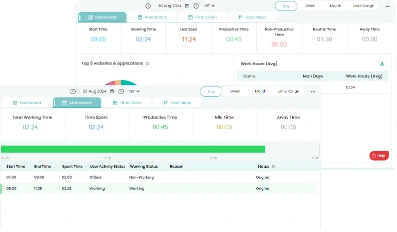
- Timeline View: Provides a color-coded, hour-by-hour breakdown of the day showing productive, away, and working time, which is how you find your genuine good hours instead of assuming them.
- Automatic Time Capture: Records hours without manual entry, so the two-week baseline in tip 8 happens on its own.
- Productivity Classification: Labels apps and websites as productive, non-productive, or neutral for your context, then shows the split rather than guessing at it.
- Work-life Balance Overview: Shows focus time, breaks, and over-utilization in one view, with alerts for over-utilization and burnout risk.
- Idle Time Detection and Break Reminders: Helps configure break scheduling with automatic reminders, which matters when nobody walks past your desk to suggest lunch.
- Heatmaps and project-level time tracking: Highlights which projects consumed the week and where the fragmentation clustered.
On privacy, here’s the fair thing to say: employees can see their own data, screenshot blur protects sensitive information, role-based access limits who can view records, and keystroke activity measures intensity, not content.
You don’t need to watch anyone 24/7, you just need to know where those four hours a week may be lost to distractions, something employees and managers often do not notice.
Want to know where your focus hours are actually going?
Time Champ turns your workday into a clear timeline, so you can protect the hours that matter.
A Few Final Words
Staying focused while working from home is not a character test. It is a design job, and about half of it is not yours to fix. Start with the two changes that carry the most weight, a protected morning block and your phone in another room, then measure for a fortnight before you change anything else.
And if your focus problem turns out to be structural, no amount of personal discipline will touch it. That is worth knowing early, because it is a conversation with your manager rather than another app.

Shabana Shaik

Table of Content
 Why Is It So Hard to Focus While Working From Home?
- How Long Does It Actually Take to Refocus After an Interruption?
- What Are the Biggest Distractions When Working From Home?
- 8 Ways to Stay Focused While Working From Home
- How to Protect Your Focus on Hybrid Days
- So, What Usually Goes Wrong?
- Focus Is a Design Problem, Not a Willpower Problem
- How Time Champ Helps You See Where Your Focus Actually Goes
- A Few Final Words
Related Blogs
Trade the commute for 13 real reasons to work from home, from bigger savings to deeper focus. Plus how to ask for remote work and hold on to it for good.
Shabana Shaik | Jul 29, 2026
Explore the essentials of remote work culture, including best practices, and strategies to enhance your productivity in a virtual environment!
Sai Keerthi Uppala | Oct 17, 2024
Boost remote team productivity with practical management tips, proven best practices, key metrics, and tools that help your remote teams perform better.
Anjali | Jul 16, 2026
Learn how to motivate remote employees using proven strategies to build trust, increase engagement, recognize achievements, and improve performance.
Thasleem Shaik | Jul 28, 2026
Struggling to keep your remote team connected? Explore 10 proven strategies to boost engagement, strengthen teamwork, and build a thriving remote culture!
Tarun Kumar Reddy | Mar 14, 2025
Explore 15 advantages and disadvantages of working from home in 2026, with the latest insights, practical solutions, and strategies for remote workers.
Jahnavi Pulluri | Jul 29, 2026


 4.7/5 avg.
Ready to Manage Your Workforce Smarter?
Join our family of 1500+ companies using smart insights to redefine workforces!

Free Trial
No Credit Card Required