Thinking about becoming a Chief Financial Officer (CFO), curious about how much they earn, or wondering what they actually do? A CFO is much more than the person who manages a company's finances. They play a key role in shaping business strategy, managing risks, driving growth, and guiding major financial decisions.
Here's everything you need to know about the role.
Who Is a Chief Financial Officer (CFO)?
A Chief Financial Officer (CFO) is the senior executive responsible for managing an organization's financial health and strategy. They oversee budgeting, financial planning, cash flow, reporting, risk management, and investment decisions to help the business achieve its short and long-term goals.
Beyond managing finances, a CFO works closely with the CEO and other executives to support strategic decision-making. They analyze financial data, identify growth opportunities, manage financial risks, and provide insights that help the company make informed business decisions. In most organizations, the CFO reports directly to the CEO and serves as a key member of the executive leadership team.
What Are the Key Responsibilities of a Chief Financial Officer (CFO)?
A Chief Financial Officer (CFO) handles several responsibilities that influence an organization's financial health and long-term success. Their work involves everything from managing cash flow and compliance to supporting executive decision-making and leading the finance team.
A CFO develops financial strategies that support the company's long-term objectives. They create budgets, forecast future revenue and expenses, and evaluate different financial scenarios to help the business make informed decisions. They also identify opportunities to improve profitability while maintaining financial stability.
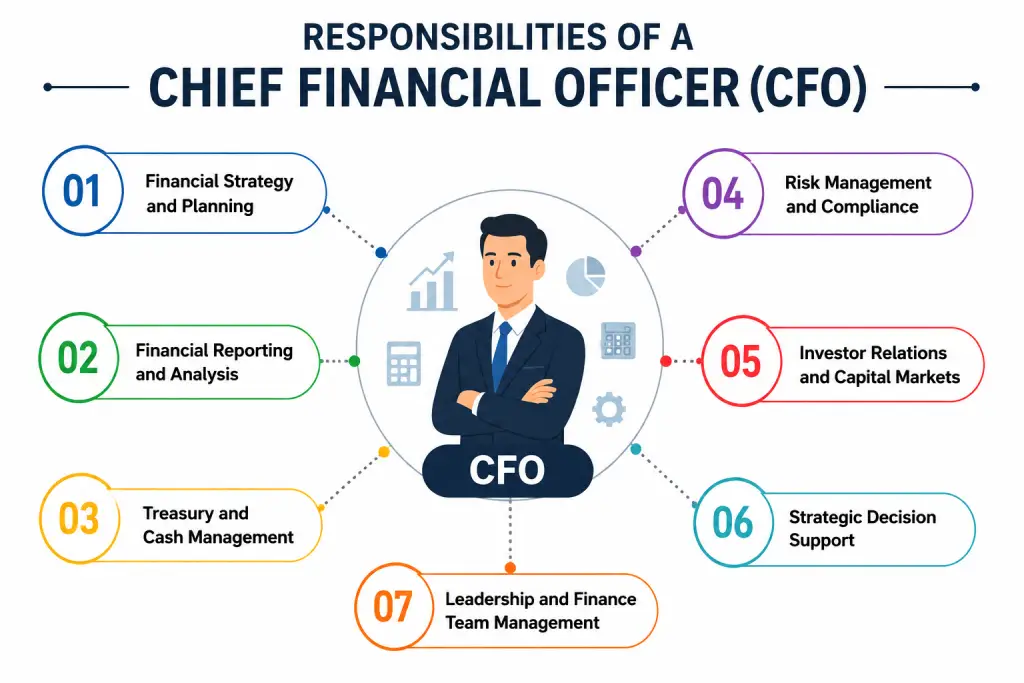
Financial Reporting and Analysis
One of the CFO's primary responsibilities is overseeing accurate financial reporting. They review financial statements, analyze key performance metrics, and present reports to executives, board members, and investors. These insights help leadership understand the company's financial position and make data-driven business decisions.
Treasury and Cash Management
A CFO manages the organization's cash flow to make sure there is enough capital to support daily operations and future investments. They oversee liquidity, working capital, banking relationships, and financing activities while balancing short-term financial needs with long-term growth plans.
Risk Management and Compliance
Every business faces financial and regulatory risks. A CFO identifies potential risks, develops strategies to minimize them, and helps the company comply with financial regulations, tax laws, and accounting standards. They also oversee internal controls and financial audits to maintain transparency and reduce financial exposure.
Investor Relations and Capital Markets
For public companies and growing businesses, a CFO acts as the primary financial representative for investors, lenders, and financial institutions. They communicate the company's financial performance, explain business strategies, manage fundraising activities, and support initiatives such as mergers, acquisitions, or public offerings.
Strategic Decision Support
A CFO works closely with the CEO and executive team to evaluate major business decisions. Whether it's expanding into new markets, launching products, investing in technology, or acquiring another company, the CFO provides financial analysis and risk assessments that help leadership choose the best course of action.
Leadership and Finance Team Management
Beyond financial oversight, a CFO leads the finance and accounting teams. They establish financial policies, improve operational processes, mentor senior finance professionals, and build a high-performing finance function that supports business goals.
What Skills and Qualifications Does a Chief Financial Officer (CFO) Need?
If being a CFO were only about working with Excel, every spreadsheet expert would be running a company. In reality, the role requires financial expertise, leadership, and smart decision-making.
Essential Skills
The journey to becoming a CFO involves developing both technical and leadership skills. From analyzing financial data to influencing business strategy, every skill plays an important role in the position. Some of the most important skills include:
- Financial Management: A deep understanding of accounting, budgeting, workforce forecasting, and financial reporting.
- Strategic Thinking: The ability to align financial decisions with long-term business goals.
- Leadership: Experience leading finance teams and collaborating with other executives.
- Analytical Skills: The ability to interpret financial data and turn it into actionable insights.
- Communication: Explaining complex financial concepts clearly to executives, investors, and stakeholders.
- Decision-making: Evaluating risks, weighing opportunities, and making informed business decisions under pressure.
- Problem-solving: Finding practical solutions to financial and operational challenges.
Educational Qualifications
Most CFOs start with a bachelor's degree in Finance, Accounting, Economics, or Business Administration. Many professionals also pursue a Master of Business Administration (MBA) or a master's degree in finance to strengthen their leadership and strategic management skills.
Professional Certifications
While certifications aren't always mandatory, they can strengthen expertise and improve career prospects. Common certifications include:
- CPA (Certified Public Accountant) for accounting and financial reporting expertise.
- CFA (Chartered Financial Analyst) for investment management and financial analysis.
- ACCA (Association of Chartered Certified Accountants) for global accounting and finance knowledge.
- CMA (Certified Management Accountant) for strategic financial planning and performance management.
Experience Required
One cannot become a CFO overnight, right? Most professionals spend 10 to 15 years building experience in finance, accounting, auditing, financial planning, or investment management before reaching the role. Many begin as Financial Analysts, Accountants, Controllers, or Finance Managers and gradually move into senior leadership positions such as Director of Finance or Vice President of Finance before becoming a CFO.
To make it even easier to understand, think of it this way:
If the CEO is the captain steering the ship, the CFO is the one making sure there's enough fuel, the route makes financial sense, and the ship doesn't sail straight into a storm.
Chief Financial Officer (CFO): Key Facts at a Glance
If you're looking for a quick overview of the Chief Financial Officer (CFO) role, the table below highlights the most important facts, including their responsibilities, reporting structure, qualifications, and average salary.
| Category | Details |
|---|---|
| Role | Senior executive responsible for managing an organization's financial strategy and performance. |
| Reports To | Chief Executive Officer (CEO) |
| Common Job Titles | Chief Financial Officer (CFO), Finance Director (in some regions) |
| Primary Responsibilities | Financial planning, budgeting, forecasting, reporting, cash flow management, risk management, compliance, and strategic decision-making. |
| Typical Direct Reports | Financial Controller, VP of Finance, Treasurer, FP&A Manager, Accounting Manager, Investor Relations Manager |
| Key Skills | Financial analysis, strategic planning, leadership, communication, decision-making, and risk management |
| Educational Qualifications | Bachelor's Degree in Finance, Accounting, Economics, or Business Administration; MBA is often preferred. |
| Professional Certifications | CPA, CFA, CMA, ACCA (varies by organization and country) |
| Experience Required | Typically, 10–15+ years in finance, accounting, auditing, or corporate finance, with leadership experience. |
| Average Salary (U.S.) | Approximately $450,000-$650,000+ per year (base salary), excluding bonuses and equity. |
| Works Closely With | CEO, COO, CHRO, CTO, CMO, Board of Directors, investors, auditors, and financial institutions. |
| Main Goal | Strengthen the organization's financial health, manage risks, and support sustainable business growth. |
Chief Financial Officer (CFO) vs CEO
The Chief Financial Officer (CFO) and Chief Executive Officer (CEO) are two of the most important leaders in an organization, but their responsibilities are very different.
To clear up any confusion, here's a simple comparison of the roles and responsibilities of a Chief Financial Officer (CFO) and a Chief Executive Officer (CEO).
| Chief Financial Officer (CFO) | Chief Executive Officer (CEO) |
|---|---|
| Oversees the company's financial strategy and performance. | Leads the overall business strategy and operations. |
| Manages budgeting, forecasting, financial reporting, cash flow, and risk management. | Sets the company's vision, goals, and long-term direction. |
| Advises leadership on investments, financial planning, and cost management. | Makes major business decisions across all departments. |
| Works closely with investors, auditors, banks, and financial institutions. | Represents the company to shareholders, customers, partners, and the public. |
| Reports directly to the CEO and collaborates with the board on financial matters. | Reports to the board of directors and is accountable for the company's overall performance. |
| Average Salary (U.S.): $450,000-$650,000+ per year (base salary), excluding bonuses and equity. | Average Salary (U.S.): $500,000-$1 million+ per year (base salary), excluding bonuses, equity, and incentives. |
| Experience: Typically 10-15+ years in finance, accounting, auditing, or corporate finance, with progressive leadership experience. | Experience: Usually 15-20+ years of leadership experience across multiple business functions before becoming CEO. |
Chief Financial Officer (CFO) vs Financial Controller
The Chief Financial Officer (CFO) and Financial Controller both play essential roles in managing a company's finances, but their focus and responsibilities are different.
If you're wondering how these roles differ, the table below provides a simple comparison to help you understand them better.
| Chief Financial Officer (CFO) | Chief Executive Officer (CEO) |
|---|---|
| Oversees the company's financial strategy and performance. | Leads the overall business strategy and operations. |
| Manages budgeting, forecasting, financial reporting, cash flow, and risk management. | Sets the company's vision, goals, and long-term direction. |
| Advises leadership on investments, financial planning, and cost management. | Makes major business decisions across all departments. |
| Works closely with investors, auditors, banks, and financial institutions. | Represents the company to shareholders, customers, partners, and the public. |
| Reports directly to the CEO and collaborates with the board on financial matters. | Reports to the board of directors and is accountable for the company's overall performance. |
| Average Salary (U.S.): $450,000–$650,000+ per year (base salary), excluding bonuses and equity. | Average Salary (U.S.): $500,000–$1 million+ per year (base salary), excluding bonuses, equity, and incentives. |
| Experience: Typically, 10-15+ years in finance, accounting, auditing, or corporate finance, with progressive leadership experience. | Experience: Usually 15-20+ years of leadership experience across multiple business functions before becoming CEO. |
Whether you're planning to become a Chief Financial Officer (CFO) or simply learning about the role, understanding their responsibilities, skills, qualifications, and leadership impact is a great place to start. Who knows? One day, you could be the CFO making the financial decisions that shape an organization's future.
We hope this guide has helped you take one step closer to understanding the role.

Decisions Backed by Data
Trends and team-level analytics that show what matters.
Explore Workforce Analytics →