Staff Augmentation vs Managed Services: Key Differences
Compare staff augmentation vs managed services, their costs, benefits, control, and responsibilities to choose the right workforce model for your business.
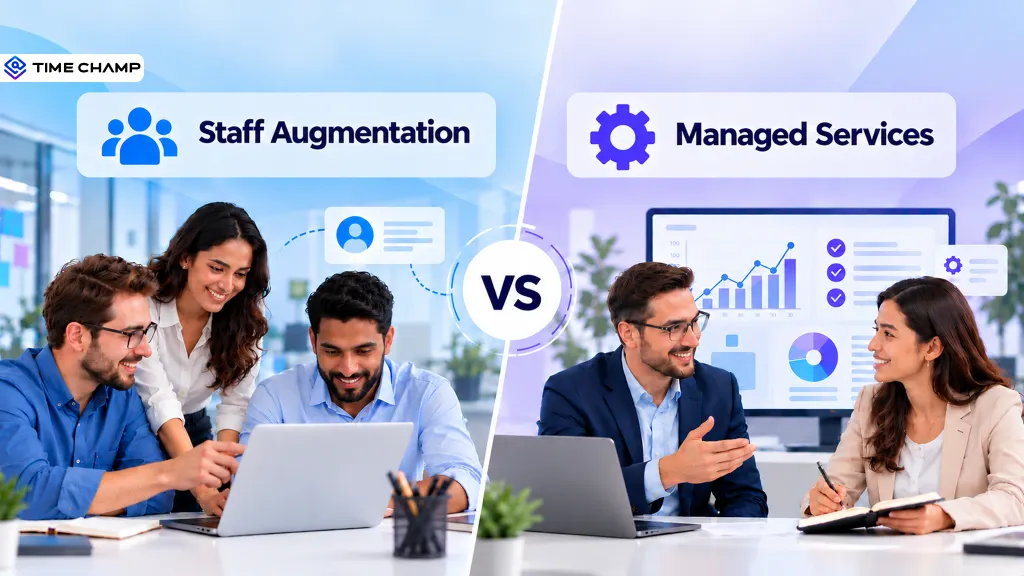
Choosing the right outsourcing model can be challenging when you need skilled professionals while maintaining control over work, costs, and outcomes. You may be unsure whether hiring external talent or outsourcing an entire function better suits your business needs. Understanding staff augmentation vs managed services can help you make that decision with greater clarity. Comparing how each model handles management, accountability, flexibility, costs, and service delivery can help you choose the approach that best aligns with your goals.
This blog explains how staff augmentation and managed services work and how they differ. It also covers their key benefits and the factors you should consider when choosing between them.
What Is Staff Augmentation?
Staff augmentation is a hiring strategy where businesses add external professionals to their existing teams to fill skill or capacity gaps. These professionals work under the company’s direction, follow its processes, and contribute to ongoing projects. The business retains control over priorities, workflows, and overall project outcomes.
What Are Managed Services?
Managed services are an outsourcing model that involves transferring a defined business function or ongoing service to an external provider that manages its delivery. The provider supplies the people, processes, and expertise needed to operate the function and is accountable for agreed performance standards, outcomes, or service levels.
Staff Augmentation vs Managed Services: A Side-by-Side Comparison
Staff augmentation and managed services can both help you access external expertise, but they give very different levels of control and responsibility. The key difference is whether you are adding people to manage yourself or handing a function to a provider that manages its delivery.
| Comparison Factor | Staff Augmentation | Managed Services |
|---|---|---|
| What you get | Skilled professionals who extend your existing team | A defined service or business function managed by a provider |
| Who manages the work | Your internal team manages daily tasks and priorities | The service provider manages the team, processes, and delivery |
| Accountability | Your business remains accountable for project outcomes | The provider is accountable for agreed outcomes and service levels |
| Level of control | High control over people, tasks, and workflows | Control is focused on outcomes, scope, and service expectations |
| Cost structure | Usually hourly, daily, or per-resource pricing | Typically a fixed recurring fee or outcome-based pricing |
| Flexibility | Easy to add or reduce resources as requirements change | Changes usually require adjustments to the service scope or contract |
| Scalability | Scale by adding or removing professionals | Scale by expanding or reducing the managed service scope |
| Management effort | Higher because your team directs the external staff | Lower because the provider handles day-to-day management |
| Risk ownership | More delivery and management risk remains with your business | More operational and delivery responsibility shifts to the provider |
| Best suited for | Skill gaps, temporary capacity needs, and projects requiring close internal direction | Ongoing functions, specialized operations, and services requiring continuous management |
| Performance measurement | Often based on individual productivity, tasks, or project contribution | Commonly measured through SLAs, KPIs, service quality, and outcomes |
| Provider’s role | Supplies qualified professionals to work as an extension of your team | Owns the processes, resources, and delivery required to provide the service |
Still unsure which workforce model fits your business?
Time Champ helps you track productivity, time, and performance across your workforce.
Advantages of the Staff Augmentation and Managed Services Model
Both models can help you address talent gaps and improve operational capacity, but they create different benefits for your business. Staff augmentation gives you greater control over external talent, while managed services shifts more responsibility for delivery and operations to the provider.
Advantages of the Staff Augmentation Model
- Faster Access to Needed Skills: Bring qualified professionals into your team without waiting through lengthy recruitment and hiring cycles, helping you address urgent skill gaps sooner.
- Greater Workforce Flexibility: Add specialized resources when workloads increase and scale your team back when project demands decline, without committing to permanent headcount.
- Stronger Project Control: You retain control over task assignments, priorities, workflows, and communication, allowing external professionals to work within established processes and support your project goals.
- Lower Hiring Overhead: Reduce the recruitment, onboarding, and long-term employment costs associated with adding permanent employees while paying for the skills and capacity you need.
- Better Team Integration: External professionals can work directly with your existing employees, tools, and workflows, making it easier to maintain alignment with internal project goals.

Did You Know?
47% of CHROs rank talent retention and skills shortages among their top three barriers to executing HR strategy, making flexible access to specialized talent increasingly valuable.
Advantages of the Managed Services Model
- More Predictable Operating Costs: A defined service arrangement can make expenses easier to forecast by replacing many variable operational costs with an agreed recurring fee or pricing structure.
- Reduced Management Burden: The provider takes responsibility for staffing, processes, daily operations, and service delivery, allowing your internal team to spend more time on strategic priorities.
- Access to Broader Expertise: You can tap into a team of specialists and established processes without building and maintaining the same level of expertise internally.
- Proactive Service Management: Managed providers can use continuous monitoring, automation, and established operating processes to identify issues early and maintain consistent service performance.
- Easier Operational Scaling: Services can be expanded or adjusted as business requirements change, helping you scale operations without managing every staffing change internally.
Did You Know?
87% of U.S. companies say managed services are highly integrated into their digital transformation strategies.
How to Choose Between a Staffing Partner and a Managed Services Provider
Choosing between a staffing partner and a managed services provider depends on what your business needs from the external partner. Staff augmentation is ideal when you need skilled professionals to work under your existing management, while managed services are better suited for ongoing functions handled by an external provider. Consider these factors before making your decision.
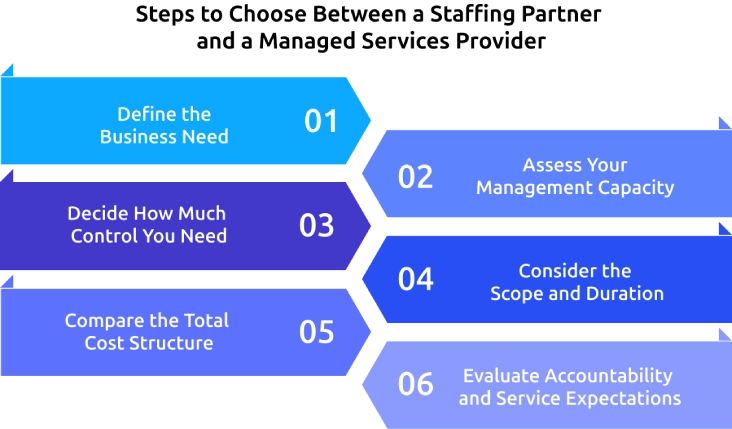
1. Define the Business Need
Start by identifying whether you need additional people or an externally managed function. If your primary need is to fill skill or capacity gaps within an existing team, a staffing partner can provide the professionals you need. If you need an entire function managed with defined service expectations, a managed services provider may be a better choice.
2. Assess Your Management Capacity
Consider whether your internal team has enough time and expertise to manage external resources. Staff augmentation works best when you can assign tasks, set priorities, and oversee daily work. Managed services can be more appropriate when your internal team wants to reduce day-to-day management responsibilities.
3. Decide How Much Control You Need
Determine how closely you need to control workflows, tasks, and execution. With staff augmentation, your business retains direct control over how external professionals work. With managed services, you define the expected outcomes and service requirements while the provider takes greater responsibility for execution.
4. Consider the Scope and Duration
Look at whether the requirement is temporary, project-based, or ongoing. Short-term skill gaps, changing project requirements, and temporary increases in workload often align well with staff augmentation. Recurring functions with clearly defined responsibilities and service levels are generally better suited to managed services.
5. Compare the Total Cost Structure
Don’t compare providers based only on hourly or monthly rates. Consider management time, recruitment costs, onboarding, resource replacement, technology, service coverage, and the level of responsibility transferred to the provider. Staff augmentation may provide more flexibility around resource costs, while managed services can offer greater cost predictability through an agreed service arrangement.
6. Evaluate Accountability and Service Expectations
Before selecting a model, establish who owns delivery, performance, risks, and service quality. If your internal team wants to remain responsible for project outcomes, a staffing partner may be the better option. If you want the provider to take responsibility for agreed outcomes, KPIs, or SLAs, a managed services provider may provide a stronger fit.
How Time Champ Supports Managed Workforce Operations
Managing distributed or externally supported teams can make it difficult to track work hours, productivity, workloads, and project progress. Without reliable workforce data, you may struggle to identify performance gaps, allocate resources, and keep projects on schedule. Time Champ is a smart employee monitoring software that helps you solve these challenges with features such as automated time tracking, productivity monitoring, attendance tracking, project tracking, workload management, and detailed reports. It gives you clear, real-time insights into employee activity and performance, helping you make informed decisions and manage teams more efficiently.
Here are the key features of Time Champ that help you improve workforce visibility, streamline team management, and make data-driven decisions.
- Automated Time Tracking: Automatically records work hours across projects and tasks, helping you maintain accurate time records without relying on manual timesheet entries.
- Real-Time Productivity Insights: Measures productive hours, focus time, idle time, and application usage, helping you identify productivity trends and address performance gaps sooner.
- Project and Task Tracking: Connects employee time with projects, tasks, milestones, and deadlines, helping you monitor delivery progress and allocate resources more effectively.
- Workforce Analytics and Reports: Provides dashboards and detailed reports on attendance, productivity, activity, and performance, helping you make informed workforce decisions.
- Workload Management: Highlights employee availability, workload capacity, and potential bottlenecks, helping you distribute tasks more effectively and avoid overloading team members.
- Employee Activity Visibility: Tracks app and website usage, activity levels, screenshots, and work patterns, giving you greater visibility into how work is progressing across remote, hybrid, and in-office teams.
Struggling to maintain visibility across distributed and managed teams?
Time Champ tracks time, productivity, activity, and workloads in one place for smarter workforce management.
Conclusion
Choosing the right staff augmentation vs managed services model comes down to the level of control, flexibility, and accountability your business needs. Staff augmentation works well when you need skilled professionals who can integrate with your existing team, while managed services suit businesses that want a provider to own delivery and operations. Evaluate your goals, management capacity, budget, project scope, and outcomes before deciding. Once you select the model, use workforce visibility and performance data to keep operations efficient. Start by assessing your needs, then choose the model that supports growth.

Anjali

Table of Content
 What Is Staff Augmentation?
- What Are Managed Services?
- Staff Augmentation vs Managed Services: A Side-by-Side Comparison
- Advantages of the Staff Augmentation and Managed Services Model
- How to Choose Between a Staffing Partner and a Managed Services Provider
- How Time Champ Supports Managed Workforce Operations
- Conclusion
Related Blogs

Reduce costs, access specialized talent, and improve efficiency with outsourcing. Compare its types, benefits, risks, and the top outsourcing companies.
Anjali | Oct 26, 2026
Uncover the hidden costs of outsourcing that impact ROI. Explore 12 overlooked expenses and learn how to calculate the true cost before you outsource.
Jahnavi Pulluri | Oct 16, 2026
Build a strong business case for outsourcing with 7 practical steps, ROI calculations, key advantages, and risk mitigation strategies for smarter decisions.
Anjali | Oct 26, 2026
Compare the best online outsourcing websites for 2026, including real fees, hiring tips, platform features, and proven ways to manage freelancers easily.
Jahnavi Pulluri | Aug 13, 2026
Learn why workforce analytics is essential for process reinvention, how it reinvents key business processes, best practices & how to measure success.
Anjali | Oct 26, 2026
Learn outsourcing ROI calculation with the right formula, hidden cost inputs, a worked procurement example, and a practical model you can build easily.
Jahnavi Pulluri | Oct 26, 2026


 4.7/5 avg.
Ready to Manage Your Workforce Smarter?
Join our family of 1500+ companies using smart insights to redefine workforces!

Free Trial
No Credit Card Required