Business Case Outsourcing: Steps, ROI & Key Benefits
Build a strong business case for outsourcing with 7 practical steps, ROI calculations, key advantages, and risk mitigation strategies for smarter decisions.

You may see outsourcing as a way to reduce costs, access specialized talent, or scale operations faster. But without a clear financial and operational justification, it can be difficult to convince stakeholders that outsourcing is the right move. A well-structured business case outsourcing approach helps you compare costs, quantify potential returns, weigh the benefits, and address risks before making the decision.
This blog covers the key elements of an outsourcing business case and seven practical steps to build one. It also explains how to calculate outsourcing ROI, evaluate its advantages and risks, and make a more informed outsourcing decision.
What Is a Business Case for Outsourcing?
A business case for outsourcing is a structured analysis that compares the costs, benefits, risks, and expected returns of moving a business function to an external provider. It helps decision-makers determine whether outsourcing can deliver greater financial value, operational efficiency, scalability, or strategic benefits than keeping the function in-house.

Did You Know?
According to KPMG, 81% of companies now expect outsourcing providers to act as strategic collaborators, while 75% seek transformational outcomes such as new business models and technology innovation.
What to Include in an Outsourcing Business Case
A strong outsourcing business case should give decision-makers a clear view of why outsourcing is needed, what it will cost, what value it can deliver, and how potential risks will be managed. Include these key elements to build a complete and convincing case:
- Business Objectives: Clearly define the business problem you want outsourcing to solve, such as reducing costs, improving productivity, accessing specialized skills, or increasing scalability.
- Current-State Analysis: Assess your existing processes, workforce capacity, productivity levels, operational costs, and performance gaps to establish a reliable baseline for comparison.
- Cost and Financial Analysis: Compare current in-house costs with projected outsourcing costs, including salaries, technology, training, management, vendor fees, transition expenses, and other relevant costs.
- Expected Benefits and ROI: Quantify the expected financial and operational benefits, such as cost savings, productivity improvements, faster turnaround times, and potential return on investment.
- Risks and Mitigation Strategies: Identify potential risks related to data security, service quality, compliance, vendor dependency, and business continuity, along with practical measures to reduce them.
- Implementation and Success Metrics: Outline the transition plan, responsibilities, timelines, and KPIs that will be used to measure whether the outsourcing initiative delivers the expected results.
How to Build a Business Case for Outsourcing: 7 Steps
Building a business case outsourcing starts with defining the current problem, comparing total costs, measuring potential value, addressing risks, and presenting decision-makers with a clear path forward. Follow these seven steps to create a practical, data-backed case:
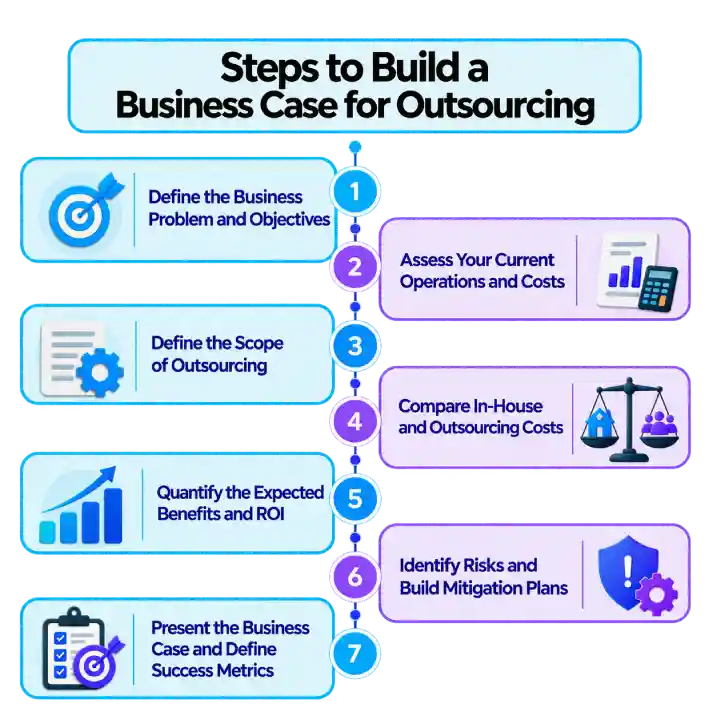
1. Define the Business Problem and Objectives
Identify the specific problems outsourcing should solve, such as high operating costs, skill shortages, delayed delivery, or limited capacity. Then define clear objectives, such as reducing expenses, improving turnaround time, increasing capacity, or accessing specialized expertise. Turn these objectives into measurable targets so you can evaluate the proposal objectively.
2. Assess Your Current Operations and Costs
Document your current processes, staffing needs, workloads, productivity, service quality, and technology expenses. Calculate your fully loaded in-house cost by including salaries, benefits, recruitment, training, management, facilities, and technology. This gives you a reliable baseline for comparing outsourcing options.
3. Define the Scope of Outsourcing
Specify which processes, tasks, teams, locations, and service volumes you plan to outsource, as well as what will remain in-house. Assign responsibility for each activity to avoid confusion about ownership and accountability. Then define the required service levels and expected outcomes so providers can submit comparable proposals.
4. Compare In-House and Outsourcing Costs
Create a side-by-side comparison of your current operating model and the proposed outsourcing model. Include vendor fees, transition costs, technology, knowledge transfer, internal coordination, retained staff, and ongoing management. Comparing total costs instead of salaries alone will give you a more accurate view of the potential financial impact.
5. Quantify the Expected Benefits and ROI
Calculate the broader value outsourcing could provide beyond direct cost savings. Consider improvements in productivity, turnaround time, capacity, hiring requirements, service quality, and access to specialized expertise. Link each benefit to a realistic KPI and use the estimates to calculate the potential return on investment.
6. Identify Risks and Build Mitigation Plans
Address risks related to data security, compliance, service quality, communication, vendor dependency, and business continuity. Create a practical mitigation plan for each significant risk, using tools such as service-level agreements, security controls, performance reviews, and exit clauses. This shows you that the risks have been considered and can be managed.
7. Present the Business Case and Define Success Metrics
Summarize the business problem, recommended outsourcing model, financial impact, expected benefits, key risks, implementation plan, and success criteria. Tailor the presentation to stakeholder priorities, such as ROI for finance or service quality for operations. Set measurable KPIs before implementation and review them regularly to confirm that the arrangement is delivering the expected results.
Why struggle with unclear productivity and outsourcing costs?
Time Champ tracks work hours, productivity, and performance to help you build a stronger business case.
How to Calculate Outsourcing ROI (Formula + Worked Example)
To calculate outsourcing ROI accurately, first establish your fully loaded in-house cost, then calculate the total cost of outsourcing for the same scope of work. Compare the resulting financial benefits with the total outsourcing investment to determine whether the arrangement delivers a worthwhile return.
Step 1: Calculate Your Total In-House Cost
Start by adding all costs associated with performing the function internally. Include:
- Employee salaries and benefits
- Recruitment and onboarding
- Training and development
- Software and technology
- Infrastructure and facilities
- Management and administrative overhead
- Other function-specific operating costs
This creates a more realistic baseline than comparing an outsourcing quote with employee salaries alone.
Step 2: Calculate Your Total Outsourcing Cost
Next, determine the complete cost of the outsourced arrangement. Include:
- Provider fees
- Transition and setup costs
- Technology or integration expenses
- Knowledge-transfer costs
- Vendor management and coordination
- Quality monitoring and compliance costs
- Any retained internal resources
Including these costs prevents your ROI from being overstated by leaving one-time or ongoing expenses out of the calculation.
Step 3: Calculate the Financial Benefit
Subtract the total outsourcing cost from the value generated through outsourcing.
Net Benefit = Total Benefits - Total Outsourcing Cost
For a cost-focused business case, the benefit may primarily come from savings:
Cost Savings = Total In-House Cost - Total Outsourcing Cost
You can also include measurable benefits such as increased capacity, faster delivery, reduced hiring requirements, or additional revenue generated from freed internal resources when these can be reasonably quantified.
Step 4: Apply the Outsourcing ROI Formula
Use the standard ROI calculation:
Outsourcing ROI = (Total Benefits - Total Outsourcing Cost) ÷ Total Outsourcing Cost × 100
A positive percentage indicates that the quantified benefits exceed the outsourcing investment. A higher percentage represents a greater return relative to the amount invested.
Worked Example
Suppose a company currently spends $500,000 per year to manage a customer support function internally. After accounting for salaries, benefits, recruitment, technology, management, and other overheads, this represents its total in-house cost.
The company receives an outsourcing proposal costing $320,000 per year, including provider fees and ongoing management costs. It also expects $30,000 in transition and setup costs during the first year.
The calculation would be:
Total In-House Cost = $500,000
Total Outsourcing Cost = $320,000 + $30,000 = $350,000
Net Benefit = $500,000 − $350,000 = $150,000
Outsourcing ROI = ($150,000 ÷ $350,000) × 100 = 42.9%
So, the estimated first-year outsourcing ROI is 42.9%, with a net financial benefit of $150,000.
For subsequent years, if the one-time $30,000 transition cost does not recur, the ROI would be higher:
Net Benefit= $500,000 − $320,000 = $180,000
ROI = ($180,000 ÷ $320,000) × 100 = 56.25%
This example also shows why you should separate first-year costs from recurring costs when evaluating an outsourcing decision. Transition expenses can reduce initial ROI even when the long-term economics remain attractive.
Advantages of Outsourcing Worth Putting in the Business Case
Outsourcing can strengthen your business case when its benefits are tied to measurable business outcomes rather than presented as generic advantages. From lowering operating costs to accessing specialized talent and scaling faster, the following benefits can show stakeholders why outsourcing may create long-term business value.
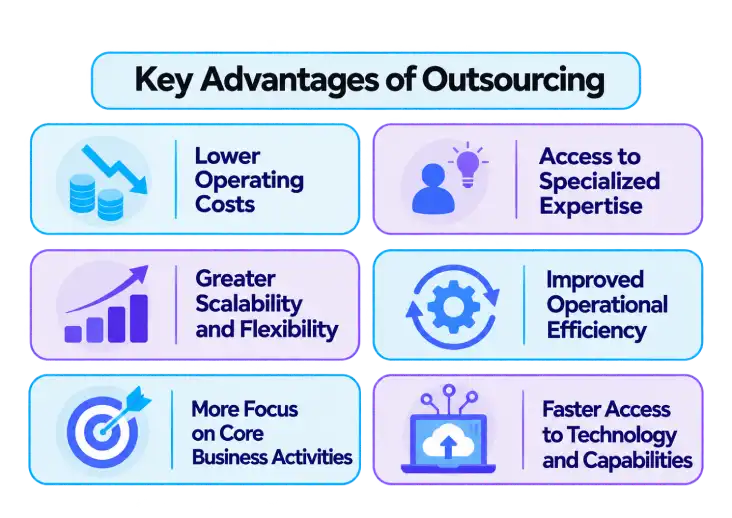
Lower Operating Costs
Outsourcing can reduce expenses related to salaries, recruitment, training, infrastructure, technology, and other overheads. You pay for the services and capacity you need without investing heavily in building and maintaining an internal team.
Access to Specialized Expertise
Outsourcing gives you access to professionals with specialized skills and industry experience. This helps fill internal skill gaps while avoiding the time and expense of recruiting and training new employees.
Greater Scalability and Flexibility
You can quickly increase or reduce outsourced support as business needs change. This flexibility is useful during seasonal peaks, periods of rapid growth, or fluctuations in workload without requiring permanent changes to your workforce.
Improved Operational Efficiency
Outsourcing providers use established processes, tools, and workflows to complete tasks more efficiently. Their expertise can improve turnaround times, consistency, productivity, and service quality while reducing pressure on internal teams.
More Focus on Core Business Activities
Outsourcing routine or non-core tasks allows your internal employees to focus on growth, innovation, customer service, and other strategic priorities. This helps ensure that valuable internal resources are directed toward activities that create the greatest business impact.
Faster Access to Technology and Capabilities
Many outsourcing providers already have the technology, infrastructure, and systems needed to deliver services effectively. This allows you to adopt new capabilities faster while reducing the time and investment required to develop them internally.
Did You Know?
Deloitte found that 83% of surveyed executives were already leveraging AI as part of their outsourced services, showing how outsourcing is increasingly being used to access technology-enabled capabilities.
What Are the Risks of Outsourcing and How to Mitigate Them
Outsourcing can create significant business value, but overlooking its potential risks can weaken your business case. Identify the major risks upfront and pair each one with a practical mitigation strategy to protect costs, service quality, data, and business continuity.
Data Security and Privacy Risks
An external provider may access confidential company, employee, or customer data. Poor security controls could lead to data breaches or unauthorized access.
How to Mitigate It: Check the provider’s security practices before signing a contract. Use access controls, encryption, data protection requirements, breach procedures, and regular security reviews.
Loss of Control Over Operations
Outsourcing can reduce your direct visibility into how work is performed. This may make it harder to maintain quality, productivity, and customer service standards.
How to Mitigate It: Set clear SLAs, KPIs, reporting requirements, and escalation procedures. Review performance regularly and maintain appropriate internal oversight.
Communication and Coordination Problems
Different time zones, processes, or communication styles can cause misunderstandings and delays. These issues may affect teamwork and service delivery.
How to Mitigate It: Set clear communication rules, assign points of contact, use shared tools, and schedule regular meetings. Document responsibilities and processes clearly.
Hidden or Unexpected Costs
The quoted price may not include transition, training, integration, management, or change-request costs. These additional expenses can reduce expected savings.
How to Mitigate It: Calculate the total cost before outsourcing. Review the contract carefully, clarify included services, and budget for transition and ongoing management costs.
Vendor Dependency and Business Continuity
Relying heavily on one provider can make it difficult to continue operations if the provider faces financial, technical, or operational problems.
How to Mitigate It: Check the provider’s stability and disaster recovery plans. Keep important documentation internally, include exit terms in the contract, and prepare backup plans.
Declining Service Quality
Service quality may decline if the provider lacks proper training or does not understand your processes and customer expectations. Staff turnover and weak monitoring can make the problem worse.
How to Mitigate It: Set clear quality standards and SLAs from the start. Provide proper training, monitor KPIs, review performance regularly, and require corrective action when standards are not met.
How Does Time Champ Support a Stronger Outsourcing Business Case
Outsourcing might be hard to manage when you cannot clearly track productivity, work hours, service quality, and costs. Without accurate data, you may miss inefficiencies, overspend, and struggle to know whether outsourcing is worthwhile. Time Champ is a smart employee monitoring software that gives you real-time workforce visibility, helping you measure outsourced performance, identify inefficiencies, and support data-driven outsourcing decisions.
Here are the Key Time Champ features that can strengthen your outsourcing business case:
- Real-Time Productivity Monitoring: Tracks employee activity, productivity trends, idle time, and workload to help you identify inefficiencies and improve resource utilization.
- Automated Time Tracking: Captures work hours, breaks, attendance, and idle periods automatically, helping you maintain accurate records and reduce manual tracking errors.
- Call Monitoring and Quality Insights: Monitors call activity, recordings, and talk-time data to help you evaluate agent performance, maintain service quality, and support SLA compliance.
- Shift and Workforce Management: Creates and adjusts shifts while monitoring attendance and team availability, helping you manage distributed and multi-shift outsourced teams more efficiently.
- Performance and Productivity Reports: Generates detailed reports on productivity, time, tasks, and team performance to measure whether your outsourcing arrangement is meeting its expected outcomes.
- Actionable Alerts and Insights: Provides alerts for late logins, idle time, productivity drops, and shift issues so you can address problems before they affect costs or service delivery.
Struggling to prove your outsourced team is delivering the expected value?
Time Champ gives you real-time productivity, time, and performance insights to make data-driven decisions.
Conclusion
A strong business case outsourcing strategy goes beyond comparing vendor prices. Assess your current costs, define clear objectives, calculate potential ROI, evaluate the advantages, and address risks before making a decision. Use measurable KPIs to track whether outsourcing delivers the expected savings, productivity, quality, and scalability. With the right data and a structured evaluation, you can present a stronger case to stakeholders and make a more confident outsourcing decision. Start by reviewing your current operations, identifying opportunities, and building a business case around measurable outcomes.

Anjali

Table of Content
 What Is a Business Case for Outsourcing?
- What to Include in an Outsourcing Business Case
- How to Build a Business Case for Outsourcing: 7 Steps
- How to Calculate Outsourcing ROI (Formula + Worked Example)
- Advantages of Outsourcing Worth Putting in the Business Case
- What Are the Risks of Outsourcing and How to Mitigate Them
- How Does Time Champ Support a Stronger Outsourcing Business Case
- Conclusion
Related Blogs

Reduce costs, access specialized talent, and improve efficiency with outsourcing. Compare its types, benefits, risks, and the top outsourcing companies.
Anjali | Jul 13, 2026
In-house vs outsourcing explained with key differences, pros, cons, costs, and practical tips to help you choose the best approach for your organization.
Anjali | Jul 02, 2026
Explore the various types of Business Process Outsourcing (BPO) services, their benefits, and how they streamline operations for businesses.
Mounika Sai | Nov 21, 2023
Discover the 12 benefits of outsourcing, including cost savings, access to global talent, and practical tips for managing outsourced teams effectively.
Guna Lakshmi | Jul 10, 2026
Learn how to kickstart your BPO business with this comprehensive step-by-step guide, covering everything from planning to execution. Get insights now!
Tarun Kumar Reddy | Nov 17, 2023
The future of outsourcing is changing with AI, nearshoring, and outcome-based models. Explore the latest trends, predictions, and what you should expect.
Thasleem Shaik | Jul 31, 2026


 4.7/5 avg.
Ready to Manage Your Workforce Smarter?
Join our family of 1500+ companies using smart insights to redefine workforces!

Free Trial
No Credit Card Required