Quality Assurance in Project Management: Process & Methods
Learn quality assurance in project management, how it differs from quality control, the 6-step QA process, key methods, and essential metrics for success.
Organizations lose an average of 11.4% of their project investment because of poor project performance, according to PMI's Pulse of the Profession 2020. Often, the issue is work that seems complete but later comes back with defects, rework, and unexpected costs.
Many of these problems can be avoided with the right quality assurance practices. When teams have clear processes, regular reviews, and defined quality standards, they're more likely to catch issues early instead of fixing them after the work is complete.
In this blog, you'll learn what quality assurance in project management is, how it differs from quality control, the six-step QA process, key QA methods, and the most important metrics to track.
What is Quality Assurance in Project Management?
Quality assurance (QA) in project management is the process of planning, monitoring, and improving the methods used to deliver a project so that the outcome consistently meets quality standards. Instead of finding defects after the work is complete, QA focuses on preventing them through standardized processes, reviews, audits, and continuous improvement.
Quality Assurance vs. Quality Control in Project Management
Quality assurance and quality control are closely related, which is why they're often confused. While both contribute to delivering high-quality projects, they play different roles throughout the project lifecycle. Understanding how they work together helps teams prevent issues early and verify quality before the final handover.
| Aspect | Quality Assurance (QA) | Quality Control (QC) |
|---|---|---|
| Focus | Processes used to create deliverables | Finished deliverables |
| Goal | Prevent defects | Detect and correct defects |
| Timing | Throughout the project | During inspections, testing, and reviews |
| Key Question | Are we following the right process? | Does this deliverable meet the requirements? |
| Typical Activities | SOPs, training, audits, peer reviews | Testing, inspections, sampling, acceptance reviews |
| Who Is Involved | Project manager, quality manager, project team | Testers, reviewers, inspectors |
| Output | Improved processes and standards | Approved deliverables and defect reports |
The strongest projects use both. Quality assurance helps teams avoid recurring issues, while quality control verifies that the final work meets customer and project requirements.
The Quality Assurance Process in Project Management: 6 Steps
Quality assurance is a continuous process that helps teams prevent defects instead of fixing them later. While every project is different, most follow the same six steps to improve quality, reduce rework, and deliver better outcomes.
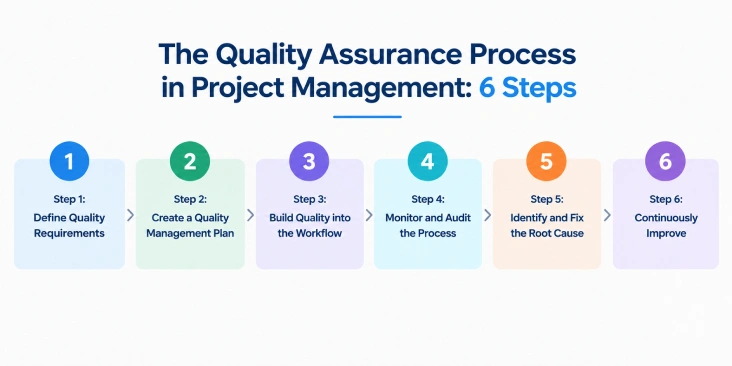
Step 1: Define Quality Requirements
Start by agreeing on what quality means for the project. Define clear quality standards, acceptance criteria, compliance needs, and customer expectations, so everyone works toward the same goal.
Step 2: Create a Quality Management Plan
Document how quality will be managed throughout the project. Include the standards, review process, quality checks, tools, and team responsibilities needed to maintain consistency.
Step 3: Build Quality into the Workflow
Integrate quality into daily work through standardized processes, templates, training, peer reviews, and automation. The goal is to prevent errors before they occur rather than depending on final inspections.
Step 4: Monitor and Audit the Process
Regularly review whether the team is following the agreed quality processes. Process audits help identify gaps early, ensuring issues are addressed before they affect the final deliverables.
Step 5: Identify and Fix the Root Cause
When issues arise, look beyond the defect to understand why it happened. Root cause analysis techniques, such as the Five Whys or Pareto Analysis, help prevent recurring problems.
Step 6: Continuously Improve
Review project outcomes, document lessons learned, gather feedback, and update processes based on what worked and what didn't. Continuous improvement helps teams deliver higher-quality projects over time.
Improve Project Quality from Start to Finish!
Track workflows, reduce rework, and gain the visibility you need to deliver high-quality projects
Quality Assurance Methods and Techniques Project Teams Use
Project teams use different quality assurance methods depending on the project type, risk level, and quality standards they need to meet.
Here are some of the most commonly used QA methods in project management.
| Method | What It Does | Best Suited For |
|---|---|---|
| Statistical Process Control (SPC) | Uses control charts to monitor process performance and identify variations before they become defects. | Manufacturing, data processing, and other repetitive processes |
| Failure Mode and Effects Analysis (FMEA) | Identifies potential failures, assesses their impact, and prioritizes preventive actions. | Product development, new processes, and high-risk projects |
| Total Quality Management (TQM) | Promotes continuous improvement by making quality a shared responsibility across the organization. | Long-term quality improvement initiatives |
| Failure Testing | Tests products or systems under extreme conditions to uncover weaknesses. | Software, hardware, infrastructure, and safety-critical projects |
| Quality Audits | Reviews whether project activities follow established quality standards and procedures. | Projects with regulatory, contractual, or compliance requirements |
| Peer Reviews and Checklists | Uses a second reviewer and standardized checklists to catch issues before work moves forward. | Code reviews, documentation, content, and design deliverables |
| Six Sigma (DMAIC) | Uses a structured, data-driven approach to reduce recurring defects and improve processes. | Projects with repetitive quality issues |
Quality Assurance Metrics Worth Tracking
How do you know if your quality assurance process is actually working? The answer lies in the metrics you track. A few well-chosen indicators can help project teams find problems early, reduce rework, and continuously improve their processes.
| Metric | What It Tells You | How To Calculate It |
|---|---|---|
| First-pass yield | Percentage of work completed correctly on the first attempt | Deliverables accepted without rework ÷ Total deliverables × 100 |
| Defect escape rate | Percentage of defects found by the client after delivery | Client-reported defects ÷ Total defects × 100 |
| Rework effort | Time spent correcting completed work | Rework hours ÷ Total project hours × 100 |
| Defect density | Number of defects relative to the size of the deliverable | Defects ÷ Size unit (for example, per 1,000 lines of code or 100 records) |
| Process audit compliance | How consistently the team follows quality processes | Audit checkpoints passed ÷ Total checkpoints reviewed × 100 |
| First-submission acceptance | Percentage of deliverables accepted without revisions | Deliverables accepted on first submission ÷ Total submissions × 100 |
Each metric tells part of the story. Reviewing them together helps you evaluate process performance more accurately and identify opportunities for continuous improvement.
How Time Champ Supports Quality Assurance in Project Management
A quality assurance process is only as effective as the visibility you have into your projects. When you can see how work is progressing, where rework is happening, and which processes need improvement, it's much easier to maintain quality throughout the project lifecycle.
Time Champ is employee monitoring software that gives you a clear view of how work gets done. From tracking project progress and team activities to monitoring workflows, it helps teams find quality issues early, reduce rework, and keep projects running smoothly.
- Reduce Costly Rework: Track the time spent on rework to find recurring quality issues and improve the processes causing them.
- Ensure Every Task is Quality-Checked: Set up approval stages and verification checkpoints so work isn't marked complete until it has been reviewed.
- Improve Review Accuracy: Use screenshots and screen recordings to validate completed work, support audits, and resolve issues faster.
- Simplify Audits and Compliance: Access call recordings and work history to streamline quality reviews, coaching sessions, and compliance checks.
- Prevent Errors Caused by Team Overload: Monitor workloads to identify overutilized employees early and redistribute work before quality begins to suffer.
- Understand the True Cost of Quality: Compare planned and actual project hours to measure the impact of rework on project timelines and budgets.
Deliver High-Quality Projects with Confidence!
Track progress, monitor quality, and ensure every project meets your standards with Time Champ
Conclusion
Quality assurance helps teams do the job right the first time by focusing on better processes instead of fixing mistakes later. A clear QA process, supported by the right methods and performance metrics, leads to fewer defects, less rework, and more successful projects. As projects become more complex, making quality assurance part of your everyday workflow becomes even more important.

Jahnavi Pulluri

Table of Content
 What is Quality Assurance in Project Management?
- Quality Assurance vs. Quality Control in Project Management
- The Quality Assurance Process in Project Management: 6 Steps
- Quality Assurance Methods and Techniques Project Teams Use
- Quality Assurance Metrics Worth Tracking
- How Time Champ Supports Quality Assurance in Project Management
- Conclusion
Related Blogs

Explore key features of project management and software for efficient task management and enhanced team collaboration.
Jahnavi Pulluri | May 21, 2024
Discover the 10 best enterprise project management software for 2026. Compare features, pricing, pros and cons to scale the operations and align strategy.
Anjali | Apr 02, 2026
Learn what a project management framework is, its components, importance, popular methodologies, benefits, and challenges for organizations.
Guna Lakshmi | Apr 08, 2026
Learn how to integrate productivity tracking with project management without broken workflows or manual exports. A practical step-by-step guide.
Guna Lakshmi | May 06, 2026
Download free agile project management templates in Excel, Word, and PDF formats to plan, track, and manage agile projects with clarity and control.
Thasleem Shaik | Feb 19, 2026
Get 7 free construction project management templates, download them for free in Excel, Word, and PDF formats and plan schedules and budgets effectively.
Guna Lakshmi | Apr 08, 2026


 4.7/5 avg.
Ready to Manage Your Workforce Smarter?
Join our family of 1500+ companies using smart insights to redefine workforces!

Free Trial
No Credit Card Required