The Pickle Jar Theory: Meaning, Benefits, and Examples
Understand the Pickle Jar Theory and learn how this popular time management technique helps you balance priorities and increase efficiency.

When you hear about the Pickle Jar Theory, it probably sounds like it has something to do with pickles stored in a jar, right? But it's actually one of the simplest and most effective time management techniques for organizing your task priorities.
The theory uses a pickle jar as a visual metaphor to show how different tasks compete for your limited time and attention. When you understand this simple concept, you can take control of your time, improve productivity, and focus on what matters most.
What is the Pickle Jar Theory?
The Pickle Jar Theory was introduced to a wider audience by leadership expert Jeremy Wright through his 2002 book, The Pickle Jar Theory: Mastering Your Days and Your Life.
The Pickle Jar Theory is a popular time management concept that compares your available time to a pickle jar. The theory suggests that your day is like an empty jar that can only hold a limited amount of items. The items placed inside the jar represent your tasks and responsibilities.
In the pickle jar theory of time management, tasks are divided into four categories:
- Rocks Your most important and high-priority tasks
- Pebbles Important but less critical activities
- Sand Small tasks and routine work
- Water Distractions and low-value activities
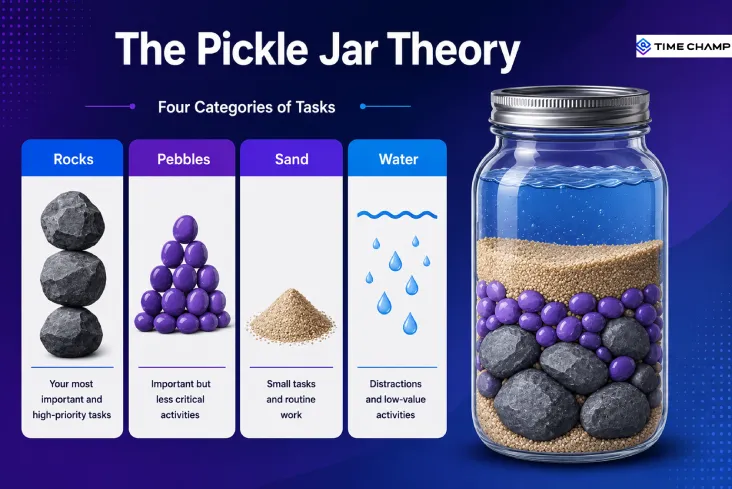
This time management pickle jar theory encourages you to schedule your highest-priority tasks first and fit less important activities around them. For additional strategies to stay organized and productive, check out these 20 essential time management techniques.
Step-by-Step Process to Implement Pickle Jar Theory
If your most important tasks keep getting pushed aside, the Pickle Jar Theory can help you prioritize effectively. Follow these steps to organize your day smartly:
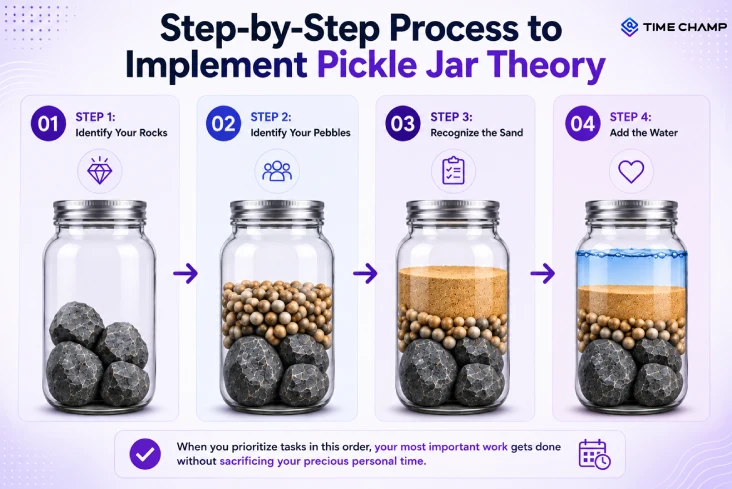
Step 1: Identify Your Rocks
Start by listing the tasks that have the greatest impact on your goals. These are your "rocks." These activities drive the most value and should receive your attention before anything else. If your rocks don't fit into your schedule, it's a sign that less important tasks are taking up too much space.
Examples:
- Completing a project deadline
- Preparing for an important presentation
- Strategic planning
- High-priority client work
Step 2: Identify Your Pebbles
Next, identify tasks that are important but not urgent. While these activities support your long-term success, they can usually be scheduled around your rocks. Think of pebbles as the tasks that support progress but aren't your top priorities.
Examples:
- Team meetings
- Skill development
- Routine reporting
- Planning future projects
Step 3: Recognize the Sand
Sand represents small tasks that consume time but contribute less value. These activities are often necessary, but they shouldn't dominate your day. If you spend too much time on sand, you may struggle to make progress on your most important priorities.
Examples:
- Checking emails frequently
- Administrative work
- Minor requests
- Non-essential updates
Step 4: Add the Water
Water represents personal time, breaks, and activities that support a healthy work-life balance. Just as water fills the remaining space in a jar, these activities fit into your schedule after your rocks, pebbles, and sand have been prioritized. This ensures your important work gets done while still leaving room for rest and personal well-being.
Examples:
- Lunch breaks
- Exercise
- Family time
- Hobbies and leisure activities
When you prioritize tasks in this order, your most important work gets done without sacrificing your precious personal time.
Pickle Jar Theory Example
Understanding the theory is one thing, but applying it to your daily routine is where the real value lies. The example below shows how a typical workday can be organized using the Pickle Jar Theory. It prioritizes high-impact tasks (rocks) before important activities (pebbles), routine work (sand), and personal time or distractions (water).
| Time | Category | Task |
|---|---|---|
| 9:00 AM - 11:00 AM | Rocks | Complete a client proposal and finalize project requirements |
| 11:00 AM - 12:00 PM | Rocks | Prepare for a project review meeting |
| 12:00 PM - 1:00 PM | Pebbles | Attend a team meeting and coordinate with stakeholders |
| 2:00 PM - 3:00 PM | Pebbles | Review your employees' work and plan next week's tasks |
| 3:00 PM - 4:00 PM | Sand | Respond to emails and update spreadsheets |
| 4:00 PM - 4:30 PM | Sand | Organize files and handle minor requests |
| 4:30 PM - 5:00 PM | Water | Take a coffee break, catch up with teams, organize your workspace, and read non-essential updates |
Advantages of the Pickle Jar Theory
The pickle jar theory offers several benefits that can help you manage your time more effectively and focus on what matters most. Here are some key benefits of applying it to your daily routine:
- Helps Prioritize Important Tasks: Encourages you to focus on high-impact activities before less important work consumes your time.
- Improves Time Management: Provides a simple framework for organizing tasks and making better use of your day.
- Boosts Productivity: Ensures critical work gets completed first, helping you achieve more meaningful results.
- Reduces Stress and Overwhelm: Makes large workloads feel more manageable by clearly separating priorities.
- Improves Decision-Making: Helps you determine which tasks deserve immediate attention and which can be postponed or delegated.
- Prevents Time Wastage: Makes it easier to identify distractions and low-value activities that interfere with productivity.
- Encourages Better Work-Life Balance: Helps you make time for both important work and personal commitments.
How Time Champ Helps You Apply the Pickle Jar Theory in Real Life
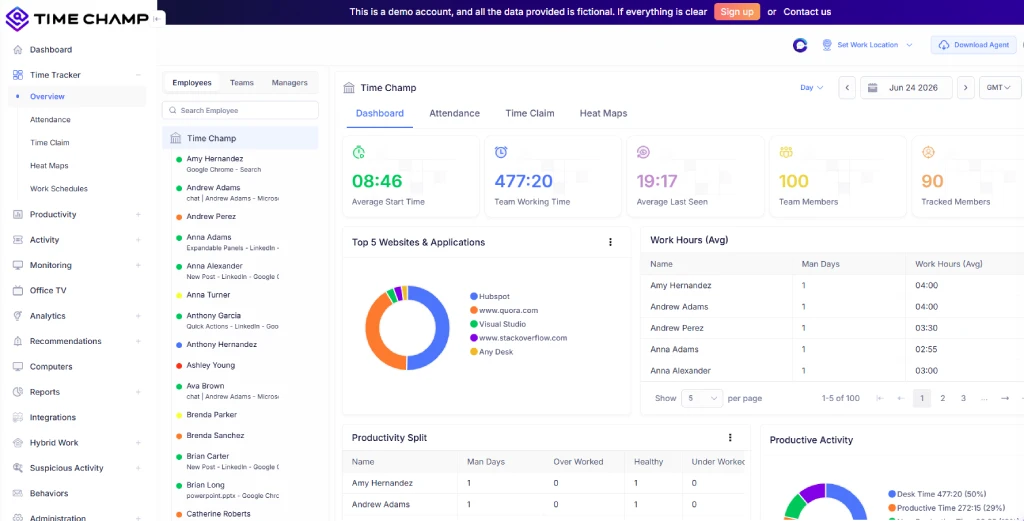
The Pickle Jar Theory works best when you have visibility into how your time is actually spent. This is where Time Champ can help.
Time Champ is an employee monitoring and time management software that helps you track work hours, monitor productivity, and gain deeper insights into how work gets done. It provides real-time workforce intelligence and productivity analytics, making it easier to identify your rocks, pebbles, sand, and water.
- Track work hours automatically without manual entries, giving you a clear picture of where your time is spent throughout the day.
- Monitor productive and unproductive activities to uncover distractions and focus more on high-value work.
- Track tasks, deadlines, and project progress in one place to ensure your most important priorities stay on schedule.
- Manage attendance and work schedules efficiently to stay organized and keep priorities on track.
- Receive instant alerts when excessive time is spent on unproductive websites or applications, helping you get back on track quickly.
- Track time spent on apps and websites to see whether your day is focused on important tasks or distracted by low-value activities.
Ready to Make the Pickle Jar Theory Work in Real Life?
Use Time Champ to track, prioritize, and optimize your workday by eliminating distractions and keeping high-impact work on track.
Conclusion
The Pickle Jar Theory is a practical time management method that helps you focus on your most important tasks before less valuable activities consume your time. Prioritizing tasks effectively and minimizing distractions can help you boost productivity, stay organized, and make consistent progress toward achieving your goals.
With Time Champ, applying the pickle jar theory becomes easier through real-time visibility into how your time is spent.

Guna Lakshmi

Table of Content
 What is the Pickle Jar Theory?
- Step-by-Step Process to Implement Pickle Jar Theory
- Pickle Jar Theory Example
- Advantages of the Pickle Jar Theory
- How Time Champ Helps You Apply the Pickle Jar Theory in Real Life
- Conclusion
Related Blogs
Download free freelance timesheet templates to track billable hours, manage projects, improve productivity, and simplify time management for freelance work.
Anjali | May 29, 2026
Learn how time tracking improves remote team productivity through better visibility, accountability, performance tracking, and smarter team management.
Anjali | May 16, 2026
Want to boost productivity? Uncover 20 time tracking best practices that can transform your workflow and help you achieve more with less effort.
Guna Lakshmi | July 01, 2025
Discover effective ways to build employee trust in automatic time tracking software and create a transparent, productive, and positive work environment.
Thasleem Shaik | Mar 13, 2025
Find out why you may need to monitor freelancer work, including key pros and cons that affect productivity, quality, accountability, and trust in teams.
Jahnavi Pulluri | Apr 29, 2026
Learn how automated time tracking improves team productivity, reduces manual work, builds trust, and delivers smarter workforce insights for managers today.
Anjali | May 15, 2026


 4.7/5 avg.
Ready to Manage Your Workforce Smarter?
Join our family of 1500+ companies using smart insights to redefine workforces!

Free Trial
No Credit Card Required