Outsourced Lead Generation: A Complete B2B Guide (2026)
Outsourced lead generation can strengthen your B2B pipeline. Compare outsourcing models, costs, benefits, risks, and 7 practical steps to get started.
If your sales team is spending hours finding prospects without closing deals, your pipeline can quickly become inconsistent and difficult to scale. Limited resources and poor-quality leads can make it difficult to build a steady, scalable pipeline. Outsourced lead generation gives you access to specialized teams that can handle prospect research, outreach, lead qualification, and appointment setting while your sales team focuses on converting opportunities. Shifting these time-consuming activities to an experienced partner can help you build a more consistent pipeline without taking on the full burden of hiring and managing an in-house team.
This guide helps you learn how outsourced lead generation works, the different outsourcing models, and how it compares with an in-house approach. You'll also learn about the process, benefits, risks, and costs of these services.
What Is Outsourced Lead Generation?
Outsourced lead generation is a sales strategy in which a business delegates prospect research, outreach, and lead qualification to an external specialist. The provider uses its people, processes, and channels to identify suitable prospects and create qualified sales opportunities, allowing the internal sales team to focus on nurturing prospects and closing deals.
What Are the Main Lead Generation Outsourcing Models
The right outsourcing model depends on how much of the lead generation process you want an external partner to manage. Common approaches range from dedicated sales development support to appointment setting, lead qualification, and prospect data services.
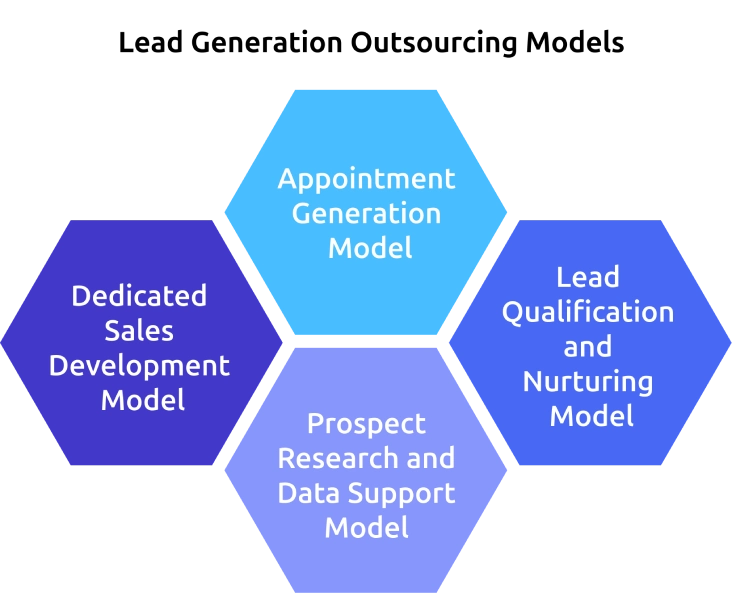
1. Dedicated Sales Development Model
A dedicated external sales development team works as an extension of your internal sales function. The team can handle prospect research, cold outreach, follow-ups, qualification, and handoffs while following your ICP, messaging, and sales processes.
Best For: B2B companies that need consistent prospecting capacity and want an external team to manage a large part of the outbound process.
2. Appointment Generation Model
In this approach, the provider focuses on turning targeted prospects into qualified sales meetings. It manages outreach, follow-ups, initial conversations, and calendar booking, while your sales representatives take over once a prospect is ready for a deeper discussion.
Best For: Businesses that already have a capable sales team but need a steady flow of qualified appointments without expanding their internal SDR capacity.
3. Lead Qualification and Nurturing Model
Here, an external team screens incoming or previously generated leads against your qualification criteria. It can follow up with prospects, identify their needs and buying intent, and pass sales-ready opportunities to your representatives.
Best For: Companies receiving a high volume of leads that need better filtering before sales reps spend time on them.
4. Prospect Research and Data Support Model
This model focuses on building and maintaining a reliable prospect database. Providers research target accounts, identify relevant decision-makers, verify contact information, and organize prospect data so your sales team can run targeted campaigns.
Best For: Businesses that have an internal outreach team but need additional support with prospect research, list building, and data accuracy.

Did You Know?
B2B Content Marketing Trends report found that 45% of B2B marketers planned to increase investment in AI-powered marketing tools, highlighting growing technology adoption.
In-House vs Outsourced Lead Generation: Which One Fits Your Business?
Choosing between an in-house team and an external partner depends on your budget, growth plans, available sales resources, and how much control you want over lead generation. An in-house setup gives you greater ownership of people and processes, while outsourcing can provide faster access to specialized expertise and additional prospecting capacity without building a team from scratch.
| Factor | In-House Lead Generation | Outsourced Lead Generation |
|---|---|---|
| Cost | Requires ongoing spending on salaries, benefits, tools, training, recruitment, and management. | Usually involves a retainer, project fee, or performance-based structure, reducing the need for direct hiring and infrastructure costs. |
| Time to Launch | Takes time to recruit, onboard, train, and ramp new team members before they reach full productivity. | Can start faster because the provider already has trained personnel, processes, and prospecting infrastructure. |
| Control | You have direct control over messaging, workflows, daily activities, and team priorities. | Control is shared with the provider, so expectations, communication, reporting, and processes must be clearly defined. |
| Expertise and Resources | Your team develops expertise around your products, market, customers, and internal processes over time. | You can access specialized prospecting skills, established workflows, databases, and outreach expertise without developing everything internally. |
| Scalability | Expanding capacity usually means recruiting and training additional employees, which can slow down growth. | You can generally increase or reduce support more quickly based on campaign requirements, market expansion, or changes in demand. |
| Management Effort | Sales leaders are responsible for hiring, coaching, performance management, workflow supervision, and team retention. | The provider typically handles much of the day-to-day team management, reducing the operational workload for your internal sales leaders. |
| Long-Term Knowledge and Ownership | Knowledge about your customers, messaging, and sales process remains within the organization and can compound over time. | Some operational knowledge remains with the external provider, so you need strong documentation, CRM access, reporting, and handoff processes to maintain continuity. |
How to Outsource Lead Generation in 7 Steps
Outsourcing lead generation works best when you treat it as a structured sales process, not simply handing prospecting off to an external provider. Before outreach begins, define your target audience, success criteria, provider responsibilities, and sales handoff process so the external team can work toward outcomes that matter to your business.
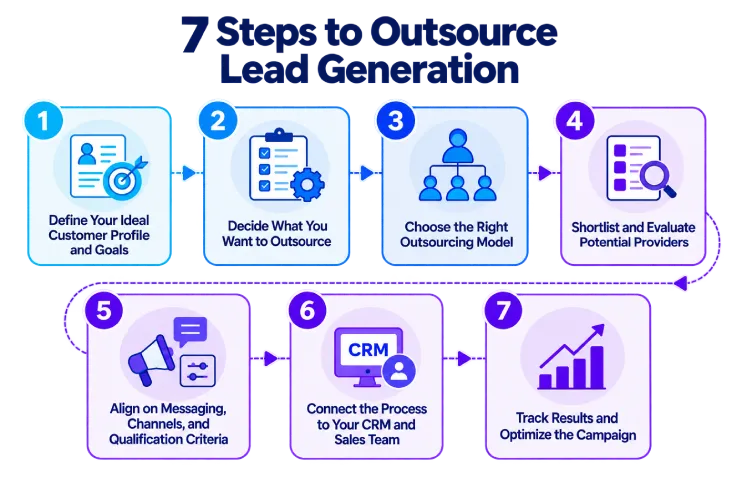
1. Define Your Ideal Customer Profile and Goals
Start by documenting who you want to reach and what you expect the program to achieve. Specify your target industries, company size, decision-maker roles, locations, pain points, buying signals, and disqualifying criteria, then set measurable goals such as qualified leads, meetings, pipeline value, or conversion rates.
2. Decide What You Want to Outsource
Determine which parts of your lead generation process should remain in-house and which should be handled externally. You can outsource prospect research, list building, outreach, lead qualification, appointment setting, or the entire top-of-funnel process depending on your team's capabilities and capacity.
3. Choose the Right Outsourcing Model
Select a model that matches your goals, budget, and required level of involvement. Compare options such as a dedicated sales development team, appointment-setting service, lead qualification support, or prospect research and data services before deciding how to structure the engagement.
4. Shortlist and Evaluate Potential Providers
Compare providers based on relevant industry experience, targeting capabilities, data quality, outreach methods, case studies, team structure, communication, and reporting. Ask prospective partners to explain how they build lists, personalize outreach, qualify leads, and handle unsuccessful campaigns without relying only on promised lead volumes.
5. Align on Messaging, Channels, and Qualification Criteria
Give your provider a clear picture of your value proposition, buyer pain points, brand voice, objection handling, and lead qualification requirements. Agree on the channels to use, such as email, phone, or LinkedIn, and define exactly when a prospect should be considered qualified and handed to your sales team.
Did You Know?
Gartner’s B2B Buyer Survey found that 67% of B2B buyers prefer a rep-free buying experience, highlighting the growing importance of self-directed digital research.
6. Connect the Process to Your CRM and Sales Team
Make sure qualified leads move directly into your existing sales workflow without being passed through disconnected spreadsheets or inboxes. Establish CRM processes, ownership rules, response-time expectations, reporting routines, and feedback loops so your sales team can act on opportunities quickly, and the provider can refine its targeting.
7. Track Results and Optimize the Campaign
Review performance regularly and focus on metrics that show pipeline quality, not just activity. Track qualified leads, meetings held, cost per qualified opportunity, conversion rates, pipeline contribution, and ultimately revenue, then use sales feedback to refine targeting, messaging, and outreach as the campaign progresses.
What Are the Benefits of Outsourced Lead Generation?
Outsourcing lead generation can help you build pipeline capacity without taking on the full cost and management effort of an in-house team. Working with a specialized partner can help you strengthen prospecting, free up sales resources, and adapt lead generation efforts as your business grows.
Reduces Hiring and Operating Costs
You can avoid many of the expenses involved in recruiting, training, and maintaining a dedicated lead generation team. Working with an external team that already has the necessary resources and processes can help you reduce spending on salaries, benefits, tools, and infrastructure.
Gives Your Sales Team More Time to Sell
Outsourcing prospect research, outreach, follow-ups, and initial qualification allows you to spend more time on high-value activities. Your internal team can focus on sales conversations, nurturing qualified prospects, and closing opportunities while an external team manages repetitive prospecting tasks.
Provides Access to Specialized Expertise and Tools
An experienced lead generation partner brings established outreach processes, prospecting expertise, data resources, and sales technology to your campaigns. This gives you access to capabilities that may take significant time and investment to build internally.
Scales Lead Generation More Easily
You can increase or reduce lead generation capacity based on your sales targets, seasonal demand, or market expansion plans. This flexibility makes it easier to test new markets or increase prospecting activity without going through another round of hiring and training.
Builds a More Consistent Sales Pipeline
A dedicated external team can maintain prospecting and follow-up activities consistently, helping prevent lead generation from slowing down when your internal sales team becomes busy. With clear targeting and qualification criteria, the process can create a steadier flow of relevant opportunities for your sales team to pursue.
What Are the Risks of Outsourcing Lead Generation?
Outsourcing can expand your prospecting capacity, but the wrong provider or a poorly managed process can create new challenges. Setting clear expectations, qualification standards, and oversight from the start can help you avoid these common risks.
Low-Quality or Unqualified Leads
Some providers may prioritize lead volume over lead quality, leaving your sales team with prospects that do not match your ideal customer profile. This can waste sales time and make your pipeline look stronger than it actually is.
Inconsistent Brand Messaging
An external team may not fully understand your positioning, value proposition, or brand voice. If outreach relies on generic messaging, prospects may receive an inconsistent experience that can weaken trust in your company.
Reduced Visibility and Control
When prospecting is handled externally, you have less direct oversight of daily outreach, follow-ups, and lead qualification. Without regular reporting, shared workflows, and clear performance standards, it can become difficult to identify problems and adjust the campaign quickly.
Data Security and Compliance Issues
Outsourced teams may access prospect information, CRM records, and other business data as part of their work. Weak data-handling practices or non-compliant outreach can expose your business to security, privacy, and regulatory risks.
Poor Targeting and Strategy Alignment
If your provider doesn’t clearly understand your ideal customer, qualification criteria, and sales goals, it may target the wrong accounts or optimize for activity without building a meaningful pipeline. Strong alignment between your internal team and the provider is essential for keeping campaigns focused on the right opportunities.
Losing visibility into how your outsourced team spends its time?
Time Champ helps you monitor productivity and maintain accountability with actionable insights.
How Much Does Outsourced Lead Generation Cost?
Outsourced lead generation typically costs $3,000 to $10,000 or more per month for a managed B2B program, although pricing varies significantly by service model. Providers may charge a fixed monthly retainer, or a fee for each qualified lead or meeting, so it is important to compare what each pricing structure actually includes.
| Pricing Model | Typical Cost | What You Usually Get |
|---|---|---|
| Monthly Retainer | $3,000-$10,000+/month | Ongoing prospect research, outreach, qualification, follow-ups, reporting, and campaign management. |
| Pay Per Qualified Lead | $150-$800/lead | A defined number of leads that meet agreed qualification criteria. |
| Pay Per Appointment | $150-$1,000+/meeting | Outreach and qualification focused on generating sales appointments; higher rates generally apply to stricter qualification requirements. |
| Hybrid Pricing | $2,500-$5,000/month + $150-$300/meeting | A combination of ongoing campaign support and additional charges based on qualified meetings or other agreed outcomes. |
How Time Champ Helps Manage Outsourced Lead Generation Teams
Managing an outsourced lead generation team can be difficult when you cannot see how agents spend their time or track their daily performance. This lack of visibility can make it harder to maintain accountability and prevent productivity issues. Time Champ is a smart employee monitoring software that helps you manage outsourced lead generation teams with time tracking, activity monitoring, productivity insights, detailed reports, and real-time alerts. These features help you improve visibility, manage team performance, and keep lead generation operations running efficiently.
Here are the key Time Champ features you can use to manage outsourced lead generation teams effectively:
- Tracks Time Spent on Prospecting Tasks: Automatically records work hours, breaks, idle periods, and task-level time, helping you see how much time your outsourced team spends on lead generation activities.
- Monitors Employee Activity in Real Time: Monitors agent activity across tasks, websites, and applications, making it easier to identify idle time, workload issues, and gaps in day-to-day productivity.
- Provides Productivity and Performance Insights: Analyzes productivity trends, activity levels, and work patterns so you can identify underperformance and make better decisions about team capacity and workload.
- Gives Real-Time Alerts: Provides automated alerts for idle time, late logins, productivity drops, and shift issues, helping you respond quickly without waiting for periodic performance reviews.
- Generates Detailed Performance Reports: Offers productivity, time, tasks, attendance, and other workforce data reports to evaluate outsourced team performance and maintain clearer accountability.
- Supports CRM and Workflow Integration: Integrates with CRM platforms, VoIP systems, helpdesk tools, and other productivity applications, helping outsourced lead generation teams maintain connected workflows and reporting.
Struggling to keep outsourced lead generation teams productive and accountable?
Time Champ gives you real-time visibility to track, monitor, and improve team performance.
Conclusion
Outsourced lead generation can help you expand prospecting capacity, access specialized expertise, and keep your sales team focused on closing opportunities. The right approach depends on your goals, budget, target audience, and required level of control. Before choosing a provider, define clear qualification criteria, compare pricing models, and establish measurable KPIs. Then, start with a structured program and optimize it based on pipeline results.

Anjali

Table of Content
 What Is Outsourced Lead Generation?
- What Are the Main Lead Generation Outsourcing Models
- In-House vs Outsourced Lead Generation: Which One Fits Your Business?
- How to Outsource Lead Generation in 7 Steps
- What Are the Benefits of Outsourced Lead Generation?
- What Are the Risks of Outsourcing Lead Generation?
- How Much Does Outsourced Lead Generation Cost?
- How Time Champ Helps Manage Outsourced Lead Generation Teams
- Conclusion
Related Blogs

Reduce costs, access specialized talent, and improve efficiency with outsourcing. Compare its types, benefits, risks, and the top outsourcing companies.
Anjali | Jul 13, 2026
BPO stands for Business Process Outsourcing and it entails the hiring of external companies to perform certain jobs.
Vijaya Lakshmi | Apr 02, 2024
In-house vs outsourcing explained with key differences, pros, cons, costs, and practical tips to help you choose the best approach for your organization.
Anjali | Jul 02, 2026
Learn how to kickstart your BPO business with this comprehensive step-by-step guide, covering everything from planning to execution. Get insights now!
Tarun Kumar Reddy | Nov 17, 2023
Explore the essential metrics to accurately measure and enhance your sales productivity, helping your team work smarter and achieve higher results.
Jahnavi Pulluri | Jan 11, 2025
Track team productivity without watching people: 8 metrics with formulas, the three that fit your team, and how to spot when your numbers are being gamed.
Shabana Shaik | Aug 31, 2026


 4.7/5 avg.
Ready to Manage Your Workforce Smarter?
Join our family of 1500+ companies using smart insights to redefine workforces!

Free Trial
No Credit Card Required