How Healthcare Organizations Use Employee Monitoring
Learn how employee monitoring in healthcare protects patient data, tracks admin productivity, detects insider threats, and keeps your organization audit-ready.
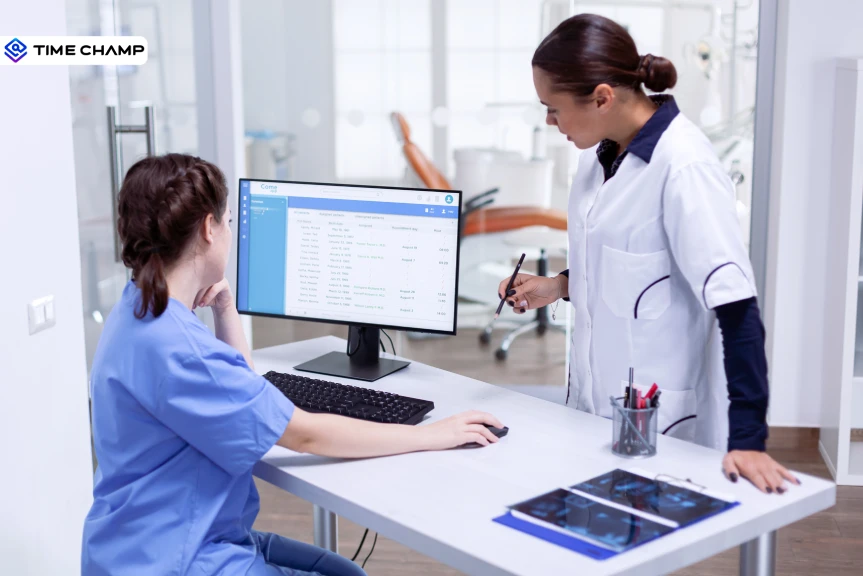
Access controls tell you who can reach your systems. Employee monitoring tells you what they do with that access.
Employee monitoring healthcare helps you understand how your staff uses systems and handles the data during work hours. It gives you clear visibility into daily activities across billing, administration, and support teams. It helps you track productivity, protect patient data through data loss prevention, detect insider threats, identify burnout signals, and maintain audit-ready activity logs for compliance.
This blog explains which healthcare teams need monitoring, what to track, how it supports data protection & compliance, and what to look for when choosing the right tool for a healthcare environment.
What Employee Monitoring Covers in Healthcare
Employee monitoring healthcare acts as a visibility layer on top of your access and scheduling systems. Access controls show you who is allowed to use certain systems. Activity tracking shows you what they actually do during their work sessions. It tracks which files they open, systems they use, how productive they are, and whether their behavior matches their role.
This difference is important in healthcare because the most common data risks do not come from external attackers. They often come from staff who already have access but use it incorrectly. For example, a billing employee may open records outside their assigned tasks, a coordinator may copy files to a personal USB device, or an admin’s activity may suddenly drop before they leave the organization. These are signals that access controls cannot detect, but monitoring can do that effectively.
What employee monitoring covers in your healthcare organization:
- Productivity of your admin and back-office staff.
- Data loss prevention for patient and operational records.
- Insider threat detection based on unusual behavior.
- Audit-ready activity logs for compliance reviews.
- Staff burnout and overutilization risk in high-pressure roles.
What it does not cover: Clinical workflow monitoring, patient monitoring, EMR system auditing, or trade surveillance. These require specialized clinical and compliance systems outside the employee monitoring category.

Did You Know?
The IBM Report found that the healthcare sector had the highest average breach cost at $9.77 million, showing why strong monitoring practices are essential.
Which Healthcare Teams Need Employee Monitoring
Healthcare organizations have different types of teams, and each one has its own monitoring needs. A billing team works differently from a remote admin team, and both are very different from IT or security teams. Because of this, monitoring should be tailored based on individual roles.
The table below shows each team, what you need to monitor, and the features that help you do it effectively.
| Healthcare Team | Monitoring Need | TC Features That Cover It |
|---|---|---|
| Medical billing and coding teams | Track productivity, idle time, and task accuracy for high-volume data work. | Activity monitoring, role-based productivity classification, timeline view, and idle alerts. |
| Remote clinical admins and coordinators | See work sessions, verify activity, and track attendance for remote staff. | Activity monitoring, automated attendance, and screen recording for verification. |
| IT and data security teams | Monitor access to patient data, track file movement, and control USB usage. | File monitoring, USB blocking, upload/download alerts, and compliance reports. |
| Multi-site and hybrid admin teams | Track activity across locations, detect absence patterns, and compare productivity. | Real-time alerts for missed check-ins and team vs individual productivity comparison. |
| HR and workforce operations teams | Identify burnout, attrition risks, and overwork patterns. | Attrition prediction, work-life balance insights, and overutilization alerts. |
Struggling to track staff activity and protect patient data?
Time Champ helps you monitor work, prevent risks, and stay audit-ready.
Key Monitoring Capabilities for Healthcare Organizations
Healthcare organizations need clear visibility into how staff use systems, handle data, and perform daily tasks. You can achieve this with the right monitoring capabilities that focus on productivity, security, and compliance. The following capabilities help you reduce risks, protect sensitive data, and maintain control across your workforce.
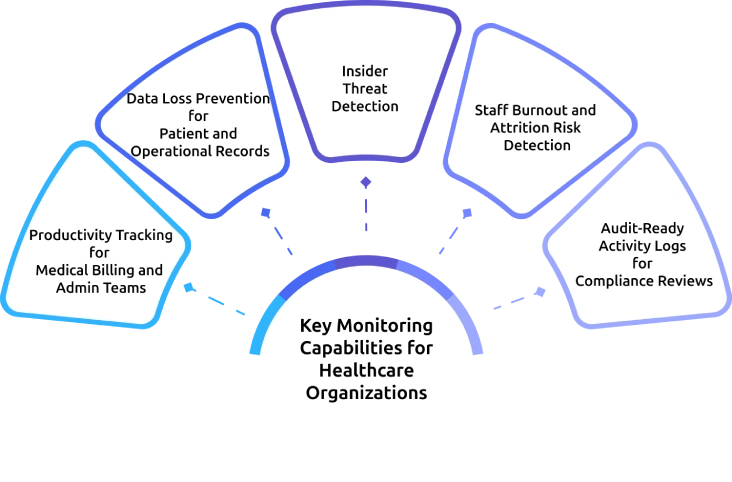
Productivity Tracking for Medical Billing and Admin Teams
Medical billing, coding, and administrative teams handle large volumes of sensitive data every day. Their accuracy and consistency directly affect revenue and compliance. You need clear visibility into how each team member spends their work sessions to maintain quality and performance.
Productivity monitoring helps you track which applications your team uses, how much time they spend on productive work, and when idle or non-work activity increases. You can quickly spot when attention shifts away from work and take action early.
The system classifies each application as productive, non-productive, or neutral based on the role. For example, when a billing specialist uses healthcare software, the system marks it as productive. If the same person spends time on social media, it flags it as non-productive. You can compare performance across teams and identify gaps before they affect output quality. This makes employee monitoring healthcare essential for maintaining performance and accuracy.
Data Loss Prevention for Patient and Operational Records
Patient records, insurance data, billing details, and staff information are highly sensitive. You must protect this data at all times. Data loss prevention (DLP) helps you control how your staff handles and moves data during their work.
- File Movement Tracking
Tracks every file action, including creation, editing, deletion, and transfer. The system records exact timestamps and file paths for each action. If someone moves patient data to an unusual location or outside their normal workflow, you can detect and review it immediately.
- USB Device Monitoring and Control
Monitor all USB devices connected to your systems in real time. The system helps you block unauthorized devices instantly. It also records each USB event with user details, time, and device information, so you can always have a clear record for audits or investigations.
- Upload and Download Violation Alerts
Monitor how data moves through web platforms. The system alerts you when someone tries to upload files to personal cloud storage, send data through personal email, or use unapproved external services. These real-time alerts help you act before data leaves your environment.
- Compliance-ready Violation Reports
Generate clear reports of all DLP activities in XLSX, CSV, or PDF formats. These reports help you during audits and compliance checks. Role-based access ensures that only authorized IT and compliance teams can view sensitive data.
Insider Threat Detection
Insider threats in healthcare do not always come from bad intent. Sometimes employees misuse access without realizing the risk. For example, a departing employee may download patient records before leaving, a billing staff member may access records outside their assigned scope, or a coordinator may still use systems from a previous role. You can spot these risks early through activity data before they cause damage.
Behavioral monitoring helps you track how each user normally works. It highlights unusual actions such as accessing new file types, working at odd hours, downloading large amounts of data, or using systems outside their role. You receive real-time alerts when these changes happen, so you can investigate quickly and take action before the issue becomes serious.
This kind of behavioral analysis is part of a wider move toward AI in healthcare operations, where predictive models help flag risks before they turn into bigger problems.
Staff Burnout and Attrition Risk Detection
Healthcare has some of the highest staff turnover rates of any industry. Administrative and clinical support staff handle constant pressure from high case volumes, complex workflows, and frequent organizational changes. You can see early signs of disengagement and resignation in activity data weeks before an employee leaves. Time Champ’s attrition prediction software brings these signals together into per-employee risk scores, so HR teams can step in early and take immediate action.
You can identify warning signs such as reduced productivity time despite long work sessions, increasing idle time, extended working hours, and lower tool usage. These patterns appear in monitoring data before an employee decides to leave. For healthcare organizations, replacing experienced billing and admin staff is costly and disruptive, so identifying these signals early helps you reduce risk and maintain stability.
Audit-Ready Activity Logs for Compliance Reviews
Healthcare compliance reviews focus on two key questions: who had access to what, and what did they do with it? Employee monitoring healthcare helps you answer these questions with clear, detailed records. Every work session creates a timestamped activity log that shows which systems were accessed, which applications were used, how long each session lasted, and when behavior changed from the normal pattern for that role. Time Champ is HIPAA-compliant and ISO 27001:2022 certified, so the monitoring layer meets the standards your compliance and procurement teams expect.
You can store these logs securely with role-based access controls and export them in standard formats for audits, regulatory submissions, or investigations. These records give you clear proof that you actively monitor access and review unusual activity.
How Time Champ Supports Healthcare Organizations
Struggling to track staff activity, protect patient data, and stay audit-ready at the same time? Many healthcare organizations face this challenge because access controls alone do not show how employees actually use systems. Time Champ solves this challenge by giving you complete workforce visibility through its employee monitoring system. It helps you track application usage, classify productivity based on roles, and view detailed timelines of each work session. You can quickly review activity during audits or investigations without confusion.
Time Champ also strengthens data security. It monitors file movement, controls USB devices, and alerts you to any unusual uploads or downloads across all devices, whether your teams work on-site or remotely. At the same time, it helps you detect burnout and attrition risks early through behavioral insights. With secure, role-based access to data, you stay compliant while keeping control. You can also use it alongside your existing systems or as a standalone solution.
Struggling to track employee attendance accurately?
Time Champ helps you monitor attendance automatically without manual effort.
Conclusion
Healthcare organizations face constant pressure to protect sensitive patient data, maintain strict compliance, and manage workforce performance effectively. You cannot rely on access controls alone to handle these challenges. You need clear visibility into how your staff actually uses systems and data every day. Employee monitoring healthcare helps you close this gap. It allows you to track productivity, prevent data loss, detect insider threats early, and identify burnout signals before they affect performance or retention. With the right monitoring approach, you can strengthen security, improve accountability, and support your teams while staying fully prepared for audits and compliance reviews.

Anjali

Table of Content
-
 What Employee Monitoring Covers in Healthcare
-
Which Healthcare Teams Need Employee Monitoring
-
Key Monitoring Capabilities for Healthcare Organizations
-
How Time Champ Supports Healthcare Organizations
-
Conclusion
Instant Signup
Thank you for your request!
We have received your signup request and our team will get back to you soon. In the meantime, you can book a demo to see Time Champ in action.
Book a DemoFree trial. No credit card required. Prefer a walkthrough? Book a demo.
Related Blogs

The cause of employee burnout has become very common these days. Employees are getting burned out during the working hours for several reasons.

Understand employee monitoring legal compliance, key laws, and best practices to track work activity while protecting privacy and avoiding legal risks.
Thasleem Shaik | Apr 14, 2026
Discover how network data loss prevention protects sensitive data and shields your business from costly breaches and regulatory risks.
Thasleem Shaik | Jan 18, 2025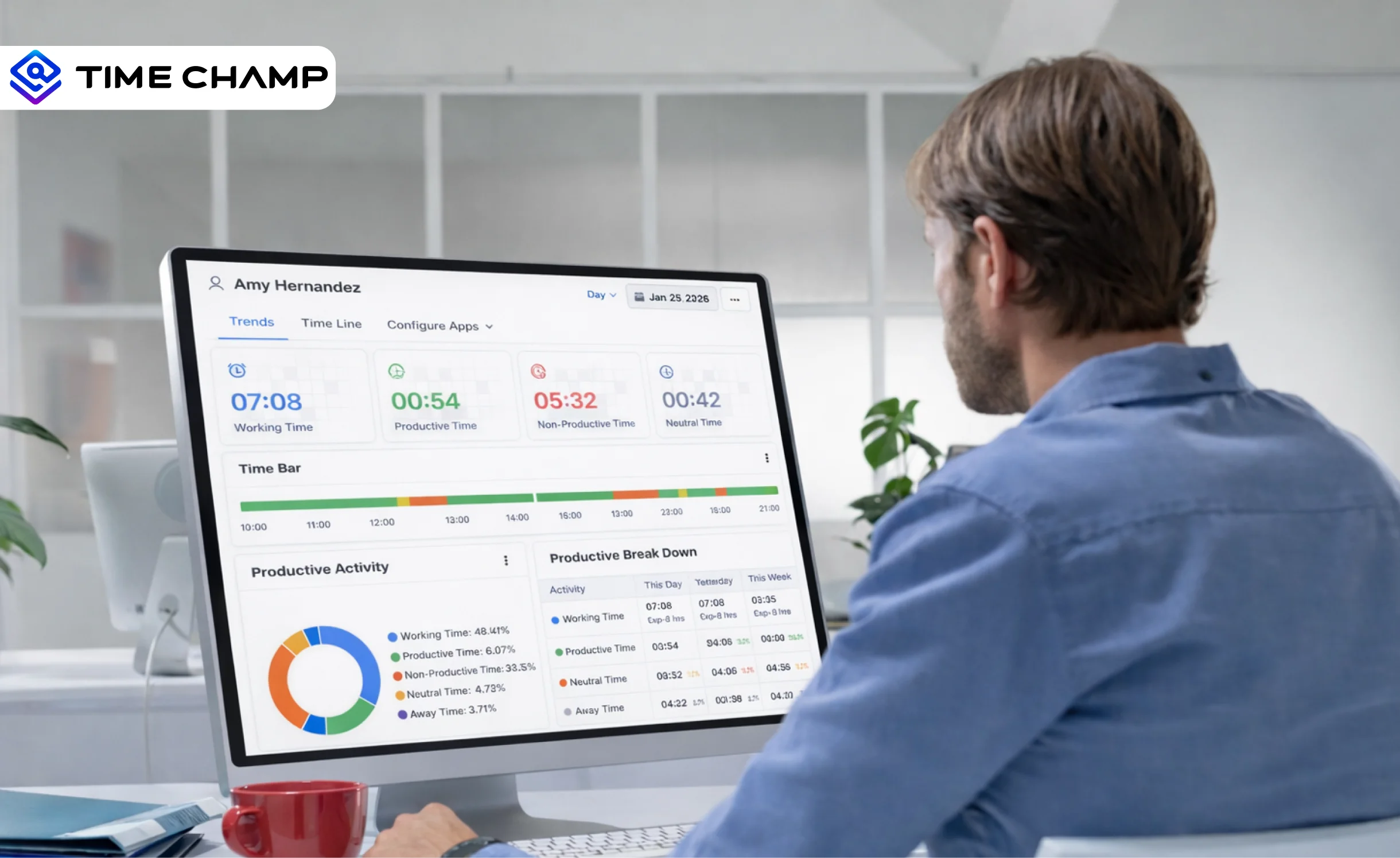
Discover what workforce intelligence is, why it's critical, real examples, implementation steps, key benefits, challenges & how AI transforms the future.
Explore the best remote employee management software systems for productivity, collaboration, and performance tracking.
Jahnavi Pulluri | Mar 12, 2025
The AI employee monitoring software goes beyond basic tracking. It predicts risks, reveals patterns, and gives you real clarity to lead your team better.


 4.7/5 avg.
Ready to Manage Your Workforce Smarter?
Join our family of 1500+ companies using smart insights to redefine workforces!

Free Trial
No Credit Card Required