Chat Support Outsourcing: Costs, Models & Benefits
Chat support outsourcing: four delivery models, real pricing ranges, and the benefits worth weighing before you outsource live chat support operations.

When chat volumes spike, your team may struggle to respond quickly as routine conversations pile up. Hiring more agents may solve the capacity gap, but it also adds recruitment, training, and staffing costs. Chat support outsourcing lets you extend your support capacity through external agents while managing costs, coverage, and service demands more flexibly. The right outsourcing model can help you handle fluctuating chat volumes, provide broader coverage, and maintain a consistent customer experience.
You’ll see how chat support outsourcing works, which models and pricing options are available, what benefits and challenges to consider, and how to measure the right outsourced chat team.
What Is Chat Support Outsourcing?
Chat support outsourcing is the practice of hiring an external company or specialized team to handle customer conversations through live chat and digital messaging channels. These teams can answer questions, resolve issues, assist with purchases, and provide technical support, helping businesses extend coverage, manage chat volumes, and maintain responsive customer service.
The Four Chat Support Outsourcing Models
Not every business needs the same approach to outsourced chat support. The right model depends on your chat volume, support complexity, operating hours, and how much control you want to retain over customer interactions.
1. Basic (Tier-1) Support Model
How it Works: An external support team manages straightforward, repetitive customer conversations using established scripts, FAQs, and response guidelines.
Best For: Businesses handling common questions, order-status requests, account assistance, appointment queries, and other routine issues.
Limitation: This model is less suitable for complex technical problems or conversations that require extensive product knowledge and personalized troubleshooting.
2. Remote-First Support Model
How it Works: Customer support agents work remotely from different locations and communicate with customers through digital chat platforms without operating from a single support center.
Best For: Businesses that want access to a wider talent pool, flexible staffing, or support across multiple regions without maintaining a centralized facility.
Limitation: Remote teams require strong communication, security controls, workforce coordination, and performance visibility to maintain consistent service quality.
3. AI-First Hybrid Model
How it Works: AI handles initial conversations, answers routine questions, and routes interactions based on customer intent. Human agents step in when a request requires judgment, empathy, or more detailed assistance.
Best For: Businesses with high chat volumes and many repetitive queries that want to automate simple interactions while keeping human support available for complex cases.
Limitation: AI workflows need regular monitoring, accurate knowledge sources, and ongoing optimization to prevent incorrect responses and poor customer experiences.

Did You Know?
Gartner’s survey found that73% of customer service organizations were expected to implement agent-assist solutions by the end of 2025, supporting the shift toward AI-assisted human support.
4. 24/7 Coverage Model
How it Works: Support is distributed across agents working in different shifts or time zones, allowing customer conversations to be handled beyond standard business hours.
Best For: E-commerce, SaaS, and global businesses serving customers across multiple regions or requiring support outside a traditional workday.
Limitation: Coordinating teams across shifts and time zones can make quality control, handoffs, training, and consistent service standards more challenging.
How Much Does Chat Support Outsourcing Cost?
There is no single price for outsourced chat support because providers use different billing models and price their services based on location, coverage, chat volume, and support complexity. Current 2026 pricing data shows that outsourced chat support can range from about $7 to $45+ per agent hour, while dedicated-agent and per-resolution models follow different pricing structures.
| Pricing Model | Typical 2026 Cost | Best Suited For |
|---|---|---|
| Offshore agent-hour | $7-$15/hour | Routine, high-volume chat support |
| Nearshore agent-hour | $15-$28/hour | Teams needing closer time-zone or cultural alignment |
| Onshore agent-hour | $25-$45/hour | Specialized or complex customer support |
| Per chat/contact | $2-$8/chat | High-volume, clearly defined interactions |
| Dedicated agent | $1,200-$3,500/month | Consistent volume requiring dedicated support |
| Managed service | $1,500-$4,000+/month | Businesses needing broader support management |
Did You Know?
KPMG’s managed services research found that 72% of companies using managed services have implemented them for customer service, making it the most common function in the study.
Benefits of Chat Support Outsourcing
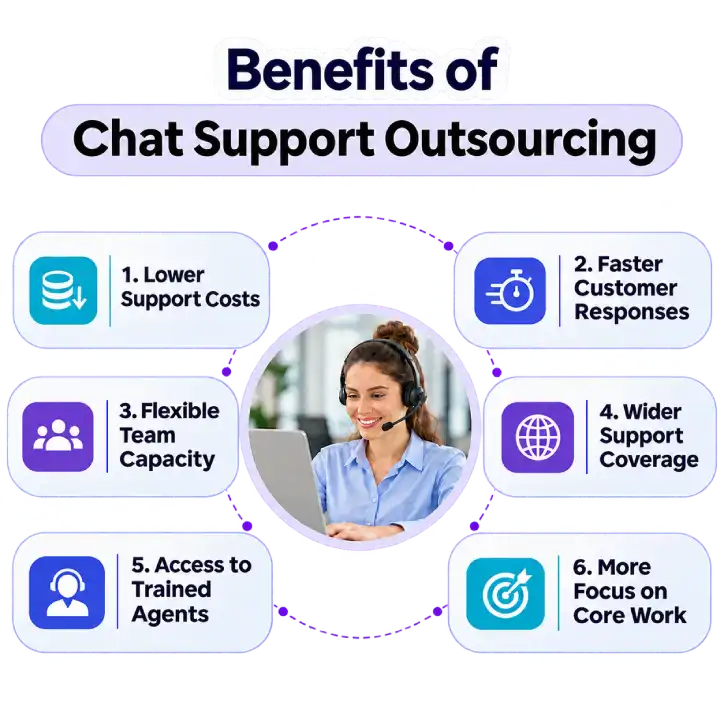
Outsourcing chat support can do more than take conversations off your internal team’s plate. With the right provider and service model, you can extend coverage, respond faster, and add support capacity without building the entire operation yourself.
1. Lower Support Costs
You can reduce the expense of recruiting, training, staffing, and maintaining an in-house chat team. Outsourcing can also help you avoid fixed infrastructure costs while paying for the level of support your operation actually needs.
2. Faster Customer Responses
Dedicated chat agents can focus on real-time conversations without juggling chat alongside multiple support channels. Faster responses can reduce customer waiting time and help prevent visitors from leaving before receiving assistance.
3. Flexible Team Capacity
Your support needs can change with seasons, promotions, product launches, or unexpected spikes in demand. An outsourced team can give you additional capacity when volumes rise without requiring permanent hiring for every peak period.
4. Wider Support Coverage
Outsourcing makes it easier to extend chat availability beyond your regular business hours. With agents working across shifts and time zones, you can provide support during evenings, weekends, holidays, or around the clock.
5. Access to Trained Agents
You can tap into agents who already have experience handling customer conversations, troubleshooting common issues, following support workflows, and working with chat platforms. This can shorten the time and effort required to build an effective support operation internally.
6. More Focus on Core Work
Moving routine and high-volume chat interactions to an external team gives your internal employees more time for complex customer issues, product work, sales, and other higher-value responsibilities.
Looking to make outsourced support more efficient?
Time Champ gives you clear insights into team productivity and performance.
Challenges of Chat Support Outsourcing and How to Manage Them
Outsourcing can expand your support capacity, but handing customer conversations to an external team can introduce new operational challenges. Clear processes, regular communication, and consistent oversight can help you maintain service quality while getting the benefits of an outsourced team.
1. Inconsistent Brand Voice
External agents may not initially understand your brand tone, products, or customer expectations, which can lead to responses that feel inconsistent with your in-house support.
How to Overcome It: Provide detailed brand guidelines, product documentation, response examples, and regular training. Review conversations regularly and give agents feedback on tone, accuracy, and customer handling.
2. Gaps in Product Knowledge
Outsourced agents may struggle with complex questions when they lack sufficient knowledge about your products, services, or internal processes.
How to Overcome It: Build a centralized knowledge base with product information, troubleshooting steps, FAQs, and escalation procedures. Keep these resources updated and provide ongoing training as products or policies change.
3. Communication and Handoff Issues
Poor communication between your internal and outsourced teams can delay escalations, create duplicate work, or leave customers waiting for answers.
How to Overcome It: Define clear escalation rules, assign ownership for different issue types, and establish reliable communication channels. Document handoff procedures so agents know when and how to involve your internal team.
4. Maintaining Consistent Quality
Managing support quality becomes harder when conversations are handled by a team outside your organization. Without regular oversight, response quality, adherence to processes, and service levels can vary between agents or shifts.
How to Overcome It: Set measurable service standards and review key metrics such as first response time, resolution time, customer satisfaction, and SLA adherence. Conduct regular quality checks and use performance feedback to address recurring issues.
5. Data Security and Privacy Risks
Outsourced agents may need access to customer information and business systems, increasing the need for strong controls around sensitive data.
How to Overcome It: Assess providers’ security practices, limit access to only the information agents need, use secure systems, and establish clear data-handling requirements. Regular audits can help ensure these standards remain in place.
6. Managing Fluctuating Chat Volumes
Sudden increases in chat requests can overwhelm an outsourced team just as they can an internal one, resulting in longer wait times and unresolved conversations.
How to Overcome It: Share expected demand patterns with your provider and agree on staffing requirements for peak periods. Flexible staffing arrangements can help increase coverage when demand rises without maintaining excess capacity during quieter periods.
How to Measure the Performance of an Outsourced Chat Team
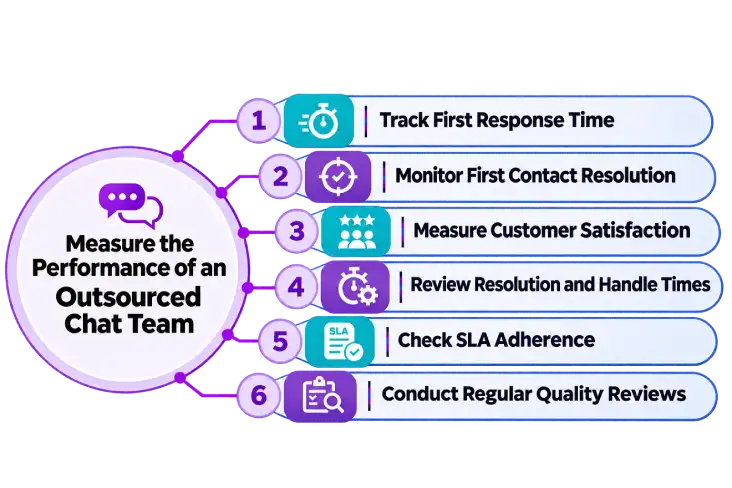
Outsourcing your chat operations does not remove the need for performance oversight. You need a balanced view of speed, resolution quality, customer satisfaction, and service consistency to know whether your provider is delivering the level of support you expect.
Track First Response Time
Measure how long customers wait before receiving the first response from an agent. A rising response time can indicate understaffing, inefficient chat routing, or agents handling too many conversations at once.
Monitor First Contact Resolution
Track the percentage of customer issues resolved during the first interaction without requiring another chat or follow-up. A strong FCR rate indicates that agents have the knowledge, tools, and authority needed to resolve issues effectively.
Measure Customer Satisfaction
Use post-chat surveys to measure how customers rate their support experience. Review CSAT alongside response and resolution metrics because fast responses do not necessarily mean customers received helpful or satisfactory support.
Review Resolution and Handle Times
Measure how long agents take to complete conversations and resolve customer issues. Avoid treating shorter handling times as automatically better; unusually low times can indicate rushed responses, while longer times may point to knowledge gaps or inefficient processes.
Check SLA Adherence
Set clear service-level targets with your outsourcing provider for response times, resolution times, escalations, and other agreed requirements. Track actual performance against these commitments to identify recurring service gaps and address them before they affect customers.
Conduct Regular Quality Reviews
Review a sample of chat transcripts to assess response accuracy, tone, policy compliance, documentation, and escalation handling. Combine these reviews with KPI trends and regular calibration sessions so recurring issues lead to targeted coaching or process improvements.
How Time Champ Supports Outsourced and Blended Chat Teams
Managing outsourced and blended chat teams can make it hard to know whether agents are following schedules, staying productive, and maintaining expected work standards. Limited visibility can leave you relying on manual follow-ups to spot attendance issues, idle time, and productivity gaps. Time Champ is a smart employee monitoring software with workforce management features that gives you visibility into agent activity, work hours, attendance, and productivity. It helps you monitor distributed chat teams, identify performance gaps, and manage outsourced operations with less manual effort.
Here are the key features of Time Champ that help you manage outsourced and blended chat teams effectively:
- Automated Time Tracking: Tracks clock-ins, work hours, breaks, and idle periods automatically, helping you maintain accurate records across outsourced and blended teams.
- Real-time Productivity Insights: Shows activity levels, productivity patterns, app usage, and idle time, helping you identify where agents may need support or workload adjustments.
- Shift Management: Helps you create and adjust shifts for distributed teams, making it easier to coordinate coverage across different schedules and time zones.
- Attendance Visibility: Gives you a live view of who is present, absent, or on leave, helping you spot attendance gaps before they affect support coverage.
- Real-time Alerts: Sends alerts for late logins, idle time, and productivity drops, helping you address operational issues sooner rather than waiting for periodic reviews.
- Performance Reports: Provides detailed reports on time, productivity, tasks, and work patterns, helping you review team performance, identify trends, and make better workforce decisions.
Struggling to track your outsourced chat team?
Time Champ gives you real-time visibility into productivity and attendance.
Conclusion
Chat support outsourcing can help you control support costs, extend coverage, and handle changing customer volumes without expanding your in-house team. Choosing the right model, provider, and performance measures is essential for maintaining service quality and customer satisfaction. With clear expectations and regular performance reviews, outsourced teams can become a reliable extension of your support operation. Assess your current chat workload, compare suitable outsourcing models, and choose an approach that strengthens your customer support while supporting long-term growth.

Anjali

Table of Content
 What Is Chat Support Outsourcing?
- The Four Chat Support Outsourcing Models
- How Much Does Chat Support Outsourcing Cost?
- Benefits of Chat Support Outsourcing
- Challenges of Chat Support Outsourcing and How to Manage Them
- How to Measure the Performance of an Outsourced Chat Team
- How Time Champ Supports Outsourced and Blended Chat Teams
- Conclusion
Related Blogs

Contact center services help businesses manage customer support across multiple channels. Compare types, benefits, costs, technologies, and AI trends.
Thasleem Shaik | Aug 10, 2026
Explore employee performance monitoring types, effective methods, common mistakes, and practical ways to improve overall team performance for modern workplaces.
Anjali | May 08, 2026
How to start a call center using a complete setup process covering costs, software, staffing, compliance, operations, and business planning.
Thasleem Shaik | Jul 29, 2026
Learn simple ways to measure and boost call center productivity, helping your team work more efficiently and improve customer service.
Jahnavi Pulluri | Jan 10, 2025
Discover 10 proven workload management strategies to prevent employee burnout, improve productivity, and build a healthier workplace!
Guna Lakshmi | Jul 31, 2026
The future of outsourcing is changing with AI, nearshoring, and outcome-based models. Explore the latest trends, predictions, and what you should expect.
Thasleem Shaik | Jul 31, 2026


 4.7/5 avg.
Ready to Manage Your Workforce Smarter?
Join our family of 1500+ companies using smart insights to redefine workforces!

Free Trial
No Credit Card Required