Call Center SLA: Meaning, Types, Formula, & Best Practices
Get the call center SLA basics, including key terms, types, calculation formulas, benchmarks, benefits, and practical tips for better service levels.
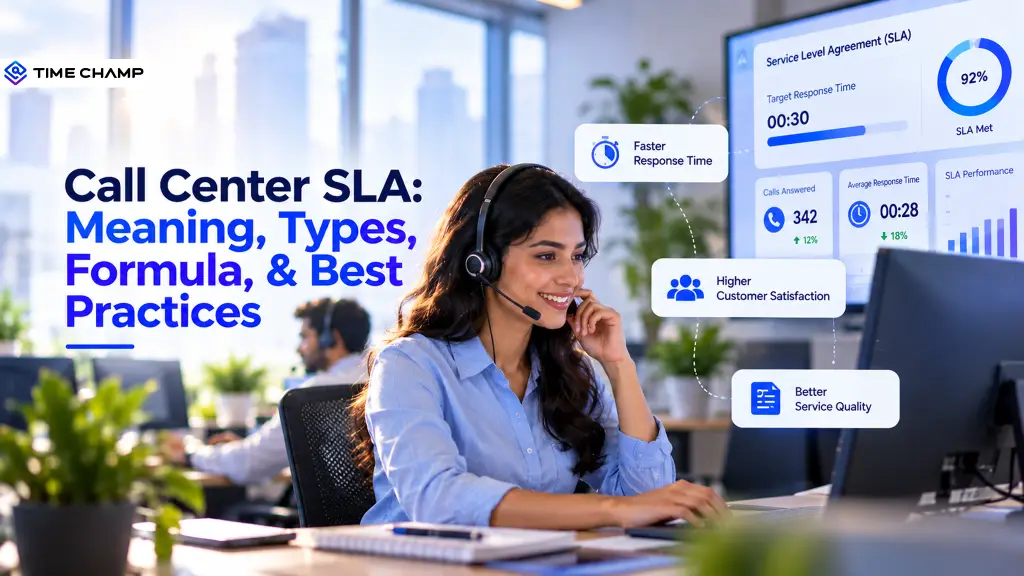
When customers contact your call center, the time they spend waiting and the quality of the service they receive can shape their overall experience with your brand. An SLA may sound like paperwork, but it can make a real difference. It can help you keep your queues moving smoothly and reduce the risk of losing customers because of long wait times.
In this guide, you’ll see what a call center SLA covers, how the service level formula works, and which standards make sense for your team.
What Is a Call Center SLA?
A call center SLA is a formal commitment that sets the standard of service you promise to deliver to your customers or clients. It spells out how fast your agents answer calls, how quickly they resolve issues, and what quality your customers can expect on every interaction.
For example, a common call center SLA may state that 80% of calls should be answered within 20 seconds. This gives you a clear way to track service quality, plan staffing, and understand whether customers are getting help within the expected time.
SLA: Meaning, Full Form, and Related Terms
SLA stands for Service Level Agreement. That is the full form, but in a call center, what matters more is what the term actually covers and protects.
You’ll often see SLA and service level used as if they mean the same thing, but they don’t. Mixing them up can make the rest of the topic confusing. Here are the related terms you should know before you go further.
- Service level is the percentage metric itself, most commonly the 80/20 standard, meaning 80% of calls are answered within 20 seconds. Service level is a number your team hits or misses. SLA is the agreement built around that number.
- KPI (Key Performance Indicator) is a broader term for any metric you track to judge performance, like average handle time or first-call resolution. Every SLA target is a KPI, but not every KPI you track shows up in your SLA.
- OLA (Operational Level Agreement) works like an internal SLA, used between teams or departments inside your own company rather than between you and an outside client or provider.
- ASA (Average Speed of Answer) is the average wait time before an agent picks up a call. It sits close to service level but measures an average, not a pass-or-fail percentage.
- Abandonment Rate is the share of callers who hang up before reaching an agent, and it pulls your service level down every time it climbs.
Still relying on scattered data to track agent productivity?
Use Time Champ to bring productivity, attendance, and schedule data together.
What Are the Different Types of SLAs?
Not every SLA follows the same structure. The right type depends on who you serve, how you deliver the service, and how much flexibility you need in your service commitments. Here are the main types and when to use each one.
1. Customer-Based SLA
A customer-based SLA sets terms for one specific client or account. If you run a call center for multiple clients, create separate targets, response times, and escalation rules for each client based on the terms you agree on. For example, a retail client and a healthcare client may need different service level targets and response times, so build each SLA around the specific needs of that client.
2. Service-Based SLA
A service-based SLA applies the same standard to everyone who uses a particular service, regardless of who they are. If you offer phone support, live chat, and email as separate services, each one gets its own SLA that covers every customer who uses it. This works well when you deliver a consistent service across a broad customer base and don't need account-specific terms.
3. Multilevel SLA
A multilevel SLA combines both approaches in one structure. It uses different layers, with a corporate level that sets baseline standards for the whole company, a customer level that adds requirements for a specific client, and a service level that covers individual services. This structure gives you more flexibility. Set company-wide minimums while tailoring targets for specific clients or services.
4. Internal SLA
An internal SLA sets service expectations between teams or departments within the same company rather than between you and an outside client. For example, your call center team might set an internal SLA with IT for resolving technical issues within a specific time. This helps prevent system problems from affecting your ability to meet customer-facing targets. These agreements usually stay within the company, but they help keep the different parts of your call center SLA working together.
How to Calculate SLA in a Call Center (Formula + Worked Example)
Calculating your service level comes down to one formula, but the result only makes sense when you know exactly which calls count and which do not. Here’s how to run the calculation correctly, along with the areas where service level calculations often go wrong.
The Service Level Formula
Use this service level formula to calculate your call center’s performance for any period, whether it’s an hour, a day, or a full month.
Service Level (%) = (Calls Answered Within Threshold ÷ Total Calls Offered) × 100
Your threshold is the number of seconds you commit to answering calls within. Total calls offered includes every call that reaches your queue, whether you answer it or not. Run this calculation by channel, team, or individual agent to see where your service level actually breaks down instead of relying on one blended number.
A Worked Example
Say your center receives 1,000 calls in a day, and your agents answer 820 of them within your 20-second target.
Service Level = (820 ÷ 1,000) × 100 = 82%
You hit your 80/20 target for that day. Run the same service level calculation across shorter intervals too. A daily average of 82% can still hide a difficult stretch between 9 and 10 AM when your service level drops to 60%. Check 15- or 30-minute intervals if you want to catch problems before they appear in your monthly report.
How Abandoned Calls Change the Result
This is where two call centers can report different numbers from the same raw data. Calculating service level depends on how you treat calls that end before an agent answers.
You’ll typically see two approaches:
- Exclude abandoned calls from the count. You measure only the calls that agents answer, so a caller who hangs up after 15 seconds does not affect the score.
- Include abandoned calls in your total. Every call that enters the queue counts toward your denominator, whether an agent answers it or not. Under this method, a rise in abandoned calls lowers your service level even when your agents answer every call they reach at the same speed.
Choose one method and document it in your SLA. If you switch between approaches or let different teams use different calculations, your service level numbers stop being comparable from month to month. You also lose a clear view of whether staffing problems or reporting differences caused the change.
Call Center SLA Benchmarks for 2026
There is no single call center service level standard that works for every operation. Your ideal target depends on your call volume, customer expectations, staffing costs, and the type of service you provide. Still, 80/20 remains a widely used benchmark, meaning you aim to answer 80% of calls within 20 seconds.
| Service Level Target | What It Means | Typical Use |
|---|---|---|
| 80/20 | Answer 80% of calls within 20 seconds | Common middle-range target |
| 85/15 | Answer 85% of calls within 15 seconds | Higher service target |
| 90/15 | Answer 90% of calls within 15 seconds | High service target |
| 90/20 | Answer 90% of calls within 20 seconds | High service target |
| 80/30 | Answer 80% of calls within 30 seconds | More moderate target |
| 90/60 | Answer 90% of calls within 60 seconds | More moderate target |

Did You Know?
SQM Group, a research firm that benchmarks contact center performance, puts the industry benchmark for call abandonment rate at 5 percent, with anything under that considered good performance.
What Are the Benefits of SLAs in a Call Center?
A clear SLA does more than set a service target. It gives you a shared standard for service, makes performance easier to measure, and creates a clear link between your commitments and your day-to-day call center operations.
Here are the key benefits an SLA brings to your call center.
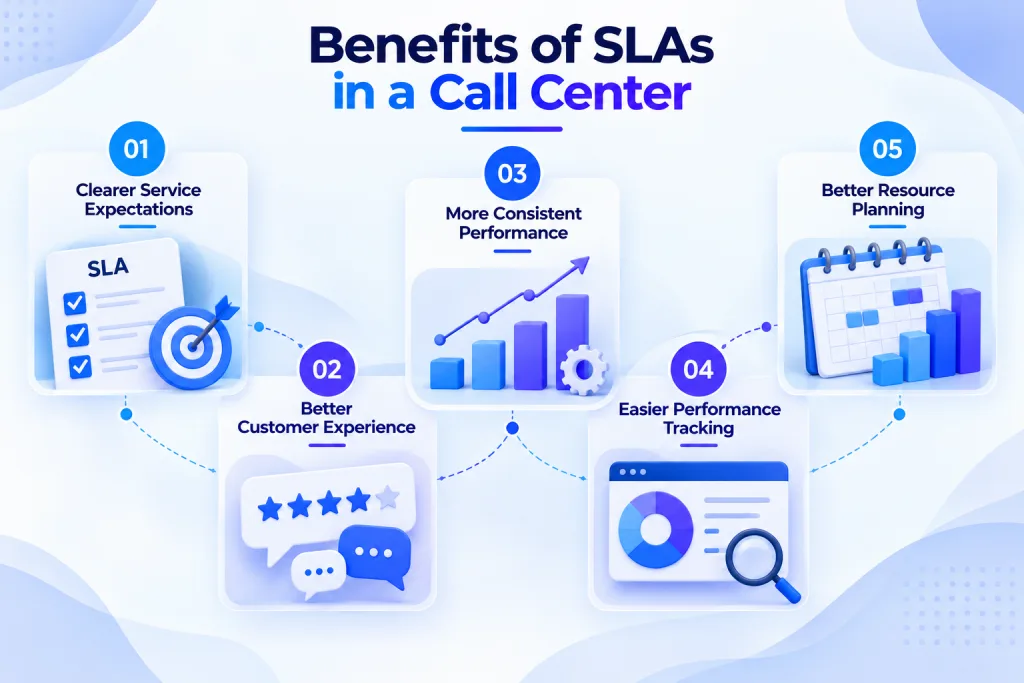
1. Clearer Service Expectations
An SLA tells you exactly what level of service you need to deliver. Instead of working with vague expectations, you have defined targets for response time, service level, quality, and other agreed measures. This gives your team a clear standard to work toward and gives your clients a clear view of the service they should expect.
2. Better Customer Experience
When you meet your SLA targets consistently, you reduce unnecessary waiting and create a more predictable service experience. Your customers get faster responses and a clearer level of service. A well-defined SLA also helps you spot gaps between the service you promise and the experience you deliver.
3. More Consistent Performance
An SLA gives you a fixed standard for measuring service over time. You can compare your actual results with the agreed target instead of judging performance from one report or one busy period. This makes it easier to see whether your service stays consistent across different periods, teams, or service channels.
4. Easier Performance Tracking
An SLA turns your service expectations into measurable targets. You can track your call center service level, response time, abandonment rate, and other agreed metrics against those targets. That gives you a clearer picture of whether your actual performance matches the service you promised.
5. Better Resource Planning
Your SLA targets give you a clearer basis for planning the resources you need to deliver the promised service. When you know the response time and service level you need to maintain, you can plan staffing and coverage around those expectations. This helps you balance customer service requirements with the resources required to meet them.
What Are the Best Practices to Improve SLA in Your Call Center?
Improving your call center service level starts with putting the right coverage in place at the right time. Accurate forecasting, practical schedules, real-time monitoring, and strong schedule adherence all work together to help you meet your SLA consistently.
Here are the practices that can help you improve your SLA without relying on one metric alone.
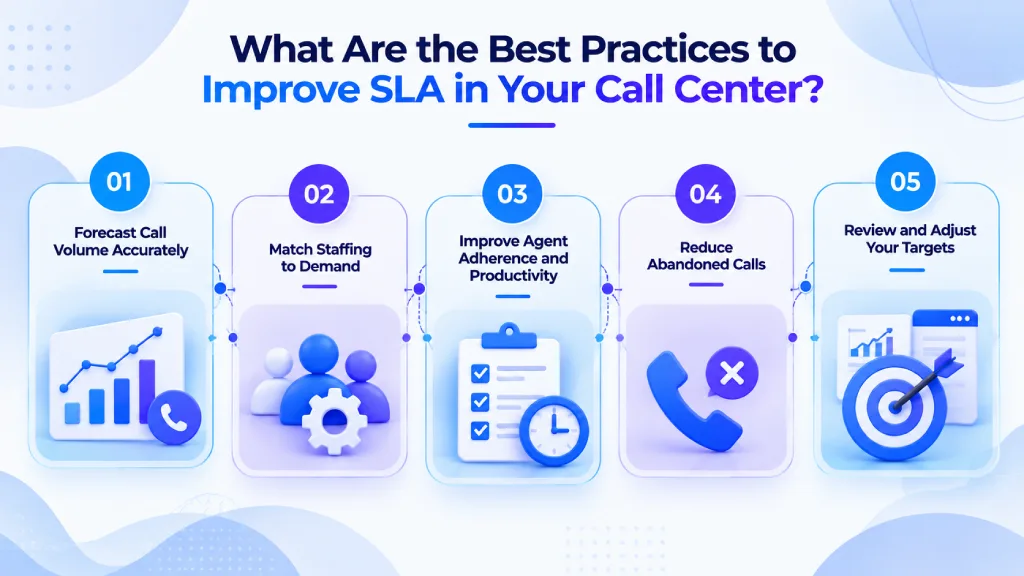
1. Forecast Call Volume Accurately
Start with a clear view of when calls are likely to arrive. Use your historical call volume, handle time, seasonal patterns, promotions, and other known changes to build your forecast.
An inaccurate forecast can leave you short on coverage during busy periods or with more capacity than you need during quieter periods. In fact, 28% of contact centers do not measure forecast accuracy, according to ICMI research. Tracking your forecast accuracy helps you see where your estimates miss actual demand and improve future staffing decisions.
2. Match Staffing to Demand
Your staffing plan needs to match the workload your forecast predicts. Having enough agents overall does not help when too few agents are available during your busiest intervals.
Adjust your schedules around peak periods and make sure you have the right skills available when demand rises. Effective call center workforce management brings forecasting, staffing, scheduling, and real-time management together to support your service level targets.
3. Improve Agent Adherence and Productivity
Your staffing plan only works if agents actually follow it. Late logins, extended breaks, and off-schedule time all chip away at coverage even when your forecast was correct. Track adherence and productivity so gaps show up early, before they turn into a missed SLA. This is where Time Champ fits in. It does not calculate service level or manage your call queue. Instead, it gives you visibility into schedule adherence, attendance, and how agents spend their logged-in time. This helps you make sure your team provides the coverage your forecast requires. See how it works for call centers.
4. Reduce Abandoned Calls
Long waits can push callers to leave the queue before you answer. Reduce unnecessary abandonment by improving coverage during busy periods, providing useful queue information, and offering callbacks or self-service options where they make sense. Do not treat abandonment as a problem caused by staffing alone.
5. Review and Adjust Your Targets
Your SLA target should match your actual service needs and operating conditions. If you set an unnecessarily aggressive target, you may need more staffing and higher operating costs without gaining enough customer value in return.
Review your target when call patterns, customer expectations, staffing conditions, or service requirements change. A regular review helps you keep your SLA realistic and aligned with your current workload, customer needs, and available resources.
Not sure where productivity drops are coming from?
Try Time Champ to see workforce patterns clearly and act on them faster.
Conclusion
A strong call center SLA gives you more than a service target. It helps you set clear expectations, measure performance, and keep your service level aligned with customer needs. When you combine realistic targets with accurate forecasting, proper staffing, and consistent monitoring, you have a better chance of meeting your SLA without adding unnecessary pressure or cost.
If you also want clearer visibility into agent productivity, attendance, and schedule adherence, Time Champ can give you the workforce data that supports better staffing and day-to-day decisions. Get clearer insights into productivity and attendance. Book a demo with Time Champ today.

Thasleem Shaik

Table of Content
 What Is a Call Center SLA?
- SLA: Meaning, Full Form, and Related Terms
- What Are the Different Types of SLAs?
- How to Calculate SLA in a Call Center (Formula + Worked Example)
- Call Center SLA Benchmarks for 2026
- What Are the Benefits of SLAs in a Call Center?
- What Are the Best Practices to Improve SLA in Your Call Center?
- Conclusion
Related Blogs
Learn simple ways to measure and boost call center productivity, helping your team work more efficiently and improve customer service.
Jahnavi Pulluri | Jan 10, 2025
Discover the 18 global best call center outsourcing companies to optimize customer support. Choose from leading names for exceptional service and efficiency.
Mounika Sai | Nov 16, 2023
Discover the 10 best call centre quality assurance software for 2025. Compare features, pricing, pros, and cons to boost service quality and performance.
Thasleem Shaik | Nov 07, 2025
How to start a call center using a complete setup process covering costs, software, staffing, compliance, operations, and business planning.
Thasleem Shaik | Jul 29, 2026
Contact center services help businesses manage customer support across multiple channels. Compare types, benefits, costs, technologies, and AI trends.
Thasleem Shaik | Aug 10, 2026
Explore the essential metrics to accurately measure and enhance your sales productivity, helping your team work smarter and achieve higher results.
Jahnavi Pulluri | Jan 11, 2025


 4.7/5 avg.
Ready to Manage Your Workforce Smarter?
Join our family of 1500+ companies using smart insights to redefine workforces!

Free Trial
No Credit Card Required