Call Center Shift Scheduling: Types & Best Practices
Call center shift scheduling made easier with practical steps, shift types, best practices, and ways to tackle common scheduling challenges for busy teams.

A busy call center rarely follows a predictable rhythm. Sudden call spikes, unexpected absences, and uneven workloads can leave customers waiting while your agents feel overwhelmed. Call center shift scheduling helps you plan agent coverage, balance workloads, and maintain smooth operations throughout the day. With a well-organized schedule, you can respond to changing demand while supporting both customer satisfaction and team performance.
This blog covers the common types of call center shifts and the key steps for creating an effective schedule. It also highlights common scheduling challenges and best practices to help you manage shifts more efficiently.
What Is Call Center Shift Scheduling?
Call center shift scheduling is the process of assigning agents to specific shifts, work hours, breaks, and coverage periods based on expected call volume, staffing needs, agent availability, and skills. It helps ensure adequate coverage during busy periods while keeping workloads balanced and schedules practical for the team.
Why Shift Scheduling Matters in a Call Center
Effective scheduling directly affects how smoothly your call center operates. A well-planned schedule helps you:
- Maintain Adequate Coverage: Ensure enough agents are available when call volumes are high, reducing customer wait times and abandoned calls.
- Balance Agent Workloads: Distribute shifts and peak-hour responsibilities more evenly to prevent some agents from becoming overloaded.
- Control Staffing Costs: Match scheduled hours with expected demand to limit unnecessary overtime and idle time.
- Support Service Levels: Put the right number of agents with the required skills on each shift to meet customer service targets.
- Improve Schedule Predictability: Give agents clearer work patterns so they can plan their time and manage their responsibilities.
- Handle Demand Fluctuations: Adjust staffing around peak hours, seasonal demand, unexpected absences, and changes in call volume.
What Are the Common Call Center Shift Types
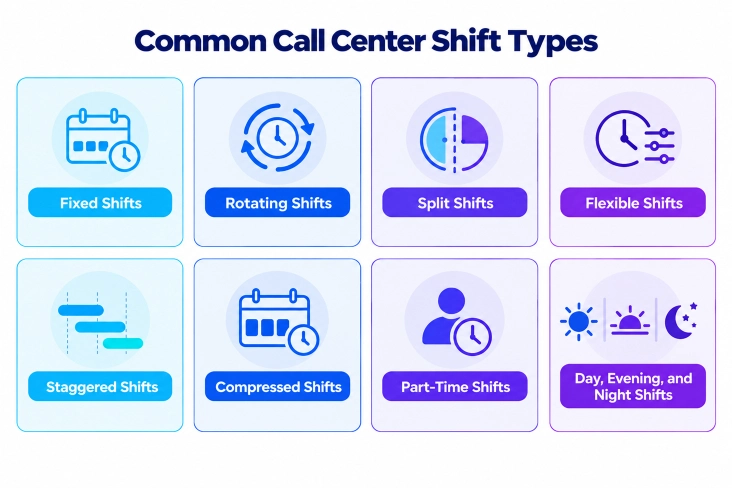
Call centers use different shift patterns to maintain coverage across business hours, peak periods, weekends, and overnight operations. The right model depends on call volume, operating hours, staffing requirements, and the level of flexibility your agents need.
1. Fixed Shifts
Agents work the same hours and days each week, such as 9 AM to 5 PM, Monday through Friday. Fixed shifts give your agents predictable schedules, making it easier for them to plan their personal lives while helping you maintain consistent staffing. Use this model when your call volumes remain relatively stable.
2. Rotating Shifts
Agents move between different shifts according to a set schedule. For example, an agent may work the morning shift for one week, the afternoon shift the next, and the night shift after that. Rotating shifts help distribute less desirable hours more fairly and are useful for call centers that operate for extended hours or 24/7.
3. Split Shifts
A split shift divides an agent’s working hours into two separate periods with a longer break between them. For example, an agent could work from 8 AM to 12 PM and return from 4 PM to 8 PM. This model can align staffing with two distinct periods of high call demand while reducing coverage during quieter hours.
4. Flexible Shifts
Flexible shifts allow agents to adjust their start and end times within defined scheduling limits. You can use this model to place more agents around expected peak periods while giving employees greater control over their working hours. It can be particularly useful for remote, hybrid, and part-time call center teams.
5. Staggered Shifts
With staggered shifts, agents start and finish at different times instead of the entire team beginning work simultaneously. For example, some agents might start at 8 AM, others at 8:30 AM, and others at 9 AM. This creates more consistent coverage as call volumes change throughout the day and helps prevent sudden staffing gaps.
6. Compressed Shifts
A compressed shift arrangement gives agents their required weekly hours across fewer, longer workdays. A common example is four 10-hour shifts instead of five 8-hour shifts. This approach can extend daily coverage and give agents additional days off, making it useful when your call center needs longer operating windows.
7. Part-Time Shifts
Part-time shifts assign agents with fewer working hours than a standard full-time schedule. Call centers can use these shifts to cover specific periods when demand rises, such as lunch hours, evenings, weekends, or seasonal peaks. They provide additional staffing capacity without requiring every agent to work a full schedule.
8. Day, Evening, and Night Shifts
Call centers operating across extended or 24-hour periods often divide coverage into broad time blocks. A typical arrangement may include a morning or day shift, an afternoon or evening shift, and a night shift. These schedules help maintain continuous coverage while allowing you to assign more agents to periods with higher expected call volumes.
How to Build a Call Center Shift Schedule: Step by Step
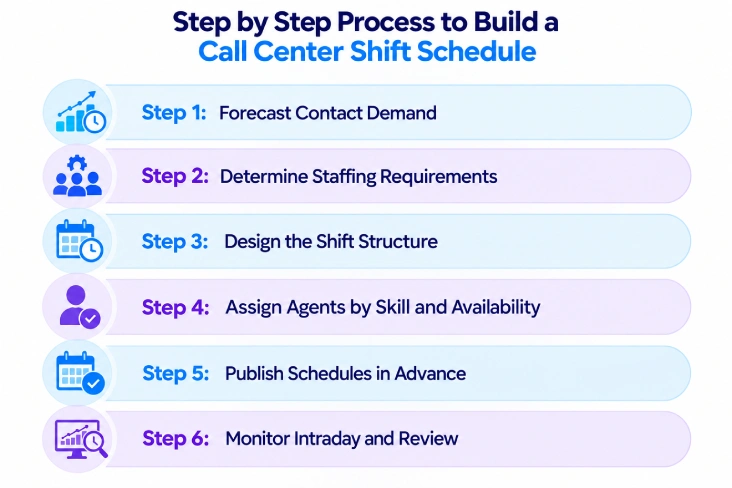
Creating an effective call center schedule requires matching staffing levels with customer demand, agent skills, availability, and unexpected changes. Follow these steps to build a schedule that supports consistent coverage and efficient operations.
Step 1: Forecast Contact Demand
Start by analyzing historical call volumes to identify when customers are most likely to contact your center. Review patterns by hour, day, week, season, and channel where relevant. Factor in promotions, holidays, product launches, and other events that could change demand. Use these forecasts to determine when you need the highest level of coverage.
Step 2: Determine Staffing Requirements
Translate your demand forecast into the number of agents needed for each time period. Consider expected contact volume, average handling time, service-level targets, shrinkage, breaks, meetings, training, and planned time off. Build enough capacity to handle normal fluctuations without consistently overstaffing quiet periods or leaving peak periods understaffed.
Step 3: Design the Shift Structure
Choose shift types that align with your operating hours and demand patterns. Decide where fixed, rotating, split, flexible, staggered, or part-time shifts can provide the right coverage. Place more staffing around predictable peak periods and create overlapping shifts where handoffs or demand transitions require additional coverage.
Step 4: Assign Agents by Skill and Availability
Match agents to shifts based on their skills, experience, availability, and contractual working hours. Make sure each period has enough agents who can handle the required languages, products, customer segments, or support queues. Check for scheduling conflicts and avoid assigning excessive consecutive hours that could contribute to fatigue.
Step 5: Publish Schedules in Advance
Release schedules early enough for agents to plan around their working hours and raise conflicts before the shift begins. Clearly communicate start times, end times, breaks, days off, and any shift changes. Establish a consistent process for requesting time off, swapping shifts, and reporting availability changes.
Step 6: Monitor Intraday and Review
Track actual contact volume, staffing levels, adherence, wait times, and service performance throughout the day. If demand changes unexpectedly, make controlled adjustments such as moving available agents between queues or activating backup coverage. After each scheduling period, compare planned staffing with actual results and use those insights to improve your next schedule.
Struggling to match agent availability with changing demand?
Time Champ helps you track workforce activity and make informed scheduling decisions.
Common Call Center Scheduling Challenges to Avoid
Even a well-planned schedule can fall short when it does not account for real-world changes in call volume, agent availability, and skill requirements. Watch for these common issues when creating and managing your call center shifts.
Failing to Account for Changing Call Volumes
Customer demand rarely stays consistent throughout the day. If you schedule the same number of agents for every time slot, you may end up with too few agents during busy periods and excess capacity when demand drops. Use historical patterns and current forecasts to adjust staffing levels around predictable peaks and quieter periods.
Overlooking Attendance and Last-Minute Absences
Late arrivals, unexpected leave, and no-shows can quickly create staffing gaps. A schedule that looks fully covered on paper may not provide enough agents when the shift actually begins. Build backup coverage into your staffing plan and maintain a clear process for reporting absences and finding replacements.
Building Schedules with Little Room for Flexibility
Rigid schedules can make it difficult to respond when demand changes, or agents need adjustments. Give your workforce reasonable flexibility through shift swaps, varied start times, or additional coverage options where operationally possible. This can help you respond to changing requirements without disrupting the entire schedule.

Did You Know?
NICE’s 2025 Workforce Management Trends report found that average unmanaged contact-center attrition was 39% in 2024, showing why scheduling flexibility and accurate workforce planning remain important retention considerations.
Underestimating Time Lost to Non-Call Activities
Agents are not available for customer interactions during every paid hour. Meetings, training, coaching, breaks, administrative work, planned leave, and other activities reduce the time available for handling contacts. Account for these periods when calculating staffing requirements, so your schedule reflects actual agents' availability.
Assigning Shifts Without Considering Agent Skills
Having enough agents scheduled does not guarantee adequate coverage if the right skills are missing. For example, a shift may have sufficient headcount but lack agents trained for technical support or specific customer languages. Map agent skills to expected demand and make sure critical skill groups are represented across each shift.
Call Center Shift Scheduling Best Practices
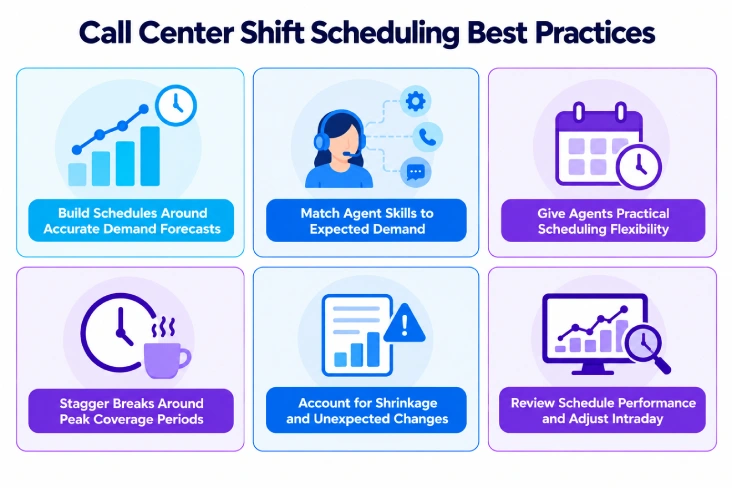
A good schedule should keep coverage aligned with customer demand while giving agents workable schedules and enough flexibility to handle changes. Use these best practices to make your call center scheduling more accurate, balanced, and responsive.
1. Build Schedules Around Accurate Demand Forecasts
Analyze historical contact data to predict demand by hour, day, season, holiday, promotion, and business event. Update forecasts when patterns shift. Accurate predictions help schedule enough agents during busy periods while avoiding unnecessary staffing during slower times.
2. Match Agent Skills to Expected Demand
Identify the skills required for each expected contact type, including languages, technical knowledge, product expertise, and queue experience. Assign qualified agents accordingly. Adequate headcount is ineffective when scheduled employees cannot resolve the contacts they receive.
Did You Know?
ICMI’s research found that only 38% of contact-center respondents measure agent satisfaction and well-being alongside workforce-management metrics, pointing to a gap between operational scheduling and employee experience.
3. Give Agents Practical Scheduling Flexibility
Provide flexible start times, shift swaps, shift bidding, or varied shift lengths when operationally feasible. Consider individual preferences and availability during scheduling. Thoughtful flexibility can improve satisfaction, attendance, and retention while preserving the coverage customers require.
4. Stagger Breaks Around Peak Coverage Periods
Distribute breaks, lunch, meetings, and coaching sessions throughout the day without scheduling them simultaneously. Maintain sufficient availability during high-volume periods. Staggered activities reduce coverage gaps, protect service levels, and help prevent longer customer waiting times.
5. Account for Shrinkage and Unexpected Changes
Include training, meetings, breaks, leave, absenteeism, and other non-contact activities in staffing calculations. Reserve additional capacity for unexpected absences and demand spikes. Planning for shrinkage and disruptions prevents schedules from relying on perfect attendance and uninterrupted availability.
6. Review Schedule Performance and Adjust Intraday
Monitor actual volume, staffing, adherence, wait times, and service levels after publishing schedules. Compare results with forecasts and make timely adjustments to assignments, breaks, or activities. Use performance findings to refine future forecasts, staffing plans, and scheduling decisions.
How Can Time Champ Simplify Call Center Shift Scheduling
Managing call center shifts becomes difficult when you have limited visibility into agent attendance, workload, breaks, productivity, and actual working hours. Without reliable data, you may struggle to identify coverage gaps, balance workloads, or adjust schedules when real-time conditions change. Time Champ is an employee monitoring software with dedicated call center monitoring features that gives you real-time visibility into agent activity, attendance, productivity, breaks, and performance so you can make better scheduling decisions.
Key Time Champ features that can support more effective call center shift scheduling include:
- Real-Time Agent Activity Insights: Shows agent activity across tasks, websites, and applications in real time, helping you identify active, idle, or overloaded agents and adjust staffing promptly.
- Time & Attendance Tracking: Records clock-ins, clock-outs, late logins, and absences to help you manage agent availability and shift coverage.
- Break Insights: Tracks break frequency and duration to help you identify coverage gaps and schedule breaks around busy periods.
- Productivity & Workload Analytics: Highlights productivity trends and workload levels to help you balance assignments and reduce burnout risks.
- Personalized Reports & Dashboards: Provides customizable reports on productivity, time, tasks, dates, and teams to support data-driven scheduling decisions.
- Shift Scheduling & Timesheet Management: Helps you manage shifts, approve work logs, and compare scheduled hours with actual logged time.
Struggling to keep call center shifts aligned with real-time activity?
Time Champ gives you the visibility to track attendance, productivity, breaks, and workloads in one place.
Conclusion
Effective call center shift scheduling helps you maintain reliable coverage, balance agent workloads, and respond to changing customer demand. Forecasting contact volume, matching skills to shifts, accounting for shrinkage, and reviewing performance regularly can help you build schedules that work for both customers and agents. Use workforce data to identify gaps, adjust staffing, and improve scheduling decisions over time. Start by reviewing your current shifts, identifying coverage challenges, and applying these best practices to create a more efficient and responsive call center operation.

Anjali

Table of Content
 What Is Call Center Shift Scheduling?
- What Are the Common Call Center Shift Types
- How to Build a Call Center Shift Schedule: Step by Step
- Common Call Center Scheduling Challenges to Avoid
- Call Center Shift Scheduling Best Practices
- How Can Time Champ Simplify Call Center Shift Scheduling
- Conclusion
Related Blogs

Discover the ultimate guide to call centre workforce management. Learn key functions, pros, cons, optimisation tips, and how real-time WFM boosts ROI.
Thasleem Shaik | Oct 01, 2025![What is Intraday Workforce Management? - Guide [2025]](https://www.timechamp.io/images/intraday-workforce-management.webp)
Intraday management helps boost workforce efficiency. Learn key steps, strategies, and best practices to optimise real-time operations for better results.
Thasleem Shaik | Sep 01, 2025
Learn simple ways to measure and boost call center productivity, helping your team work more efficiently and improve customer service.
Jahnavi Pulluri | Jan 10, 2025
Track the right workforce planning metrics with key KPIs, formulas, examples, and best practices to improve hiring, retention, and workforce decisions.
Thasleem Shaik | Jul 17, 2026
Learn what workforce management software is, how it works, its key features, benefits, types, and how to choose the best solution for your team in 2026.
Jahnavi Pulluri | Aug 07, 2026
Simple Headcount planning: the 7-step process, a free template, sizing methods, and the capacity audit that gets your roles approved in budget season.
Shabana Shaik | Aug 12, 2026


 4.7/5 avg.
Ready to Manage Your Workforce Smarter?
Join our family of 1500+ companies using smart insights to redefine workforces!

Free Trial
No Credit Card Required