ABC Technique Explained: What It Is and Why It Matters
Learn what the ABC Technique is, how it works, and why it matters. Discover how this time management method improves focus, efficiency, and productivity.

Have you ever started your day with a long to-do list, only to spend hours checking off small tasks while the important ones remain untouched?
The problem often isn't a lack of time, it's a lack of clear priorities. When everything feels urgent, it's easy to focus on the easiest tasks instead of the most important ones.
That's where the ABC Technique helps. And no, it's not about relearning the alphabet, it just happens to be one of the simplest ways to bring order to a chaotic to-do list.
In this blog, I’ll explain what the ABC Technique is, how it works, and how you can use it to improve your productivity and manage your time more effectively.
What is the ABC Technique?
The ABC technique is a time-management method that helps you prioritize tasks based on their importance and consequences. It divides tasks into three categories:
- A: Tasks are the most important and have real consequences if they are not completed.
- B: Tasks are important but less urgent, with minimal short-term impact if delayed.
- C: Tasks are nice to do but have little to no consequence if left undone.
The idea is simple: complete your A tasks first, then move on to B tasks, and finally tackle C tasks if time allows.
Productivity expert Alan Lakein popularized it in his 1973 book on personal time management. The ABC Technique has stayed relevant for decades because of its simplicity. You don’t need complex systems, apps, or color-coded tools, just a clear sense of what truly matters.
| Label | What It Means | The Test | Example |
|---|---|---|---|
| A: Must Do | High importance with real consequences if missed | If I skip this today, something breaks. | Client deliverable due at 5, payroll approval |
| B: Should Do | Important but less urgent; limited impact if delayed | I should do this, but nothing breaks today. | Drafting next sprint plan, non-urgent review |
| C: Nice to Do | Low priority, optional, easy to drop | Nobody notices if this waits a week. | Tidying a shared folder, saving articles |
Why Most To-Do Lists Fail Without Task Prioritization
Most to-do lists fail because they treat every task as equal. A flat list gives no signal about what actually matters, so people naturally shift toward easier or more urgent-looking tasks and keep delaying high-value work. Over time, the list stops being a planning tool and starts becoming a source of “fake productivity.”
A to-do list tells you what to do. It doesn’t tell you what to do first. That missing priority layer is exactly what the ABC Technique adds, and it’s often the gap that holds back even people with strong time management skills, leaving them wondering where their day actually went.
How the ABC Technique Works (Step-by-Step)
The ABC Technique works in five simple steps. Once it becomes a habit, the entire system takes just a few minutes.
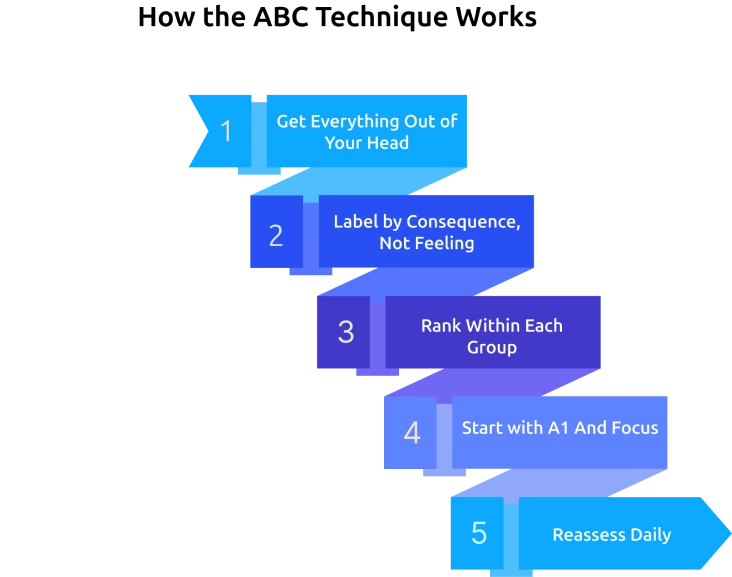
Step 1: Get Everything Out of Your Head
Start with a brain dump. Write down everything, such as meetings, replies, reports, and tasks you’ve been postponing. You can’t prioritize what isn’t visible, and putting it on paper immediately reduces mental clutter.
Step 2: Label by Consequence, Not Feeling
Go through your list and assign each task an A, B, or C. Focus on one question: If I don’t do this in the next 24 hours, what actually happens? If something meaningful breaks, it’s an A. If it can wait without real impact, it’s a B or C.
Step 3: Rank Within Each Group
Not all A tasks are equal. Order them as A1, A2, A3 based on urgency or impact. This step is often skipped, but it’s what prevents your list from feeling overwhelming even after prioritizing.
Step 4: Start with A1 And Focus
Begin with A1 before anything else. The idea is simple, complete your most important task first, because the rest of the day rarely becomes less distracting.
Step 5: Reassess Daily
Priorities change quickly, a ‘B’ task can become an A overnight, and some C tasks may no longer matter at all. Revisit and reorder your list each day (or the night before) so it reflects your current reality. You can also combine this with time blocking, ABC tells you what to do, and time blocking helps you decide when to do it.
ABC or ABCDE: When Should You Add D and E?
The ABCDE method is an extension of the ABC Technique introduced by productivity expert Brian Tracy. While the original ABC method helps you prioritize tasks you need to complete, ABCDE goes a step further by helping you reduce or remove tasks from your workload entirely.
If your main challenge is not just prioritization but having too much on your plate, adding D and E can be especially useful.
| Letter | Meaning | Use It When |
|---|---|---|
| A | Must do, serious consequences | There is a real deadline or cost if it is missed |
| B | Should do, moderate importance | It matters, but it can wait until the A tasks are done |
| C | Nice to do, no real consequences | It is optional and can be safely delayed |
| D | Delegate | Someone else can handle it effectively |
| E | Eliminate | It adds no real value and can be removed completely |
Simple Rule to Follow
Start with the basic ABC system first. If you notice your A list keeps growing without control, that is a clear sign you should introduce D and E. This helps you delegate more effectively and eliminate unnecessary tasks, so you can focus only on what truly matters.
The A-List Audit: Were Your A Tasks Really A?
The A-List Audit is a simple weekly review where you compare your A-priority tasks with what you actually worked on. It helps you check whether your priorities stayed accurate once the day got busy.
Most prioritization systems fail not because the method is wrong, but because no one verifies their priorities afterward.
Once a week, ask:
- Did my A tasks get my best focus time, or leftover time?
- Were any A tasks actually lower-priority work in disguise?
- Which A tasks keep getting pushed week after week?
If a task stays in your A list for too long without progress, it may not truly be an A, it might need to be redefined, downgraded, or delegated.
How To Run the ABC Technique Across a Team?
1. Define A Against Shared Goals
A task should only be an A if it directly supports a team goal or has a real deadline. If it doesn’t move outcomes forward, it’s probably not an A, no matter how important it feels individually.
2. Use a Simple “24-Hour Test”
During weekly check-ins, ask: What actually breaks if this task is delayed by one day? This helps remove subjectivity and quickly clarifies priority conflicts.
3. Balance the Workload, Not Just Priorities
Pay attention to how A tasks are distributed across the team. If a few people consistently carry most of the A tasks, the issue is workload imbalance, not prioritization.
The key takeaway is simple: if A tasks are always concentrated on the same people, the problem isn’t motivation or effort, it’s workload management. Without balance, prioritization systems quietly turn into burnout systems.
Common Mistakes That Quietly Break the ABC Technique
The ABC Technique is simple, which is exactly why it often breaks in subtle, predictable ways. Here are the most common mistakes to watch for:
1. Everything Becomes an A
If most of your list is labeled A, you haven’t prioritized, you’ve just relabeled everything. A true ‘A’ list is small, usually just one to three high-impact tasks.
2. Labeling by Urgency Instead of Consequence
The loudest or most urgent task isn’t always the most important. Prioritization should be based on consequences, not notifications or pressure.
3. Not Re-Ranking Regularly
A list set on Monday and never reviewed slowly drifts out of reality by midweek. Priorities change, and your list should change with them.
4. Ignoring C Tasks
C tasks that stay on your list indefinitely aren’t “waiting”, they’re clutter. Either delete them, delegate them, or stop carrying them forward every day.
5. Confusing Being Busy with Being Productive
Clearing a bunch of C tasks can feel productive, but it rarely moves essential work forward. If this becomes a pattern, the issue isn’t the list, it’s how priorities are being chosen.
How Time Champ Helps the ABC Technique Work Better
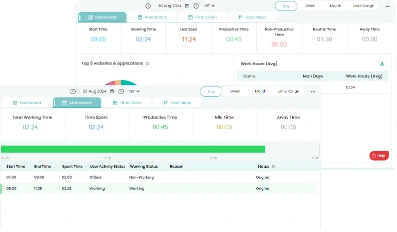
The ABC Technique helps you decide what should matter. Time data shows you what actually got your time. Time Champ is an employee monitoring software with a workforce intelligence layer that connects the ABC technique with time data, so you’re not depending on memory when reviewing priorities.
Key ways it supports prioritization:
Automatic Activity Tracking
Work hours, idle time, and app and website usage are automatically recorded as work happens. This makes weekly reviews faster and more accurate, without depending on guesswork.
App and Website Categorization
Allows you to classify whether applications and websites are productive, unproductive, or neutral. This helps you see whether your planned A-priority time actually went to A-level work.
Focus Time and Context Switching Insights
Track how long focus blocks last and how often interruptions occur. This helps explain why important tasks sometimes stay unfinished despite being prioritized.
Reports, Dashboards, and Heatmaps
Visual reports highlight when focus peaks and where it breaks, at both individual and team levels.
Workload and Burnout Indicators
Find imbalance early, like when someone consistently carries too many high-priority tasks or shows signs of overload before deadlines are affected.
Stop letting important tasks slip through the cracks
Track productivity, reduce distractions, and keep your A-priority work on track
Conclusion
The ABC Technique is a simple way to bring clarity to your daily workload and focus on what truly matters. Instead of reacting to every task equally, it helps you prioritize with intention and structure. When used consistently, it improves productivity, reduces overwhelm, and makes time management far more effective. Combined with regular review and real data, it becomes a system that keeps you aligned with your goals every day.

Jahnavi Pulluri

Table of Content
 What is the ABC Technique?
- Why Most To-Do Lists Fail Without Task Prioritization
- How the ABC Technique Works (Step-by-Step)
- ABC or ABCDE: When Should You Add D and E?
- The A-List Audit: Were Your A Tasks Really A?
- How To Run the ABC Technique Across a Team?
- Common Mistakes That Quietly Break the ABC Technique
- How Time Champ Helps the ABC Technique Work Better
- Conclusion
Related Blogs

Learn what time management skills are, compare key skills, explore examples with stats, and see how they differ from time management techniques.
Thasleem Shaik | Apr 08, 2026
Still believe multitasking saves time? Discover 10+ common time management myths that are holding you back and learn what actually works.
Guna Lakshmi | Jun 03, 2026
Explore the essentials of project time management, its importance, best processes and top tips to meet deadlines without fail and boost workforce productivity.
Shabana Shaik | Oct 10, 2024
Learn how to build a time management plan that aligns roles, goals, and schedules. A practical, step-by-step guide to lead your team with clarity.
Thasleem Shaik | May 25, 2026
Compare the 10 best time management apps for 2026, with free plans, pricing, and what each tool is best for, so you can pick the right one for your team fast.
Guna Lakshmi | May 26, 2026
Setting the right time management goals can improve focus, organize priorities, and help you manage work with more clarity and consistency every day.
Thasleem Shaik | May 27, 2026


 4.7/5 avg.
Ready to Manage Your Workforce Smarter?
Join our family of 1500+ companies using smart insights to redefine workforces!

Free Trial
No Credit Card Required