What is the Average Salary in South Korea? Outsourcing Perks
Explore South Korea's salary trends and outsourcing advantages. Uncover competitive wages and benefits in this dynamic job market for informed decisions.

South Korea, one of the world’s biggest economic leaders in the world and home to industry giants such as Samsung and Hyundai, offers the business sector unlimited opportunities and an employment market. With an average annual salary stands at 45,780,105 KRW, or USD 32,241.44. It stands as an ideal destination for outsourcing with its average, median, and minimum wages, annual salary increments, and the unique benefits of outsourcing to this dynamic and competitive economy.
What is the Average Salary in South Korea?
South Korea is a country well known for its highly growing economy and advanced technological development, and its excellent quality of life is reflected in its wage structures. The average salary varies broadly based on profession, location, or experience. These are trends essential to know to anyone working in South Korea, a local professional, an expat, or a business looking for talent. Below, we break down average, median, and minimum salaries to give you a clearer picture of the earnings landscape.
Average Salary
The average gross salary in South Korea is KRW 45,780,105 per year (32241.44 USD), which translates to a monthly average of KRW 3,815,000(2686.78 USD). The variation in average gross annual salaries is vast, depending on the industry, type of job, and city, with averages higher in the Seoul area than in smaller cities. The most common factors influencing these variations are industrial demand, experience, and the company type, conglomerate or small enterprise.
Median Salary
The median salary is the midpoint in the salary range when all wages are ordered from lowest to highest. It gives an easier view of average wages, as it reduces the bias that outliers like very high incomes and very low incomes make in the range. The median salary in South Korea is approximately 3,500,000 KRW, which to a certain extent amenable to the average. This implies that income distribution across most employees in the workforce is quite proportional.
Minimum Wage
A minimum wage is the lowest wage that an employer legally needs to pay their regular employees as compensation to meet their basic needs. The South Korean government passed the Minimum Wage Act in 1986 to standardize and protect the minimum wage of its labor force.
In 2024, South Korea’s minimum hourly wage is set at KRW 9,860. However, for 2025, the minimum wage is being brought at KRW 10,030 per hour; marking a 1.7% rise from the previous year and surpassing the KRW 10,000 threshold for the first time. On account of a standard 40-hour workweek, this new rate translates to KRW 2,096,270 per month or KRW 25,155,240 annually.
The decision was made by the Minimum Wage Commission during its meeting on July 11, 2024, after a 53-day negotiation period between labor and management groups. This rate of wage will come into effect from January 1, 2025, when finalized by the Ministry of Employment and Labor of South Korea.
Key Factors Influencing Salary in South Korea
South Korea’s wages vary by experience, education, industry, and geographical location among the employees on the wage bill. This section explains how these elements define earnings in connection to roles and sectors.
1. By Experience Level
Experience is the driving factor for salary levels within South Korea. Entry levels are much lower than career and senior levels. Typically, salaries increase by about 32% when transitioning from entry-level to mid-career roles, and experienced professionals earn 50% more than mid-career counterparts on average. This trend reflects some of the value placed within the South Korean workplace over expertise and tenure.
| Experience Level | Average Salary Range (KRW) |
|---|---|
| Entry-Level (0-5 years) | 2,500,000 – 3,500,000 |
| Mid-Level (5-10 years) | 4,000,000 – 6,000,000 |
| Senior-Level (10+ years) | 6,000,000 – 10,000,000 |
Source:Glassdoor
2. By Roles and Expertise
This may vary from role to responsibility that goes with it and the specialty required. Highly responsible professional requirements tend to fetch much greater salaries. Some of the higher medical professionals, including doctors, surgeons, etc., even pull some of the highest pay in the country. That is between KRW 8,280,000 and KRW 26,400,000 based on experience and expertise levels.
| Job Title | Average Salary in South Korea (KRW) |
|---|---|
| Chief Executive Officer | 8,780,000 |
| Attorney | 8,050,000 |
| Dentist | 9,370,000 |
| Pilot | 6,690,000 |
| Surgeon | 8,280,000 – 26,400,000 |
| Project Manager | 4,560,000 |
| Business Analyst | 4,900,000 |
| Architect | 4,580,000 |
| Engineer | 3,770,000 |
| Nurse | 3,000,000 |
| Financial Analyst | 5,260,000 |
| Developer / Programmer | 3,950,000 |
| Secondary School Teacher | 3,090,000 |
| Chef | 2,510,000 |
| Graphic Designer | 2,540,000 |
| Sales Representative | 2,600,000 |
| Call Center Representative | 1,530,000 |
| Waiter/Waitress | 1,240,000 |
| Cashier | 1,520,000 |
Source: Paylab
3. By Educational Qualification
South Korean workers who have a degree at the bachelor’s level get paid 24% higher compared to those who only have a diploma. A master’s degree holder is paid 29% higher than a worker holding a bachelor’s degree. It follows that a Ph.D. degree holder enjoys the highest amount, 23% higher compared to a master’s degree holder. This trend highlights the importance of higher education in advancing careers.
4. By Industry Type
Salaries in South Korea differ across industries; with specialized fields to pay better wages, for example, in technological and finance fields. For the low-skilled requirement of some sectors such as construction and retail, salaries become low. Such variances arise as a result of demand and industry profitability.
| Industry | Average Monthly Salary (KRW) |
|---|---|
| Healthcare | 5,800,000 |
| Banking | 4,250,000 |
| Education | 4,070,000 |
| Construction | 2,410,000 |
| IT & Software | 5,000,000 |
Source: Paylab
5. By City
As compared to the different areas, the average salary is vastly different in South Korea. Larger cities like Seoul usually have higher wages because more businesses are being performed along with better infrastructure, with a higher cost of living. On the other hand, provinces with few businesses or less developed infrastructures usually offer lower salaries. This is a comparison of some of South Korea’s main cities.
| City | Average Salary (KRW) |
|---|---|
| Seoul | 52,319,400 |
| Busan | 51,479,800 |
| Incheon | 50,519,600 |
| Daegu | 49,561,800 |
| Daejeon | 48,721,100 |
| Gwangju | 47,758,300 |
| Suwon | 46,921,300 |
| Ulsan | 46,080,100 |
| Goyang | 45,119,800 |
| Seongnam | 44,040,700 |
| Bucheon | 43,198,900 |
Source: Paylab
6. By Gender
A gender pay gap still lingers in South Korea, male workers get paid nearly 30% more, on average, than females. For example, a male worker in South Korea can earn approximately KRW 3,800,000 compared to approximately KRW 2,500,000 by his female counterpart. Efforts to address this disparity are ongoing, but progress remains slow.
Salaries in Popular Professions in South Korea
In South Korea, certain professions offer significantly higher earnings, often reflecting the level of expertise, experience, and responsibility required. The top executive jobs in management, law enforcement, and aviation, and professors and lecturers are very highly paid; these have impressive salaries attached to their occupations. Here’s a table that shows some of the best-paying positions in this country.
| Profession | Average Annual Salary (KRW) |
|---|---|
| Chief Executive Officer (CEO) | 200,000,000 – 500,000,000+ |
| Chief Operating Officer (COO) | 150,000,000 – 400,000,000 |
| Chief Financial Officer (CFO) | 120,000,000 – 350,000,000 |
| Executives and Senior Management | 120,000,000 – 150,000,000 |
| Lawyers | 80,000,000 – 90,000,000 |
| Airline Pilots | 100,000,000 – 105,000,000 |
| University Professors | 80,000,000 – 90,000,000 |
Source: Paylab
Understanding Salary Growth in South Korea
- South Korean salary growth tends to be based on seniority, and an overwhelming majority of South Korean firms utilize the “hobongje” system, under which wages increase steadily with tenure rather than solely performance.
- The largest raises are awarded to workers who are of middle age and have been with their organizations for roughly 10 to 20 years, thereby showing a clear career progression of wages.
- South Korea’s wage growth rate is faster than many OECD countries, with an average mid-career wage growth rate of 15.1%, against the OECD average of 5.9%.
- Companies, especially those in the newer economies such as those in the technology and finance sectors have embraced the performance-based pay system and recognize talent and output as opposed to seniority.
- While other organizations continue moving away from traditional pay structures featuring pay-for-performance, merit-based pay, seniority structures persist in large organizations, especially those with strong labor unions.
- Performance evaluation systems are increasingly being implemented in private organizations with the primary purpose of enhancing performance and wage fairness.
- The current salary rise tendencies are still influenced by economic factors and government policies as well as labor union negotiations.
Comparing Average Salary in South Korea vs Other Countries
Country-level trends in salaries often provide valuable insights for job seekers, employers, and even those seeking global employment opportunities. South Korea is a competitive country, with its growing software industry and its healthy economy. Here’s how South Korea stacks up against other nations:
| Country | Average Monthly Salary | Equivalent in USD |
|---|---|---|
| South Korea | ₩3,700,000 | $2,800 |
| Singapore | SGD 5,800 | $4,200 |
| India | ₹40,000 | $480 |
| Japan | ¥400,000 | $2,700 |
| Germany | €3,000 | $3,200 |
| United States | $4,500 – $5,000 | $4,500 – $5,000 |
| United Kingdom | £2,800 | $3,500 |
| Philippines | ₱25,000 | $440 |
| China | ¥10,000 | $1,400 |
| South Africa | ZAR 25,000 | $1,300 |
Source: Numbeo
Benefits of Outsourcing to South Korea
South Korea’s IT outsourcing market is expected to hit US$12.77 billion in 2024 with an annual growth of 8.29%, and US$19.02 billion by 2029. This growth shows South Korea as an essential outsourcing destination. Here are some key benefits of outsourcing to South Korea.
1. Highly Skilled Workforce
South Korea is known for its brilliant and well-educated workforce in sectors like technology, engineering, and finance. The country is one of the biggest spenders on human capital, putting about 7% of its GDP towards education. This investment has the potential to maintain a continuing pool of properly qualified professionals to meet the demands of a global marketplace.
2. Cost-Effectiveness
South Korea is the most cost-effective outsourcing destination as compared to other developed countries. Cost of living, wages, taxes, and other business expenses are about 2.5% lower than in countries like the USA. Thus, it is a cost-effective outsourcing destination for those organizations, which are seeking ways to cut costs while maintaining quality.
3. Advanced Technological Infrastructure
South Korea ranks as the world’s most innovative country. According to the World Population Review 2024, this nation has a state-of-the-art technological infrastructure with widespread internet connectivity. Its technologically advanced edge gives businesses up-to-date tools and innovations so that outsourcing business operations become much faster, more efficient, and more effective.
4. Proximity to Other Key Asian Markets
Having its economic base in the center of East Asia, South Korea has easy access to markets in countries like China and Japan. This in combination with the available free trade zones, makes South Korea an ideal outsourcing location hub for companies seeking to expand in Asia.
How Time Champ Enhances Outsourcing Efficiency
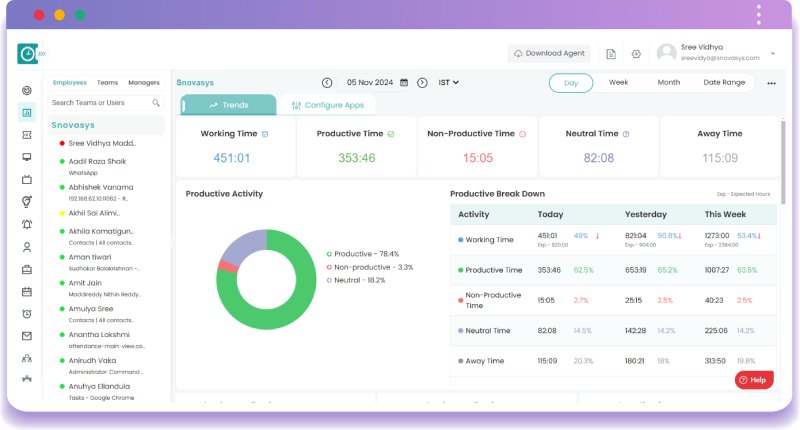
Time Champ is a tool developed to enhance the effectiveness of outsourcing and the management of remote teams, to aid businesses in the administration of remote workers. Here’s how Time Champ helps enhance outsourcing efficiency:
Real-Time Time Tracking
Time Champ allows the accurate time tracking of real work hours so that businesses would be able to see the output of outsourced teams. This makes managers aware of the current situation, therefore, tasks would not be behind schedule or above budget.
Improves Accountability and Transparency
By tracking employee activities and work hours, Time Champ increases accountability. It helps outsourced teams to be answerable for their work output, giving businesses detailed reports that ensure quality, while at the same time minimizing inefficiency and missed deadlines.
Task and Project Management Integration
Time Champ integrates easily with task and project management tools, enabling businesses to run outsourced projects efficiently. Managers allocate work, lay out schedules, and track performance in real time so that projects can be on the right track and successfully finished within the laid-down time frame.
Enhances Employee Focus and Productivity
By using Time Champ tracking capabilities, businesses will be able to keep track of outsourced teams and guarantee the quality of their work. This is because managers can be able to track distractions as well as idle time, giving them an area to intervene, thus increasing productivity with good results.
Unlock the full potential of outsourced employees with Time Champ. Get started now!
Start your free trial today and see the difference.
Conclusion
Therefore, the knowledge of average salary landscapes in South Korea is important for professional and business planning. South Korea is moving further ahead in the ranking of global economic powers, salary trends are balancing competitive pay with a high standard of living. Whether it is to chase a career move or start a business, or whether exploring the world job markets, the constantly changing salary patterns in South Korea will offer a great insight into the prospect of career progression in a blooming economy.
Table of Content
-
 What is the Average Salary in South Korea?
-
Key Factors Influencing Salary in South Korea
-
Salaries in Popular Professions in South Korea
-
Understanding Salary Growth in South Korea
-
Comparing Average Salary in South Korea vs Other Countries
-
Benefits of Outsourcing to South Korea
-
How Time Champ Enhances Outsourcing Efficiency
-
Conclusion
Related Blogs

Discover the average salary in Pakistan and explore outsourcing trends, offering valuable insights into the economy and business opportunities.
Shabana Shaik | 10 March 2025
Discover The Average Salary in Bangladesh and outsourcing impact. Learn why it’s a rising player in global outsourcing.
Shabana Shaik | 25 February 2025
Discover the key factors influencing the average salary in India across industries, regions, and job levels, as well as insights
Mounika Sai | 10 January 2025
Discover the average salary in Colombia and explore the key factors affecting earnings, including industries, experience, and location. Find out
Sai Keerthi Uppala | 18 December 2024
Discover the average salary in South Africa and explore outsourcing trends. Learn key insights into wages, industries, and business opportunities.
Sai Keerthi Uppala | 18 December 2024
Learn about the average salary in Hong Kong, from minimum wage to maximum salaries, and gain insights into industry variations.
Sai Keerthi Uppala | 18 December 2024


 4.7/5 avg.
Ready to Manage Your Workforce Smarter?
Join our family of 1100+ companies using smart insights to redefine workforces!

Free Trial
No Credit Card Required