What is the Delphi Technique?
The Delphi technique is a structured method for making decisions or forecasts by collecting opinions from a group of experts through several rounds of anonymous questionnaires. After each round, experts review a summary of the responses and can update their answers until the group reaches a common agreement.
How Does the Delphi Method Work? Step-by-Step
Most Delphi studies involve 2-4 rounds and end when experts reach a predefined level of agreement or when responses become stable.
1. Define the Problem
Start with a clear, specific question or objective. For example, instead of asking, "What are our future staffing needs?" ask, "How many support engineers will we need by next March?"
2. Select the Expert Panel
Choose experts with relevant knowledge and diverse perspectives to ensure balanced and well-informed opinions.
3. Send the First Questionnaire
Distribute a questionnaire with open-ended or structured questions. All responses are collected anonymously.
4. Summarize the Responses
The facilitator reviews the answers, prepares a summary of the key findings, and highlights areas of agreement and disagreement.
5. Conduct Additional Rounds
Experts review the summary and revise or explain their responses based on the group's feedback. This process is repeated until opinions begin to converge.
6. Measure Consensus
Evaluate whether the panel has reached the desired level of agreement or whether the responses have stabilized.
7. Report the Results
Present the final findings to decision-makers and use the insights to support planning, forecasting, or strategic decisions.
Improve Planning with Smarter Workforce Insights!
Make confident decisions backed by real-time workforce data
Types of Delphi technique
Over time, the Delphi method has evolved into several variations to meet different research, business, and decision-making needs. While all follow the same basic principle of collecting expert opinions through multiple rounds, they differ in their process, purpose, and level of interaction among participants.
| Type | How It Works | Best Used For |
|---|---|---|
| Classical Delphi | Begins with open-ended questions, followed by rating or ranking in later rounds to build consensus. | Exploring new or complex problems where little information is available. |
| Modified Delphi | Starts with a predefined list of ideas or statements based on existing research or data. | Saves time when the possible options are already known. |
| Policy Delphi | Focuses on collecting different viewpoints instead of reaching a single consensus. | Evaluating policy decisions and understanding different perspectives. |
| Real-Time (e-Delphi) | Conducted online with instant feedback, allowing participants to review and update responses more quickly. | Large or geographically dispersed expert panels that need faster results. |
| RAND/UCLA Appropriateness Method | Uses two rounds of ratings with a structured discussion between them to assess the suitability of specific actions. | Healthcare and clinical decision-making, especially for evaluating treatments or procedures. |
Benefits of the Delphi Technique
The Delphi technique is widely used because it helps organizations make better decisions by combining expert knowledge in a structured and unbiased way. Its emphasis on anonymity, feedback, and multiple rounds leads to more reliable outcomes than many traditional group discussions.
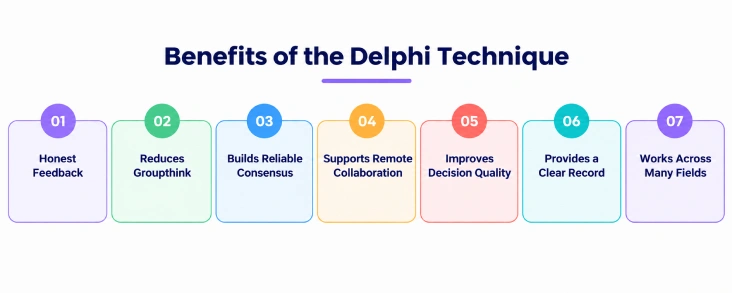
- Honest Feedback: Experts can share their opinions freely because their responses remain anonymous, reducing the influence of hierarchy and peer pressure.
- Reduces Groupthink: Since participants do not interact directly, dominant personalities cannot influence the group's decisions, giving every expert an equal voice.
- Builds Reliable Consensus: Multiple rounds of feedback help experts refine their opinions and gradually reach a well-informed agreement.
- Supports Remote Collaboration: Experts can participate from different locations, making it easy to involve specialists from around the world.
- Improves Decision Quality: Participants can reconsider their responses after reviewing the group's feedback, which results in more thoughtful and accurate judgments.
- Provides a Clear Record: Every round is documented, making the decision-making process transparent and easier to review or justify later.
- Works Across Many Fields: The method can be used for forecasting, strategic planning, policy development, risk assessment, product development, and HR planning.
Limitations of the Delphi Technique
While the Delphi technique is a valuable decision-making method, it also has some limitations. Understanding these challenges helps you apply the method effectively and interpret the results with caution.
- Time-Consuming: Completing multiple rounds of questionnaires and feedback can take several weeks or even months.
- Depends on Expert Selection: The quality of the results depends on choosing knowledgeable and diverse experts. A weak panel can lead to unreliable conclusions.
- May Encourage Artificial Consensus: Some participants may adjust their answers to match the majority rather than their true opinions.
- Participant Dropouts: Experts may lose interest or become unavailable during later rounds, reducing the quality of the final results.
- Relies On Expert Opinions: Even when experts agree, their conclusions are still based on judgment and may not always match real-world outcomes without supporting data.
- Requires Skilled Facilitation: A poorly designed questionnaire or biased feedback can influence responses and reduce the reliability of the study.

Decisions Backed by Data
Trends and team-level analytics that show what matters.
Explore Workforce Analytics →