Time Champ > Blog > What Is Strategic Planning? Examples, Models, Steps & Process > Content
What Is Strategic Planning? Examples, Models, Steps & Process
Learn what strategic planning is, why it matters, elements, steps, models & frameworks, examples, pros & cons & how workforce intelligence improves it.

Many organizations struggle because they make decisions based on assumptions instead of having real visibility into how work actually happens. This often causes strategies to fail during execution when workforce realities don’t match the plan. Strategic planning solves this by providing clear direction and using real-time insights into capacity, risks, and impact to make sure plans actually work.
In this blog, you’ll learn what strategic planning is, the proven models and steps to build an effective plan, and real examples of how you use strategic planning to make better decisions and achieve goals. By the end, you’ll be able to build strategies that connect teams to the most important goals, reduce execution gaps, manage risks early, and deliver measurable results.
What Is Strategic Planning?
Strategic planning is a process that you follow to establish long-term objectives, priorities, and determine how your organization can move from where it is to where you want it to be. It defines a clear direction and how resources, efforts, and decisions align with that direction over time.
The main purpose of strategic planning is to help you think about the future in a clear, structured way. It helps you in clarifying objectives, setting boundaries around decision-making, and documenting how goals translate into action. A clear strategic plan acts as a point of reference that guides planning, implementation, and evaluation across different sections of the organization.
Strategic planning also forms the foundation of strategic business planning as it brings structure to the process of defining goals, priorities, and initiatives. It also ensures consistency in planning activities and provides a framework that teams can follow as strategies evolve and circumstances change.
Why Is Strategic Planning Important?
Strategic planning is crucial in the decision-making process and achieving organizational goals. Here you can see why it plays a crucial role in long-term business success.

- Provides Clear Direction for Decisions: You can prioritize what is really important and avoid reactive decision-making. When the direction is clear, daily decisions support long-term goals instead of going against them.
- Aligns Goals with Real Capacity and Constraints: This approach makes you think about the people, time, and resources available before you set goals. This alignment minimizes overcommitment and enhances the chances of successfully implementing your plans and initiatives.
- Closes the Gap Between Planning and Execution: Most strategies fail because execution is unclear. A structured plan defines responsibilities, expectations, and outcomes, keeping execution aligned with the strategy.
- Creates Consistency Across Teams and Initiatives: Strategic business planning depends on shared priorities. A strong planning framework ensures teams work toward the same goals even when strategies evolve or conditions change.
- Improves Risk Awareness and Adaptability: It assists you in determining risks, dependencies and possible disruptions at an early stage. This consciousness enables you to make plans in advance rather than responding to emerging issues.
- Makes Progress Measurable and Visible: Breaking long-term objectives into measurable outcomes provides clarity. This makes it easier for you to track progress, evaluate results, and adjust course when necessary.
What Are the Key Elements of Strategic Planning?
Strategic planning works best when you look at its core aspects. These elements make sure your plan is practical, achievable, and aligned with your organization’s goals. Here are the key components of strategic planning:
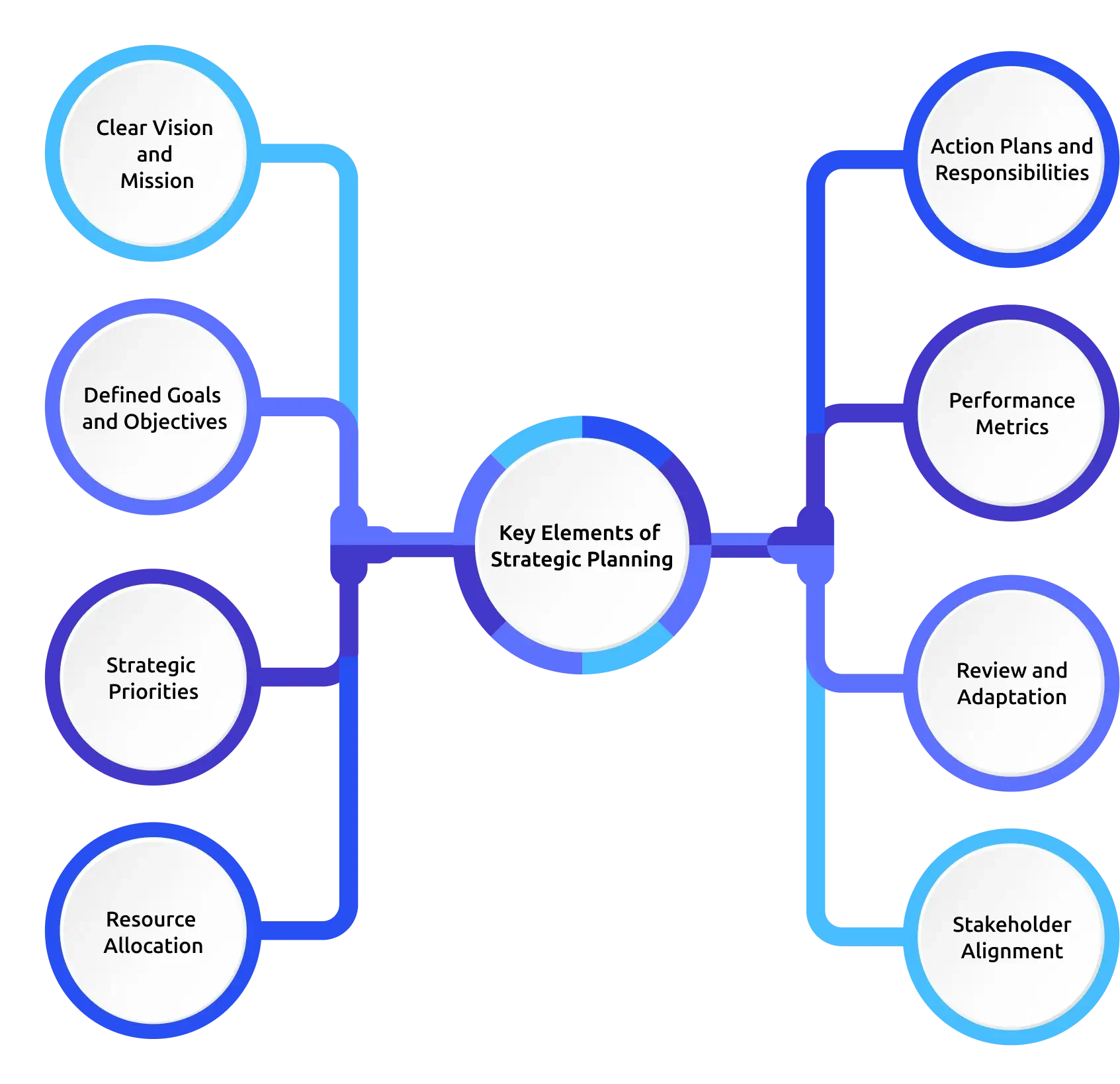
- Clear Vision and Mission: A strategic plan starts with a well-defined vision and mission. This clarifies the purpose of the organization, its long-term direction, and the impact you aim to make. It serves as the foundation of all planning decisions.
- Defined Goals and Objectives: Set goals with clear targets, timelines, and measurable results. These goals transform the vision into actionable steps and give teams a clear target to achieve.
- Strategic Priorities: Determine and prioritize the most critical initiatives. Strategic priorities guide resource allocation, help avoid distractions, and ensure your team is working on what truly matters.
- Resource Allocation: Check your people, time, and budgets to make sure you align resources with priorities. This alignment makes sure that plans stay within your capacity and constraints.
- Action Plans and Responsibilities: Divide objectives into actionable steps and assign responsibilities. This ensures accountability, smooth implementation, and eliminates gaps between planning and implementation.
- Performance Metrics: Define the measurement of success. KPIs and measurable outcomes help track progress, assess results, and adjust plans when needed.
- Review and Adaptation: A strategic plan is not static. Regularly review outcomes, market conditions, and internal performance to adapt plans, mitigate risks, and maintain relevance over time.
- Stakeholder Alignment: Make sure that every team and department understands its role and the contribution of its work to strategic goals. Alignment fosters collaboration, consistency, and organizational cohesion.
What Are the 7 Steps in the Strategic Planning Process?
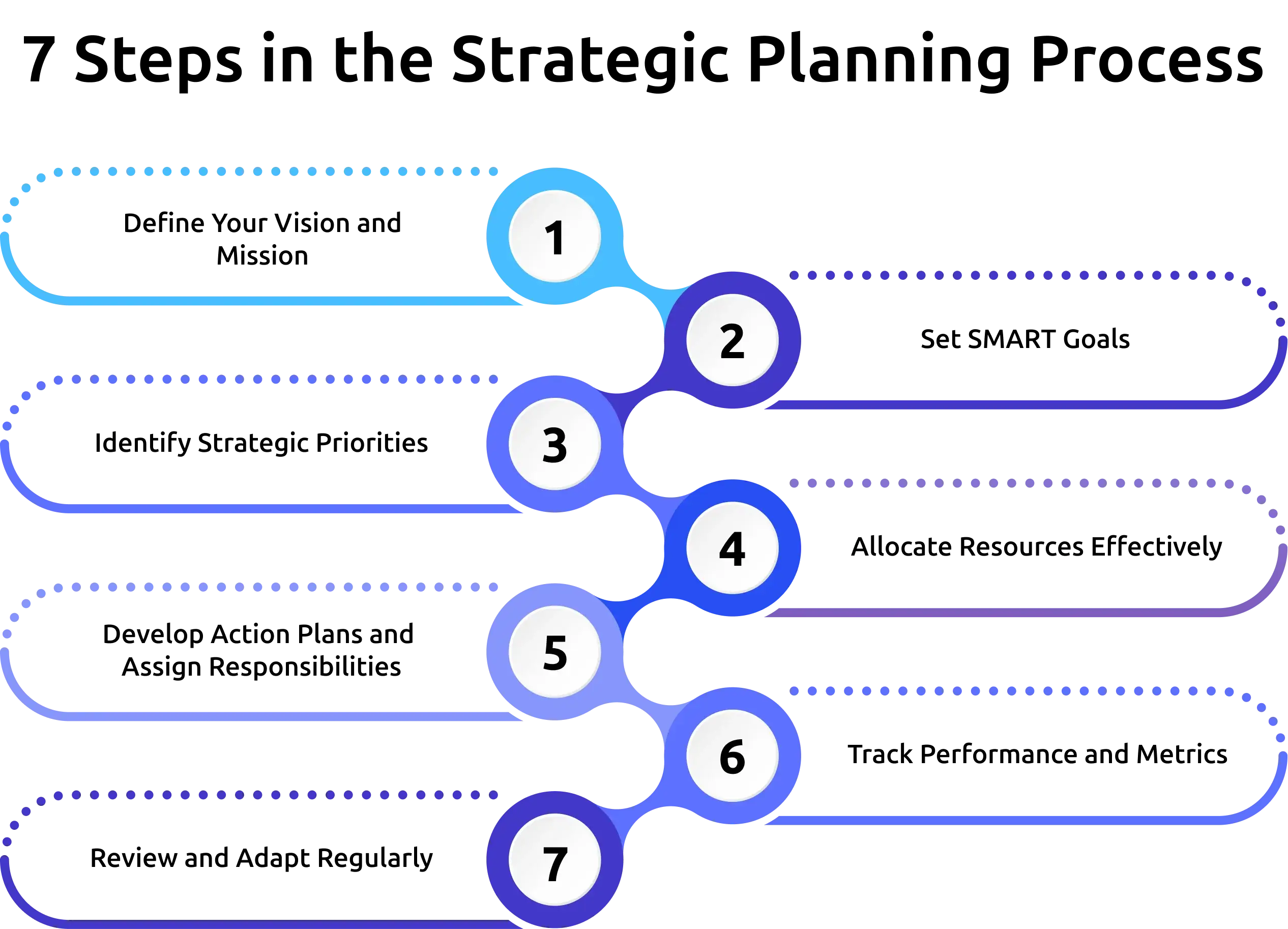
Most organizations spend time on strategic planning, yet still fail to achieve real outcomes because execution breaks down. Studies show that nearly 90% of organizations do not implement their strategies successfully, often due to unclear priorities and weak accountability. It’s not usually because the ideas are bad. It happens because there is no clear process to follow. The 7 steps below break strategic planning into clear, practical actions so your strategy moves beyond planning and into everyday work.
1. Define Your Vision and Mission
Clarify what your organization exists to achieve and where it aims to go. Write a clear vision and mission that guide decisions and keep teams aligned. Involve leadership and key stakeholders, then document the statements and share them widely to maintain a consistent focus.
2. Set SMART Goals
Convert your strategy into SMART goals that are specific, measurable, achievable, relevant, and time-bound. Define targets, deadlines, and expected outcomes for each goal. Keep goals realistic based on capacity, and ensure every team understands what success looks like and how it will be measured.
3. Identify Strategic Priorities
Choose the most important initiatives that will deliver the greatest business impact. Evaluate each priority based on value, urgency, effort, and risk. Limit priorities to what your organization can execute well, and remove low-impact work that distracts teams from delivering meaningful progress.
4. Allocate Resources Effectively
Assign the right people, time, budget, and tools to each strategic priority. Check workforce capacity before finalizing commitments, and rebalance workloads where needed. Address skill gaps early through training, hiring, or support, so execution does not stall due to resource constraints.
5. Develop Action Plans and Assign Responsibilities
Break each priority into clear actions with timelines, dependencies, and measurable deliverables. Assign ownership to one accountable person for every task or outcome. Define expectations and communication points, ensuring teams know what to deliver, when to deliver it, and how progress will be reported.
6. Track Performance and Metrics
Select KPIs that show progress, outcomes, and business impact, not just activity. Monitor performance through regular reviews and real-time reporting. Compare results against targets, identify delays or risks early, and take corrective action quickly to keep execution aligned with the plan.
7. Review and Adapt Regularly
Run regular strategy reviews to assess results, identify blockers, and check whether priorities still match business needs. Update goals and action plans based on new data, risks, or changing conditions. Communicate changes clearly so teams stay aligned and execution remains consistent.
Struggling to turn strategic plans into real execution?
Try Time Champ today to gain real-time visibility into capacity, progress, and execution risks!
What Are Common Strategic Planning Models and Frameworks?
Strategic planning models and frameworks help you think clearly and make better decisions. They give structure to your analysis and reduce guesswork. Based on your goals, you can use one or combine a few. Here you can see the most common strategic planning models and frameworks.
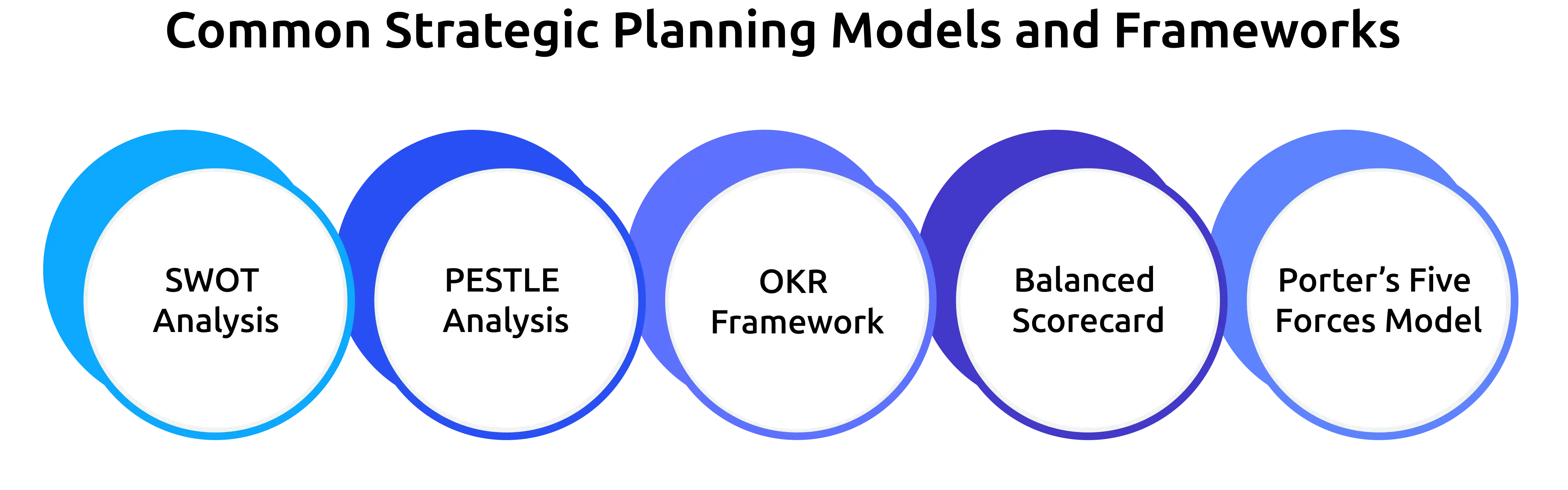
SWOT Analysis
SWOT analysis helps you understand the current position of your organization. You examine internal strengths and weaknesses, along with external opportunities and threats. This model helps you to make decisions grounded in reality rather than assumptions. It allows you to see risks early and where you can grow or improve.
PESTLE Analysis
PESTLE analysis focuses on the external factors that influence your strategy. It looks at political, economic, social, technological, legal and environmental conditions. This framework helps you plan ahead for changes that are beyond your control. It is especially useful in new market entry or long-term planning.
OKR Framework
OKRs assist in turning strategy into clear and measurable results. You establish goals that indicate what you want to accomplish and key results that show how you will measure success. This model makes teams focused and aligned. It also makes progress visible and easier to track over time.
Balanced Scorecard
The balanced scorecard helps you measure success beyond just financial outcomes. It encourages you to track performance in such areas as customers, internal processes, and learning and growth. This framework ensures that your strategy is not only based on short-term gains but also long-term health. It also assists you in balancing execution and improvement.
Porter’s Five Forces Model
This model assists you in understanding the competitive environment of your industry. It examines competition, new entrants, substitutes, suppliers, and buyers. You can use it to assess market pressure and profitability. It helps you position your business better and make smarter competitive decisions.
What Is an Example of Strategic Planning?
Business Context: A local fitness studio wants more members, better attendance, and new fitness programs over the next year.
| Step | Example Plan for the Fitness Studio |
|---|---|
| Define Vision and Mission |
|
| Set SMART Goals | Increase membership by 25%, have 70% of members attend monthly classes, and initiate 3 new fitness programs this year. |
| Identify Priorities |
1. Introduce new yoga, HIIT, and strength classes. 2. Keep existing members happy through loyalty programs. 3. Attract new members through social media. |
| Allocate Resources | Recruit 2 trainers, assign one employee to handle social media, and allocate a budget of $1,000/month to new equipment and promotions. |
| Create Action Plans | Introduce new classes in May (Lead Trainer), launch a loyalty program in June (Manager), post on social media at least twice a week (Marketing), and monitor attendance at classes (Front Desk). |
| Track Performance | Track the number of members joined, class attendance, and social media engagement. Gather feedback on new programs monthly. |
| Review and Adapt | Review progress every 3 months, adjust class schedules, add or remove programs based on member interest, and update staffing or budget as needed. |
Outcome: The studio grows its membership, keeps members engaged, launches new programs successfully, and everyone knows their role. Plans become clear, measurable, and achievable.
What Are the Pros and Cons of Strategic Planning?
Strategic planning helps organizations set direction, prioritize work, and stay focused on long-term goals. But it can also face challenges like poor assumptions, lack of visibility, and weak execution. Below are the key pros and cons, along with ways to overcome the common issues.
| Pros of Strategic Planning | Cons of Strategic Planning and How to Overcome Them |
|---|---|
| Clear strategic planning gives direction for decision-making. You avoid reactive choices by setting priorities early and keeping daily actions aligned with long-term goals. | Strategic planning can rely too much on assumptions. You can overcome this by using workforce intelligence to see real capacity, workload, and risks before finalizing plans. |
| A structured planning process aligns goals with real resources. Reviewing people, time, and budgets before committing assists you in setting achievable targets and avoiding overcommitment. | Plans often fail during execution due to a lack of visibility. AI-driven workforce insights assist you in tracking progress in real time and highlighting gaps before they turn into delays. |
| Consistent goal setting keeps teams focused on what is really important. Defining priorities clearly prevents distractions and reduces work that does not support the strategy. | Strategic plans can stay the same over time and not adapt to new situations. AI-based trend analysis supports regular reviews by highlighting changing workload patterns and emerging risks. |
| Regular performance tracking makes progress visible. Measuring outcomes and reviewing results assists you in correcting issues early and improving future planning. | Manual tracking takes time and limits accuracy. Automated reporting and workforce analytics reduce effort and provide reliable data for faster decisions. |
| Clear task ownership improves execution. Assigning responsibilities and timelines ensures accountability and keeps work moving as planned. | Accountability breaks down when updates are unclear. Workforce intelligence tools collect updates continuously and highlight problems early without waiting for reviews. |
| Ongoing reviews keep strategy relevant. Adjusting plans based on results and feedback helps you respond to change instead of reacting too late. | Priorities that change cause confusion within teams. AI-driven insights demonstrate the impact of changes on capacity and timelines to ensure changes remain realistic. |
How to Improve the Strategic Planning with Workforce Intelligence
Workforce intelligence improves strategic planning by replacing assumptions with real data on capacity, progress, and risk. It helps you plan with clarity and act with confidence. Here you can see how it strengthens strategic planning in practice.
1. Use Real-Time Capacity Insights
Workforce intelligence provides you with a clear picture of who is available, what they are working on, and how much they can handle. This information can help you to set realistic goals, assign tasks effectively, and avoid overloading your team. This assists your plans to align with actual capacity rather than assumptions, so execution becomes smoother and more predictable.
2. Track Progress and Spot Bottlenecks Early
Workforce intelligence allows you to track the real-time progress of work. You notice delays, identify bottlenecks, and make adjustments before problems become critical. This keeps your strategic plan on track and prevents minor issues from affecting long-term results.
3. Align Resources with Strategic Priorities
Workforce data can help you align available people, skills, and time with your most important initiatives. This alignment ensures you give high-priority projects the attention they need and use resources efficiently across the organization. It reduces wasted effort and improves how well your team achieves results.
4. Make Data-Driven Decisions
Workforce intelligence offers objective data on workloads, trends, and performance, instead of relying on assumptions. These insights can help you prioritize initiatives, decide on deadlines, and dynamically adjust plans. This will make your strategic planning more informed, objective and results-oriented.
5. Enhance Collaboration and Accountability
Workforce intelligence tools automatically track the progress and completion of tasks. Teams can clearly see what you expect from them and how their work contributes to bigger goals. You are able to detect gaps at an early stage and reallocate tasks when necessary. This enhances accountability and makes everyone work towards shared results.
6. Predict and Prepare for Future Challenges
Advanced workforce analytics can highlight potential risks, including overworked teams, skills gaps, or upcoming capacity shortages. This information can help you to make changes to plans, recruit the right talent, or redistribute work before these challenges affect your strategy. This proactive approach helps keep your plans strong.
How Does Strategic Planning Differ from Strategic Workforce Planning?
Here is the difference between strategic planning and strategic workforce planning.
| Aspect | Strategic Planning | Strategic Workforce Planning |
|---|---|---|
| Focus | Examines your long-term objectives and general direction. It helps you to determine what is actually important to the business. | Ensures that the right individuals with the right skills are in the right place to accomplish your organization’s goals. |
| Purpose | Leads the decision-making process, helps you to align resources, and transforms your strategy into action. | Make the best use of your team so that your plans can be successfully completed. |
| Time Horizon | Usually oriented towards long-term objectives and development. | Focuses on matching the needs of the workforce with the present and future objectives. |
| Planning Inputs | Takes into account the market trends, business goals, budgets, and operational data. | Utilizes workforce data such as availability, skills, workload, and performance. |
| Decision Areas | Assists you in determining what initiatives to undertake, how to distribute resources, and how to measure progress. | Helps you decide who does what, when, and how, so your team completes work efficiently. |
| Outcome | Gives clear direction, measurable goals, and aligned initiatives across the organization. | Makes sure that the right individuals are in the right positions at the right time and minimizes risk and enhances outcomes. |
Turn Strategy into Action with Real-Time Workforce Intelligence
Strategic plans fail when you do not know what is actually happening in your team. You might set ambitious goals, but your team could already be handling too much work, working on the wrong priorities, or spending time on tasks that do not move the strategy forward. When this happens, your plan stays on paper and execution breaks down. You need real visibility into capacity, progress, and workload before you finalize any strategy.
Time Champ is a workforce intelligence software that provides complete visibility into your workforce activities and performance. It shows who is available, what work the team is doing, and whether tasks are on track. You can track progress in real time, spot bottlenecks early, and reassign tasks before delays become a problem.
With this workforce intelligence data, you can set realistic goals, allocate resources effectively, and keep your strategic plan aligned with what your team can actually deliver. Time Champ helps you bridge the gap between planning and execution, so your strategy becomes measurable, realistic, and achievable.
Need a better way to execute strategy across teams?
Try Time Champ to balance workloads, improve accountability, and keep execution on track.
Conclusion
Strategic planning only works when your goals match real capacity, and your team can actually execute the plan. If you rely on assumptions, your strategy stays on paper and execution falls apart. But when you use a clear planning process, set realistic priorities, and track progress with real data, you can turn your strategy into measurable results.
Using workforce intelligence tools like Time Champ, you can spot bottlenecks early, balance workload, and adjust plans before they break. In the end, strategic planning becomes a practical way to guide your organization, align your people, and achieve the outcomes you want.

Tarun Kumar Reddy

Table of Content
-
 What Is Strategic Planning?
-
Why Is Strategic Planning Important?
-
What Are the Key Elements of Strategic Planning?
-
What Are the 7 Steps in the Strategic Planning Process?
-
What Are Common Strategic Planning Models and Frameworks?
-
What Is an Example of Strategic Planning?
-
What Are the Pros and Cons of Strategic Planning?
-
How to Improve the Strategic Planning with Workforce Intelligence
-
How Does Strategic Planning Differ from Strategic Workforce Planning?
-
Turn Strategy into Action with Real-Time Workforce Intelligence
-
Conclusion
Related Blogs
Discover strategic workforce planning: definition, process, tools, and templates. Align talent with business goals and prepare your workforce for the future.
Shabana Shaik | September 16, 2025
Download 5 free workforce planning templates for 2025 in Excel. Simplify headcount planning, skills gap analysis, succession & project capacity planning.
Thasleem Shaik | October 01, 2025
Discover 10 workforce planning models every HR professional should know to align talent with business goals, improve efficiency, and plan for the future.
Thasleem Shaik | September 30, 2025
Find the best capacity planning software tools for IT, manufacturing, and more. Compare features, pricing, pros, and cons to choose the right tool for 2025.
Guna Lakshmi | November 11, 2025
Discover 10 key workforce planning metrics for 2025. Learn how these analytics metrics impact hiring, retention, productivity & strategic HR planning.
Guna Lakshmi | September 15, 2025
Discover dynamic workforce planning: what it is, why it’s important, key components, how to create a plan, and how it differs from strategic planning.
Guna Lakshmi | September 15, 2025


 4.7/5 avg.
Ready to Manage Your Workforce Smarter?
Join our family of 1500+ companies using smart insights to redefine workforces!

Free Trial
No Credit Card Required