What Is Time Estimation and Why Does It Matter?
Learn what time estimation is, its importance, and how accurate time planning can improve productivity, task management, and decision-making in daily life.

Ever started a task thinking, “This will only take 10 minutes,” only to realize an hour has already passed? You might have experienced how difficult it can be to accurately predict how long things will take, whether it’s finishing work, studying, replying to emails, or even getting ready in the morning.
And that’s exactly where time estimation becomes more important.
Poor time estimates can lead to missed deadlines, messy plans, and unnecessary stress, but with better time estimation, managing your day becomes much easier.
In this blog, I’ll explain what time estimation is, why it matters, and how it can help you become more productive.
What is Time Estimation?
Task estimation is the process of predicting the time, effort, and resources needed to complete a task or project. It helps individuals and teams plan work efficiently, set realistic deadlines, improve productivity, and manage projects more effectively.
Almost every plan you make depends on some form of time estimation, whether it’s setting a deadline, planning your day, managing a project, or estimating how long a task will take. The goal is to make realistic estimates that help you plan and adjust more easily as you learn and gain experience.
Why Does Time Estimation Matter?
A single wrong estimate can throw off your entire schedule, especially when deadlines, client meetings, or important deliverables are involved. Tasks start taking longer than expected, deadlines begin slipping, and suddenly everything feels rushed and unorganized.
Here’s why time estimation is important:
- Helps you set realistic deadlines
- Improves planning and task management
- Reduces stress caused by poor scheduling
- Prevents delays and missed commitments
- Makes workloads easier to manage
- Improves productivity and efficiency
- Helps teams allocate resources more effectively
- Builds trust with clients and stakeholders
Without proper time estimation, even simple tasks can become difficult to manage. Better estimates lead to smoother workflows, clearer expectations, and more predictable results.
Why Are Time Estimates Usually Too Optimistic?
Most time estimates are overly optimistic because of a mental bias known as the “planning fallacy.” When you imagine completing a task, you naturally picture the best-case scenario, where everything goes smoothly and nothing causes delays.
In reality, unexpected interruptions, revisions, and additional work are often left out of the estimate. As a result, people tend to underestimate how long tasks will actually take.
Psychologists Daniel Kahneman and Amos Tversky introduced the concept of the planning fallacy, explaining why people consistently make unrealistic time predictions even when past experiences suggest otherwise.
The practical takeaway is simple: your first estimate is usually too short. Instead of depending only on memory or instinct, using past data and structured estimation methods can help you create more realistic timelines.
Want to Make Your Time Estimates More Accurate with Real Data?
Use historical time insights to plan smarter, estimate better, and deliver projects on time.
What Are the Main Time Estimation Methods?
Estimating time isn’t always as simple as guessing how long a task might take. Some projects need high-level estimates, some require detailed planning and careful breakdowns. That’s why different time estimation methods exist, each designed for different situations, project sizes, and levels of uncertainty.
Here are some of the most commonly used time estimation methods:
| Method | How It Works | Best When |
|---|---|---|
| Top-down | Start with the overall project timeline, then break it down into phases and tasks. | Early planning stages, when detailed information is limited. |
| Bottom-up | Estimate each small task individually, then combine them to get the total estimate. | You need more detailed and accurate estimates. |
| Three-point | Use optimistic, realistic, and pessimistic estimates to calculate a balanced timeline. | The project involves uncertainty or potential risks. |
| Analogous | Estimate based on the timeline of a similar past project. | You have historical project data available. |
| Parametric | Use predefined rates or formulas, such as hours per page or tasks per day. | The work is repetitive and measurable. |
| Expert judgement | Rely on insights from experienced professionals or subject experts. | The project is complex or requires specialized knowledge. |
Each method works best in different situations, and combining multiple approaches often leads to more accurate time estimates.
Tips to Improve Your Time Estimation
Estimating time becomes much easier when you follow a structured process instead of relying on rough guesses. Here’s a simple step-by-step approach to creating more realistic time estimates:
- Break the Task into Smaller Parts: Divide the work into smaller, manageable tasks that are easier to estimate accurately.
- Look at Similar Past Tasks: Check how long similar work took in the past instead of relying only on memory or assumptions.
- Choose the Right Estimation Method: Use methods such as bottom-up, analogous, or three-point estimation, depending on the task's complexity and uncertainty.
- Add Buffer Time: Leave room for interruptions, revisions, meetings, or unexpected delays that may affect the timeline.
- Estimate Using a Range: Instead of giving one exact number, provide a realistic range like “3–5 days” to account for uncertainty.
- Review and Improve Your Estimates: Compare the estimated time with the actual time after completing the task to improve future estimates.
Following these steps can help you create more accurate timelines, reduce scheduling issues, and manage work more confidently.
Common Challenges in Time Estimation
Even with careful planning, estimating time accurately can be difficult. Unexpected delays, unclear requirements, and everyday distractions often make tasks take longer than expected.
Here are some common challenges people face while estimating time:
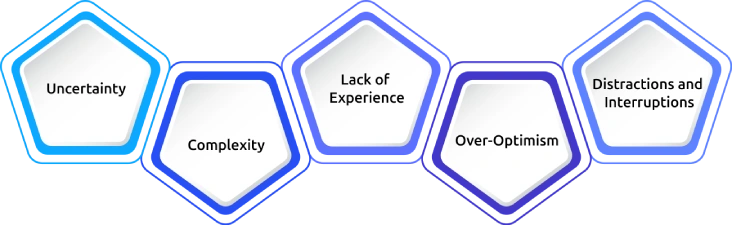
1. Uncertainty: Unexpected problems, changing requirements, or technical issues can delay tasks and make estimates less accurate.
2. Complexity: Some tasks seem simple at first but turn out to involve more work than expected, making it difficult to predict the actual time required.
3. Lack of Experience: When you haven’t worked on similar tasks before, it becomes harder to estimate timelines realistically due to limited past references.
4. Over-Optimism: People often assume tasks will go smoothly and underestimate the time needed, leading to unrealistic deadlines.
5. Distractions and Interruptions: Meetings, notifications, emails, and task switching can reduce focus and increase the actual time needed to complete work.
Understanding these challenges can help you create more realistic estimates and improve your planning over time.
How Time Champ Helps You Improve Time Estimation
Accurate time estimation becomes easier when you make your decisions on real work data instead of assumptions. This is exactly what Time Champ is designed to solve.
Time Champ is a time tracking and employee monitoring software that tracks how much time is actually spent on tasks, projects, and daily activities. This gives you a clearer understanding of work patterns, helping you create more realistic timelines and avoid underestimating tasks.
Here’s how Time Champ supports better time estimation:
- Automatic Time Tracking: Track time spent on apps, projects, and tasks automatically without depending on manual timers.
- Task Time Tracking: Measure how long tasks actually take to improve future estimates and project planning.
- Project Management: Break projects into tasks, milestones, and workflows for more structured planning and estimation.
- Task Management: Organize and monitor tasks with real-time tracking to manage workloads more effectively.
- Activity Tracking: Identify focus time, idle periods, and interruptions that may affect productivity and timelines.
- Real-Time Reports: Get daily, weekly, and custom reports that help you analyze work patterns and improve planning accuracy.
With real-time tracking and work insights, Time Champ helps you make estimation more accurate and planning more predictable.
Bring Clarity to Your Time Estimation Process!
Track real work patterns with Time Champ and turn every project into a well-planned workflow.
Conclusion
Time estimation is a simple skill, but it has a big impact on how you plan, work, and deliver tasks. When your estimates are realistic, it becomes easier to manage deadlines and reduce unnecessary stress. While perfect accuracy is not possible, using the right methods and learning from experience can improve your planning over time. With better estimation, you can work more confidently and stay in control of your schedule.

Jahnavi Pulluri

Table of Content
 What is Time Estimation?
- Why Does Time Estimation Matter?
- Why Are Time Estimates Usually Too Optimistic?
- What Are the Main Time Estimation Methods?
- Tips to Improve Your Time Estimation
- Common Challenges in Time Estimation
- How Time Champ Helps You Improve Time Estimation
- Conclusion
Related Blogs
Discover how time blocking boosts productivity, focus, and performance, and how it can enhance your time management.
Shabana Shaik | Sep 13, 2024
Create a clear time tracking policy to boost productivity and ensure accurate work-hour reporting. Download a free customizable template.
Thasleem Shaik | Oct 04, 2024
Learn what time management skills are, compare key skills, explore examples with stats, and see how they differ from time management techniques.
Thasleem Shaik | Apr 08, 2026
What if your time management myths are holding you back? Find which beliefs are stopping you from becoming more productive and find other improved methods.
Thasleem Shaik | Mar 15, 2025
Discover practical time management techniques to improve focus, prioritize tasks, reduce distractions, and manage your workday more effectively.
Thasleem Shaik | May 21, 2026
Learn how to build a time management plan that aligns roles, goals, and schedules. A practical, step-by-step guide to lead your team with clarity.
Thasleem Shaik | May 25, 2026


 4.7/5 avg.
Ready to Manage Your Workforce Smarter?
Join our family of 1500+ companies using smart insights to redefine workforces!

Free Trial
No Credit Card Required