Productivity Paradox: What It Is and How to Beat It
Why does more tech mean less output? Understand what the productivity paradox is, why it's back in 2026, and how to beat it by measuring what truly counts.

If you are wondering what this productivity paradox is, then allow me to explain with an example.
Picture this: Last year, your team added a new project tool, a new chat app, two AI assistants, and a dashboard that promised to change everything. The budget went up. The demos looked amazing. And yet, somehow, your team feels slower. Tasks take longer, people are tired, and you keep wondering what went wrong and where all that productivity went. Sound familiar?
If you are nodding for this example, then you have already met the productivity paradox. It is a frustrating gap between all the tech you buy and the results you actually get. The good news is that it is not a mystery, and it is definitely not permanent. Tag along, because in this guide, I will lay out what the productivity paradox really means, why the AI productivity paradox is making a comeback in 2026, and the practical, measurable way to beat it.
What is The Productivity Paradox?
The productivity paradox is the strange reality where heavy investment in technology does not produce the productivity gains you expect. You spend more on tools, software, and now “Revolutionary AI”, but output stays next to zero, or it might even drop. It challenges the assumption that more technology always means more efficiency.
So, the productivity paradox’s meaning is pretty simple once you say it plainly: the money goes up, the output does not follow. It shows up at every scale, from a national economy to your own 10-person team. And it tends to sting the most for the companies trying their hardest to modernize, because they are the ones spending the most and expecting the biggest jump.
Where it started: the Solow paradox
The paradox is not a Genz term. In fact, back in 1987, Nobel Prize-winning economist Robert Solow summed it up perfectly: "You can see the computer age everywhere but in the productivity statistics." Companies were pouring money into computers, yet the productivity numbers barely moved.
Economists later called it the Solow paradox, and it became one of the great puzzles in business. The technology eventually paid off, but only after companies learned how to actually work with it. That lag is the heart of the whole problem.
Why is The AI Productivity Paradox Back in 2026?
The AI productivity paradox is the modern version of Solow's puzzle. Companies have adopted AI fast, but the productivity boom has not shown up in the numbers yet. Early research finds small or near-zero effects on output and hours, which is exactly what a paradox looks like in its early, messy years.
The AI productivity paradox is today's version of Solow's puzzle. Companies didn’t take a long time to adopt AI, but the productivity gains that were expected with the AI adoption are nowhere near visible.
Even early studies show little to no impact on output and working hours so far, which is often how these productivity shifts look in their early stages.
This is the part that surprised many people. One large study of AI chatbots at work found near-zero impact on earnings and hours, ruling out productivity effects bigger than about 2 percent two years after ChatGPT launched.
McKinsey has openly asked whether the Solow paradox is back, noting that excitement over AI has not yet turned into broad productivity gains.
Why the productivity gap? Here are a few honest reasons:
- New Bottlenecks: AI speeds up one step and clogs another. Code gets written faster, then waits longer for human review.
- A Learning Curve: Teams need time to redesign how they work, not just bolt AI onto old habits.
- Measurement Blind Spots: If you are not tracking where time actually goes, you cannot see whether AI helped or just added another tab.
This lesson from history is comforting: the gains usually do come, but only for the teams that change how they work and measure the change. Which brings us to what causes the paradox in the first place.
What Actually Causes the Productivity Paradox?
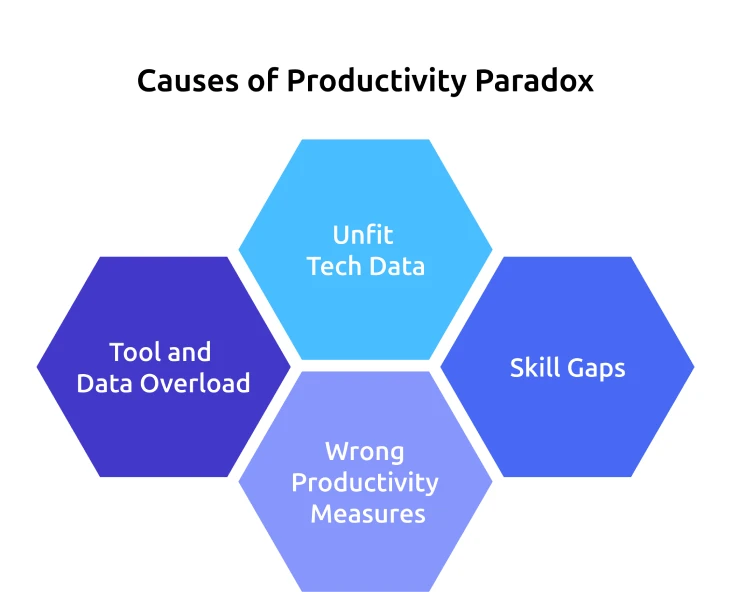
Basically, the productivity paradox usually comes from four things: technology that does not fit how people actually work, a skills gap that leaves staff fumbling with new tools, outdated metrics that miss the full picture, and plain overload from too many tools and too much data.
When I dig into a team stuck in the paradox, the cause is almost always one of these four. Often it is more than one at once:
- Tech That Does Not Fit the Workflow: Teams buy a tool because it is trendy, not because it matches how the team works. So, people work around it, and the tool keeps adding more steps instead of removing them.
- A Skills Gap Nobody Planned For: It’s no secret that new tools need new skills, and without proper onboarding, people constantly need to figure out things on their own, which might even cause frustration and lead to an unused feature stack.
- Measuring the Wrong Things: If you only track raw output per hour, you will miss quality, focus, and rework. The numbers obviously say everything is fine, while your team keeps struggling quietly. A better set of productivity metrics fixes this.
- Tool and Data Overload: A stack of ten apps, five dashboards, and endless notifications, people spend more time managing these tools than doing work. This is the everyday face of the paradox in small teams.
There is also a people side, though. In fact, Microsoft calls it productivity paranoia: Most leaders worry their teams are slacking while those same teams feel overworked. In Microsoft's research, 85 percent of leaders said the shift to hybrid work made it hard to feel confident their people were being productive.
That trust gap is fuel for the paradox, because it just pushes managers to add more and more tools and a bit more pressure instead of bringing in clarity.
Signs That Tell Your Team Is Stuck in The Productivity Paradox?
You are likely in a productivity paradox if spending keeps rising while output stays low, new tools make work more complex instead of keeping it simpler, adoption is low, and burnout is skyrocketing. The clearest tell is when more technology somehow leads to more confusion, not less.
Here are the signs worth watching, and what each one is quietly telling you:
| Sign You Notice | What it Usually Means |
|---|---|
| Spending climbs, but output does not | Your tools are not matched to real work, or no one is measuring the return. |
| New tools add steps, not speed | Poor fit or weak onboarding. Simplicity should always win. |
| Low adoption or quiet resistance | The tool does not solve a problem your team actually has. |
| Apps that do not talk to each other | Integration gaps create copy-paste busywork and errors. |
| Rising burnout and disengagement | Overload, not laziness. A common and serious burnout signal. |
| Data everywhere, decisions nowhere | You are collecting more data than you can ever use. Quality should be the first parameter. |
Want to Save Costs and Improve Tool Adoption?
Time Champ helps you cut wasted licenses and lift adoption
How to Beat the Productivity Paradox?
If you follow a few proper steps, beating the productivity paradox is quite simple:
- Try fixing things before adding new features
- Train people properly
- Measure the right things
- Simplify your tool stack
- And Prioritize visibility
You fix what you see!
The old advice was to align first, train next, and simplify later, that’s still true. But here is the experienced version, reordered so it actually helps you move the right needle:
- Measure First, Then Judge the Tech: Before you blame a tool or buy a new one, get a clear baseline of where time and focus actually go. Decisions made on guesses keep the paradox alive and thriving.
- Match Technology to the Workflow: Map how work really happens, then choose tools that remove extra or unnecessary steps. Give your team a choice, so they decide what they use.
- Close the Skills Gap on Purpose: Provide an ongoing, hands-on training, it really beats a one-time demo. Remember: confident users are the productive users.
- Rethink Your Metrics: Add quality, focus time, and rework to your view of how to measure employee productivity, not just raw output.
- Simplify Ruthlessly: If two tools do one job, you don’t need both, just cut one. Every app you remove gives your team a very needed focus back.
- Protect Against Burnout: Balance workloads and encourage taking breaks. A rested team is the cheapest productivity upgrade you will ever get.
A 30-second Self-check
Ask yourself one question: Can you show, with data, where your team's time went last week? If you are unable to do that, then this is the blind spot where the productivity paradox lives. Fixing it starts with finally being able to see.
How Does Productivity Tracking Help You Beat It?
Now productivity tracking really helps to beat this productivity paradox, because it lets you track each employee’s productivity, how well they are doing, and where they are slacking, which tools are draining productivity, and which tools are the teams more productive in.
Overall productivity tracking software gives you all the visibility you ever need to eliminate the productivity paradox from the roots.
To get that right visibility, you need the right tool, which tracks real activity, puts together captured data, and gives valuable insights. That’s what Time Champ does, it’s a productivity tracking and employee monitoring software that helps you eliminate productivity paradox, engage employees, reduce burnout, and tells you which tools make your team more efficient.
Brownie points for showing unused licenses, meaning when you invest in 100 licenses for a tool, and your team only uses 10 or nothing at all.
Here’s Time Champ’s detailed capability checklist:
- Real-time activity tracking shows where work time goes, so a flat output number finally has an explanation.
- Goal and progress tracking ties effort to outcomes, not just hours logged.
- Workload balancing flags who is overloaded before burnout sets in.
- Data-driven insights like heatmaps and time-usage trends help you spot the tool or task that is silently eating the day.
- Flexible monitoring for remote and hybrid teams, it gives clarity without micromanaging.
Most employee monitoring software stops at activity logs. Time Champ goes a step further and adds the workforce intelligence layer that tells you why the numbers look the way they do, which is exactly the missing piece in every productivity paradox. If you want a deeper how-to guide on productivity tracking, go with this link: productivity tracking software.
A Quick Checklist Before You Buy the Next Tool
The best way to beat the productivity paradox is to stop feeding it. Before the next purchase, go through this checklist once:
- Problem First: What exact problem does this solve, and how will we know it worked?
- Fit Check: Does it match how the team already works, or are we forcing a new habit?
- Overlap Check: Does it replace a tool, or just add a tenth tab?
- Adoption Plan: Who trains the team, and when?
- Measurement Plan: Which metric will prove it helped in 60 days?
If you cannot answer these, the tool is more likely to deepen the paradox than fix it. Five minutes of honesty with these five questions saves you months of frustration later.
Tired of Playing Guess What’s Wrong with the Team?
Time Champ shows you exactly which tools drain productivity!
Wrapping Up on the Productivity Paradox
The productivity paradox feels personal when it is your budget and your team, but it follows a pattern we have seen since 1987, and are seeing again with AI. Technology does not pay off on its own. It pays off when you fit it to real work, train people, simplify the stack, and most of all, measure what is actually happening. Get visibility first, and the paradox stops being a mystery and starts being a to-do list. Your team’s best work is not gone, it’s just waiting for you to clear the noise first.

Shabana Shaik

Table of Content
 What is The Productivity Paradox?
- Why is The AI Productivity Paradox Back in 2026?
- What Actually Causes the Productivity Paradox?
- Signs That Tell Your Team Is Stuck in The Productivity Paradox?
- How to Beat the Productivity Paradox?
- A 30-second Self-check
- How Does Productivity Tracking Help You Beat It?
- A Quick Checklist Before You Buy the Next Tool
- Wrapping Up on the Productivity Paradox
Instant Signup
Thank you for your request!
We have received your signup request and our team will get back to you soon. In the meantime, you can book a demo to see Time Champ in action.
Book a DemoFree trial. No credit card required. Prefer a walkthrough? Book a demo.
Related Blogs

Empower your team's productivity with expert strategies. From setting SMART goals to reducing distractions, discover effective methods for success. Elevate your business performance and unlock growth potential.
Shabana Shaik | Jun 23, 2024
Implement a productivity tracking tool with clear steps, setup tips, and best practices to track employee productivity and improve team performance.
Thasleem Shaik | Apr 30, 2026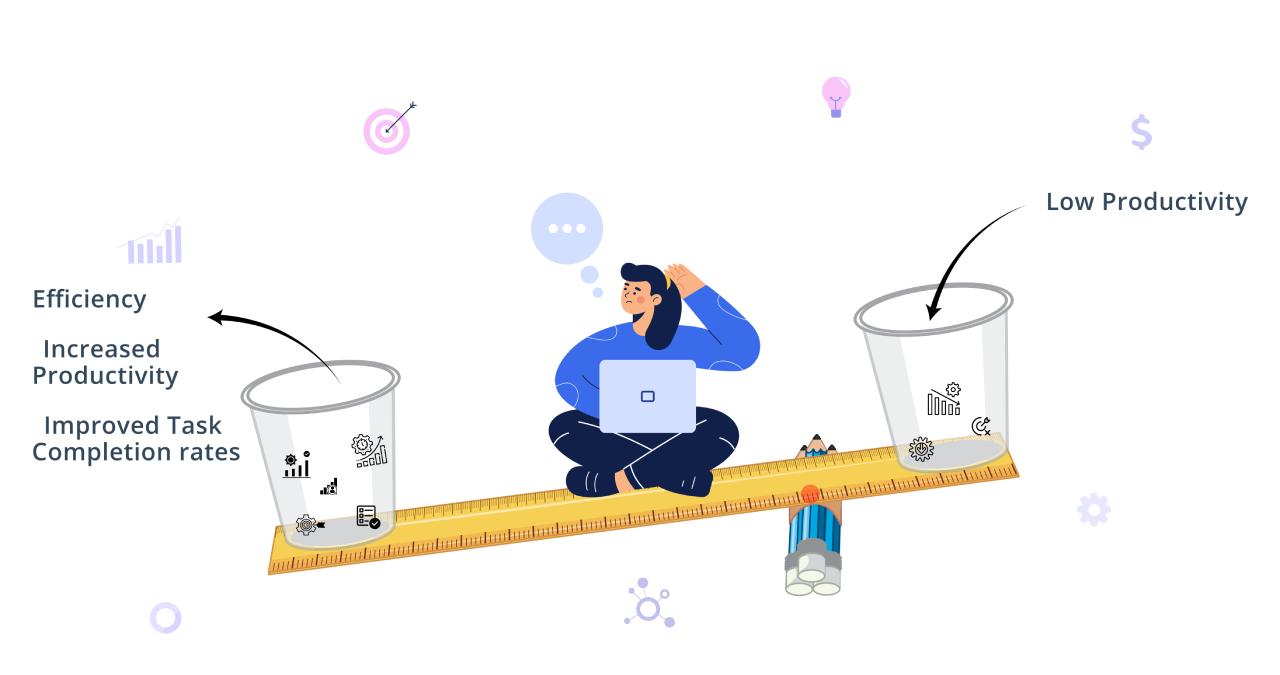
Transform your team's productivity with our guide. Discover benefits and strategies to measure and improve performance.
Shabana Shaik | Jun 21, 2024
Discover the top 20 productivity hacks to get more done, boost efficiency, and stay focused. Learn expert tips to maximize your workflow and results!
Thasleem Shaik | Nov 14, 2024
Find out the causes of low productivity in the workplace and find ways to enhance productivity and increase employee output.
Jahnavi Pulluri | Jun 28, 2024
Learn what productivity intelligence is, why it's important, how it works, ways it transforms team performance, pros & cons, and how to measure it.
Shabana Shaik | Feb 11, 2026


 4.7/5 avg.
Ready to Manage Your Workforce Smarter?
Join our family of 1500+ companies using smart insights to redefine workforces!

Free Trial
No Credit Card Required