What is Operational Efficiency? Benefits & Strategies
Operational efficiency helps you get more value from time, money, and resources. See how to measure it, reduce waste, and improve daily workflows.

Think about how much time disappears into tasks that should take minutes but take hours. Add repeated work, manual processes, unnecessary handoffs, and avoidable errors, and the impact can become much larger than you expect.
Operational efficiency helps you identify these gaps and improve the way work moves through your operation. It connects the resources you put into your processes with the results you get out of them.
In this article, you’ll see what operational efficiency means, why it matters, how you can measure it, and the practical strategies you can use to improve it.
What Is Operational Efficiency?
Operational efficiency means getting the best possible results from the time, money, people, tools, and processes you already have. In simple words, it is about doing work in a smarter way, with less waste, fewer delays, and better outcomes.
It does not mean rushing employees or cutting costs in every area. A business becomes operationally efficient when it removes unnecessary steps, uses resources carefully, and still delivers quality work on time.
For example, if a team can complete the same task in less time by reducing manual work and avoiding repeated approvals, that is operational efficiency. The goal is not just to do more work, but to create more value with less effort and fewer mistakes.
Why Does Operational Efficiency Matter?
Running your operation efficiently is not just about cutting costs. It is about making sure the time, effort, money, and resources you put into your work create as much value as possible.
When you improve operational efficiency, you can remove unnecessary work, reduce delays, and make everyday processes easier to manage. Here are the main ways it can strengthen your operation.
- Get More Value from Your Resources: You can make better use of your existing time, budget, tools, and workforce instead of constantly adding more resources to handle growing workloads.
- Reduce Unnecessary Costs: Inefficient processes can create extra labor hours, rework, delays, and other avoidable expenses. Removing these wasteful steps can help you control operating costs and protect your margins.
- Improve Productivity: When you simplify repetitive or time-consuming processes, you can spend more time on work that creates real value. This helps you increase useful output without simply adding more hours.
- Deliver a Better Customer Experience: Faster processes, fewer errors, and more consistent service can help you respond to customer needs more effectively. Efficient operations can also make it easier to maintain quality as demand changes.
- Make Growth Easier to Manage: Efficient processes can help you handle more work without increasing resources at the same rate. That gives you more room to scale while keeping costs and workloads under control.
Losing valuable time because you cannot see where it goes?
Use Time Champ to uncover productivity gaps and make smarter decisions.
How to Measure Operational Efficiency
You cannot improve what you cannot measure. If you want to improve operational efficiency, you first need a clear picture of what you put into your processes and what you get back from them.
Start by choosing metrics that connect directly to your goals. Then compare your results over time, look for gaps, and check whether your changes actually improve performance. The right operational efficiency metrics help you see where resources go, where work slows down, and where you can make a meaningful improvement.
Key Operational Efficiency Metrics
The right metrics depend on what you want to improve. Instead of tracking every available number, focus on measures that show how well your processes use resources and produce results.
- Cost Per Unit: Shows how much your team spends to produce one unit of output. A lower cost can indicate better resource use when quality stays consistent.
- Cycle Time: Measures how long a process takes from start to finish. A shorter cycle time can indicate smoother workflows and fewer delays.
- Output Per Employee: Compares your output with the workforce resources that support it. This can help you see whether your current processes support productive use of time and effort.
- Defect or Error Rate: Shows how often your process produces mistakes or requires rework. Fewer errors can reduce wasted resources and protect quality.
- On-time Delivery Rate: Measures how consistently the team completes work or delivers orders within the expected timeframe. A declining rate can point to capacity or workflow problems.
- Resource Utilization: Shows how effectively you use available resources such as equipment, working hours, or capacity. Very low utilization can signal unused capacity, while excessive utilization can create bottlenecks and overload.
The important point is to measure efficiency as a balance between resources and results, not as a race to produce more at any cost. A faster process that creates more errors or lowers quality may not improve your overall efficiency.
Examples of Operational Efficiency
You can spot operational efficiency in many parts of your day-to-day work. It can come from removing an unnecessary step, reducing excess inventory, automating a repetitive task, or making a handoff between teams smoother.
The clearest examples connect a change in the way you work with a measurable improvement in time, cost, output, quality, or speed. Here are some practical examples across different types of operations.
1. Lean Manufacturing
You can improve manufacturing efficiency by removing waste from the production process. For example, you can reorganize a production line to reduce unnecessary movement, shorten waiting time, or reduce material waste.
The result can be faster production, lower costs, and more consistent output without reducing product quality. Lean methods focus on reducing waste and improving the flow of value through a process.
2. Retail Inventory Management
Keeping stock levels closer to actual demand can improve inventory efficiency. Just-in-time inventory provides one example. Materials or products arrive when they are needed instead of sitting in storage for longer than necessary. This approach can reduce storage costs and excess inventory while helping keep the products customers want available.
3. Automation of Repetitive Tasks
Routine tasks that follow clear rules often provide good opportunities for automation. Updating inventory records, sending alerts, processing orders, and routing requests are a few examples.
Automation can remove manual steps, shorten processing time, and reduce errors. Measuring the process before and after automation helps confirm whether the change actually improves efficiency.

Did You Know?
PwC’s Digital Trends in Operations Survey found that 72% of US operations and supply chain leaders considered automating operations a top AI investment priority. However, 89% said their technology investments had not fully delivered the results they expected.
What Are the Strategies to Improve Operational Efficiency?
The right operational efficiency strategies depend on where your processes lose time, money, or effort. Start with the areas that create the most friction, then use the following approaches to make those processes simpler and more effective.
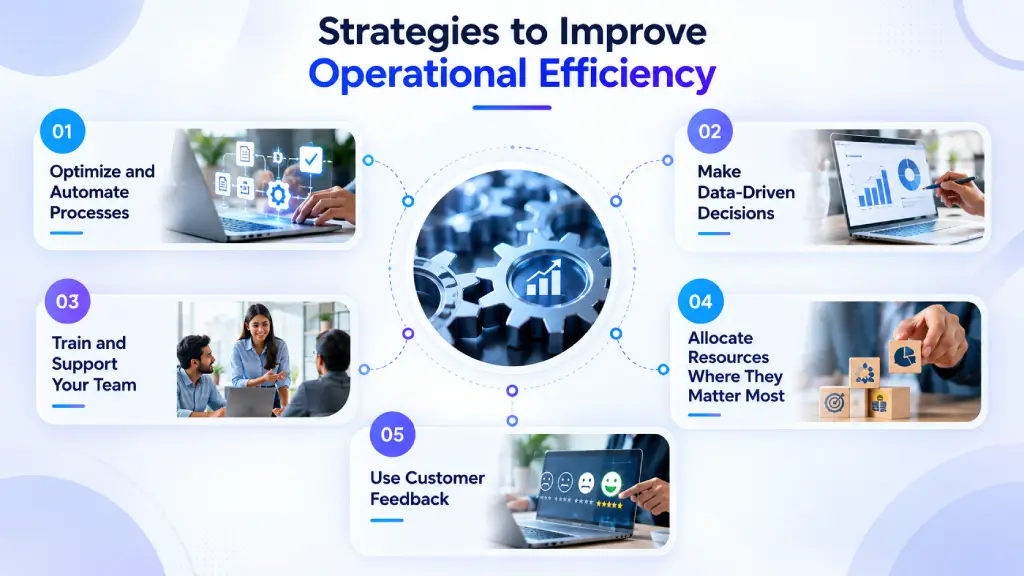
1. Optimize and Automate Processes
Start by looking at how work moves from one step to the next. Remove unnecessary steps, simplify complicated workflows, and standardize repeatable tasks before introducing automation.
Once the process works well, automate suitable routine tasks such as data entry, approvals, notifications, or recurring reports. Automating a flawed process can simply make the inefficiency happen faster, so process improvement should come first.
2. Make Data-Driven Decisions
Use your operational efficiency metrics to see what actually needs attention. Track measures such as cycle time, cost per unit, output, error rates, and resource utilization to identify gaps and compare results before and after a change. Clear data can help you move beyond assumptions and focus your efforts on processes that have the greatest impact.
3. Train and Support Your Team
Even a well-designed process can lose its value when your team does not have the skills or information needed to follow it effectively. Provide clear instructions, practical training, and the right tools for the work.
Feedback also matters. The team working closest to a process can often point out delays, repeated tasks, and practical problems that are easy to miss when you only look at performance data.
4. Allocate Resources Where They Matter Most
Look at where your time, budget, tools, and workforce capacity create the most value. Shift resources away from low-value activities and toward processes that directly affect important outcomes. Regularly reviewing resource use can also help you spot underused capacity and areas where demand has outgrown available resources.
5. Use Customer Feedback
Your customers can reveal problems that internal metrics may not show clearly. Complaints about slow responses, repeated requests, delays, or inconsistent service can point to weaknesses in your processes.
Use that feedback to identify where the customer experience breaks down, then adjust the relevant workflow. This keeps efficiency improvements connected to the value your customers actually receive.
Still guessing where productivity and resource gaps are coming from?
Try Time Champ to replace guesswork with actionable productivity insights.
Common Operational Efficiency Mistakes to Avoid
Improving your processes can create meaningful gains, but the wrong changes can create new problems. Cutting costs too deeply, automating unsuitable tasks, or changing workflows without enough input can make everyday work harder.
Keep these common mistakes in mind before making changes so you can improve performance without sacrificing quality or flexibility.
1. Over-Automating Without Human Oversight
Automation works best when you apply it to clear, repeatable processes. If you automate a complex workflow without understanding its exceptions, the system can repeat mistakes at a much faster rate. Keep human judgment where a process involves unusual cases, important decisions, or quality checks.
2. Ignoring Feedback from the Team
The people who work with a process every day often notice delays, unnecessary steps, and recurring problems first. Ignoring their feedback can leave important inefficiencies hidden.
Ask for input before changing a workflow and give your team a clear way to report problems after the change. Their practical experience can help you improve a process without creating new friction.
3. Cutting Costs Without Looking at Value
Lower spending does not automatically mean better efficiency. Cutting resources too deeply can affect quality, customer service, output, or workload. Instead of focusing only on reducing expenses, look at the relationship between cost, output, quality, and value. A process that costs less but creates more errors may ultimately cost you more.
4. Resisting Change
A process can become inefficient simply because you keep doing it the same way even after your needs change. New workloads, technologies, customer expectations, or business goals may require a different approach. Give new processes time to settle, explain why the change matters, and use performance data to refine the workflow. Clear communication and early involvement can make it easier to adopt new ways of working.
How Time Champ Helps Improve Operational Efficiency
Improving your processes becomes easier when you know where time goes, how workloads are distributed, and which activities slow work down. This visibility helps you identify gaps and make decisions based on actual work data instead of assumptions.
Time Champ gives you productivity and time insights that help you see these patterns across your work. You can use that information to identify bottlenecks, review resource use, and make more informed decisions about how work gets done.
- Productivity Tracking: Productivity data can show where time and effort go across your work. These insights can help you spot low utilization, workload issues, and areas that need attention.
- Time Tracking: Tracking time across different activities gives you a clearer view of how work hours get distributed. You can use this information to spot time-consuming tasks and identify opportunities to reduce wasted time.
- Task Management: A clear view of tasks and workloads can help you identify unnecessary work, uneven task distribution, and areas where you can simplify processes or reduce overload.
- Workforce Analytics: Workforce analytics brings these patterns together so you can compare productivity trends and measure the impact of process changes. Instead of relying only on assumptions, you can use actual work data to see whether an improvement produces the result you want.
- Resource Utilization and Capacity Planning: Looking at workload patterns, utilization, and productivity trends can help you identify underused resources or workloads that may exceed available capacity. These insights help you allocate resources effectively, shift work where needed, and plan capacity before resource gaps affect your operations.
Are hidden productivity gaps costing you time and resources?
Use Time Champ to see where work slows down and make data-backed improvements.
Conclusion
Operational efficiency comes down to making better use of the resources you already have while reducing unnecessary work, delays, and costs. Once you measure where your processes lose time or create waste, you can make focused changes and keep improving the way work gets done. If you want clearer insight into time, productivity, workloads, and resource use, Time Champ can help you turn that information into practical decisions.

Thasleem Shaik

Table of Content
 What Is Operational Efficiency?
- Why Does Operational Efficiency Matter?
- How to Measure Operational Efficiency
- Examples of Operational Efficiency
- What Are the Strategies to Improve Operational Efficiency?
- Common Operational Efficiency Mistakes to Avoid
- How Time Champ Helps Improve Operational Efficiency
- Conclusion
Related Blogs

Need an operational plan template? Get 7 free, ready-to-use Excel, Word & PDF templates, from basic to strategic and nonprofit, plus tips to fill each one.
Chethana | Nov 07, 2025
Understand operational intelligence: definition, real examples, benefits, challenges, how it differs from business intelligence & helps scale businesses.
Anjali | Feb 11, 2026
Strategic planning vs operational planning: definitions, differences, benefits, and use cases to align long-term goals with daily execution effectively.
Anjali | Apr 08, 2026
Learn what workforce efficiency means in 2025, why it matters, key factors, how to measure, tips to improve, and what a good workforce efficiency rate is.
Guna Lakshmi | Sep 15, 2025
Compare productivity vs efficiency with real examples, practical benefits, key differences, and actionable tips to improve business results and performance.
Thasleem Shaik | Jun 29, 2026
Invest in employees to supercharge performance! Learn strategies for boosting productivity and loyalty to optimize your workforce.
Shabana Shaik | Apr 11, 2024


 4.7/5 avg.
Ready to Manage Your Workforce Smarter?
Join our family of 1500+ companies using smart insights to redefine workforces!

Free Trial
No Credit Card Required