Payroll Outsourcing: Benefits, Costs & How It Works
Considering payroll outsourcing? See how it works, what service providers offer, its key benefits and challenges, and how to choose the right provider.
One payroll mistake can turn payday into a scramble of corrections, employee complaints, and compliance worries. As routine processing consumes your HR and finance teams, they face mounting administrative pressure, delayed payments, inaccurate records, and less time for work that drives the business forward. Payroll outsourcing shifts these responsibilities to experienced providers, helping you reduce administrative workload, improve accuracy and efficiency, and free your internal teams to focus on higher-value priorities.
In this blog, you’ll understand what payroll outsourcing is, how it works, and its different types. You’ll also understand the costs, benefits, challenges, and key factors to consider when choosing a provider.
What Is Payroll Outsourcing?
Payroll outsourcing is a business arrangement where an external payroll provider takes responsibility for managing selected payroll tasks or the entire payroll function. These services can include calculating wages, processing payments, handling deductions, preparing payroll reports, and supporting compliance requirements, reducing the administrative burden on internal teams.
How Does Payroll Outsourcing Work?
Payroll outsourcing works through a coordinated process where you share essential workforce and payroll information with an external provider, who then handles the agreed payroll tasks. From collecting employee data to processing payments and maintaining compliance, each step helps keep payroll accurate, timely, and manageable.
- Set Up Your Payroll Account: You provide the provider with essential company and employee information, including pay rates, tax details, payment information, and relevant payroll policies.
- Submit Payroll Inputs: Before each pay cycle, send updated information such as hours worked, attendance, overtime, leave, bonuses, new hires, and employee departures.
- Review and Calculate Payroll: The provider checks the submitted information, calculates gross and net pay, and applies the required deductions, taxes, and contributions.
- Verify Payroll Details: Review the preliminary payroll figures and reports to identify discrepancies or required adjustments before giving final approval.
- Process Payments and Compliance: After approval, the provider processes employee payments and handles the agreed tax filings, statutory contributions, and other compliance requirements.
- Receive Payslips and Reports: Employees receive their payslips, while you get payroll reports and records for reconciliation and future reference.
- Manage Ongoing Updates: The provider continues to support payroll adjustments, compliance changes, employee queries, and updates required for subsequent pay cycles.
Types of Payroll Outsourcing Services
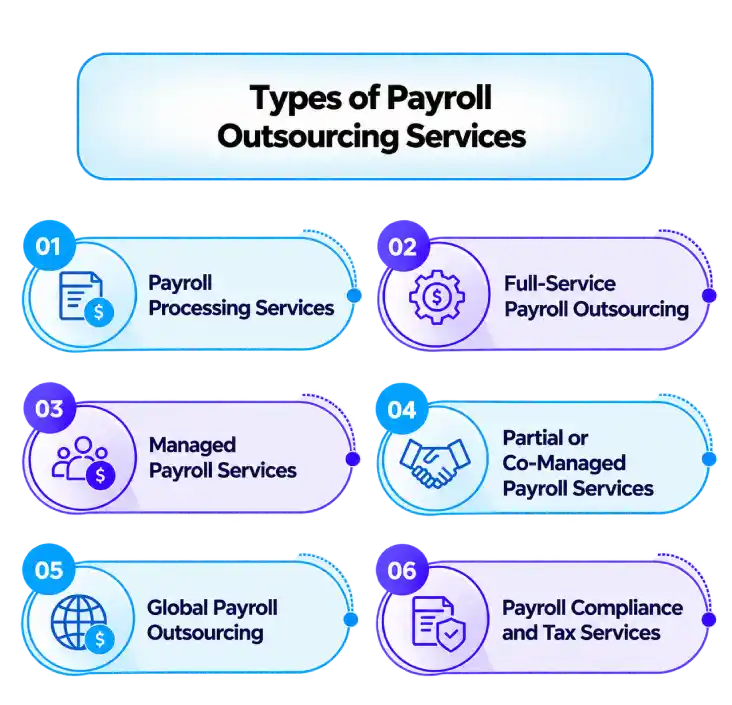
Payroll outsourcing services can vary based on how much of the payroll function you want an external provider to manage. You can outsource specific tasks or hand over most of the payroll cycle, depending on your internal resources, workforce size, compliance needs, and level of control.
Payroll Processing Services
The provider handles core payroll activities such as calculating wages, applying deductions, processing payments, and generating payslips. This option works well when you have an internal team but want to reduce the manual effort involved in running payroll.
Full-Service Payroll Outsourcing
The provider manages most or all payroll activities, from collecting and validating payroll inputs to processing payments, preparing reports, and handling agreed compliance requirements. Your team typically supplies the required information and reviews the final payroll.
Managed Payroll Services
A payroll specialist manages the ongoing payroll function on your behalf, including processing, tax filings, payment distribution, record-keeping, and compliance monitoring. This model is useful when you want to reduce day-to-day payroll administration while retaining oversight of the results.
Partial or Co-Managed Payroll Services
You and the external provider divide payroll responsibilities according to an agreed workflow. Your team may retain employee data management and approvals, while the provider handles calculations, compliance tasks, or reporting.
Global Payroll Outsourcing
A provider coordinates payroll for employees across multiple countries, helping manage different tax systems, employment regulations, currencies, and reporting requirements. This option is particularly useful for businesses with international or multi-country workforces.
Payroll Compliance and Tax Services
The provider manages payroll-related tax calculations, filings, statutory contributions, and regulatory requirements within the agreed scope. This can help reduce the administrative burden of keeping payroll aligned with changing regulations.
Payroll Outsourcing vs. In-House Payroll
Choosing between payroll outsourcing and in-house payroll depends on how much control, time, expertise, and resources you want to dedicate to payroll. In-house payroll keeps the process within your organization, while outsourcing shifts defined payroll responsibilities to an external provider. Comparing the two across these key areas can help you choose the approach that best fits your business needs.
| Key Factor | Payroll Outsourcing | In-House Payroll |
|---|---|---|
| Cost | Involves recurring or per-employee fees, reducing internal payroll costs and making expenses easier to budget. | Requires staff, software, training, and operational resources, increasing costs as payroll becomes more complex. |
| Control & Transparency | You retain oversight and approvals while providers manage daily processing through established systems and workflows. | Your team maintains direct control over payroll processes, approvals, records, and access to sensitive data. |
| Compliance & Risk | Payroll specialists manage agreed tax filings and statutory requirements, helping reduce compliance risks and administrative pressure. | Your team must monitor tax rules, filing deadlines, and regulatory changes to maintain payroll compliance. |
| Security | Data is handled through provider systems, making security practices, access controls, and protection measures important considerations. | Payroll data stays within internal systems, managed according to your organization’s security policies and access controls. |
| Administrative Workload | Providers manage agreed payroll activities, reducing routine administrative work and freeing internal teams for higher-value priorities. | HR or finance teams handle calculations, deductions, payments, records, and other payroll activities internally. |
| Scalability | Services can scale with workforce growth, reducing the need to expand your internal payroll function proportionally. | Workforce growth may require additional payroll staff, technology, processes, and resources to manage increasing complexity. |
Key Benefits of Payroll Outsourcing for Businesses
Managing payroll internally can consume significant HR and finance resources, especially as your workforce grows and payroll requirements become more complex. Outsourcing shifts routine processing and specialized responsibilities to experienced providers, helping you operate payroll more efficiently while giving your internal teams more time to focus on business priorities.
Free Up Internal Resources
Outsourcing routine payroll calculations, filings, payments, and reporting reduces the time you spend on administrative work. This gives you more capacity to focus on strategic initiatives, employee support, and activities that contribute to business growth.

Did You Know?
41% of payroll teams spend an additional 4-10 hours fixing payroll mistakes during each pay cycle, adding to their administrative workload.
Improve Payroll Accuracy
Payroll providers combine specialized expertise with automated processes to reduce calculation mistakes, incorrect deductions, payment errors, and other issues. More accurate payroll helps you ensure employees are paid correctly and reduces the time and cost associated with correcting errors.
Stay Ahead of Compliance Changes
Providers monitor applicable tax rules, filing requirements, and regulatory updates within their service scope. This support helps you maintain compliant payroll processes, meet important deadlines, and reduce the risk of penalties.
Access Specialized Payroll Expertise
You gain access to professionals experienced in payroll calculations, tax requirements, reporting, and regulatory processes. Their knowledge helps you manage complex payroll responsibilities confidently without having to build and maintain the same level of expertise internally.
Strengthen Payroll Data Protection
Established payroll providers use dedicated platforms and security controls to protect sensitive employee and payroll information. This helps reduce security risks while giving you greater confidence that payroll data is handled through reliable, structured processes.
Scale Payroll More Easily
Outsourced payroll services can accommodate workforce growth and increasing payroll complexity. This allows you to manage additional employees, locations, and payroll requirements without expanding your internal payroll resources at the same pace.
Spending too much time checking hours, attendance, and payroll inputs?
Time Champ gives you accurate workforce data with automated tracking and reports.
Common Challenges of Payroll Outsourcing and How to Manage Them
Outsourcing payroll can reduce administrative pressure, but handing payroll responsibilities to an external provider introduces new risks around data, communication, costs, and operational control. Knowing these challenges in advance helps you set clear expectations and build safeguards into your provider agreement.
Protecting Sensitive Payroll Information
Challenge: Outsourcing gives an external provider access to sensitive information such as salaries, bank details, tax records, and employee data.
How to Manage It: Evaluate the provider’s encryption, access controls, authentication measures, security certifications, and data protection policies before sharing payroll information.
Maintaining Visibility Over Payroll Operations
Challenge: You may have less visibility into daily payroll activities, making it harder to identify errors, track progress, or resolve urgent issues quickly.
How to Manage It: Define reporting requirements, approval workflows, performance metrics, and regular review meetings in the service agreement.
Avoiding Communication Delays
Challenge: Missed deadlines, unclear instructions, or slow responses from the provider can lead to payroll errors and delayed employee payments.
How to Manage It: Assign dedicated contacts on both sides, establish clear submission deadlines, and define escalation procedures and response times through SLAs.
Connecting Existing Business Systems
Challenge: Poor compatibility between the provider’s payroll platform and your HR, attendance, accounting, or time-tracking systems can create duplicate data entry and errors.
How to Manage It: Check available integrations before signing a contract and test data flows between systems during implementation to identify issues early.
Did You Know?
A 2025 HR.com report found that 43% of organizations identified a lack of technology integration as a key payroll challenge. The report also found that 41% cited payroll technology costs and 33% cited inconsistent or minimal automation as challenges.
Controlling Unexpected Service Costs
Challenge: Additional charges for setup, off-cycle payroll runs, custom reports, integrations, or other services can increase your overall outsourcing costs.
How to Manage It: Request a detailed pricing structure that clearly lists included services, additional fees, usage-based charges, and potential cost increases.
Managing Provider Changes and Continuity
Challenge: Switching providers or dealing with service disruptions can involve data migration, reconciliations, system changes, and temporary payroll complications.
How to Manage It: Review exit terms, data ownership, migration support, business continuity measures, and transition procedures before entering the agreement.
How to Choose a Payroll Outsourcing Provider
Choosing a payroll outsourcing provider is an important decision that affects payroll accuracy, compliance, employee experience, and costs. Compare providers based on their services, technology, pricing, support, and ability to meet your business needs. A structured evaluation can help you choose a provider that supports your current operations and future growth.
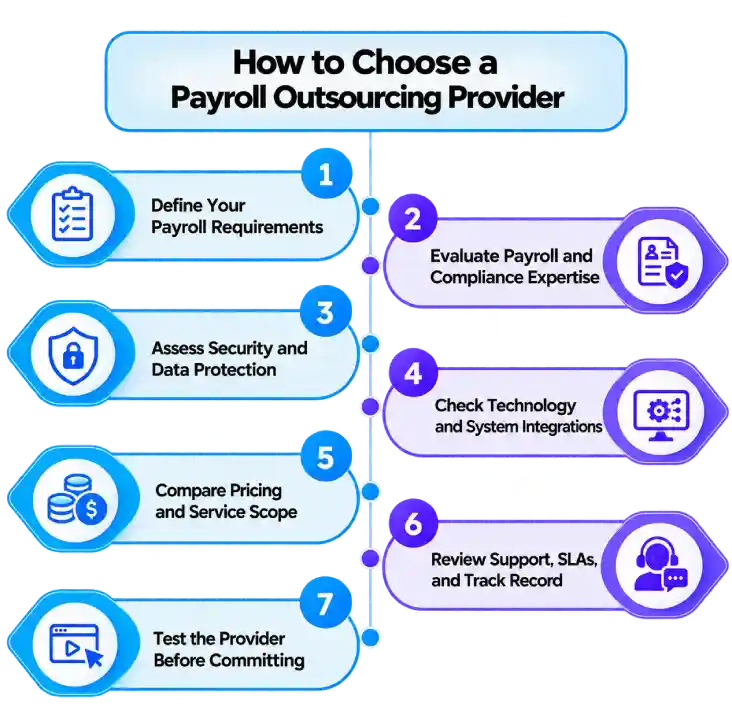
1. Define Your Payroll Requirements
Start by identifying what you want to outsource, including payroll processing, tax filings, compliance, reporting, employee support, and year-end activities. Consider your employee count, pay schedules, locations, worker types, and current payroll challenges before approaching providers.
2. Evaluate Payroll and Compliance Expertise
Check whether the provider has experience handling the tax rules, statutory requirements, and payroll regulations that apply to your business. Ask about their compliance processes, specialist teams, experience with similar businesses, and approach to regulatory changes.
3. Assess Security and Data Protection
Review how each provider protects, stores, and accesses your data, because payroll involves sensitive employee information. Look for strong access controls, encryption, authentication measures, security certifications, and clearly documented data protection practices.
4. Check Technology and System Integrations
Make sure the provider’s payroll platform can connect with your existing HR, accounting, attendance, time-tracking, and other relevant systems. Ask how data is synchronized, how integrations are maintained, and how migration will be handled during implementation.
5. Compare Pricing and Service Scope
Request detailed quotes that clearly separate standard services from additional charges. Compare setup fees, recurring costs, per-employee charges, off-cycle processing, integrations, reporting, and other add-ons to understand the provider’s total cost.
6. Review Support, SLAs, and Track Record
Evaluate the provider’s reputation, client references, implementation experience, support model, and response times. Confirm who will handle payroll issues, how urgent problems are escalated, and whether you will have a dedicated point of contact.
7. Test the Provider Before Committing
Ask shortlisted providers to demonstrate how their platform handles real payroll scenarios relevant to your business. Use the same requirements and scenarios for each provider so you can compare accuracy, usability, reporting, support, and overall fit before making your final decision.
How Time Champ Supports Accurate Payroll Management
Inaccurate work-hour records, manual timesheets, and inconsistent attendance data can make every payroll cycle harder for your HR and finance teams. These issues can lead to incorrect pay calculations, repeated reconciliations, and unnecessary payroll corrections. Time Champ is an employee monitoring software that helps you create more reliable payroll inputs by automatically tracking work hours, attendance, overtime, and employee activity in one platform. Its payroll-ready timesheets and workforce reports give your team accurate records that can support faster payroll processing and fewer manual errors.
Here are the key Time Champ features that help streamline payroll and improve accuracy:
- Automated Time Tracking: Automatically records employee work hours without requiring manual time entries. This provides accurate hours for payroll calculations and reduces timesheet errors.
- Attendance Tracking: Monitors attendance, punch-ins, punch-outs, breaks, and shift information, helping you maintain reliable attendance records and reduce discrepancies when preparing payroll inputs.
- Payroll-Ready Timesheets: Generates timesheets from tracked work data and allows you to review and approve them before payroll processing. This creates a verified record of employee hours and reduces manual reconciliation during each pay cycle.
- Overtime Tracking: Captures work hours, including overtime, as part of automated time records that help your team account for additional hours accurately when preparing employee payroll information.
- Workforce Reports and Analytics: Real-time reports provide visibility into attendance, work hours, activity, and workforce patterns across teams. These insights help you verify payroll inputs and identify discrepancies before processing.
- HR and Payroll Workspace: Brings HR records, attendance, time tracking, timesheets, and payroll-related workflows into one workspace. This reduces duplicate data entry and makes employee information easier to manage across your workforce operations.
Tired of fixing payroll errors caused by inaccurate time and attendance data?
Time Champ automates tracking and timesheets for more reliable payroll inputs.
Conclusion
Payroll outsourcing can reduce administrative pressure, improve payroll accuracy, and simplify compliance as your workforce grows. Evaluate your payroll needs, compare providers carefully, and strengthen your payroll inputs with reliable workforce data. Start by identifying your biggest payroll challenges, then choose the right tools and processes to make every pay cycle more efficient.

Anjali

Table of Content
 What Is Payroll Outsourcing?
- How Does Payroll Outsourcing Work?
- Types of Payroll Outsourcing Services
- Payroll Outsourcing vs. In-House Payroll
- Key Benefits of Payroll Outsourcing for Businesses
- Common Challenges of Payroll Outsourcing and How to Manage Them
- How to Choose a Payroll Outsourcing Provider
- How Time Champ Supports Accurate Payroll Management
- Conclusion
Related Blogs
Discover how to calculate payroll hours and streamline the process with Time Champ. Learn best practices for accurate payroll management in this guide.
Tarun Kumar Reddy | Sep 18, 2024
Improve workforce productivity with attendance reports that simplify attendance tracking, support workforce planning, and help you make better decisions.
Anjali | Aug 17, 2026
Explore timesheet management, its benefits, challenges, and best practices. Learn how the right system helps improve accuracy, planning, and productivity.
Jahnavi Pulluri | Aug 26, 2026
Employee attendance tracker helps businesses maintain accurate work hour records, ensure labor law compliance, manage overtime, and prevent legal issues.
Thasleem Shaik | Mar 15, 2025
Reduce costs, access specialized talent, and improve efficiency with outsourcing. Compare its types, benefits, risks, and the top outsourcing companies.
Anjali | Jul 13, 2026
Discover how field service workforce management improves scheduling, boosts team productivity, lowers operational costs, and enhances customer satisfaction.
Jahnavi Pulluri | Aug 22, 2025


 4.7/5 avg.
Ready to Manage Your Workforce Smarter?
Join our family of 1500+ companies using smart insights to redefine workforces!

Free Trial
No Credit Card Required