How to Measure AI ROI at Work: A Practical Framework (2026)
Measure AI ROI with a practical framework, proven productivity metrics, and actionable steps to evaluate the business impact and maximize AI investments.

You invest in AI tools expecting faster work, higher productivity, and lower costs. But without clear measurement, it’s difficult to know whether AI is delivering real business value or simply increasing software expenses. Knowing how to measure AI ROI is essential for making smarter investment decisions and maximizing the impact of AI across your workplace.
See a practical framework, meaningful productivity metrics, and proven evaluation methods for measuring AI ROI. You’ll also see common measurement mistakes and ways to track results with confidence.
What Does AI ROI Actually Mean?
AI ROI (Return on Investment) measures the financial and operational value a business derives from AI initiatives relative to the total cost of implementing, maintaining, and using those solutions. It helps you determine whether AI investments are improving productivity, reducing costs, increasing efficiency, and delivering measurable financial and operational outcomes.
Formula: Net Benefits - Total AI Costs/Total AI Costs x 100
Why Measuring AI ROI Matters for Your Business
Investing in AI is only valuable when it delivers measurable results. Without tracking ROI, it’s difficult to know whether AI is improving productivity, reducing costs, or supporting your business goals. Measuring AI ROI gives you clear evidence of what works, helping you make smarter decisions and maximize the value of every AI investment.
Here’s why measuring AI ROI is important:
- Justifies AI Investments: Shows whether AI is delivering enough value to justify implementation and ongoing costs.
- Identifies High-impact AI Use Cases: Reveals which AI tools and workflows generate the greatest business value, helping you prioritize future investments.
- Improves Employee Productivity: Measures whether AI reduces manual work, saves time, and helps your employees complete tasks more efficiently.
- Supports Better Decision-making: Provides reliable insights that help leaders decide where to expand, improve, or replace AI initiatives.
- Optimizes Operational Costs: Highlights opportunities to reduce unnecessary spending and improve resource utilization.
- Tracks Business Performance Over Time: Monitors changes in productivity, efficiency, cost savings, and overall business outcomes as AI adoption grows.
- Encourages Continuous Improvement: Identifies performance gaps and optimization opportunities, allowing teams to refine AI usage for better results.
- Builds Stakeholder Confidence: Demonstrates measurable business outcomes, making it easier to gain support from leadership, investors, and other stakeholders.

Did You Know?
According to Gallup's 2026 U.S. workplace research, 28% of employees use AI at work a few times a week or more. As AI adoption continues to grow, measuring AI ROI is essential to determine whether it is delivering meaningful business results.
The AI Productivity Metrics That Actually Drive ROI
Measuring AI ROI starts with tracking the right metrics. Looking only at time saved or cost reduction gives an incomplete picture of AI's impact. A balanced set of productivity, operational, and business metrics helps you evaluate whether AI is improving efficiency, delivering measurable outcomes, and creating long-term value.
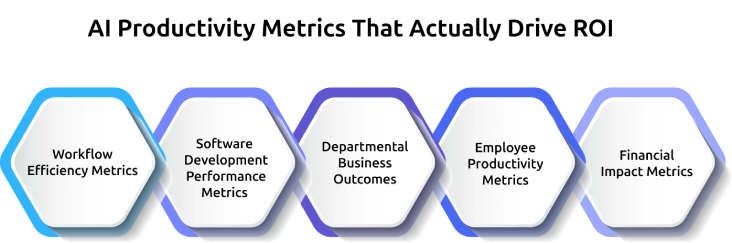
Workflow Efficiency Metrics
These metrics focus on how quickly and smoothly everyday processes are completed after AI adoption. Comparing the workflows before and after implementation can help you identify improvements in speed, consistency, and task execution. It helps you understand whether AI is streamlining operations and reducing delays in daily processes.
Software Development Performance Metrics
These evaluate how AI influences different stages of development, including coding, testing, and deployment. They highlight changes in development speed, code quality, and issue resolution efficiency. It helps your teams assess whether AI is improving development productivity without compromising quality.
Departmental Business Outcomes
Departmental business metrics measure the impact of AI on each team's business goals. The KPIs vary by department, such as sales growth, customer satisfaction, hiring efficiency, marketing performance, or service quality. These metrics show whether AI is helping individual departments achieve measurable business results.
Employee Productivity Metrics
Employee productivity metrics measure how AI influences the way employees work throughout the day. They evaluate improvements in output, task completion, productive time, and the reduction of repetitive manual work. These metrics help you identify whether AI is enabling employees to accomplish more work with greater efficiency.
Financial Impact Metrics
Financial impact metrics measure the monetary value generated by AI compared with the total investment required to implement and maintain it. They evaluate whether AI contributes to cost savings, revenue growth, and overall profitability. These metrics help determine whether AI investments are delivering a positive return and support long-term business growth.
Not sure if your AI investments are delivering real business value?
Time Champ helps you track productivity and measure AI ROI with confidence.
5 Steps to Measure AI ROI Effectively
Before you calculate AI ROI, you need a structured approach that measures both costs and outcomes. Following a clear process helps you avoid inaccurate assumptions, track meaningful business improvements, and evaluate whether your AI investments are delivering measurable value.
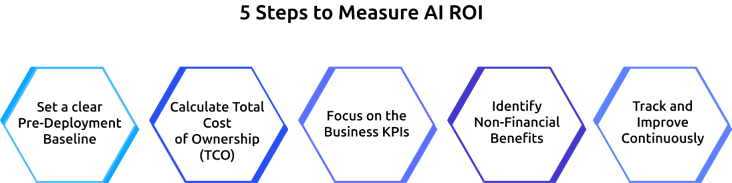
1. Set a clear Pre-Deployment Baseline
Start by measuring how work is performed before AI adoption. Measure task completion time, productivity levels, costs, and error rates. This baseline helps you compare performance changes accurately. Without it, you cannot clearly determine whether AI is improving efficiency or delivering measurable value.
2. Calculate Total Cost of Ownership (TCO)
Consider every expense involved in implementing AI, not just subscription fees. Include costs for setup, training, integration, infrastructure, and ongoing support. A complete cost view ensures accurate ROI calculation. Ignoring hidden expenses can lead to misleading conclusions about AI’s financial impact.
3. Focus on the Business KPIs
Identify metrics that directly support your business goals. Track outcomes such as productivity improvements, revenue growth, cost savings, and customer satisfaction. These indicators reflect real business value. Avoid relying only on AI usage metrics, as they do not show meaningful impact.
4. Identify Non-Financial Benefits
Evaluate improvements that may not immediately appear in financial reports. Consider better decision-making, reduced employee workload, improved collaboration, and faster response times. These benefits enhance overall efficiency. Over time, they contribute significantly to long-term business performance and ROI.
5. Track and Improve Continuously
Review your metrics and compare them with your baseline data regularly. Identify areas where AI performance can improve and refine your processes. Continuous monitoring ensures better outcomes. This approach helps you maximize AI value and adapt strategies as business needs evolve.
Common AI ROI Measurement Mistakes to Avoid
Many AI initiatives fail to show their true value because organizations measure the wrong things or overlook important factors. Avoiding these common mistakes helps you calculate AI ROI more accurately, make better investment decisions, and identify opportunities to improve AI performance over time.
Measuring AI Usage Instead of Business Outcomes
High AI adoption doesn't automatically mean high ROI. Tracking metrics like the number of prompts, logins, or AI-generated outputs provides limited insight into business value. Focus on outcomes such as productivity improvements, cost savings, faster project delivery, or revenue growth.
Ignoring the Full Cost of AI
Many organizations calculate ROI using only software subscription costs. This approach overlooks implementation, employee training, system integration, maintenance, infrastructure, and support expenses. Include every direct and indirect cost to measure AI ROI accurately.
Skipping Baseline Performance Measurements
Without measuring performance before AI implementation, it's impossible to determine whether AI actually improved results. Always record baseline metrics such as task completion time, operational costs, employee productivity, and error rates before deploying AI.
Tracking Too Many Vanity Metrics
Not every metric reflects business success. Measuring prompt counts, chatbot conversations, or hours spent using AI may look impressive but doesn't demonstrate business impact. Prioritize KPIs that align with your organizational goals and show measurable improvements.
Expecting Immediate ROI
AI rarely delivers maximum value immediately after deployment. Teams need time to adopt new workflows, optimize processes, and build confidence in AI tools. Measure performance consistently over weeks and months to capture long-term business impact without judging results too early.
Treating AI ROI as a One-Time Measurement
AI ROI isn’t something you calculate once and forget. Business goals, workflows, and AI capabilities change over time. Review your metrics regularly, compare results against your baseline, and refine your AI strategy to ensure it continues delivering measurable value.
How Time Champ Helps You Measure and Improve AI ROI
You may struggle to clearly measure whether AI investments are actually improving productivity, reducing costs, or delivering real business value. Without proper visibility into employee activities and performance changes, it becomes difficult to track AI impact accurately. Time Champ is smart employee monitoring software that helps solve this challenge by providing detailed workforce insights, allowing you to measure productivity shifts, monitor AI tool usage, and evaluate business outcomes with confidence.
Here are the key Time Champ features that help you measure and improve AI ROI:
- Establish Performance Baselines Automatically: Captures your employee productivity, work hours, task duration, and activity patterns before AI implementation. This gives you a reliable benchmark for comparing performance improvements over time.
- Track AI Tool Adoption with App and Website Monitoring: Monitors which AI applications and websites your employees use, how frequently they use them, and the time spent on each tool. This helps you evaluate AI adoption based on actual work behavior rather than assumptions.
- Compare Task Completion Before and After AI: Measures how long tasks and projects take before and after AI adoption. Task and project time tracking helps you identify where AI is reducing manual effort and improving workflow efficiency.
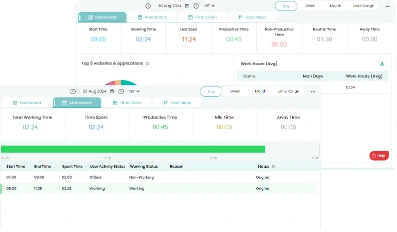
- Analyze Productive, Neutral, and Idle Time: Provides detailed insights into how employees spend their work hours by categorizing activities into productive, neutral, and idle time. This helps you determine whether AI is increasing productive work and reducing wasted time.
- Generate AI Productivity Reports and Dashboards: Offers access to real-time dashboards and customizable reports that combine productivity, time tracking, attendance, and project data into actionable insights. Share clear, data-backed reports with managers and leadership to demonstrate AI ROI.
- Measure Project and Task Performance: Evaluates project progress, task completion rates, billable hours, and resource utilization, helping you understand how AI influences delivery speed and overall team performance.
Ready to turn AI productivity into measurable business results?
Track AI performance and maximize ROI with Time Champ.
Conclusion
Evaluating the success of AI goes beyond tracking usage or automation. It requires a clear understanding of how AI improves productivity, reduces costs, and contributes to business goals. Establishing baseline performance, focusing on meaningful metrics, accounting for total costs, and reviewing results regularly will help you make informed decisions about every AI investment. Knowing how to measure AI ROI helps you identify what delivers real value, optimize AI adoption across your organization, and ensure that the technology investments continue driving measurable business growth over time.

Anjali

Table of Content
 What Does AI ROI Actually Mean?
- Why Measuring AI ROI Matters for Your Business
- The AI Productivity Metrics That Actually Drive ROI
- 5 Steps to Measure AI ROI Effectively
- Common AI ROI Measurement Mistakes to Avoid
- How Time Champ Helps You Measure and Improve AI ROI
- Conclusion
Related Blogs
![What is Workforce Intelligence? A Complete Guide [2026]](https://www.timechamp.io/images/workforce-intelligence-feature-image.webp)
Discover what workforce intelligence is, why it's critical, real examples, implementation steps, key benefits, challenges & how AI transforms the future.
Guna Lakshmi | Feb 11, 2026
Learn how resource efficiency time tracking improves workload balance, productivity, resource utilization, and project outcomes without burnout for teams.
Anjali | May 21, 2026
Workforce productivity analytics turns daily work data into clear decisions. Learn the key metrics, monitoring signals, and AI tools that improve team output.
Thasleem Shaik | Apr 21, 2026
Improve ROI with productivity tracking software by reducing wasted time, recovering billable hours, and improving workforce efficiency.
Guna Lakshmi | May 11, 2026
Learn what workforce efficiency means in 2025, why it matters, key factors, how to measure, tips to improve, and what a good workforce efficiency rate is.
Guna Lakshmi | September 15, 2025
Find the 10 best workforce intelligence software for 2026. Compare features, pricing, pros, cons to boost operational clarity and team performance.
Thasleem Shaik | Feb 11, 2026


 4.7/5 avg.
Ready to Manage Your Workforce Smarter?
Join our family of 1500+ companies using smart insights to redefine workforces!

Free Trial
No Credit Card Required