Finance and Accounting Outsourcing: How to Choose One
Learn how to choose the right finance and accounting outsourcing partner. Explore key factors, benefits, costs, and tips for making the best decision.

Finance and accounting are essential to every business, but managing them entirely in-house can become time-consuming, costly, and difficult to scale. Finance and accounting outsourcing allows businesses to delegate tasks such as bookkeeping, payroll, accounts payable, accounts receivable, and financial reporting to specialized providers.
In this guide, you’ll learn how finance and accounting outsourcing works, its key benefits, common services, potential challenges, and how to choose the right outsourcing partner for your business.
What Is Finance and Accounting Outsourcing?
Finance and accounting outsourcing is the practice of hiring an external provider to manage some or all of a company’s financial and accounting activities. These services can include bookkeeping, accounts payable and receivable, payroll processing, financial reporting, tax support, and other accounting functions.
This approach helps you access specialized expertise, reduce administrative workloads, control costs, and focus on core business operations.

Did You Know?
According to Deloitte’s survey, 35% of finance leaders currently leverage outsourcing. This highlights the growing role of outsourcing in modern finance operations.
What Finance and Accounting Functions Can Be Outsourced?
Finance and accounting outsourcing can cover a wide range of financial activities, depending on the business needs and the provider’s expertise. Companies can outsource routine transactional tasks as well as more specialized functions, helping internal finance teams reduce their workload and focus on strategic priorities.
Commonly outsourced finance and accounting functions include:
- Bookkeeping: Recording financial transactions, maintaining ledgers, and reconciling accounts.
- Accounts Payable: Managing vendor invoices, payment processing, and supplier records.
- Accounts Receivable: Handling customer invoices, payment tracking, and collections.
- Payroll Processing: Calculating salaries, processing payments, and maintaining payroll records.
- Financial Reporting: Preparing income statements, balance sheets, cash flow statements, and other financial reports.
- Tax Preparation and Support: Organizing financial information, preparing tax documents, and supporting tax compliance activities.
- Budgeting and Forecasting: Developing budgets, analyzing financial performance, and preparing forecasts to support business planning.
- Financial Analysis: Reviewing financial data, identifying trends, and providing insights to support better business decisions.
- Audit Support: Preparing financial records and documentation required for internal or external audits.
- Cash Flow Management: Monitoring cash inflows and outflows, tracking liquidity, and helping businesses manage working capital.
Can you track your outsourced finance team’s productivity?
Time Champ helps you monitor hours, activity, attendance, and productivity in one place.
When Should a Business Outsource Finance and Accounting?
Outsourcing finance and accounting becomes a practical option when managing these functions in-house becomes costly, time-consuming, or difficult to scale. The right time to outsource depends on the company's size, growth stage, financial needs, and available expertise.
The following situations indicate when outsourcing may be a suitable choice:
1. Rapid Business Growth
Growing businesses often face higher transaction volumes and more complex financial requirements. Outsourcing helps them manage these demands without immediately expanding their in-house team.
2. Overloaded Accounting Teams
When accounting teams spend too much time on repetitive tasks such as bookkeeping, invoicing, payroll, or reconciliations, outsourcing can reduce their workload and allow them to focus on higher-value activities.
3. Lack of Specialized Expertise
Businesses without in-house expertise in areas such as tax compliance, financial reporting, forecasting, or international accounting can work with outsourcing providers to access specialized knowledge without hiring permanent employees.
4. Rising Operational Costs
Maintaining an in-house finance team involves salaries, benefits, training, software, and other expenses. Outsourcing selected functions helps businesses access professional expertise while managing operating costs more efficiently.
5. Increasing Compliance Requirements
Complex tax regulations, reporting standards, and industry-specific requirements can make financial management more challenging. Outsourcing gives businesses access to professionals who can help maintain accurate records and meet applicable compliance requirements.
6. Poor or Delayed Financial Reporting
Businesses experiencing frequent reporting delays or unclear financial reports can outsource their reporting processes to improve data organization, receive timely financial information, and support better decision-making.
7. Expansion Into New Markets
Expanding into new regions can introduce additional accounting, tax, payroll, and regulatory requirements. An outsourcing partner can provide the expertise needed to manage these financial responsibilities effectively.
8. Need to Focus on Core Operations
Finance and accounting tasks can take significant time away from strategic priorities. Outsourcing routine financial activities allows business leaders to focus more on growth, customer relationships, and core operations.
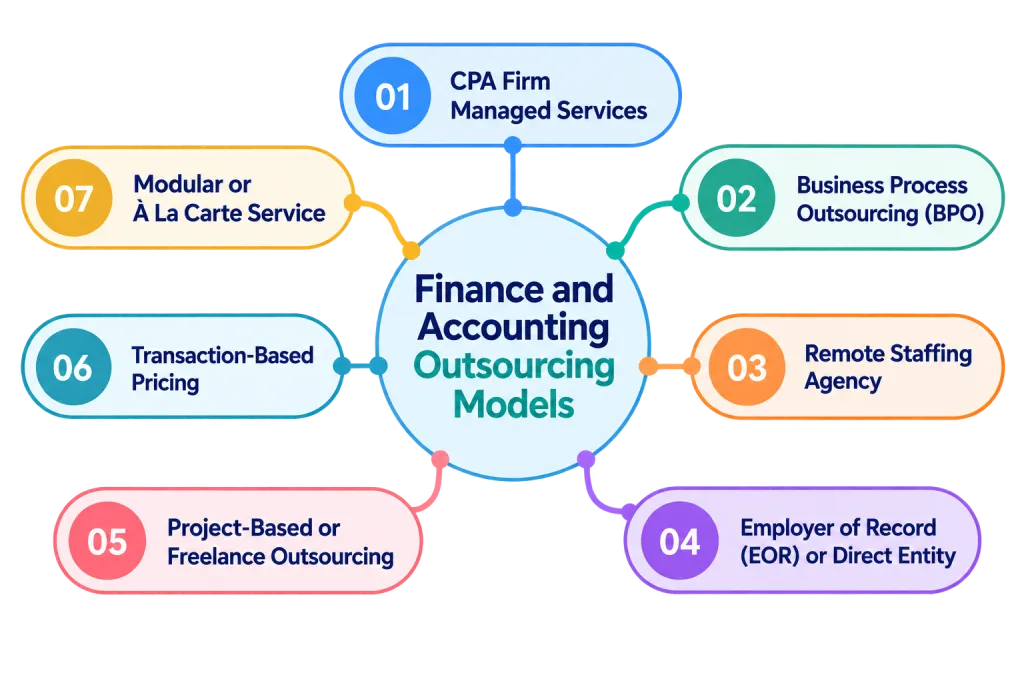
Finance and Accounting Outsourcing Models
Finance and accounting outsourcing can be arranged in different ways based on the amount of work a business delegates, the level of control it requires, and its need for flexibility. Businesses can choose from professional accounting firms, outsourced process providers, remote professionals, or international staffing solutions to meet their financial management needs.
1. CPA Firm Managed Services
A CPA firm can take responsibility for selected financial activities while providing professional accounting and tax expertise. Businesses may use this model for services such as tax preparation, compliance, financial statements, bookkeeping, and periodic accounting reviews. It is a practical option for companies that need qualified financial support without building a large internal accounting department.
2. Business Process Outsourcing (BPO)
The BPO model involves handing specific finance and accounting processes to an external provider that manages the work through its own people, systems, and processes. Common examples include accounts payable, payroll, bookkeeping, and accounts receivable. This approach is particularly useful for businesses that handle large volumes of routine transactions and want to improve process efficiency.
3. Remote Staffing Agency
A remote staffing agency connects businesses with finance professionals who work remotely as part of the company's extended team. You can assign daily responsibilities and manage the work directly, while the staffing agency typically takes care of recruitment, payroll, and other employment-related administration. This model provides additional accounting capacity without requiring employees to work from your physical office.
4. Employer of Record (EOR) or Direct Entity
Businesses expanding internationally can use an Employer of Record to hire finance professionals in another country without establishing a separate legal entity there. The EOR manages employment and compliance responsibilities, while the business oversees the employee's day-to-day work. Companies with larger international operations may instead establish their own local entity for greater control over their overseas teams.
5. Project-Based or Freelance Outsourcing
Project-based outsourcing is suitable for financial work that has a defined scope and completion date. Businesses may use freelancers or external specialists for tasks such as tax preparation, bookkeeping cleanup, audit assistance, or year-end financial work. This model provides access to expertise without requiring a long-term outsourcing contract.
6. Transaction-Based Pricing
Transaction-based outsourcing ties the service cost to the amount of work completed. Pricing may depend on factors such as the number of invoices processed, transactions recorded, or accounts reconciled. This model can provide greater flexibility for businesses whose finance workload changes significantly from one period to another.
7. Modular or À La Carte Se
A modular outsourcing model allows businesses to select individual finance and accounting services instead of outsourcing the entire function. For example, a company could outsource bookkeeping and payroll while keeping financial planning and strategic decisions in-house. This approach makes it easier to customize the outsourcing arrangement and expand or reduce services as business needs change.
Need better visibility into your outsourced finance teams?
Get clear visibility into work hours, productivity, and team activity with Time Champ’s workforce tracking solution.
How to Choose a Finance and Accounting Outsourcing Provider
Selecting the right finance and accounting outsourcing provider requires businesses to evaluate more than just service costs. Factors such as industry expertise, service capabilities, security, technology, scalability, and communication can help determine whether a provider is a good fit for the organization.
1. Evaluate Industry Experience
Businesses should look for providers with experience in their industry and business size. Relevant experience helps the provider understand specific accounting processes, regulatory requirements, reporting standards, and financial challenges.
2. Review the Service Portfolio
Businesses should identify the finance and accounting functions they need to outsource and check whether the provider offers those services. These may include bookkeeping, payroll, accounts payable, accounts receivable, tax support, financial reporting, and financial analysis.
3. Verify Experts
The qualifications and experience of the professionals handling financial processes need to be carefully reviewed. Providers with qualified accounting professionals can offer stronger support for complex accounting, tax, compliance, and reporting requirements.
4. Assess Data Security and Compliance
Since outsourcing providers handle sensitive financial information, businesses need to examine their security practices. Data protection measures, access controls, compliance standards, security certifications, and information-handling procedures should be evaluated before entering an agreement.
5. Compare Pricing and Contract Terms
Businesses should compare pricing structures and understand exactly what is included in the service agreement. Fixed-fee, transaction-based, project-based, and customized pricing models may suit different requirements. Additional fees, contract terms, and service limitations should also be reviewed.
6. Examine Technology and Integrations
A provider should have reliable technology that works with the organization's existing financial systems. Compatibility with accounting software, payroll platforms, ERP systems, and other business applications can reduce manual work and improve data accuracy.
7. Consider Scalability
Businesses should choose a provider capable of supporting changing financial requirements. The provider should be able to increase or adjust its services as transaction volumes, employee numbers, locations, or business operations grow.
8. Assess Communication and Reporting
Clear communication and consistent reporting are important for maintaining visibility over outsourced financial activities. Businesses should understand how updates will be shared, who will serve as the primary contact, how issues will be escalated, and what reports will be provided.
9. Check Reviews and Track Record
Customer reviews, case studies, references, and past performance can help businesses assess a provider's reliability and service quality. Providers with a proven track record of handling similar finance and accounting requirements may offer greater confidence in the outsourcing relationship.
How Much Does Finance and Accounting Outsourcing Cost?
The cost of finance and accounting outsourcing depends on several factors, including the services outsourced, business size, transaction volume, provider location, and level of expertise required. Businesses may pay a fixed monthly fee, hourly rate, project-based fee, or transaction-based charge depending on the outsourcing arrangement.
1. Scope of Services
The range of outsourced services has a major impact on overall cost. Basic bookkeeping typically costs less than a broader package that includes payroll, accounts payable, tax support, financial reporting, and financial analysis. More complex financial responsibilities generally require more specialized professionals and resources.
2. Business Size and Transaction Volume
Larger businesses usually handle more transactions, employees, invoices, and financial records. Higher workloads may require additional accounting professionals or more processing capacity, which can increase outsourcing costs.
3. Provider Location
The provider's location can influence pricing because labor and operating costs vary across regions. Offshore providers may offer more cost-effective rates, while onshore providers may charge higher fees for local expertise, regulatory knowledge, or closer time-zone alignment.
4. Level of Expertise
The expertise required also affects the price. Routine bookkeeping and transaction processing generally cost less than specialized services such as tax compliance, financial analysis, forecasting, or fractional CFO support. Businesses requiring senior-level financial expertise should expect higher rates.
5. Outsourcing Model
The selected outsourcing model determines how services are typically priced. Project-based arrangements may involve a one-time fee, while managed services often use monthly pricing. Transaction-based models charge according to workload, whereas dedicated teams are generally priced based on the number and experience of professionals assigned.
| Service / Pricing Model | Typical Cost Range |
|---|---|
| Basic Bookkeeping | $200–$800/month |
| Full-Service Accounting | $500–$2,500+/month |
| Accounts Payable / Accounts Receivable | $300–$1,500+/month |
| Payroll Processing | $50–$200+ per payroll run |
| Tax Preparation | $500–$3,000+ per year |
| Financial Reporting & Analysis | $500–$2,500+/month |
| Dedicated Accounting Professional | $1,500–$4,000+/month |
| Fractional CFO Services | $2,000–$8,000+/month |
| Hourly Outsourcing | $20–$100+/hour |
These are broad indicative ranges rather than fixed market rates. Actual costs can vary based on the provider, location, business requirements, transaction volume, service complexity, and professional expertise involved.
Businesses should compare providers based on overall value rather than price alone. Service coverage, accounting expertise, data security, technology, communication, and scalability can all influence whether an outsourcing arrangement delivers a worthwhile return on investment.
Worried about rising finance and accounting costs?
Time Champ helps you track team hours and productivity to identify inefficiencies and control outsourcing costs.
Risks of Finance and Accounting Outsourcing (and How to Manage Them)
Finance and accounting outsourcing can improve efficiency and provide access to specialized expertise, but it also introduces certain risks. Businesses can reduce these risks by selecting reliable providers, establishing clear processes, and maintaining appropriate oversight of outsourced financial activities.
1. Data Security and Confidentiality
Risk: Outsourcing providers handle sensitive information such as financial records, payroll data, invoices, and tax information. Weak security practices can increase the risk of unauthorized access or data breaches.
How to Manage It: Businesses should assess the provider's security controls, data protection policies, access management, and compliance certifications. Contracts should also clearly define confidentiality and data-handling requirements.
2. Loss of Control
Risk: Moving financial processes outside the organization can make it harder for internal teams to maintain visibility and control over day-to-day accounting activities.
How to Manage It: Businesses should establish clear responsibilities, approval workflows, reporting requirements, and performance metrics. Regular reviews and access to financial reports can help maintain oversight.
3. Errors and Inaccurate Financial Records
Risk: Mistakes in bookkeeping, reconciliations, reporting, or transaction processing can lead to inaccurate financial information and potentially affect business decisions.
How to Manage It: Businesses should define quality standards, use documented processes, and conduct regular reconciliations and reviews. Providers should also have appropriate quality-control procedures in place.
4. Compliance and Regulatory Issues
Risk: Incorrect tax filings, reporting errors, or failure to follow applicable regulations can result in penalties, delays, or other financial consequences.
How to Manage It: Businesses should choose providers with relevant accounting and regulatory expertise. Compliance responsibilities should be clearly documented, with regular reviews to ensure required filings and financial records are properly maintained.
5. Communication Challenges
Risk: Differences in time zones, communication methods, or business processes can make it difficult for internal teams and outsourcing providers to coordinate effectively.
How to Manage It: Businesses should establish clear communication channels, reporting schedules, response-time expectations, and escalation procedures. A dedicated point of contact can also make collaboration easier.
6. Hidden or Unexpected Costs
Risk: An outsourcing arrangement may become more expensive than expected if additional services, transaction fees, software costs, or extra support charges are not clearly defined.
How to Manage It: Businesses should review the pricing structure and service agreement carefully before signing. The contract should clearly outline included services, additional charges, payment terms, and conditions for changing the scope of work.
7. Vendor Dependency
Risk: Relying heavily on one provider can create operational difficulties if the provider experiences service disruptions, staffing issues, or other unexpected problems.
How to Manage It: Businesses should maintain documented processes, retain access to important financial records, and establish contingency and transition plans. Critical responsibilities should also have appropriate internal oversight.
8. Service Quality Issues
Risk: An outsourcing provider may not consistently meet expected standards for accuracy, turnaround times, or responsiveness.
How to Manage It: Businesses should evaluate the provider's track record and references before entering an agreement. Service-level agreements (SLAs), measurable performance indicators, and regular performance reviews can help maintain service quality.
How Time Champ Supports Finance and Accounting Outsourcing
Managing outsourced finance and accounting teams requires visibility into how employees spend their working hours, especially when teams operate remotely or across different locations. Time Champ helps businesses improve workforce visibility by tracking work hours, employee activity, attendance, and productivity.
For finance and accounting outsourcing teams, Time Champ can support better workforce management through:
- Time Tracking: Records employee work hours and helps businesses understand how time is allocated across tasks and projects.
- Productivity Monitoring: Provides visibility into employee activity and productivity patterns to help managers identify workload issues and improve efficiency.
- Attendance Management: Helps track attendance, working schedules, and time-related patterns across distributed teams.
- Project and Task Tracking: Enables businesses to monitor how employees spend time across different projects and responsibilities.
- Remote Workforce Visibility: Gives managers greater insight into outsourced and remote teams without requiring constant manual supervision.
- Reports and Analytics: Provides workforce data that can help managers review performance, identify inefficiencies, and make informed staffing decisions.
Ready to Manage Your Outsourced Finance Team More Effectively?
Get better visibility into team hours, productivity, and costs with Time Champ. Start your free trial today.
Conclusion
Finance and accounting outsourcing can help businesses manage financial operations more efficiently, access specialized expertise, and reduce pressure on internal teams. From bookkeeping and payroll to financial reporting, tax support, and financial analysis, businesses can outsource individual functions or broader finance operations based on their needs.
Choosing the right provider, outsourcing model, and security measures can help businesses manage risks while maintaining financial accuracy and operational efficiency.

Guna Lakshmi

Table of Content
 What Is Finance and Accounting Outsourcing?
- What Finance and Accounting Functions Can Be Outsourced?
- When Should a Business Outsource Finance and Accounting?
- Finance and Accounting Outsourcing Models
- How to Choose a Finance and Accounting Outsourcing Provider
- How Much Does Finance and Accounting Outsourcing Cost?
- Risks of Finance and Accounting Outsourcing (and How to Manage Them)
- How Time Champ Supports Finance and Accounting Outsourcing
- Conclusion
Related Blogs

Discover the 12 benefits of outsourcing, including cost savings, access to global talent, and practical tips for managing outsourced teams effectively.
Guna Lakshmi | Jul 10, 2026
Work piling up faster than your inbox messages? Explore 20 types of outsourcing to help your business stay productive without the chaos.
Guna Lakshmi | Jul 15, 2026
The future of outsourcing is changing with AI, nearshoring, and outcome-based models. Explore the latest trends, predictions, and what you should expect.
Thasleem Shaik | Jul 31, 2026
Compare the best online outsourcing websites for 2026, including real fees, hiring tips, platform features, and proven ways to manage freelancers easily.
Jahnavi Pulluri | Aug 13, 2026
Learn about the top 10 outsourcing risks and how to manage them effectively, protecting your business from potential challenges and disruptions
Mounika Sai | Nov 27, 2023
In-house vs outsourcing explained with key differences, pros, cons, costs, and practical tips to help you choose the best approach for your organization.
Anjali | Jul 02, 2026


 4.7/5 avg.
Ready to Manage Your Workforce Smarter?
Join our family of 1500+ companies using smart insights to redefine workforces!

Free Trial
No Credit Card Required