10 Change Management Strategies That Drive Adoption
Change management strategies help you handle organizational change with less disruption. Explore practical strategies, models, steps, and examples.
A new system, process, structure, or way of working can look simple on paper. The real challenge begins when you ask everyone to actually adopt it.
That is where change management strategies matter. They help you plan the transition, communicate what is changing, address resistance, and give your teams enough support to move forward.
In this blog, we’ll look at practical approaches, popular models, real-world examples, and ways to measure change adoption.
What Is Change Management?
Change management is a structured approach to help you plan, introduce, and sustain a change while supporting the individuals affected by it. It focuses on helping your teams understand the change, adapt to new ways of working, and adopt the intended processes, tools, or practices.
A change can involve a new technology, updated workflow, revised policy, business restructuring, or a shift in strategy. Change management connects the business side of the change with the day-to-day work required to make it successful.
10 Change Management Strategies to Implement Change
The following change management strategies focus on the areas that can directly influence how well your teams understand, accept, and adopt a change.
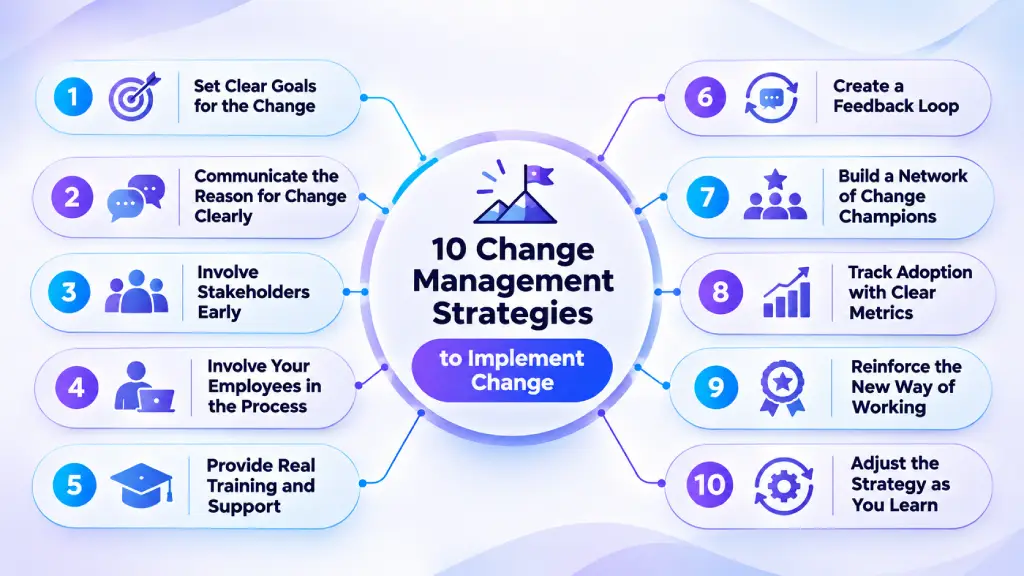
1. Set Clear Goals for the Change
Start by defining what you want the change to achieve. A clear goal gives your teams a specific outcome to work toward and gives you a way to measure progress later.
Your goal should answer three basic questions:
- What needs to change?
- Why does it need to change?
- What outcome do you expect?
For example, if you plan to introduce a new time tracking system, your goal could focus on reducing manual timesheet work, improving time data accuracy, or giving you better visibility into project hours.
2. Communicate the Reason for Change Clearly
Your teams need to understand why the change matters before they can fully support it. Simply announcing a new process or tool does not explain what prompted the decision or how the change will affect daily work.
Build your communication around the information your teams need most:
- Announce the change before rumors fill the gap.
- Explain the "why" before you explain the "how".
- Use more than one channel, since a single email or town hall rarely reaches everyone.
- Keep a two-way channel open so employees can ask questions and flag concerns.
Use consistent messages across meetings, email, collaboration tools, and other communication channels. Give your teams opportunities to ask questions and share concerns instead of treating communication as a one-way announcement.
3. Involve Stakeholders Early
Do not wait until implementation begins to bring affected stakeholders into the conversation. Early involvement gives you a clearer view of how the change will affect different roles, workflows, and priorities.
Start by identifying who will experience the change directly and who will influence its implementation. Then involve them through:
- Planning discussions
- Pilot programs
- Feedback sessions
- Process reviews
- Adoption check-ins
Their input can reveal practical issues that may not appear in the initial plan. You can then adjust the rollout before those issues create larger adoption barriers.
Struggling to keep your team on track during major changes?
Use Time Champ to track work patterns and see how your team adapts to change.
4. Involve Your Employees in the Process
People resist change less when they help shape it. Instead of planning the entire rollout behind closed doors, involve employees from the early planning stage. Create a small cross-functional group with members from different teams and levels, and let them review and test the plan before it goes live.
This approach serves two purposes. You get feedback that can improve the actual change management plan, and you build a group of internal advocates who can support the change and encourage their peers after the launch.
5. Provide Real Training and Support
A change that requires new tools, workflows, or skills can fail quickly if you don't give people the right support. Training should not be a single onboarding session that gets forgotten within a week.
- Offer hands-on training based on real tasks, not generic slide decks.
- Give employees a point of contact for questions after the change goes live.
- Build in a grace period where mistakes are expected and treated as part of learning, not failure.
6. Create a Feedback Loop
You cannot tell whether a change is working by looking at the rollout plan alone. Give employees simple ways to share what is working, what is confusing, and where they are getting stuck.
Use feedback to spot problems early and make practical changes during the rollout.
- Run short pulse surveys after key stages of the change.
- Give employees a clear channel to report problems or ask questions.
- Review feedback regularly instead of waiting until the rollout ends.
- Act on useful feedback and communicate what you changed.
7. Build a Network of Change Champions
A new process becomes easier to adopt when employees can get support from someone who already understands the change. Select a small group of trusted employees from different teams to act as change champions.
Their role is not to manage the entire change. They help explain the new process, share feedback, answer basic questions, and show others how the change works in day-to-day tasks.
8. Track Adoption with Clear Metrics
Launching a new system or process does not mean employees have adopted it. You need to track what happens after the rollout to see whether the change is becoming part of daily work.
Choose a few metrics that show whether employees are using the new process correctly and consistently.
| Metric | What It Tells You |
|---|---|
| Adoption rate | The percentage of your team actually using the new process or tool |
| Training completion | Whether employees have the knowledge to perform the new way |
| Time to proficiency | How long it takes your team to get comfortable with the change |
| Employee sentiment | How your team feels about the change, gathered through short pulse surveys |
| Business outcome | Whether the change delivers the result you set out to achieve, like reduced errors or faster turnaround |
Check these numbers regularly instead of checking them only once at the end. When a metric stalls, treat it as useful information, not a failure. Use what you learn to adjust your rollout instead of repeating the same approach and expecting a different result.
9. Reinforce the New Way of Working
The real test of change management starts after the rollout. Without reinforcement, employees may return to familiar processes when the initial attention around the change fades.
Make the new behavior part of regular work instead of treating the launch as the finish line.
- Recognize employees who consistently follow the new process.
- Include the new process in regular reviews and check-ins.
- Provide refresher training when common issues appear.
- Share progress and improvements after implementation.
- Address repeated gaps before old habits return.
10. Adjust the Strategy as You Learn
Not every change management strategy will work exactly as planned. Your initial plan may look right before launch but reveal new problems once employees start using the new process.
Use adoption data, feedback, and day-to-day results to decide what needs to change. You may need to provide more training, change the rollout timeline, update the process, or give extra support to a specific team.
A simple review cycle can help:
- Check what is working
- Identify where adoption is slowing down
- Find the reason behind the problem
- Make one practical adjustment
- Measure the result
Change Management Models and Frameworks to Know
You do not need to follow one model word for word. The right choice depends on the type of change, how large the change is, and whether your main challenge involves adoption, leadership alignment, internal structure, or the transition itself. Here are the change management models worth knowing before you pick one.
1. Lewin's Change Management Model
Kurt Lewin's model breaks change into three simple stages: Unfreeze, Change, and Refreeze. It works well when you need a clear structure for moving from an existing way of working to a new one.
The three stages include:
- Unfreeze: Prepare for the change by explaining why the current approach needs to change.
- Change: Introduce the new process, system, or way of working and support adoption.
- Refreeze: Make the new approach part of regular work so teams do not return to old habits.
The change management model is easy to understand, but its three broad stages can feel too simple for complex changes that involve many teams or ongoing adjustments.
2. Kotter's 8-Step Change Model
John Kotter's model takes a more detailed approach. It gives you eight steps for creating urgency, building support, guiding implementation, and making the change stick. Kotter introduced the model in 1995.
The eight steps are:
- Create a sense of urgency
- Build a guiding coalition
- Form a strategic vision
- Enlist volunteers
- Remove barriers
- Generate short-term wins
- Sustain acceleration
- Institute change
Kotter's model works well for large, organization-wide changes, such as mergers or company-wide platform migrations. It helps you build momentum and show quick, visible results that keep employees engaged with the change.
3. Prosci ADKAR Model
The Prosci ADKAR Model looks at change at the individual level. It focuses on the five outcomes a person needs to move through for a change to succeed and last.
ADKAR stands for:
- Awareness: Understand why the change is needed
- Desire: Choose to support and participate in the change
- Knowledge: Know what to do and how to change
- Ability: Put the new skills and behaviors into practice
- Reinforcement: Continue using the new approach and prevent backsliding
ADKAR can help you identify where adoption is getting stuck. For example, if your team understands the reason for a new system but does not know how to use it, the problem sits around Knowledge rather than Awareness.
ADKAR is a model for individual change. Prosci connects it with its broader methodology for planning and managing organizational change.
4. McKinsey 7-S Framework
The McKinsey 7-S Framework is not a step-by-step process. It works as a diagnostic tool that checks whether seven elements of your organization are working toward the same goal. These include strategy, structure, systems, shared values, skills, style, and staff. Use it before you create your rollout plan to find gaps or misalignments that could cause problems later.
5. Bridges' Transition Model
Bridges' Transition Model focuses on the human experience of moving through change. It separates change, which is the external event, from transition, which is the internal process of adjusting to that change. William Bridges introduced the model in his 1991 book Managing Transitions.
The model has three stages:
- Ending, Losing, and Letting Go: Adjust to what is changing or coming to an end.
- The Neutral Zone: Work through the uncertainty between the old and new ways of working.
- The New Beginning: Accept the new direction and start working within it.
This change management framework is useful when the main challenge involves uncertainty, adjustment, or the difficulty of leaving familiar ways of working behind.
How to Choose a Change Management Model
Each change management model looks at change from a different angle. Instead of asking which model is universally best, match the model to the problem you need to solve.
| If Your Main Need Is | A Model to Consider |
|---|---|
| A simple structure for moving from old to new | Lewin |
| A detailed step-by-step change process | Kotter |
| Understanding where adoption is getting stuck | ADKAR |
| Aligning strategy, structure, systems, and culture | McKinsey 7-S |
| Supporting the transition through uncertainty | Bridges |
You can also combine frameworks when one model does not cover the full change. For example, you might use McKinsey 7-S to check internal alignment and ADKAR to understand how individuals are adopting the change. Different models answer different questions, so combining them can give you a more complete view when the change calls for it.
Rolling out a change but struggling to see how it affects daily work?
Use Time Champ to get clear workforce insights and track what changes after implementation.
How to Build a Change Management Strategy
A strong change management strategy needs a clear plan. It comes from a series of decisions that connect your goals with the teams affected by the change. Follow these steps to build one.
- Set Clear Goals First: Before you create a change management plan, be clear about what success looks like. Are you trying to reduce turnaround time, introduce new software, or change how your teams work together? Write the goal in one sentence and connect it to a number you can track.
- Check Your Readiness: Look at where you stand today. Do you have the budget, tools, and leadership support you need for the change? Skipping this step can cause your change management process to slow down or stop halfway.
- Map Your Stakeholders List everyone affected by the change, from frontline staff to department heads. Group them based on their level of influence and how much the change affects them. This helps you decide who needs regular updates and who only needs basic information.
- Build Your Change Team: Choose a small group to manage the rollout. Give each person a clear role, such as handling communication, training, or tracking progress. A change without a clear owner can easily fall behind schedule.
- Create Your Communication Plan: Decide what you will say, who needs to hear it, and when you will share it. Use different channels such as team meetings, emails, and short videos to make sure the message reaches your team.
- Prepare Training and Support: Give your teams the skills and resources they need before the change goes live. Set up a help channel or assign a point of contact so your team can get answers quickly instead of becoming frustrated.
- Plan for Risk and Feedback: List what could go wrong and decide how you will handle each issue. Create a simple way to collect feedback during the rollout so you can adjust your change management strategy before small problems become bigger ones.
Change Management Examples
Reading about change management strategies is one thing. Watching them play out inside a real company and seeing the numbers move afterward is another. Here are three change management examples that show what happens when a company commits fully to a change and works through the resistance instead of backing off.
1. Microsoft Rebuilt Its Culture from the Inside Out
When Satya Nadella took over as CEO in 2014, Microsoft was stuck. Teams competed against each other instead of collaborating, and the internal "stack ranking" system pitted employees against their own colleagues for scores and rewards. Nadella scrapped that system and pushed a "growth mindset" culture instead, built around learning from failure rather than defending a fixed image of competence.
He backed the message with structural changes, not just a slogan. He reorganized the company around shared capabilities instead of product silos, tied performance rewards to teamwork, and pushed leadership to model the new behavior publicly. The results followed. Microsoft's market value grew from around $300 billion in 2014 to over $2.5 trillion within a decade, and Azure became one of the leading cloud platforms in the world.
Source: AbiEdu case study on Microsoft's cultural transformation
2. Adobe Walked Away from Its Own Cash Cow
In 2013, Adobe made a decision most companies would call reckless. It announced it would stop selling perpetual licenses for Creative Suite and force every customer onto a subscription model instead. The backlash was immediate. A petition against the move collected over 50,000 signatures, and Adobe's stock dropped roughly 12% in the months that followed as investors worried about short-term losses.
Adobe didn't reverse course. It phased the transition instead of forcing it overnight, kept both options running for two years, offered discounts to early adopters, and rebuilt its entire finance and reporting model around recurring revenue rather than one-time sales. By 2024, Creative Cloud had grown from zero subscribers to over 30 million paying users, and Adobe's Digital Media revenue rose from about $3 billion in 2012 to over $14 billion.
Source: Case study on Adobe's Creative Cloud transformation
Rolling out new processes without clear visibility into adoption?
Use Time Champ to track work activity and understand how your team is adjusting.
Conclusion
A successful change does not end when you launch a new tool, process, or strategy. You need to prepare your team, communicate clearly, provide support, and track how well the change is working. The right change management strategies give you a clear way to handle each stage and keep your team focused on the goal.

Thasleem Shaik

Table of Content
 What Is Change Management?
- 10 Change Management Strategies to Implement Change
- Change Management Models and Frameworks to Know
- How to Choose a Change Management Model
- How to Build a Change Management Strategy
- Change Management Examples
- Conclusion
Related Blogs

Change management makes employee monitoring adoption smoother. Learn strategies to reduce resistance, communicate transparently, and roll out in phases.
Anjali | Apr 15, 2026
Learn what employee engagement analytics is and how it uses 14 workplace signals to measure employee engagement without relying on surveys in real time.
Jahnavi Pulluri | Sep 21, 2026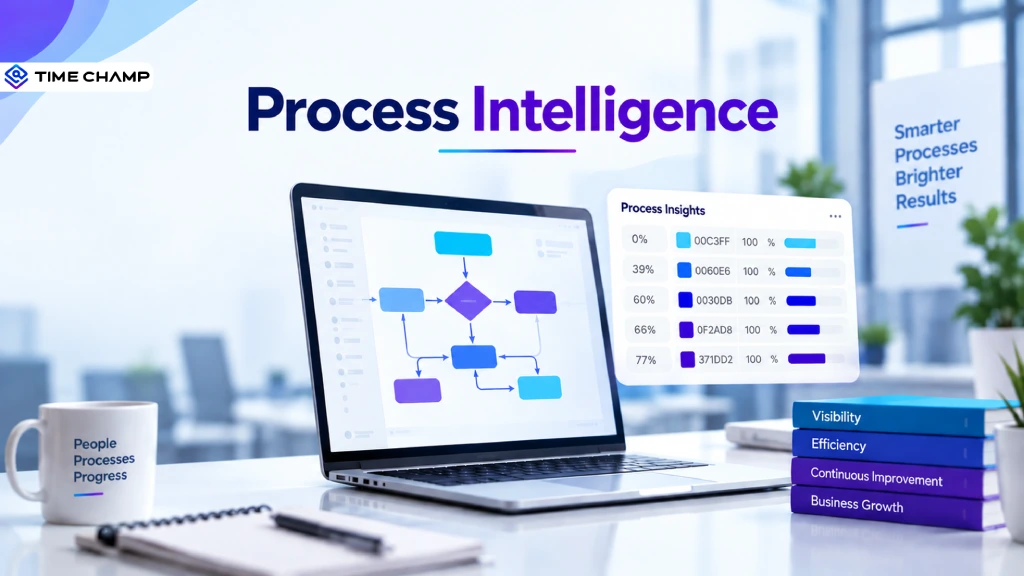
Learn what process intelligence is, how it works, its key benefits, use cases, and how it helps businesses improve processes and make smarter decisions.
Guna Lakshmi | Sep 16, 2026
Strengthen Third-Party Risk Management with practical steps, risk assessments, best practices, and proven ways to reduce vendor risks across your business.
Anjali | Sep 11, 2026
Learn how to protect intellectual property and trade secrets with practical strategies and best practices to keep your business assets secure.
Guna Lakshmi | Aug 25, 2026
Find out what is an organization, why it matters, its key characteristics, processes, types, and how the right structure improves business performance
Anjali | Aug 13, 2026


 4.7/5 avg.
Ready to Manage Your Workforce Smarter?
Join our family of 1500+ companies using smart insights to redefine workforces!

Free Trial
No Credit Card Required